Showing posts sorted by relevance for query Internet of Things. Sort by date Show all posts

Tuesday, March 31, 2015

IBM Bets $3 Billion On Internet Of Things (IBM)

They have to do something. Also, Big Blue has been doing a lot of this stuff for a while so it's not immediately apparent how much of the touted $3 Bil. is new money.
From cnet:

IBM to invest $3B in building Internet of Things business
IBM formalizes its focus on the Internet of Things as it faces competition from traditional tech rivals as well as companies such as General Electric.

IBM on Tuesday said that it will create a new Internet of Things unit and invest $3 billion over four years to build it out.

The move formalizes IBM's existing Internet of Things efforts. IBM's smarter-planet and smarter-cities businesses are connected to the Internet of Things trend. The rough idea behind the Internet of Things is that sensors will be embedded in everything and networked to create data. This flow of data could improve operations.

For IBM, the formation of the Internet of Things unit follows a familiar playbook. IBM targets a high-value growth area, invests at least a $1 billion to get the effort rolling and throws its hardware, software and consultants at the issue. In this respect, the formation of the Internet of Things unit rhymes with what IBM did with e-commerce, analytics, and cloud and cognitive computing.

IBM faces a fierce battle for enterprise Internet of Things (IoT) business. Cisco has targeted IoT, as has almost every tech vendor.

Meanwhile, nontraditional IBM rivals have strong IoT efforts. For instance, General Electric, which happens to make many of the things that will be networked, has an IoT platform called Predix. GE has invested $1 billion in industrial software development. Although GE calls the Internet of Things the industrial Internet, the concept of networking things and layering analytics on top is the same.

For IBM's part, the company said it will have more than 2,000 consultants, researchers and developers aimed at IoT and the analytics that go with it. IBM said the unit will include:
  • A cloud platform for industries aimed at verticals. IBM will offer dynamic pricing models and cloud delivery to various verticals.
  • Bluemix IoT platform as a service so developers can create and deploy applications for asset tracking, facilities management and engineering tools.
    • An ecosystem of partners ranging from AT&T to ARM to The Weather Company.

    Separately, IBM announced a partnership with the business-to-business division of The Weather Company, owner of The Weather Channel. The partnership will deliver micro weather forecasts using sensors from aircraft, drones, buildings and smartphones.
 ...MORE

Previously on the IoT channel:

"In Vegas, Imagining the Wonders of the Internet of Things"
I'm not feeling so much drawn to the concept as pushed into it....

Nudge This: "The Internet of Things Will Be a Giant Persuasion Machine"
See also:
Barron's Cover: Is the Internet-of-Things Ready-to-Wear?
The Google of the "Internet of Things" (and Morgan Stanley's 96 page IoT report) SPLK; GE
Companies That Will Benefit From The Internet of Things
Questions From MIT's 'Internet of Things Festival'
"Behind the 'Internet of Things' Is Android—and It's Everywhere" (GOOG)
"2013: The year of the Internet of Things"
"General Electric Pitches an Industrial Internet" (GE)
Former Joey Ramone Infatuant Maria Bartiromo Says Bad Things are Coming to the Market
The Internet of Things: Huggies App Sends You a Tweet Whenever Your Kid Pees...
Internet of Things: "GE teams up with AT&T and Intel to conquer the industrial internet. Here’s its plan"
The Internet of Things: Huggies App Sends You a Tweet Whenever Your Kid Pees..
Pew Research: "The Internet of Things Will Thrive by 2025"
Citigroup on the "Internet of Things"
CES 2015: "Samsung's Smart-Home Master Plan: Leave the Door Open for Others"
The Internet of Things: Everything Is Hackable
The Creepiness of the Internet Of Things
Internet of Things: In Which Izabella Approaches Escape Velocity Edition
Yeah, I Got "Your Smart Home": A Journalist Shows Us How to Hack the Neighbors
Too Funny: "Hello Dave" Shows Up On Hacked Google Nest Appliance Control System (GOOG)
The Internet of Things and Google's Home Invasion (GOOG)
"How Smart Houses And Big Data Will Change Real Estate Economics" (just wait 'til your house gets a virus)
Another Day, Another 3D Printing, Robotic Harvesting, Internet-of-Things FarmBot

Friday, June 26, 2015

McKinsey & Co. on the Internet of Things

From McKinsey:

Unlocking the potential of the Internet of Things
June 2015
The Internet of Things—sensors and actuators connected by networks to computing systems—has received enormous attention over the past five years. A new McKinsey Global Institute report, The Internet of Things: Mapping the value beyond the hype, attempts to determine exactly how IoT technology can create real economic value. Our central finding is that the hype may actually understate the full potential—but that capturing it will require an understanding of where real value can be created and a successful effort to address a set of systems issues, including interoperability.

To get a broader view of the IoT’s potential benefits and challenges across the global economy, we analyzed more than 150 use cases, ranging from people whose devices monitor health and wellness to manufacturers that utilize sensors to optimize the maintenance of equipment and protect the safety of workers. Our bottom-up analysis for the applications we size estimates that the IoT has a total potential economic impact of $3.9 trillion to $11.1 trillion a year by 2025. At the top end, that level of value—including the consumer surplus—would be equivalent to about 11 percent of the world economy (exhibit).

Exhibit

Achieving this kind of impact would require certain conditions to be in place, notably overcoming the technical, organizational, and regulatory hurdles. In particular, companies that use IoT technology will play a critical role in developing the right systems and processes to maximize its value. Among our findings:...
...MUCH MORE including Executive Summary and Full Report

Previously on the IoT channel:

Internet of Things: Hardware Startups, The VC Perspective
"Is Your Portfolio Ready for an Invasion of Disruptive Technologies?"
IBM Bets $3 Billion On Internet Of Things (IBM)
"In Vegas, Imagining the Wonders of the Internet of Things"
I'm not feeling so much drawn to the concept as pushed into it....
Nudge This: "The Internet of Things Will Be a Giant Persuasion Machine"
See also:
Barron's Cover: Is the Internet-of-Things Ready-to-Wear?
The Google of the "Internet of Things" (and Morgan Stanley's 96 page IoT report) SPLK; GE
Companies That Will Benefit From The Internet of Things
Questions From MIT's 'Internet of Things Festival'
"Behind the 'Internet of Things' Is Android—and It's Everywhere" (GOOG)
"2013: The year of the Internet of Things"
"General Electric Pitches an Industrial Internet" (GE)
Former Joey Ramone Infatuant Maria Bartiromo Says Bad Things are Coming to the Market
The Internet of Things: Huggies App Sends You a Tweet Whenever Your Kid Pees...
Internet of Things: "GE teams up with AT&T and Intel to conquer the industrial internet. Here’s its plan"
The Internet of Things: Huggies App Sends You a Tweet Whenever Your Kid Pees..
Pew Research: "The Internet of Things Will Thrive by 2025"
Citigroup on the "Internet of Things"
CES 2015: "Samsung's Smart-Home Master Plan: Leave the Door Open for Others"
The Internet of Things: Everything Is Hackable
The Creepiness of the Internet Of Things
Internet of Things: In Which Izabella Approaches Escape Velocity Edition
Yeah, I Got "Your Smart Home": A Journalist Shows Us How to Hack the Neighbors
Too Funny: "Hello Dave" Shows Up On Hacked Google Nest Appliance Control System (GOOG)
The Internet of Things and Google's Home Invasion (GOOG)
"How Smart Houses And Big Data Will Change Real Estate Economics" (just wait 'til your house gets a virus)
Another Day, Another 3D Printing, Robotic Harvesting, Internet-of-Things FarmBot

Saturday, July 30, 2016

General Electric and the Battle to Own the Internet of Things (GE)

We haven't looked in on GE or their IoT plans in a while, here's the latest from Forbes:

GE's IoT Plan For China
General Electric announced a partnership with China’s Huawei recently as it continues to build out its Internet of Things ecosystem.

The Internet of Things is a natural fit for GE. As the world’s largest maker of jet engines, diesel trains and other large industrial goods, finding ways to make things cheaper is in its DNA. Sensors and big data analytics software is just the logical next step. So in 2013 GE unveiled a productivity software platform called Predix in conjunction with Amazon Web Services, Accenture and EMC. The goal was to bring penny pinching predictive data analytics to the industrial sector at scale.
Luckily, it had a willing guinea pig: itself. Since 2013 Predix has had a profound impact on its own production lines. In 2015 GE was able to save $500 million. And the company’s Chief Digital Officer, Bill Ruh, is expecting savings of better than $1 billion by 2020.

Now it wants to get bigger in China. In a prepared statement Ruh said “the growth of the industrial Internet in China demands not only capital and development from companies like GE and our partners but also a commitment to align the private and public sector to build together”. Partnering with Huawei adds network hardware might and a powerful political ally.

GE has had some early success in China. The industrial city of Tianjin, with nascent smart city ambitions, uses Predix to control lampposts. China Airlines and China Telecom have also been using the software suite to reduce costs. Clearly GE wants more. Although production has slowed in China, it’s still the manufacturing center in the world even though its plants and businesses are among the least modern. As leaders push to climb the world ranks, GE expects the industrial Internet of Things will lead to spending of $166 billion by 2020.

Going forward Huawei will make Predix its preferred platform for industrial projects and GE will make a big investment in the developer community. This week the company announced an $11 million software incubator in Shanghai. As the second of four international centers planned, it will house 200 new GE employees working to bring makers to the Predix platform. If all goes well, Chinese developers will build software applications on top of the platform and entice Chinese businesses to invest.

What GE is doing is not terribly unique. IBM is a major competitor in many parts of the same space. It’s made good progress with its Watson cognitive computing platform. Cisco Systems was early to the Internet of Things. It is playing in every part of the stack with networking equipment, data collection and analytics. And its Jasper platform counts Ford and Boston Scientific among its portfolio of big companies now 500 strong....MORE
Previously on the IoT channel:

Internet of Things: "GE teams up with AT&T and Intel to conquer the industrial internet. Here’s its plan"
IBM Bets $3 Billion On Internet Of Things (IBM)
"General Electric Pitches an Industrial Internet" (GE)
McKinsey & Co. on the Internet of Things
The Google of the "Internet of Things" (and Morgan Stanley's 96 page IoT report) SPLK; GE
Nudge This: "The Internet of Things Will Be a Giant Persuasion Machine"
"Behind the 'Internet of Things' Is Android—and It's Everywhere" (GOOG)
The Internet of Things: Everything Is Hackable
The Creepiness of the Internet Of Things
Companies That Will Benefit From The Internet of Things
Questions From MIT's 'Internet of Things Festival'
Internet of Things: In Which Izabella Approaches Escape Velocity Edition
Too Funny: "Hello Dave" Shows Up On Hacked Google Nest Appliance Control System (GOOG)
The Internet of Things and Google's Home Invasion (GOOG)
Another Day, Another 3D Printing, Robotic Harvesting, Internet-of-Things FarmBot

And dozens more, use the 'search blog' box if interested. 

Sunday, March 20, 2016

The Internet of Things Is A Surveillance Nightmare

So what's not to love?
From The Kernel:
In 2014, security guru Bruce Schneier said, “Surveillance is the business model of the Internet. We build systems that spy on people in exchange for services. Corporations call it marketing.” The abstract and novel nature of these services tends to obscure our true relationship to companies like Facebook or Google. As the old saying goes, if you don’t pay for a product, you are the product.

But what happens when the Internet stops being just “that fiddly thing with a mouse” and becomes “the real world”? Surveillance becomes the business model of everything, as more and more companies look to turn the world into a collection of data points.

If we truly understood the bargain we were making when we give up our data for free or discounted services, would we still sign on the dotted line (or agree to the Terms and Conditions)? Would we still accept constant monitoring of our driving habits in exchange for potential insurance breaks, or allow our energy consumption to be uploaded into the cloud in exchange for “smart data” about it?

If this were simply the Grand Internet Bargain—your personal data for free or discounted services—ported to “the real world,” maybe we’d accept it. We’d accept constant monitoring of our driving habits for potential insurance breaks, for example, or allow information about our energy consumption to be uploaded into the cloud in exchange for “smart data” about it.

Nowhere is our ignorance of the trade-offs greater, or the consequences more worrisome, than our madcap rush to connect every toaster, fridge, car, and medical device to the Internet.

Welcome to the Internet of Things, what Schneier calls “the World Size Web,” already growing around you as we speak, which creates such a complete picture of our lives that Dr. Richard Tynan of Privacy International calls them “doppelgängers”—mirror images of ourselves built on constantly updated data. These doppelgängers live in the cloud, where they can easily be interrogated by intelligence agencies. Nicholas Weaver, a security researcher at University of California, Berkeley, points out that “Under the FISA Amendments Act 702 (aka PRISM), the NSA can directly ask Google for any data collected on a valid foreign intelligence target through Google’s Nest service, including a Nest Cam.” And that’s just one, legal way of questioning your digital doppelgänger; we’ve all heard enough stories about hacked cloud storage to be wary of trusting our entire lives to it. But with the IoT, the potential goes beyond simple espionage, into outright sabotage. Imagine an enemy that can remotely disable the brakes in your car, or (even more subtly) give you food poisoning by hacking your fridge. That’s a new kind of power. “The surveillance, the interference, the manipulation … the full life cycle is the ultimate nightmare,” says Tynan.

The professional spies agree that the IoT changes the game. “‘Transformational’ is an overused word, but I do believe it properly applies to these technologies,” then CIA Director David Petraeus told a 2012 summit organized by the agency’s venture capital firm, In-Q-Tel, “particularly to their effect on clandestine tradecraft,” according to Wired.

Clandestine tradecraft is not about watching, but about interfering. Take, for example, the Joint Threat Research Intelligence Group (JTRIG), the dirty tricks division of GCHQ, the British intelligence agency. As the Snowden documents reveal, JTRIG wants to create “Cyber Magicians” who can “make something happen in the real…world,” including ruining business deals, intimidating activists, and sexual entrapment (“honeypots”). The documents show that JTRIG operatives will ignore international law to achieve their goals, which are not about fighting terrorism, but, in fact, targeting individuals who have not been charged with or convicted of any crime.

The Internet of Things “is a JTRIG wet dream,” says security researcher Rob Graham. But you don’t have to be a spy to take advantage of the IoT. Thanks to widespread security vulnerabilities in most IoT devices, almost anyone can take advantage of it. That means cops, spies, gangsters, anyone with the motivation and resources—but probably bored teenagers as well. “I can take any competent computer person and take them from zero to Junior Hacker 101 in a weekend,” says security researcher Dan Tentler. The security of most IoT devices—including home IoT, but also smart cities, power plants, gas pipelines, self-driving cars, and medical devices—is laughably bad. “The barrier to entry is not very tall,” he says, “especially when what’s being released to consumers is so trivial to get into.”...MORE
Previously on the IoT channel:
The 'Smart'-Everything Trend has Officially Turned Stupid
The Data Harvesters: Winners In The Internet of Things
Last year we had a different nominee, along with a special gift for our readers:
The Google of the "Internet of Things" (and Morgan Stanley's 96 page IoT report) SPLK; GE

"In Vegas, Imagining the Wonders of the Internet of Things"
I'm not feeling so much drawn to the concept as pushed into it....

Nudge This: "The Internet of Things Will Be a Giant Persuasion Machine"

See also:
Barron's Cover: Is the Internet-of-Things Ready-to-Wear?
Companies That Will Benefit From The Internet of Things
Questions From MIT's 'Internet of Things Festival'
Internet of Things: In Which Izabella Approaches Escape Velocity Edition
"2013: The year of the Internet of Things"
"Behind the 'Internet of Things' Is Android—and It's Everywhere" (GOOG)
The Internet of Things: Everything Is Hackable
The Creepiness of the Internet Of Things
Yeah, I Got "Your Smart Home": A Journalist Shows Us How to Hack the Neighbors
Too Funny: "Hello Dave" Shows Up On Hacked Google Nest Appliance Control System (GOOG)
The Internet of Things and Google's Home Invasion (GOOG)
"General Electric Pitches an Industrial Internet" (GE)
Former Joey Ramone Infatuant Maria Bartiromo Says Bad Things are Coming to the Market
The Internet of Things: Huggies App Sends You a Tweet Whenever Your Kid Pees...
Internet of Things: "GE teams up with AT&T and Intel to conquer the industrial internet. Here’s its plan"
Pew Research: "The Internet of Things Will Thrive by 2025"
Citigroup on the "Internet of Things"
CES 2015: "Samsung's Smart-Home Master Plan: Leave the Door Open for Others"
"How Smart Houses And Big Data Will Change Real Estate Economics" (just wait 'til your house gets a virus)
Another Day, Another 3D Printing, Robotic Harvesting, Internet-of-Things FarmBot

Saturday, January 10, 2015

"In Vegas, Imagining the Wonders of the Internet of Things"

I'm not feeling so much drawn to the concept as pushed into it.
From Barron's Tech Trader:

The Consumer Electronics Show is now a creative muddle, but some firms, like Silicon Laboratories and Atmel, may emerge as winners.
The Internet of things, which is basically the next step in the computer revolution, is a bit of a mess and a muddle of products at the moment, many with dubious appeal. 

But it is a creative mess, driven by intriguing new companies with plenty of imagination. Some will fail, others may contribute useful, lasting innovations. The mess and the inklings of promise were on full display last week at the Consumer Electronics Show in Las Vegas, one of the biggest electronics trade shows in the world. 

One key point of interest for tech-stock investors: The simplest kinds of chips, called microcontrollers, may triumph in these early days of the Internet of Things, or IoT. That could make winners out of Silicon Laboratories (ticker: SLAB) and Atmel (ATML), among others. The IoT involves cramming chips and sensors into all manner of objects. The experiments at the show were equal parts thrilling and absurd.

THE HIGH POINT OF the absurd was a keynote from Samsung Electronics (005930.Korea) chief executive Boo-Keun Yoon. Some of his ideas had the quaint time-saving appeal of the washing machine in the 1950s. The average home of the future will automatically dim the lights when you put on a movie, and help you pick out a bottle of wine from your automated “smart” cellar.

Some of his other visions resembled the ultimate nanny state—a world of devices that suffocate with their helpfulness. He described a connected hat that would measure your brain waves, send the data to the Internet, and diagnose if your brain is failing. Yoon’s visions are lofty speculations: What actually exists right now in the IoT is a chaotic soup bubbling with ideas—stuff the show’s lead economist, Shawn DuBravac, has referred to as “fragmented innovation.”

Consider some of the exhibits. If your child is sick at home, your phone can act as a wireless thermometer using technology from start-up Vivalnk, with the help of chip maker NXP Semiconductors (NXPI). The phone scans a disposable plastic sticker you place on the child’s forehead. The sticker has a heat sensor that relays his temperature to the smartphone, all without the need to burden the child with an old-fashioned, oral thermometer.

There is also a newfangled personal beer-making machine—a godsend for the college dorm—that can be monitored and controlled from your smartphone. 

There is an iPhone app that will let you adjust the heat in your Hyundai from inside your house, so it’s already toasty or cool when you get in for a drive.

There is a small sensor the shape of a doggie bone that clips to your puppy and sends constant updates to your phone about how much exercise the canine is getting. If you’re too lazy to wear a Fitbit or another fitness tracker, make the dog do it!

The show also featured a gaggle of flying drones that can follow you on your bike ride and take a video of your journey. Drones are big: DuBravac estimates the drone market will see revenue rise by half this year, to perhaps $130 million, on sales of some 425,000 drones. 

And there’s some serious money going into the more prominent of these efforts. 

A start-up in Taipei called Gogoro is developing a nifty-looking electric scooter for dense urban markets. Unlike the Tesla (TSLA) sedan, it doesn’t take hours to charge its battery. Rather, Gogoro plans to deploy ATM-style battery depots around town. You ride your scooter over, swap in a new battery, and you’re on your way in minutes.

The company’s CEO, Horace Luke, has received $50 million from prominent Taiwanese investors and says he’s working to close a further round of $100 million. The IoT aspect consists of the scooter’s 30 onboard sensors and the 25 sensors on the battery. By uploading the sensor data, each scooter helps a central Internet data center model, in real time, the patterns of all scooters on the road and determine the number of battery stations to deploy in an area to accommodate demand.

It’s hard to know which of these quixotic projects will produce major revenue for existing electronic-component vendors such as Intel (INTC). Intel’s CEO, Brian Krzanich, made a pitch at the show for how Intel’s technology can make drones savvier and able to fly through obstacles with no human input. For the moment, though, Intel’s best opportunity is selling the chips that power the Internet data centers that support the IoT.
The variety of IoT devices really look less like Intel’s complex PC chips and more like the humble microcontroller. Microcontrollers have been around for decades. They form the brains of industrial equipment and various automobile functions. That highly fragmented market looks a lot like the new IoT, says semiconductor analyst Craig Ellis, of B. Riley, who thinks Silicon Labs could be a winner. The company is best known for its chips in the Nest smart thermostat that was acquired last year by Google (GOOGL)....MORE
In Vegas, Imagining the Wonders of the Internet of Things

See also:
Barron's Cover: Is the Internet-of-Things Ready-to-Wear?
The Google of the "Internet of Things" (and Morgan Stanley's 96 page IoT report) SPLK; GE
Companies That Will Benefit From The Internet of Things
Questions From MIT's 'Internet of Things Festival'
"Behind the 'Internet of Things' Is Android—and It's Everywhere" (GOOG)
"2013: The year of the Internet of Things"
"General Electric Pitches an Industrial Internet" (GE)
Former Joey Ramone Infatuant Maria Bartiromo Says Bad Things are Coming to the Market
The Internet of Things: Huggies App Sends You a Tweet Whenever Your Kid Pees...
Internet of Things: "GE teams up with AT&T and Intel to conquer the industrial internet. Here’s its plan"
The Internet of Things: Huggies App Sends You a Tweet Whenever Your Kid Pees..
Pew Research: "The Internet of Things Will Thrive by 2025"
Citigroup on the "Internet of Things"
CES 2015: "Samsung's Smart-Home Master Plan: Leave the Door Open for Others"

The Internet of Things: Everything Is Hackable
The Creepiness of the Internet Of Things
Internet of Things: In Which Izabella Approaches Escape Velocity Edition
Yeah, I Got "Your Smart Home": A Journalist Shows Us How to Hack the Neighbors
Too Funny: "Hello Dave" Shows Up On Hacked Google Nest Appliance Control System (GOOG)
The Internet of Things and Google's Home Invasion (GOOG)  
"How Smart Houses And Big Data Will Change Real Estate Economics" (just wait 'til your house gets a virus)
Another Day, Another 3D Printing, Robotic Harvesting, Internet-of-Things FarmBot

Wednesday, April 9, 2014

The Google of the "Internet of Things" (and Morgan Stanley's 96 page IoT report) SPLK; GE

From Barron's Tech Trader Daily:

Splunk: Could They Be the Google of The Internet of Things?
Earlier today I had a meeting with Francois Meunier of Morgan Stanley, who last week penned a 96-page paper on the Internet of Things, or “IoT,” as he calls it, along with several colleagues at Morgan in different areas of tech.

Meunier was in town from the bank’s offices in London and was kind enough to spend some time walking through the report. I had inquired about posting a full copy of the report in PDF form. Although Meunier understands the interest of readers to get their hands on it, at this time Morgan Stanley has not approved any posting of the note, I’m sorry to say.
Perhaps the biggest takeaway is that although hardware is mentioned prominently as the initial beneficiary, Meunier thinks software may have the bigger payoff.

Which is a lot to say for someone like Meunier whose first passion is chip companies.

Meunier did, certainly, have things to say about chips: Freescale (FSL) is an important name with increasing IoT exposure. CSR PLC (CSR), the maker of wireless chips for bluetooth, should benefit from increasing connections inside the proliferating devices. The same is true of Silicon Labs (SLAB), though Morgan Stanley doesn’t formally cover that name.

In sensors, privately held Robert Bosche has about a third of the market for wireless chips of the “micro-electromechanical,” or MEMS, variety, roughly the same as for ST Microelectronics (STM).
But in the area of software, Meunier points out how profound a change the IoT may be, with General Electric (GE), of all companies, bulking up on application development.

GE has a software business related to Internet of Things, called “Predix,” which can be used for things like optimizing assets of companies in many different industries. Meunier flipped open the report to page 45, where Predix is described as a nearly $1 billion business:

To date, GE has launched 24 Predix products during 2012/13, of which 14 were announced at the October 2013 GE Minds & Machine show in Chicago. GE has said it hopes to double the rate of annual new product launches. At this show, GE announced that these products had received $400m of bookings that had converted into $290m of revenues. At that pace, it seems likely that sales could exceed a $1bn run-rate by the end of 2014.

It’s possible that, as odd as it may seem, that such old-world companies investing in software “may increasingly be viewed as software companies of a sort,” says Meunier.

But perhaps his greatest praise was left for Splunk (SPLK), the Big Data and analytics technology provider. Splunk’s wares have been used for things such as log analysis, for applications in computer security. But the applications are much bigger. “Splunk is great at sifting and analyzing large data sets of unstructured data,” he notes. As more and more devices get connected to the Net — wearables, wireless crop-monitoring systems, home infrastructure — there is a large role for Splunk’s software to play in analyzing and managing all those connections, he muses....MORE
Tiernan doesn't link to the paper itself so, via the VC's at McRock Capital:
April 3, 2014
Morgan Stanley Blue Paper
The ‘Internet of Things’ Is Now 
Connecting the Real Economy 
(96 page PDF)

Previously on the IoT channel:

Companies That Will Benefit From The Internet of Things
Questions From MIT's 'Internet of Things Festival'
"Behind the 'Internet of Things' Is Android—and It's Everywhere" (GOOG)
"2013: The year of the Internet of Things"
"General Electric Pitches an Industrial Internet" (GE)
Former Joey Ramone Infatuant Maria Bartiromo Says Bad Things are Coming to the Market
The Internet of Things: Huggies App Sends You a Tweet Whenever Your Kid Pees...
Internet of Things: "GE teams up with AT&T and Intel to conquer the industrial internet. Here’s its plan"
The Internet of Things: Everything Is Hackable

Wednesday, November 5, 2014

The Creepiness of the Internet Of Things

From the New York Review of Books:
The Creepy New Wave of the Internet


halpern_1-112014.jpg
Penelope Umbrico/Mark Moore Gallery, Los Angeles A detail of Penelope Umbrico’s Sunset Portraits from 11,827,282 Flickr Sunsets on 1/7/13, 2013. For the project, Umbrico searched the website Flickr for scenes of sunsets in which the sun, not the subject, predominated. The installation, consisting of two thousand 4 x 6 C-prints, explores the idea that ‘the individual assertion of “being here” is ultimately read as a lack of individuality when faced with so many assertions that are more or less all the same.’ A collection of her work, Penelope Umbrico (photographs), was published in 2011 by Aperture.
Every day a piece of computer code is sent to me by e-mail from a website to which I subscribe called IFTTT. Those letters stand for the phrase “if this then that,” and the code is in the form of a “recipe” that has the power to animate it. Recently, for instance, I chose to enable an IFTTT recipe that read, “if the temperature in my house falls below 45 degrees Fahrenheit, then send me a text message.” It’s a simple command that heralds a significant change in how we will be living our lives when much of the material world is connected—like my thermostat—to the Internet.

It is already possible to buy Internet-enabled light bulbs that turn on when your car signals your home that you are a certain distance away and coffeemakers that sync to the alarm on your phone, as well as WiFi washer-dryers that know you are away and periodically fluff your clothes until you return, and Internet-connected slow cookers, vacuums, and refrigerators. “Check the morning weather, browse the web for recipes, explore your social networks or leave notes for your family—all from the refrigerator door,” reads the ad for one.

Welcome to the beginning of what is being touted as the Internet’s next wave by technologists, investment bankers, research organizations, and the companies that stand to rake in some of an estimated $14.4 trillion by 2022—what they call the Internet of Things (IoT). Cisco Systems, which is one of those companies, and whose CEO came up with that multitrillion-dollar figure, takes it a step further and calls this wave “the Internet of Everything,” which is both aspirational and telling. The writer and social thinker Jeremy Rifkin, whose consulting firm is working with businesses and governments to hurry this new wave along, describes it like this:
The Internet of Things will connect every thing with everyone in an integrated global network. People, machines, natural resources, production lines, logistics networks, consumption habits, recycling flows, and virtually every other aspect of economic and social life will be linked via sensors and software to the IoT platform, continually feeding Big Data to every node—businesses, homes, vehicles—moment to moment, in real time. Big Data, in turn, will be processed with advanced analytics, transformed into predictive algorithms, and programmed into automated systems to improve thermodynamic efficiencies, dramatically increase productivity, and reduce the marginal cost of producing and delivering a full range of goods and services to near zero across the entire economy.
In Rifkin’s estimation, all this connectivity will bring on the “Third Industrial Revolution,” poised as he believes it is to not merely redefine our relationship to machines and their relationship to one another, but to overtake and overthrow capitalism once the efficiencies of the Internet of Things undermine the market system, dropping the cost of producing goods to, basically, nothing. His recent book, The Zero Marginal Cost Society: The Internet of Things, the Collaborative Commons, and the Eclipse of Capitalism, is a paean to this coming epoch.

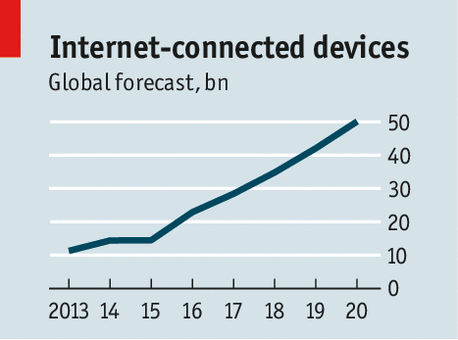
It is also deeply wishful, as many prospective arguments are, even when they start from fact. And the fact is, the Internet of Things is happening, and happening quickly. Rifkin notes that in 2007 there were ten million sensors of all kinds connected to the Internet, a number he says will increase to 100 trillion by 2030. A lot of these are small radio-frequency identification (RFID) microchips attached to goods as they crisscross the globe, but there are also sensors on vending machines, delivery trucks, cattle and other farm animals, cell phones, cars, weather-monitoring equipment, NFL football helmets, jet engines, and running shoes, among other things, generating data meant to streamline, inform, and increase productivity, often by bypassing human intervention. Additionally, the number of autonomous Internet-connected devices such as cell phones—devices that communicate directly with one another—now doubles every five years, growing from 12.5 billion in 2010 to an estimated 25 billion next year and 50 billion by 2020.

For years, a cohort of technologists, most notably Ray Kurzweil, the writer, inventor, and director of engineering at Google, have been predicting the day when computer intelligence surpasses human intelligence and merges with it in what they call the Singularity. We are not there yet, but a kind of singularity is already upon us as we swallow pills embedded with microscopic computer chips, activated by stomach acids, that will be able to report compliance with our doctor’s orders (or not) directly to our electronic medical records. Then there is the singularity that occurs when we outfit our bodies with “wearable technology” that sends data about our physical activity, heart rate, respiration, and sleep patterns to a database in the cloud as well as to our mobile phones and computers (and to Facebook and our insurance company and our employer).

Cisco Systems, for instance, which is already deep into wearable technology, is working on a platform called “the Connected Athlete” that “turns the athlete’s body into a distributed system of sensors and network intelligence…[so] the athlete becomes more than just a competitor—he or she becomes a Wireless Body Area Network, or WBAN.” Wearable technology, which generated $800 million in 2013, is expected to make nearly twice that this year. These are numbers that not only represent sales, but the public’s acceptance of, and habituation to, becoming one of the things connected to and through the Internet....MORE
See also:
Internet of Things: In Which Izabella Approaches Escape Velocity Edition
Too Funny: "Hello Dave" Shows Up On Hacked Google Nest Appliance Control System (GOOG)
The Internet of Things and Google's Home Invasion (GOOG) 
Cyber-security: "The internet of things (to be hacked)"
"How Smart Houses And Big Data Will Change Real Estate Economics" (just wait 'til your house gets a virus)
Another Day, Another 3D Printing, Robotic Harvesting, Internet-of-Things FarmBot
The Google of the "Internet of Things" (and Morgan Stanley's 96 page IoT report) SPLK; GE

Sunday, July 13, 2014

Cyber-security: "The internet of things (to be hacked)"

As the kids might say: Ya think?
From The Economist:

Hooking up gadgets to the web promises huge benefits. But security must not be an afterthought
CYBER-SECURITY is now part of all our lives. “Patches” and other security updates arrive for phones, tablets and PCs. Consultants remind us all not to open unknown files or plug unfamiliar memory sticks into our computers.

The bosses of some Western firms throw away phones and laptops after they have been to China assuming they have been hacked. And yet, as our special report this week points out, digital walls keep on being breached. Last year more than 800m digital records, such as credit- and debit-card details, were pinched or lost, more than three times as many as in 2012. According to a recent estimate by the Centre for Strategic and International Studies, a think-tank, the cost to the global economy of cybercrime and online industrial espionage stands at $445 billion a year—about as much as the GDP of Austria.

Now a new phase in this contest is emerging: “the internet of things”. This involves embedding miniature computers in objects and connecting them to the internet using wireless technology. Cisco, a technology company, predicts that 50 billion connected devices will be in circulation by the end of the decade, up from 11 billion last year. Web-connected cars and smart appliances in homes are becoming more common, as are medical devices that can be monitored by doctors many miles from their patients. Tech companies are splurging cash: witness Google’s punt on driverless cars and the $3.2 billion it has spent buying Nest, a maker of smart thermostats.

Such connectivity offers many advantages, from being able to adjust your house’s heating when you are in the office (or more likely your bed) to alerting your doctor that your insulin level has risen. But it also gives malicious hackers an easy way to burrow deeper into people’s lives. The small, embedded computers at the centre of the internet of things do not have as much processing power or memory as, say, a smartphone, so security software on them tends to be rudimentary. There have already been instances of nefarious types taking control of webcams, televisions and even a fridge, which was roped into a network of computers pumping out e-mail spam. And security researchers have found ways of hacking into some kinds of medical devices and cars, though this still requires specialist knowledge and kit. The wireless heart monitor of Dick Cheney, America’s former vice-president, was modified to stop remote assassination attempts.

Beware the fridge in Ealing
For the companies building the internet of things, its vulnerability could be costly. The tactic of pumping out new software as fast as possible and then issuing patches later to fix flaws in the code may be tolerable if all that is lost is data, but if it involves personal safety, consumers will be less tolerant....MORE
This post is a good excuse to look back at one of the better pieces on security and the Internet of Things, last seen in our ""How Smart Houses And Big Data Will Change Real Estate Economics" (just wait 'til your house gets a virus)":

The Nightmare on Connected Home Street

Illustration: Getty
I wake up at four to some old-timey dubstep spewing from my pillows. The lights are flashing. My alarm clock is blasting Skrillex or Deadmau5 or something, I don’t know. I never listened to dubstep, and in fact the entire genre is on my banned list. You see, my house has a virus again.
Technically it’s malware. But there’s no patch yet, and pretty much everyone’s got it. Homes up and down the block are lit up, even at this early hour. Thankfully this one is fairly benign. It sets off the alarm with music I blacklisted decades ago on Pandora. It takes a picture of me as I get out of the shower every morning and uploads it to Facebook. No big deal. 
I don’t sleep well anyway, and already had my Dropcam Total Home Immersion account hacked, so I’m basically embarrassment-proof. And anyway, who doesn’t have nudes online? Now, Wat3ryWorm, that was nasty. That was the one with the 0-day that set off everyone’s sprinkler systems on Christmas morning back in ’22. It did billions of dollars in damage.
Going back to sleep would be impossible at this point, so I drag myself into the kitchen to make coffee. I know this sounds weird, but I actually brew coffee with a real kettle. The automatic coffee machine is offline. I had to pull its plug because it was DDOSing a gaming server in Singapore. Basically, my home is a botnet. The whole situation makes me regret the operating system I installed years ago, but there’s not much I can do. I’m pretty much stuck with it.

When I moved into my house in the 20s, I went with an Android-compatible system because there were more accessories and they were better designed. But then I changed jobs and now my home doesn’t work with my company-issued phone. Which is a bummer because I have to keep this giant 7-inch tablet around to control everything and Google doesn’t support the hardware anymore so I can’t update it and now the door just randomly unlocks. Ugh, I’m going to have to start using keys again.

I’d just reinstall the OS, but that would be too expensive. Besides, all my Nexus Home® stuff uses proprietary chargers, and I can’t deal with having Amazon drones come in and rip out the drywall again. 
Everyone thought the connected home would be Apple or Google’s game. Turns out, that was short-sighted. An Internet-connected thermostat? LOL. Of course it was entirely about who would gain control of your SmartWall. It was the thing that controlled the screens and the lights and alarm clocks and burglar alarm and outdoor atmospheric monitoring system and interior climate control and mirrors and irrigation system and solar collector and water filtration and grocery inventory management database and kitchen appliances and communications center and automobile docking system and exercise equipment and biofeedback monitoring and medicine dispensary and stereo that mattered. But in fairness, who could have foreseen the Microsoft-Samsung deal or its consequences?...MORE
See also:
Yeah, I Got "Your Smart Home": A Journalist Shows Us How to Hack the Neighbors
The Internet of Things: Everything Is Hackable
The Internet of Things: Huggies App Sends You a Tweet Whenever Your Kid Pees...
The Google of the "Internet of Things" (and Morgan Stanley's 96 page IoT report) SPLK; GE
Companies That Will Benefit From The Internet of Things
Questions From MIT's 'Internet of Things Festival'
Former Joey Ramone Infatuant Maria Bartiromo Says Bad Things are Coming to the Market
"Behind the 'Internet of Things' Is Android—and It's Everywhere" (GOOG)
Pew Research: "The Internet of Things Will Thrive by 2025"

Monday, July 7, 2014

Pew Research: "The Internet of Things Will Thrive by 2025"

Just a personal, machine searchable, www-accessible bookmark.
From Pew Research, May 14, 2014:

Many experts say the rise of embedded and wearable computing will bring the next revolution in digital technology.
About This Report
This report is the latest research report in a sustained effort throughout 2014 by the Pew Research Center Internet Project to mark the 25th anniversary of the creation of the World Wide Web by Sir Tim Berners-Lee (The Web at 25).

A February 2014 report from Pew Internet Project tied to the Web’s anniversary looked at the strikingly fast adoption of the Internet. It also looked at the generally positive attitudes users have about its role in their social environment.

A March 2014 Digital Life in 2025 report issued by Pew Internet Project in association with Elon University’s Imagining the Internet Center looked at the Internet’s future. Some 1,867 experts and stakeholders responded to an open-ended question about the future of the Internet by 2025. They said it would become so deeply part of the environment that it would become “like electricity”—less visible even as it becomes more important in people’s daily lives.

To a notable extent, the experts agree on the technology change that lies ahead, even as they disagree about its ramifications. Most believe there will be:
  • A global, immersive, invisible, ambient networked computing environment built through the continued proliferation of smart sensors, cameras, software, databases, and massive data centers in a world-spanning information fabric known as the Internet of Things.
  • “Augmented reality” enhancements to the real-world input that people perceive through the use of portable/wearable/implantable technologies.
  • Disruption of business models established in the 20th century (most notably impacting finance, entertainment, publishers of all sorts, and education).
  • Tagging, databasing, and intelligent analytical mapping of the physical and social realms.
This current report is an analysis of opinions about the likely expansion of the Internet of Things (sometimes called the Cloud of Things), a catchall phrase for the array of devices, appliances, vehicles, wearable material, and sensor-laden parts of the environment that connect to each other and feed data back and forth. It covers the over 1,600 responses that were offered specifically about our question about where the Internet of Things would stand by the year 2025. The report is the next in a series of eight Pew Research and Elon University analyses to be issued this year in which experts will share their expectations about the future of such things as privacy, cybersecurity, and net neutrality. It includes some of the best and most provocative of the predictions survey respondents made when specifically asked to share their views about the evolution of embedded and wearable computing and the Internet of Things.
Survey respondents expect the Internet of Things to be evident in many places, including:
  • Bodies: Many people will wear devices that let them connect to the Internet and will give them feedback on their activities, health and fitness. They will also monitor others (their children or employees, for instance) who are also wearing sensors, or moving in and out of places that have sensors.
  • Homes: People will be able to control nearly everything remotely, from how their residences are heated and cooled to how often their gardens are watered. Homes will also have sensors that warn about everything from prowlers to broken water pipes.
  • Communities: Embedded devices and smartphone apps will enable more efficient transportation and give readouts on pollution levels. “Smart systems” might deliver electricity and water more efficiently and warn about infrastructure problems.
  • Goods and services: Factories and supply chains will have sensors and readers that more precisely track materials to speed up and smooth out the manufacture and distribution of goods.
  • Environment: There will be real-time readings from fields, forests, oceans, and cities about pollution levels, soil moisture, and resource extraction that allow for closer monitoring of problems.
Expert respondent Patrick Tucker, author of The Naked Future: What Happens In a World That Anticipates Your Every Move? provided a nice working description of the Internet of Things, writing: “Here are the easy facts: In 2008, the number of Internet-connected devices first outnumbered the human population, and they have been growing far faster than have we. There were 13 billion Internet-connected devices in 2013, according to Cisco, and there will be 50 billion in 2020. These will include phones, chips, sensors, implants, and devices of which we have not yet conceived.”...
...MUCH MORE

Monday, December 28, 2015

"Roundup Of Internet of Things Forecasts and Market Estimates"

From Forbes:
With the potential to streamline and deliver greater time and cost savings to a broad spectrum of enterprise tasks, opportunities for Internet of Things (IoT) adoption are proliferating. It’s encouraging to see so many industry-leading manufacturers, service providers, software and systems developers getting down to the hard work of making the vision IoT investments pay off. Forecasting methodologies shifted in 2015 from the purely theoretical to being more anchored in early adoption performance gains. Gil Press wrote an excellent post on this topic Internet of Things By The Numbers: Market Estimates And Forecasts which continues to be a useful reference for market data and insights, as does his recent post, Internet Of Things (IoT) News Roundup: Onwards And Upwards To 30 Billion Connected Things.
Key takeaways from the collection of IoT forecasts and market estimates include the following:
ABI Research market estimates
1`4 4 Trillion IoT
green graphic IoT
software BI
  • IC Insights predicts revenue from Industrial Internet of Things spending will increase from $6.4B in 2012 to $12.4B in 2015, attaining a 17.98% CAGR. IC Insights predicts the Industrial Internet will lead all five categories of its forecast, with Connected Cities being the second-most lucrative, attaining a 13.16% CAGR in the forecast period. The research firm segments the industry into five IoT market categories: connected homes, connected vehicles, wearable systems, industrial Internet, and connected cities. Source: IC Insights Raises Growth Forecast for IoT.
...MUCH MORE

Saturday, January 9, 2016

The Data Harvesters: Winners In The Internet of Things

From Barron's Tech Trader:

Winners in the Internet of Things
The electronics industry tried once again last week to make sense of this phenomenon called the Internet of Things. 

The IoT, as it’s known, is a grab bag of every conceivable object in the world that can be stuffed with circuitry and network connections and software, numerous examples of which were seen in Las Vegas at the Consumer Electronics Show. 

A lot of this stuff seems gimmicky, and it’s questionable whether much of it will function as promised. But industry wants desperately to anoint a winner among the many hopefuls making these IoT gadgets, and so does Wall Street. Fitbit (ticker: FIT), which makes bracelets that track your steps, and now smartwatches, is one primary candidate in people’s minds. 

But it was clear by the end of the week who the actual winners will be. The companies that have the most to gain from all these connected gizmos are the cloud companies, most prominently Alphabet (GOOGL), Amazon.com (AMZN), Facebook (FB), Microsoft (MSFT), and Baidu (BIDU). They will be the hubs, the centers of all the data being collected by Internet-connected devices, and the pervasive knowledge they will gain will be valuable to advertisers and others. 

Many of the connected devices are brilliant, and several are bizarre, but most will probably achieve only limited success. They include any number of cameras that take constant video of your home and warn about moving objects in the video that might be intruders. Some are devices you slip under a mattress to measure your sleep pattern. There are “smart” fetal monitors that let a mother see a baby’s heartbeat on her smartphone. Sophisticated blood-pressure wristbands will quickly scan for several types of arrhythmia and store the stats as a personal history. 

There was even one startup last week, Innit, that spoke of “digitizing” food, by which it means using software and sensors in smart ovens, to “let the chicken tell the oven how it wants to be cooked.”
The mind reels. Good, bad, or crazy, what all of these devices have in common is that they will connect to the Internet and store and analyze the data they collect from you and your neighbors.

That should be both ominous to everyone on a personal level, and intriguing to investors. The thought of data about your home, your health, your baby, and all the rest being in the cloud seems like a privatized Big Brother. Several vendors of connected security cameras with whom I spoke assured me that their data collection is highly secure and that they aren’t in the business of peeking at users’ lives. They are probably very sincere, but still, one wonders how safe and how private all this ultimately is. 

FROM THE INVESTOR’S PERSPECTIVE, the complexity of the Internet of Things will probably seduce more and more people into giving the cloud companies more and more data, thereby increasing the power and value of the cloud companies. The IoT is like the old problem of programming the clock on a VHS recorder, magnified to tens of devices in your home. As one chip executive told me last week, “I don’t want to have to program my smart car, I want to ‘friend’ my car on Facebook,” letting the social network eliminate the friction of making it all work. 

Then, too, the data collected has to be made sense of. 

Lisa Su, chief executive of chip maker Advanced Micro Devices (AMD), whose company makes chips for all the cloud companies, put it succinctly: “This idea of technology everywhere has been the mantra for a number of years now, but the bottom line is, ‘What do you do with all that data to make it useful?’ ” That’s a job for cloud companies such as Alphabet, which analyze piles of data using artificial-intelligence techniques. 

The cloud companies have a rapacious appetite for data, and they have already found ways to make every individual who uses the Internet a kind of funnel to bring more and more data into their machines.
Take, for example, a software application for mobile phones owned by Alphabet’s Google division, called Waze. It lets drivers on the highway upload information about the traffic on their route. It’s a voluntary collaborative database, in which all the drivers provide a piece of the puzzle. Only Google, up in its cloud, sees the whole picture. 

Google last week announced it is partnering with China’s Lenovo Group (0992.Hong Kong) to develop a phone that can use sensors to measure the dimensions of whatever physical space you happen to be in. Think of every person in the world being a kind of human beacon to let Google construct a 3-D map down to the centimeter....MORE 
Previously: 

Last year we had a different nominee, along with a special gift for our readers:
The Google of the "Internet of Things" (and Morgan Stanley's 96 page IoT report) SPLK; GE

If interested see "IBM Bets $3 Billion On Internet Of Things (IBM)" for more of our IoT links.  

Sunday, January 29, 2017

"Click Here to Kill Everyone"

The writer is one of the gurus* of the cybersecurity biz.

From New York Magazine's Select/All:

With the Internet of Things, we’re building a world-size robot. How are we going to control it?
Last year, on October 21, your digital video recorder — or at least a DVR like yours — knocked Twitter off the internet. Someone used your DVR, along with millions of insecure webcams, routers, and other connected devices, to launch an attack that started a chain reaction, resulting in Twitter, Reddit, Netflix, and many sites going off the internet. You probably didn’t realize that your DVR had that kind of power. But it does.

All computers are hackable. This has as much to do with the computer market as it does with the technologies. We prefer our software full of features and inexpensive, at the expense of security and reliability. That your computer can affect the security of Twitter is a market failure. The industry is filled with market failures that, until now, have been largely ignorable. As computers continue to permeate our homes, cars, businesses, these market failures will no longer be tolerable. Our only solution will be regulation, and that regulation will be foisted on us by a government desperate to “do something” in the face of disaster.

In this article I want to outline the problems, both technical and political, and point to some regulatory solutions. Regulation might be a dirty word in today’s political climate, but security is the exception to our small-government bias. And as the threats posed by computers become greater and more catastrophic, regulation will be inevitable. So now’s the time to start thinking about it.
We also need to reverse the trend to connect everything to the internet. And if we risk harm and even death, we need to think twice about what we connect and what we deliberately leave uncomputerized.
If we get this wrong, the computer industry will look like the pharmaceutical industry, or the aircraft industry. But if we get this right, we can maintain the innovative environment of the internet that has given us so much.

We no longer have things with computers embedded in them. We have computers with things attached to them.

Your modern refrigerator is a computer that keeps things cold. Your oven, similarly, is a computer that makes things hot. An ATM is a computer with money inside. Your car is no longer a mechanical device with some computers inside; it’s a computer with four wheels and an engine. Actually, it’s a distributed system of over 100 computers with four wheels and an engine. And, of course, your phones became full-power general-purpose computers in 2007, when the iPhone was introduced.

We wear computers: fitness trackers and computer-enabled medical devices — and, of course, we carry our smartphones everywhere. Our homes have smart thermostats, smart appliances, smart door locks, even smart light bulbs. At work, many of those same smart devices are networked together with CCTV cameras, sensors that detect customer movements, and everything else. Cities are starting to embed smart sensors in roads, streetlights, and sidewalk squares, also smart energy grids and smart transportation networks. A nuclear power plant is really just a computer that produces electricity, and — like everything else we’ve just listed — it’s on the internet.

The internet is no longer a web that we connect to. Instead, it’s a computerized, networked, and interconnected world that we live in. This is the future, and what we’re calling the Internet of Things.
Broadly speaking, the Internet of Things has three parts. There are the sensors that collect data about us and our environment: smart thermostats, street and highway sensors, and those ubiquitous smartphones with their motion sensors and GPS location receivers. Then there are the “smarts” that figure out what the data means and what to do about it. This includes all the computer processors on these devices and — increasingly — in the cloud, as well as the memory that stores all of this information. And finally, there are the actuators that affect our environment. The point of a smart thermostat isn’t to record the temperature; it’s to control the furnace and the air conditioner. Driverless cars collect data about the road and the environment to steer themselves safely to their destinations.

You can think of the sensors as the eyes and ears of the internet. You can think of the actuators as the hands and feet of the internet. And you can think of the stuff in the middle as the brain. We are building an internet that senses, thinks, and acts....MORE
In 2014, security guru Bruce Schneier...

On the September-October 2016 events:

Uh Oh: Internet Security Pro Hit By Botnet Made Of Internet-of-Things Connected Cameras
This is very bad....

Details Emerge On The Big Internet-of-Things Hack: This Is Just Sick

"This Is Probably Why Half the Internet Shut Down Today [Update: It’s Happening Again]"

Elbonians Will Rue The Day - Dilbert by Scott Adams