Wednesday, March 30, 2022

"US, Australia criticise India over Russia talks as Lavrov visits Delhi"

The Russian Foreign Minister is on a bit of a whirlwind tour.

From the Straits Times, March 31;

The US and Australia criticised India for considering a Russian proposal that would undermine sanctions imposed by America and its allies, showing a deepening rift between the emerging security partners as Foreign Minister Sergei Lavrov travelled to Delhi for talks.

"Now is the time to stand on the right side of history, and to stand with the United States and dozens of other countries, standing up for freedom, democracy and sovereignty with the Ukrainian people, and not funding and fuelling and aiding President Putin's war," Commerce Secretary Gina Raimondo told reporters in Washington on Wednesday (March 30).

She called reports of the arrangement "deeply disappointing," while adding that she hadn't seen details....

....MUCH MORE

And earlier from Al Arabiya:

Russian Foreign Minister Sergey Lavrov will visit New Delhi on Thursday for a two-day trip, the Indian foreign ministry said on Wednesday, as the two countries look for ways to maintain trade and other relations despite the Ukraine crisis.

It will only be Lavrov’s third visit overseas since Russia’s February 24 invasion of Ukraine, after a trip to Turkey for talks with his Ukrainian counterpart earlier this month and meetings in China starting on Wednesday.

While both India and China have called for an immediate ceasefire in Ukraine, they have refused to explicitly condemn Russia’s invasion. They have also continued to buy commodities from Russia hard hit by sweeping Western sanctions....

....MUCH MORE  

The Russians have been learning sanctions-busting tricks from the Iranians (lesson #1 turn off the transponders on ships and planes), meeting with Iran's Foreign Minister Hossein Amir Abdollahian while in Beijing yesterday.

Lavrov's next challenge is to keep the Saudis and the rest of the GCC from turning their fury at the Iran nuke deal into action.

A tough sale, but that's what he gets the big money for. 

Everyone involved should be happy they don't have to deal with Gromyko.

Société Générale's Albert Edwards Is Seeing Possible Chinese Currency Devaluation

That would not be good for Germany. Not at all

On the export front it means Chinese exports getting more competitive simply by virtue of the currency, competition that furthers the slowing of an already slowing German economy.

From ZeroHedge (the first third is about Japan and the Yen before Albert gets going on China):

Yen At Risk Of "Explosive" Downward Spiral With Kuroda Trapped... And Why China May Soon Devalue 

*****

.... In a recent note published by SocGen's resident skeptic Albert Edwards and titled "Something huge is happening in FX world, and it's not the dollar" (available to pro subs in the usual place), the strategist writes that "despite core CPI inflation surging in the US and the eurozone, Japan remains locked in deflation with core CPI there (excluding fresh food and energy) falling 1.0% yoy" and he observes that "surging commodity prices just do not seem to have the impact in Japan that they do in the west"  (another SocGen strategist, Kit Juckes, thinks he may have found an explanation why with the BoJ publishing a paper this week on the topic of the contrasting Phillips Curves in the US and Japan - link.)

Albert then goes on to note that by capping the 10y JGB at 0.25% the BoJ has committed itself to unlimited intervention – and if yields continue to rise elsewhere, that will likely accelerate QE to pin JGB 10y yields at 0.25% (now 0.23% after rising as high as 0.248%). "The further widening of the yield spread and QE/QT contrast with the US can only weigh heavily on the yen" he notes.

What does this mean in pratical terms? Well, since Japan is the one country where rates are never allowed to normalize - since the country has so much accumulated sovereign debt even a modest rise in rates would lead to an instant debt crisis - at a time when other central banks are tightening more aggressively in a tacit acknowledgement that rising bond yields reflect valid inflation concerns, "the BoJ may perversely be forced to accelerate QE as JGB yields attempt to rise above 0.25%. It’s a strange world" as Edwards puts it.

And this is where the second massive implication of the BoJ relative easing of policy comes in. Extending on this article, Edwards warns that "as the yen declines, the trend becomes a self-perpetuating phenomenon known as the ‘carry trade’ where participants actively borrow in a depreciating yen to fund higher yielding investments abroad. The appetite for such trades increases markedly when – as last week – the yen breaks below key support levels and begins to decline sharply: in short, the fundamentals combine with the technical, leading to an explosive expansion of the carry trade."

We have seen this before, most notably in the years before the Global Financial Crisis. Typically, the cheap yen funds are invested into similar instruments like higher yielding US Treasuries but as risk appetites mount, this extends into whatever momentum trade is dominant at the time. That may be commodities or it may be equities. Of course, ultimately it ends in tears (as it did in 2008 when it unwound), but as this new carry trade re-emerges, it means that the yen could fall an awfully long way from here – the ramifications of this might surprise investors.

So are we about to see another roll of the dice in Japan embracing (by default) another period of super-loose yen policy, Edwards asks. This effectively would mean that Japan is willing to soak up the west’s runaway inflation via higher import prices in the hope of kickstarting that wage / price spiral that (as we correctly predicted) never materialized in 2013 onwards. Or as the SocGen strategist rhetorically puts it:

Can a surge in Japan’s headline CPI this time around break the entrenched deflationary psychology of Japanese households? We’ll see.

We, for one, doubt it. Japan, as the premier exhibit of the insanity that is MMT, is coming to its inevitably monetary collapse. Which also means that the yen will drop much, much lower. Edwards agrees, and writes that "despite the yen being undervalued and over-sold, it is entirely plausible that it could fall a long way from here as traders get the bit between their teeth. Is Y150/$ possible? It is, because when the yen breaks, it moves sharply (eg in 2013 from 80 to 100, and again in 2015 from 100 to 120)."
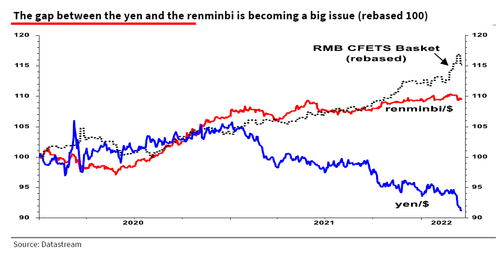
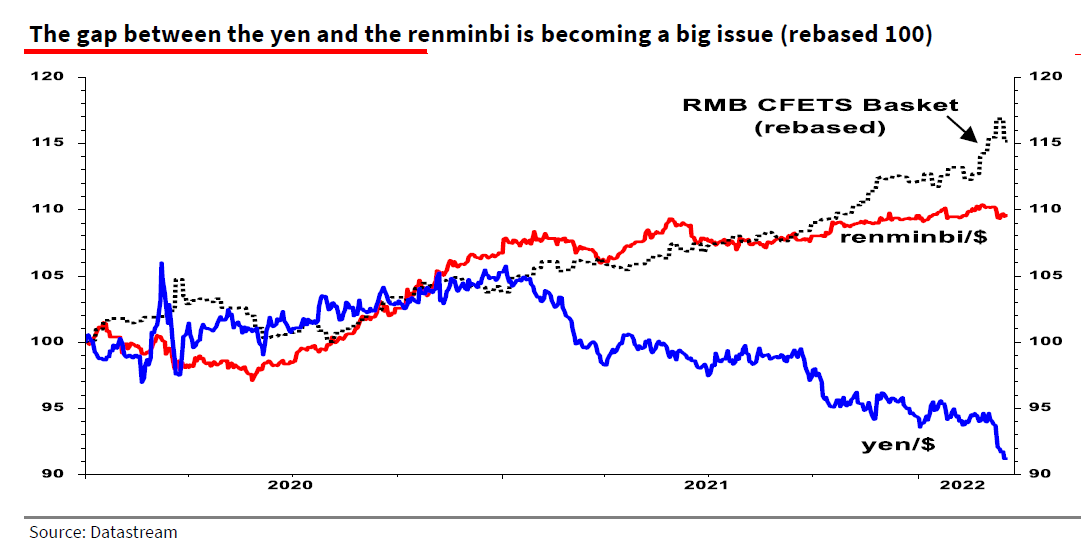
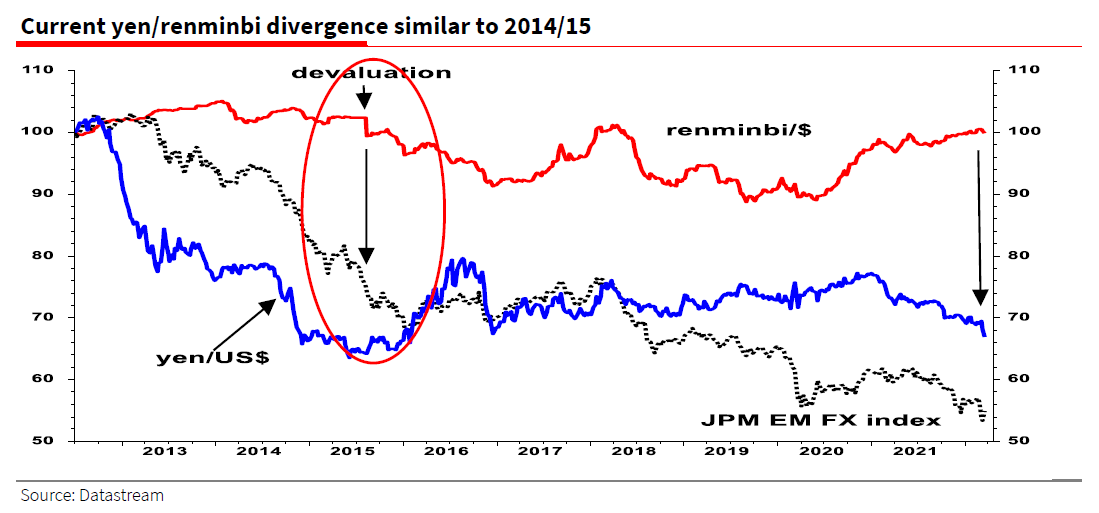
But while Japan may be a lost cause, a bigger question emerges: how will Japan's latest devaluation impact its fellow exporting powerhouse competitors, i.e., China, and as Edwards frames it, "this beggars the question how will China react? Maybe just like they did in August 2015 when the PBoC devalued? Back then persistent yen weakness had dragged down other competing regional currencies and left the renminbi overvalued."

Wait, yen weakness leading to China devaluation? According to Edwards, that indeed was the sequnece: as he shows in the chart below, the super weak yen of 2013-15, by driving down other competing Asian currencies, ultimately led us to the August 2015 renminbi devaluation.

Fast forward to today when the aggressive relative easing of the BoJ comes at a time when the PBoC also sticks out as a central bank unwilling to join the global tightening posture and instead is shifting towards an easier stance (after all, China has an imploding property sector it must stabilize at any cost)....

....MORE

Even if Germany can convince the euro poobahs that a weaker currency is required you've got your Scylla: "Germany's inflation rate jumps to 7.6%" where food and energy imports would rise in price if the ECB were to follow China in the devaluation game or you've got your Charybdis: "Bundesbank: "Germany tipped into second recession by virus"

Colloquially referred to as a rock and a hard place. I don't know what Germany can do.
Maybe hire that Nabiulina lady away from the Russian Central Bank. 

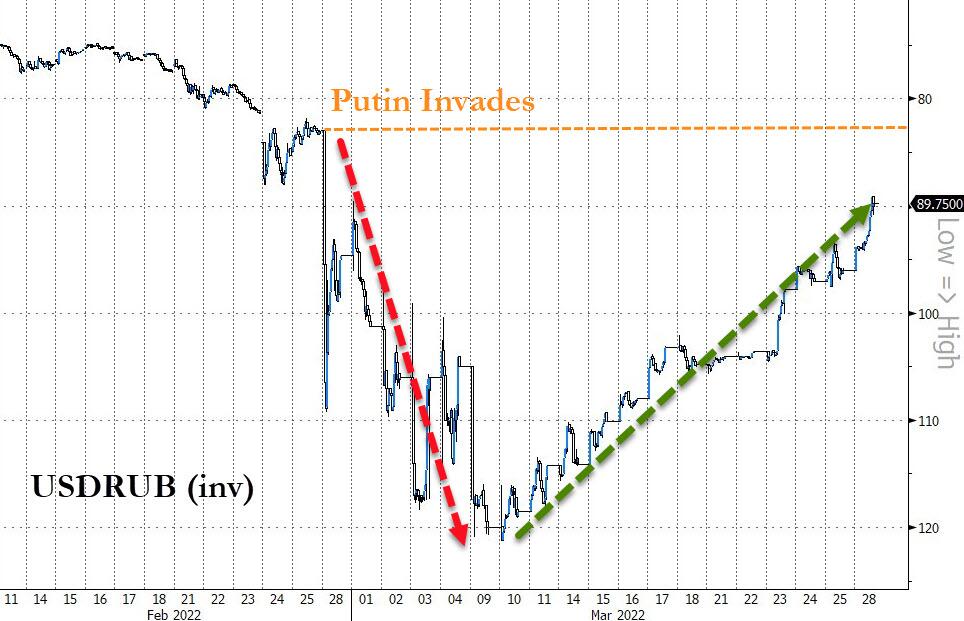
Last I saw the rouble was at 82.8837 to buy a dollar, versus 81.3166 on February 24th, the day of the invasion.

That's compared to the record low recorded on March 7th, 150.119 to 1.

She's pretty good at what she does. 

President of BlackRock Says An 'Entitled Generation' of Americans Will Face The Shock of Goods Shortages For the First Time in Their Lives

May or may not be related to the post immediately below: "Lest We Forget: 2019 -2021 Unfolded According To BlackRock's Prophesy (BLK)".
Your call.

From the Daily Mail, March 30:

President of BlackRock investment firm warns an 'entitled generation' needs to brace for shock of shortages and higher inflation: Experts warn Americans will pay an EXTRA $433 a month for basic goods this year

  • BlackRock President Rob Kapito made the remark at a conference on Tuesday
  • Kapito, 65, said an 'entitled generation' would be shocked by coming shortages
  • The BlackRock founder has an estimated net worth of more than $400M
  • Meanwhile, average Americans will pay $433 more per month due to inflation
  • Economists say nearly half of the extra costs will be from food and energy
  • Shortages in labor and raw materials continue to drive up consumer prices

The president of BlackRock investment firm has said that an 'entitled generation' of Americans will face the shock of goods shortages for the first time in their lives as supply chain disruptions continue to spur high inflation.

'For the first time, this generation is going to go into a store and not be able to get what they want,' BlackRock co-founder Rob Kapito said at an energy conference in Austin, Texas on Tuesday, according to Bloomberg.

'And we have a very entitled generation that has never had to sacrifice,' added the 65-year-old Kapito, who has an estimated net worth of more than $400 million and made $24.6 million in total compensation in 2020....

....MUCH MORE

A whiff of class warfare in the air.

We are once again confronted with the anarcho-capitalist dilemma: should I raise the drawbridge or sell pitchforks to the mob?

Lest We Forget: 2019 -2021 Unfolded According To BlackRock's Prophesy (BLK)

In August 2019 BlackRock published:

MACRO AND MARKET PERSPECTIVES 
AUGUST 2019

Dealing with the next downturn:
From unconventional monetary policy to
unprecedented policy coordination

And from there it was off to the races.

Here's the Summary page:

Unprecedented policies will be needed to respond to the next economic downturn. Monetary policy is almost exhausted as global interest rates plunge towards zero or below. Fiscal policy on its own will struggle to provide major stimulus in a timely fashion given high debt levels and the typical lags with implementation. Without a clear framework in place, policymakers will inevitably find themselves blurring the boundaries between fiscal and monetary policies. This threatens the hard-won credibility of policy institutions and could open the door to uncontrolled fiscal spending. This paper outlines the contours of a framework to mitigate this risk so as to enable an unprecedented coordination through a monetary-financed fiscal facility. Activated, funded and closed by the central bank to achieve an explicit inflation objective, the facility would be deployed by the fiscal authority.
• There is not enough monetary policy space to deal with the next downturn: The current policy space for global central banks is limited and will not be enough to respond to a significant, let alone a dramatic, downturn. Conventional and unconventional monetary policy works primarily through the stimulative impact of lower short-term and long-term interest rates. This channel is almost tapped out: One-third of the developed market government bond and investment grade universe now has negative yields, and global bond yields are closing in on their potential floor. Further support cannot rely on interest rates falling.

• Fiscal policy should play a greater role but is unlikely to be effective on its own: Fiscal policy can stimulate activity without relying on interest rates going lower – and globally there is a strong case for spending on infrastructure, education and renewable energy with the objective of elevating potential growth. The current low-rate environment also creates greater fiscal space. But fiscal policy is typically not nimble enough, and there are limits to what it can achieve on its own. With global debt at record levels, major fiscal stimulus could raise interest rates or stoke expectations of future fiscal consolidation, undercutting and perhaps even eliminating its stimulative boost.

• A soft form of coordination would help ensure that monetary and fiscal policy are both providing stimulus rather than working in opposite directions, as has often been the case in the post-crisis period. This experience suggests that there is room for a better policy – and yet simply hoping for such an outcome will probably not be enough.

• An unprecedented response is needed when monetary policy is exhausted and fiscal policy alone is not enough. That response will likely involve “going direct”: Going direct means the central bank finding ways to get central bank money directly in the hands of public and private sector spenders. Going direct, which can be organised in a variety of different ways, works by: 1) bypassing the interest rate channel when this traditional central bank toolkit is exhausted, and; 2) enforcing policy coordination so that the fiscal expansion does not lead to an offsetting increase in interest rates.

• An extreme form of “going direct” would be an explicit and permanent monetary financing of a fiscal expansion, or so-called helicopter money. Explicit monetary financing in sufficient size will push up inflation. Without explicit boundaries, however, it would undermine institutional credibility and could lead to uncontrolled fiscal spending.

• A practical way of “going direct” would need to deliver the following: 1) defining the unusual circumstances that would call for such unusual coordination; 2) in those circumstances, an explicit inflation objective that fiscal and monetary authorities are jointly held accountable for achieving; 3) a mechanism that enables nimble deployment of productive fiscal policy, and; 4) a clear exit strategy. Such a mechanism could take the form of a standing emergency fiscal facility. It would be a permanent set-up but would be only activated when monetary policy is tapped out and inflation is expected to systematically undershoot its target over the policy horizon.

• The size of this facility would be determined by the central bank and calibrated to achieve the inflation objective, which could include making up for past inflation misses. Once medium-term trend inflation is back at target and monetary policy space is regained, the facility would be closed. Importantly, such a set-up helps preserve central bank independence and credibility.

....MUCH MORE (16 page PDF)

Prescient.
Or planned.
 
Now, if you'll excuse me, I'm going to go read up on who would benefit from an historical tsunami of liquidity, as called for by the largest asset holder the world has ever known.
Back in a bit.
HT on the BlackRock White Paper, Professor Fabio Vighi whose article at the Philosophical Salon we've posted twice and linked to a half dozen times.

"Germany's inflation rate jumps to 7.6%"

Via Bloomberg's Lisa Abramowicz:

Nordea on Inflation and Yield Curves

From Nordea's Head of Market Strategy:

This is the first time I have ever seen an analyst point out the difference between nominal and real (inflation adjusted) curves. Because it is new to me, I can't say if the difference is important or if it is, by how much but it appears to be something to keep in mind amidst all the "curve" jibber-jabber.

As well as when perusing the post immediately below, Convexity Maven's look at curves: 

Convexity Maven: "Square Pegs"

For what it is worth we are betting that recession is the end result of all the Fed and Treasury and Congressional machinations of the last 2 1/4 years. The timing can be manipulated to suit the designs of the Fed's political masters but the alternative, let inflation run its course and burn itself out will result in riots like the U.S. has never seen. For reasons we will attempt to tease out over the coming months the Fed and the puppet masters behind the politicians wanted inflation to run this hot. So it has.

From Harley Bassman at Simplify Asset Management, March 28:

Cognitive dissonance is often defined as simultaneously holding conflicting or inconsistent thoughts, attitudes, and beliefs.

It is a signpost of the mature mind to accomplish this feat without first securing
a membership at the local dispensary.

Just as I cannot avert my eyes from a crash site, I similarly marvel at the opposing positions offered at the same time by our political class, with unreserved sincerity.

In contrast, the governors of the Federal Reserve Bank (the FED) instill confidence in our financial system by projecting certainty. Thus, the FED’s stress must be palpable as they presently try to jam the square peg of inflation into the round hole of a bond market signaling a recession.

Dr. Cam Harvey was a recent guest on our monthly “Keeping It Simple” webinar.
Dr. Harvey secured his PhD (at UChicago, of course) with a dissertation highlighting the relationship between the Yield Curve and economic recessions.

As a reminder, the Yield Curve is the graphical representation of interest rates between three-months and thirty-years, which usually tends to slope upwards to
reflect the greater risk inherent with longer-term bonds....

....MUCH MORE

"BOJ Steps-Up its Efforts, US 2-10 Curve steepens, and the Dollar Softens"

From Marc to Market:

Overview: A pullback in US yields yesterday and the Bank of Japan's stepped-up efforts to defend the Yield Curve Control policy helped extend the yen's recovery. This spurred profit-taking on Japanese stocks, where the Nikkei had rallied around 11% over the past two weeks. Hong Kong, China, and Taiwan led the regional advance. However, facing a surge in inflation (Spain and German states) and a jump in European natural gas prices (~9%) is snapping the Stoxx 600's three-day advance. US futures are trading with a heavier bias. The US 10-year yield has edged a little higher to 2.40%, while the two-year that briefly traded above the 10-year yield yesterday is off about four basis points. European benchmark yields are 3-6 bp higher. The greenback is trading lower against all of the major currencies, led by the yen's recovery. After poking above JPY125 to start the week, the dollar fell to around JPY121.30 today before steadying. The Canadian and Australian dollars are the laggards with minor gains. Among emerging market currencies, the Turkish lira is the notable exception, and is posting a modest decline. 

 Gold appeared to post a bullish hammer pattern yesterday but there has not been much follow-through and the yellow metal is in around a $6 range on either side of $1922. May WTI is also in a narrow range--mostly $105-$107 today. Copper and iron ore are trading firmer. Wheat is still soft after losing around 8% over the past couple of sessions.

Asia Pacific
The Bank of Japan stepped-up its efforts to cap interest rates earlier today.
It increased the amount of bonds it bought at its regular scheduled operation. It offered to buy JPY600 bln (instead of JPY450 bln) 3–5-year bond, and JPY725 bln (instead of JPY425 bln) of 5-10-year bonds, in addition to the pre-announced defense of the 0.25% cap on the 10-year bond. It did not increase the amount of longer-term bonds. Tomorrow, the BOJ is expected to announce next quarters asset purchase plans.

Although BOJ Governor Kuroda, who met with Prime Minister Kishida earlier today, does not seem concerned about the yen's weakness, Finance Minister Suzuki seemed more cautious. He suggested continuing to check if the yen's weakness is harming the economy. For example, the weaker yen is aggravating the surge in energy prices, which Kishida was to cushion the blow to households and businesses. If intervention is best understood as an escalation ladder, as we suggest, then this might be seen as a low rung. Separately, Japan reported that retail sales fell by 0.8% in February, which was more than twice the decline expected by the median forecast in Bloomberg's survey. It also drove the year-over-year rate below zero (-0.8%) for the first time since last September.

Beijing has offered some economic support for Shanghai, but the surge in Covid there, and lockdowns there and elsewhere, are seeing economists slash growth forecast and lift inflation projections. China's March PMI will be released tomorrow. A poor report is expected, and the risks are on the downside. Thus far, though, officials have used targeted measures and have not provided the overall economy with new support....

....MUCH MORE

Tuesday, March 29, 2022

San Francisco Fed: "Why Is U.S. Inflation Higher than in Other Countries?" (Spoiler: Stimmies)

From the Federal Reserve Bank Of San Francisco, March 28, 2022:

Inflation rates in the United States and other developed economies have closely tracked each other historically. Problems with global supply chains and changes in spending patterns due to the COVID-19 pandemic have pushed up inflation worldwide. However, since the first half of 2021, U.S. inflation has increasingly outpaced inflation in other developed countries. Estimates suggest that fiscal support measures designed to counteract the severity of the pandemic’s economic effect may have contributed to this divergence by raising inflation about 3 percentage points by the end of 2021.


Few people would question the devastating economic consequences of the COVID-19 pandemic, which resulted in a dramatic collapse in economic activity and loss in employment worldwide. The United States introduced unprecedented fiscal and monetary policy responses to provide rapid economic relief. The Coronavirus Aid, Relief, and Economic Security (CARES) Act was signed into law in March 2020. In the same month, the Federal Reserve lowered the target range for the federal funds rate to 0–¼% and introduced additional measures to ease liquidity.

As we begin the third year since the start of the pandemic, the U.S. economy has rebounded at an astonishing rate. Unemployment recovered from a high of 14.7% in April 2020 to 3.8% in February 2022. Meanwhile, the gap between actual GDP and its potential rate has nearly closed to less than 0.5%, as calculated by the Congressional Budget Office. However, global supply chain distortions persist, and subsequent waves of COVID-19 infections continue to disrupt service-oriented industries.

There are many reasons to expect inflation to be higher than normal (Barnichon, Oliveira, and Shapiro 2021; Bianchi, Fisher, and Melosi 2021; Shapiro 2021a,b). In this Economic Letter we widen the recent analysis with an international comparison. Though many of the pandemic distortions are common to other countries, we show that U.S. inflation has risen more quickly and increasingly diverged from inflation in other OECD (Organisation for Economic Co-operation and Development) countries. In seeking an explanation, we turn to the combination of direct fiscal support introduced to counteract the economic devastation caused by the pandemic.  Importantly, we trace the effect of these measures over time. The interplay between when assistance was delivered and how households responded to successive COVID waves created complicated dynamics in the economy. Building these dynamics into a simple model suggests that they may have contributed to about 3 percentage points of the rise in U.S. inflation through the end of 2021.

U.S. inflation is now higher than abroad
One way to illustrate what has happened with U.S. inflation is to compare it with the average rate of inflation across a group of OECD economies: Canada, Denmark, Finland, France, Germany, Netherlands, Norway, Sweden, and the United Kingdom. We rely on core inflation measures, which remove the more volatile food and energy prices. To align with what is available in all the countries in our study, we use consumer price index (CPI) inflation instead of the personal consumption expenditures price index, the preferred measure of inflation used by the Federal Reserve.

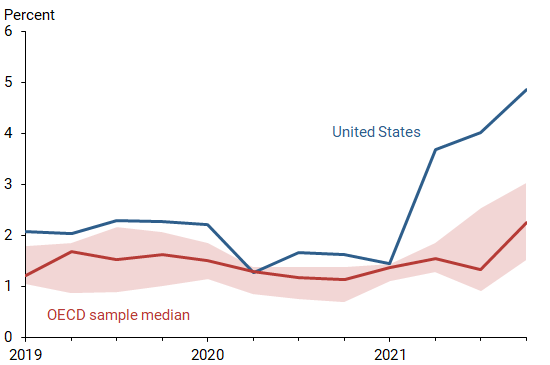
The blue line in Figure 1 displays the year-over-year percent changes in U.S. core CPI inflation. The figure also shows the median (red line) and the range between the 25% and 75% largest values (also known as the interquartile range and shown by the shaded area) of inflation for our OECD sample. A tighter range indicates that most OECD countries in our sample experienced inflation rates similar to each other. The figure shows that, before the pandemic, U.S. core CPI inflation remained, on average, about 1 percentage point above the OECD sample average. The small difference between U.S. and OECD inflation during this period is well known as many of the OECD countries struggled to get inflation up to target following the Global Financial Crisis and subsequent euro-area sovereign debt crisis.

Figure 1
Annual core CPI inflation: U.S. versus OECD

Annual core CPI inflation: U.S. versus OECD

Note: Shaded area reflects interquartile range for OECD sample.
Source: OECD Household Dashboard: cross country comparisons.

By early 2021, however, U.S. inflation increasingly diverged from the other countries. U.S. core CPI grew from below 2% to above 4% and stayed elevated throughout 2021. In contrast, our OECD sample average increased at a more gradual rate from around 1% to 2.5% by the end of 2021. These differences in inflation readings cannot be explained by measurement issues.

U.S. direct fiscal transfers are also higher than abroad....

....MUCH MORE

HT: ZeroHedge

The Great Steepening: Thoughts Of A Former Fed Open Market Desk Trader

From Fed Guy, March 21:

In the coming months a record amount of coupon Treasuries will flood the market even as demand for those securities appears to be faltering. Recent remarks from Chair Powell suggest quantitative tightening will proceed at a pace of $1t a year, double the annual pace of the prior QT. That could imply a process that quickly ramps up to around $700b in Treasuries and $300b in Agency MBS in annual run-off. At the same time, Treasury net issuance is expected to remain historically high at ~$1.5t a year. This implies that non-Fed investors will have to absorb ~$2t in issuance each year for 3 years in the context of rising inflation and rising financing costs from rate hikes. Even the most ardent bond bulls will not have enough money to absorb the flood of issuance, so prices must drop to draw new buyers. In this post we preview the coming QT, sketch out potential investor demand, and suggest a material steepening of the curve is likely.

Three Years to Shrink the Balance Sheet
Chair Powell has sketched out the contours of the upcoming QT program through a series of appearances. He noted at a recent Congressional hearing (1:48) that it may take around 3 years to normalize the Fed’s $9t balance sheet. The Fed estimates its “normalized” balance sheet based on its perception of the banking system’s demand for reserves. A conservative estimate based on the pre-pandemic Fed balance sheet size, and taking into account growth in nominal GDP and currency, arrives at a normalized balance sheet of around $6t. This would imply QT at rate of ~$1t a year, roughly twice the annual pace of the prior QT.


A decline from $9t to $6t over 3 years implies $1t a year in QT

Chair Powell suggested at his March press conference that QT would begin in May and look like the prior QT, which began with a ramp up and ended with a ramp down. The Fed’s maturity profile for Treasury coupons is front loaded and for Agency MBS is an estimated $25b a month pace. An aggregate cap that begins at $50b and ramps up to $80b would achieve $3t in QT in around 3 years. The Fed’s Treasury bill holdings are not strictly part of a QE program and may be managed separately. Note that Agency MBS prepayments are expected to be very low in the coming years as borrowers have less incentive to refinance. This may argue for a steady non-binding cap on Agency MBS reinvestments with some outright sales in the third year.

Agency MBS principal payments assumed to be $25b a month as per FRBNY estimates
Bills are excluded as they are usually handled differently.

Funding Uncle Sam
Over the next three years the market will have to absorb an unprecedented level of issuance as QT overlaps with historically high net issuance.....

....MUCH MORE

Previously linked from Fed Guy, March 7:

Breaking The System 

Rabobank Talks Ukraine and Foreign Exchange

From ZeroHedge, March 29:

Rabobank: Don't RUB Me The Wrong Way

By Michael Every of Rabobank

Now even the luvvies at the Oscars are suddenly violent, and the British phrase “Don’t rub me up the wrong way”, meaning don’t irritate me, is particularly appropriate.

The Financial Times, again, has an optimistic story about Russia’s demands of Ukraine, and this time it could be an Oscars’-host joke: “Putin claims what he actually said to Ukraine was ‘Don’t be nasty’.” The FT says Russia claims it no longer wants Ukraine to be “denazified” and is even happy with it joining the EU – provided it hands over Crimea and the Donbas. For those who feel like slapping someone in response, Ukraine has already underlined it is prepared to remain neutral, but it won’t give up any territory, demands security guarantees nobody is willing to give with territorial issues outstanding, and that any agreement must go to a referendum, closing off any backroom deals some in the US/EU/markets might like to do to make this all go away.  

So, a plank towards an off-ramp? Perhaps. Or it could be Russian “Maskirovka” given the entire war effort has been predicated on the anti-Nazi line so far. Not a very good mask, if so, given newly promoted Chechen warlord/Russian Army lieutenant general Kadyrov reportedly just stated: “Very soon we will complete the assigned tasks in Mariupol and report to the President of the Russian Federation on our readiness to take Kyiv.” One thing we can be sure of is that any negotiators with Russia will do their own catering given the last set who tried to talk peace, including oligarch Roman Abramovich, reportedly then suffered symptoms of chemical poisoning.

Yet “Peace in our time” will continue to see wild market swings - on top of the wild market swings we were already seeing. In particular, oil plummeted once again due to Shanghai going into lockdown. Presumably this latest Chinese Covid closure is economically serious enough to justify Brent closing down nearly 7% on the day, despite the fact that it has leaped back up again after all the others. Nobody ramping oil markets again, honest.

Meanwhile, Russia is pressing ahead with plans to insist on a switch EU payment for its gas to RUB by Thursday. It has underlined it won’t export it for free, while the EU says it won’t pay in RUB. That is as binary a trade as you can get, and the potential outcomes should be obvious. The FX market seems to think so anyway, with EUR/RUB strengthening from 165 at its low to 105 at time of writing. But are we really going to see Russia “win” like that given the huge geopolitical and geoeconomic implications?

The much-vaunted Russia-India RUB-INR trade flaunted as the previous catalyst for “the end of the dollar!” is, according to the Indian press, looking far more mundane. The Business Standard reports India and Russia may keep RUB out of the proposed INR-RUB trade, given its high post-sanctions volatility: payments for the rising level of commodity trade that is indeed happening are likely to be settled in INR *pegged to the dollar*, and deposited in an Indian bank account. Under the proposed trade mechanism, when India imports goods from Russia, INR equivalent to the dollar value will be deposited in an Indian bank account. When India exports goods to Russia, Indian exporters can be paid from the same account in INR. You know who used a similar arrangement to work around sanctions? Nazi Germany. I’m sorry, I mean “Nasty Germany”.

The key points are that:

  1. commodities will continue to be PRICED in DOLLARS, as we saw with the purported Saudi CNY oil sale;

  2. Russia, for now, is still accumulating new USD and EUR reserves via its energy trade surpluses; and

  3. nobody wants to touch RUB. Not even India, an emerging ‘neutral’ heavyweight in what article after article now say is a bifurcating world economy....

....MUCH MORE

"A gauge of prices for the nitrogen fertiliser ammonia in Tampa surged 43% On Friday"

From Bloomberg Intelligence via the Irish Independent, March 28:

World fertiliser price surges 43% to fresh record as supplies tighten

Fertiliser prices continue to spike to records as Russia's invasion of Ukraine puts a massive portion of the world's fertilizer supply at risk, adding to concerns over soaring global food inflation.

A gauge of prices for the nitrogen fertiliser ammonia in Tampa surged 43% to $1,625 per metric ton Friday, a record for the 29-year-old index. Production outages and tight global supply are driving the jump, according to a note from Bloomberg Intelligence....

....MORE

Also at the Independent, this morning:

Fertiliser shortage puts world food supply in peril

On Sunday we saw this at PoAndPo Agrifish:

Ireland: High input costs threaten fresh milk supply 

"Avian Influenza Cases Now Top 14.5 Million Birds; Outbreak Third Worst in US History as HPAI Continues to Spread"

Egg and  chicken prices have responded as you would expect.

From DTN Progressive Farmer, March 28:

HPAI Found in More States

Highly pathogenic avian influenza is sweeping through major commercial operations as the number of states and infected flocks continues to grow. USDA is now depopulating more than 14.5 million birds, making this year's outbreak the third largest in U.S. history.

So far in March alone, USDA has reported highly pathogenic avian influenza (HPAI) infections involving nearly 13 million birds in 16 states, with the largest single infected flock involving an egg-laying operation in Buena Vista, Iowa, that included 5.3 million chickens.

Minnesota over the weekend announced a commercial turkey operation involving 289,000 birds was infected with the H5N1 strain. Infection in another commercial turkey flock in Minnesota involving 24,000 birds was confirmed as well. Jennie-O Turkey Store issued a statement Saturday that one of the Minnesota farms impacted was part of its supply chain.

Since early February, USDA has confirmed domesticated cases with commercial and backyard flocks in Connecticut, Delaware, Illinois, Indiana, Iowa, Kansas, Kentucky, Maine, Maryland, Michigan, Minnesota, Missouri, Nebraska, New Hampshire, New York, South Dakota and Wisconsin.

When cases are found in domestic flocks, USDA and state officials quarantine the premises and birds on the property are depopulated to prevent the spread of the disease. Other flocks within a 10-kilometer (6.21 miles) radius also are quarantined. USDA is authorized to provide indemnity payments to producers and the destroyed flocks do not enter the food system. Depopulated birds are typically composted on site if possible....

....MUCH MORE

The consumer is going to have problems buying protein and as Marc Andreessen relayed, even the price of lentils has doubled.

Recently: 

I Used to Enjoy Visiting PoAndPo Agrifish

Monday, March 28, 2022

"French Fighter Jet Joy Ride Goes Très, Très Wrong"

We had posted a different version of the story in 2020 when it became more widely known as a result of the official investigation into the March 2019 incident.

From Car and Driver, Apr 13, 2020:

A French defense contractor riding in a Dassault fighter learned the hard way that the grab bar next to his seat was actually the ejection handle.

https://hips.hearstapps.com/hmg-prod.s3.amazonaws.com/images/dassault-rafale-b-of-the-french-air-force-royalty-free-image-1586806372.jpg?resize=980:*

Imagine: You work hard your whole life in the French defense industry, and when it's time to retire, your co-workers want to give you something more memorable than a gold watch or a set of golf clubs. So they set up a coveted back-seat ride in a Dassault Rafale B fighter jet, the kind of perk that requires serious connections.

Just one problem: nobody asked one particular 64-year-old civilian whether he ever wanted such a ride, or showed him much about what to expect. Next thing you know, the French Investigation Bureau for State Aviation Safety (BEA-E) is issuing a report explaining how Monsieur Newbie came to experience not only the Dassault, but also its Martin-Baker MK16 ejection seat.

Well, mistakes were made. Lots of them....

....MUCH MORE

Our Hero

https://taskandpurpose.com/uploads/2020/11/screen-shot-2020-04-14-at-115952-am-3.png

Previously: 

ICYMI: Retirement Gift Gone Bad—Man Gets Ride In Jet Fighter, Man Accidently Triggers Ejector Seat at 2500 Feet

which had the above pic and the note: "Fortunately the man's buddies were able to film the event for posterity (and the official report [link rotted]):"

Platts' "Commodity Tracker: 5 charts to watch this week" (hints of demand destruction in U.S. gasoline+++)

From S&P Global Platts, March 28:

Get a quick look at expectations on China's iron ore and steel markets for the next quarter, as well as the impact of the continuing Russia-Ukraine war in the rebar-scrap market. Our editors in the US are watching gasoline prices, and oil and gas business sentiment, while polyethylene trade is in focus in Asia. 

....3. California could foreshadow gasoline demand decline in entire US

Oil demand and mobility in California and US

What's happening? In Q4 2021, the US West Coast saw a decline in gasoline demand which was more pronounced than the entire country. This coincided with regular unleaded gasoline prices in the area reaching $4/gal. In the latest reporting week, the EIA indicated regular gasoline retail prices in California of $5.70/gal while the US averaged $4.24/gal. Over the last month, as price increases accelerated, California mobility was more tempered relative to the overall US. Weekday mobility is more inflexible than weekend mobility because a larger component is comprised of driving to work.

What's next? With California gasoline prices being so much higher than the rest of the country, it may be a leading indicator of what could ultimately be seen in the rest of the US with regards to demand impairment. As prices rise to ever more elevated levels, price elasticity is not seen as behaving linearly and demand losses grow disproportionately. Demand losses are estimated be about 35,000 b/d in a low elasticity sensitivity case, to around 300,000 b/d in a high elasticity sensitivity case. This demand loss would be mostly felt in discretionary driving and be reflected in weekend mobility data. If weekend mobility data declines, losses in gasoline demand would begin to mirror that which had already been observed in the West Coast and specifically California....
....MUCH MORE 

Whoa: "EU announces Big Tech crackdown, demands interoperability between platforms"

But what about the lovely walled gardens, designed for exclusion not interoperability?

https://keyassets.timeincuk.net/inspirewp/live/wp-content/uploads/sites/8/2017/04/11_DSC2727ps_64157101_173897022-920x584.jpg

Walled garden at Glenarm Castle via Country Life

You can have Apple or Google but no interoperability. Yet.

From Ars Technica, March 25:

Lawmakers agree on Digital Markets Act to regulate Big Tech; final votes still pending.

European regulators have agreed on a Digital Markets Act that would impose a variety of new requirements on Big Tech companies classified as "gatekeepers." Final votes on the legislation are still pending.

"The text provisionally agreed by Parliament and Council negotiators targets large companies providing so-called 'core platform services' most prone to unfair business practices, such as social networks or search engines, with a market capitalization of at least 75 billion euro or an annual turnover of 7.5 billion," a European Parliament announcement said yesterday. "To be designated as 'gatekeepers,' these companies must also provide certain services such as browsers, messengers, or social media, which have at least 45 million monthly end users in the EU and 10,000 annual business users."

Google, Apple, Amazon, Facebook owner Meta, and Microsoft would apparently have to comply with the new rules. "The Digital Markets Act puts an end to the ever-increasing dominance of Big Tech companies. From now on, they must show that they also allow for fair competition on the Internet," said Andreas Schwab, a member of the European Parliament from Germany and rapporteur for Parliament's Internal Market and Consumer Protection Committee.

EU lawmakers agreed that big messaging services such as Whatsapp, Facebook Messenger, and Apple's iMessage "will have to open up and interoperate with smaller messaging platforms, if they so request....

....MUCH MORE

"‘Advancing Equity and Inclusion in a Deep Turd World’: What I Learned at the Bloomberg Equality Summit"

I couldn't stop reading this. I considered doing so a couple times but then the very next sentence would send us careering [perfect word] off again, around the slaloms and chicanes and hairpin turns of corporate America, 2022.

Stop me before I read it again. And again.

From Elliott Management-backed (Paul Singer) Washington Free Beacon, March 26:

A terrifying thought occurred to me about halfway through day one of the Bloomberg Equality Summit, an annual gathering of corporate executives, DEI officers, and the actor who played Martin Luther King Jr. in Selma to discuss KPIs regarding CSR and ESG across a variety of GLs. (Translation: Diversity, equity, and inclusion; key performance indicators; corporate social responsibility; environment, social, and governance; global landscapes.) I realized I would rather be watching the Senate Judiciary Committee consider the Supreme Court nomination of Ketanji Brown Jackson. If I had to subject myself to a mindless marathon of performative righteousness, I'd prefer the one with fewer Ivy League buzzwords and heaping piles of corporate bullshit. Say what you will about Congress, at least it's not (overtly) sponsored by a woke hedge fund (TPG) specializing in leveraged buyouts.

Nevertheless, I persisted through nine hours and eight minutes of panel discussions and interviews about how "intentionality" is a "core dynamic" of a "deeply matrixed approach" to "driving inclusive change" and "decolonizing thinking" as we endeavor to "widen the aperture" of accountable leadership and "reimagine consumer base experiences" in the digital age. The discourse was nonsensical at times, deranged and terrifying at others. The phrase, "As goes California, goes the nation… You cannot hide from this," stuck out as particularly chilling. The summit was officially titled, "Measuring the Movement: Accountability in Action." Though I think the following phrase, as it appears in the official transcript, provides a more accurate summary: "Advancing equity and inclusion in a deep turd World."

Perhaps I was just bitter about not being able to partake in the remarkable networking opportunities. Day one of the two-day event was an in-person gathering in New York City and included a mid-morning "networking break," lunch in the "networking lounge," and climaxed with a "networking and cocktails" happy hour. I had been looking forward to representing the Washington Free Beacon, a woman-led small business intent on disrupting the alternative media space, and discussing strategies for driving inclusive equity among my peers in the industry. Alas, the host was "unable to approve" my application to attend "due to limited space." In what may or may not be a related incident, my email inquiry about why the Bloomberg summit was promoting "equality" as opposed to "equity"—the preferred term among Democratic politicians and other social justice activists—went unanswered.

Having been relegated to the lowly status of virtual attendee, my networking opportunities were limited to the online chat forum, where other virtual guests, including one very active poster named "Karen," were plugging their LinkedIn profiles and constantly thanking the summit participants for making "OUTSTANDING points!!!" I watched along in the company of some of the industry's leading experts, including a DEI and ESG adviser for Labiana Pharmaceuticals, the Manager of Global STEM Outreach, DEI and CSR Initiatives for Hitachi High-Tech in America, as well as the founder and CEO of Black Women in Artificial Intelligence....

....MUCH MORE

So much more. It's like Ravel's Boléro, it just keeps building and building

"Oil, Gold, Yen, & Yield-Curve Slapped Lower; Ruble & Crypto 'Rock'et Higher"

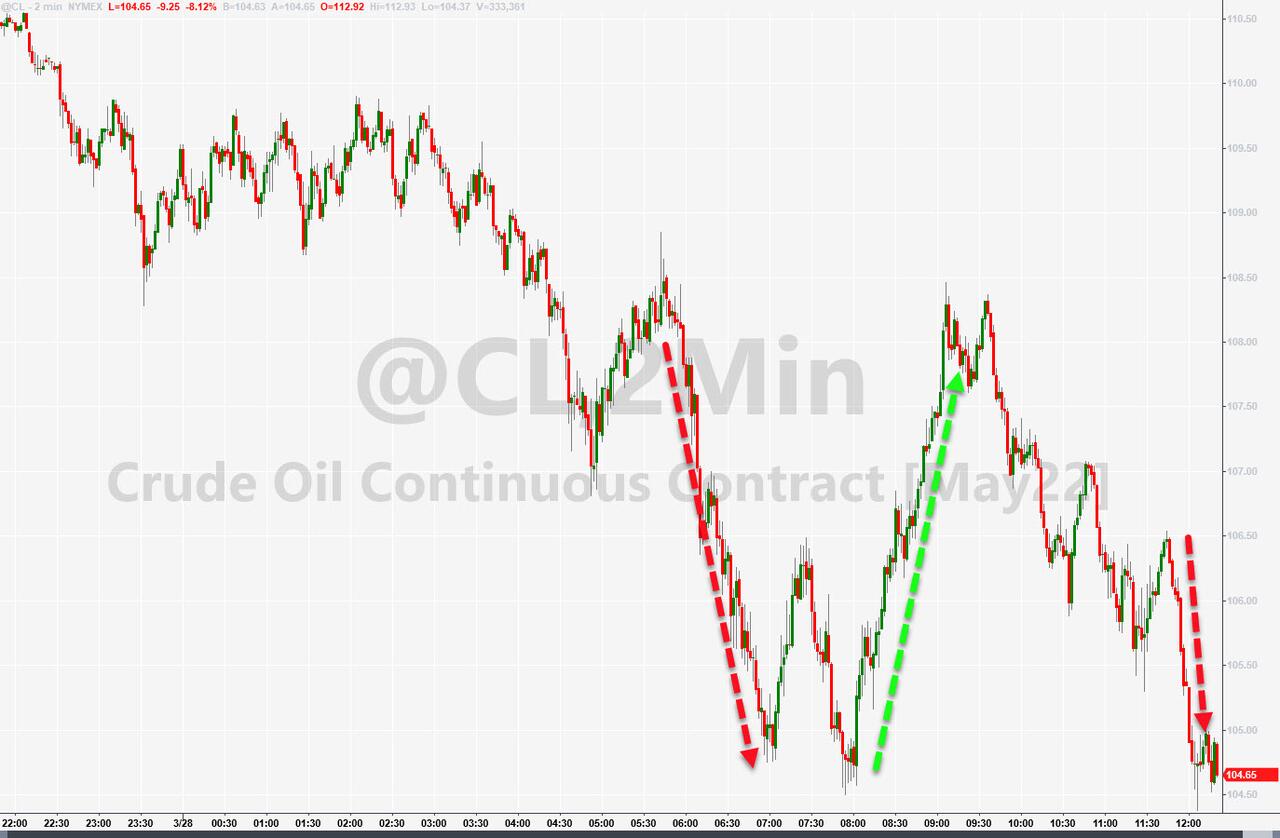
 For oil it is all about Chinese demand and no one seems to know what it is or where it's going, at least at the moment. We should get more clarity over the next few weeks but that is not much help right now. WTI $103.25 down $10.65.

From ZeroHedge:

While oil plunged and crypto soared, perhaps the biggest news of the day was that the Ruble continued to charge higher, almost erasing all of the post-invasion losses...

Source: Bloomberg

And gold in rubles has fallen back towards CBR's buying level announced last week...

Source: Bloomberg

Crude crashed on demand anxiety as China begins its lockdown in Shanghai. It was rescued briefly by OPEC+ headlines that they don't care about temporary 'war premium' and will stock to their current supply plan, but that didn't last long as the reports of progress in peace-talks sent WTI legging down further, settling with a $104 handle...

Bitcoin ripped back above $48,000 (and up to its 200DMA)...

....MUCH MORE

As always, a big thank-you to the Tyler Durdens from the directionally-challenged for the arrows.

Venerable Investment Firm, Bessemer Venture Partners, Bets On Web3 (plus the updated Bessemer antiportfolio)

These guys are very, very sharp.

First up, from PitchBook, March 18:

Q&A: Bessemer Venture Partners' big bet on Web3

Venture capital interest in blockchain and cryptocurrency startups has shot up in the past year, with 2021's total of $32 billion marking an annual increase of more than 370%, according to PitchBook data.

Blockchain is gaining more attention as it will underpin Web3, a vision for a decentralized iteration of the World Wide Web, which has become an increasingly important area of focus for many investors. 

Bessemer Venture Partners, which has earmarked $250 million for Web3 startups, is no exception. But it is also seeking to innovate further by becoming one of the first VC firms to create a decentralized autonomous organization in an effort to provide portfolio companies with a community outside of the firm that can service their needs. 

A DAO is a members-only community organized around a set of rules enforced on a blockchain. BVP's is designed as a place for people in the crypto space to connect and share ideas about products, business development and tokenomics—essentially the study of supply and demand characteristics of cryptocurrency. 

PitchBook spoke to BVP partner Ethan Kurzweil to discuss the firm's crypto strategy and the allure of Web3. This interview has been lightly edited for length and clarity.

PitchBook: Why is Bessemer setting up a DAO, and what is its purpose?

Kurzweil: We wanted to try to experiment providing portfolio services in a new way that's more aligned to the way crypto projects are formed. They tend to be more community-oriented and collaborative, with groups of people forming and sharing ideas from the very start. Rather than taking the traditional VC model and trying to force that into crypto, we wanted to reinvent how we do things to be more crypto-native from the start.

To get the full breadth of Web3, we as investors need to be open to some tweaks to our model. There's definitely problems that VCs haven't experienced or can't advise on in crypto, but the community can and is willing to provide that support and help in an open-source ethos kind of way.

PitchBook: We are seeing more DAOs being set up with an investment purpose. Is this a new alternative for crypto startups?....

....MUCH MORE 

Over the years we've visited Bessemer's Anti-Portfolio a half-dozen times, here's the latest interation:

The Anti-Portfolio.
Honoring the companies we missed.
Bessemer Venture Partners is perhaps the nation’s oldest venture capital firm, tracing our roots back to the Carnegie Steel empire. This long and storied history has afforded our firm an unparalleled number of opportunities to completely screw up.

Throughout our history, we did invest in a wig company, a french-fry company, and the Lahaina, Ka’anapali & Pacific Railroad. However, we chose to decline these investments, each of which we had the opportunity to invest in, and each of which later blossomed into a tremendously successful company.

Our reasons for passing on these investments varied. In some cases, we were making a conscious act of generosity to another, younger venture firm, down on their luck, who we felt could really use a billion dollars in gains. In other cases, our partners had already run out of spaces on the year’s Schedule D and feared that another entry would require them to attach a separate sheet.

Whatever the reason, we would like to honor these companies – our “anti-portfolio” – whose phenomenal success inspires us in our ongoing endeavors to build growing businesses. Or, to put it another way: if we had invested in any of these companies, we might not still be working.

Airbnb
Jeremy Levine met Brian Chesky in January 2010, the first $100K revenue month. Brian’s $40M valuation ask was “crazy," but Jeremy was impressed and made a plan to reconnect in May. Unbeknownst to Jeremy, $100K in January became 200 in February and 300 in March. In April, Airbnb raised money at 1.5X the “crazy” price. In December 2020, Airbnb went public at a $47 billion valuation.

Ebay
"Stamps? Coins? Comic books? You've GOT to be kidding," thought David Cowan. "No-brainer pass."

FedEx
Incredibly, Bessemer passed on Federal Express seven times....

....MUCH MORE

In Which Izabella Kaminska Toys With Oligopsony

No, not a new product from Sony. 
Rather, a limited number of buyers, more than a monopsony but fewer than an open market.
From The Blind Spot, March 24:
....EU seeks answers to energy supply crunch, U.S. LNG deal.

[This is quite a fascinating development. You can find the actual commission statement here. “A dedicated working group on green transition and LNG is being created to develop a concrete action plan on these matters, and our officials will meet this week to further discuss enhancing energy-related cooperation.” Clubbing together in this way (in a not dissimilar way the bloc did with vaccine purchases) strengthens the argument that the EU is less concerned with competition and more concerned with bargaining power on the international stage. Which is fair enough.

But it is also a bit like the opposite of OPEC — an organisation of natural gas importing countries (or cartel) committed to boycotting those who don’t satisfy their terms of engagement....