Showing posts sorted by date for query $34. Sort by relevance Show all posts

Wednesday, August 27, 2025

Rogoff: "America’s Coming Crash"

Professor Rogoff had a new book out (April 2025) and he's been talking it and its thesis up at various platforms and venues (here at the Cambridge Public Library). 

Here's the version at Foreign Affairs, August 19:

Will Washington’s Debt Addiction Spark the Next Global Crisis? 

KENNETH S. ROGOFF is Professor of Economics at Harvard University and a Senior Fellow at the Council on Foreign Relations. He was Chief Economist at the International Monetary Fund from 2001 to 2003 and is the author of Our Dollar, Your Problem: An Insider’s View of Seven Turbulent Decades of Global Finance, and the Road Ahead.

For much of the past quarter century, the rest of the world has looked in wonder at the United States’ ability to borrow its way out of trouble. Again and again, under both Democratic and Republican administrations, the government has used debt more vigorously than almost any other country to fight wars, global recessions, pandemics, and financial crises. Even as U.S. public debt rapidly climbed from one plateau to the next—net debt is now nearing 100 percent of national income—creditors at home and abroad showed no signs of debt fatigue. For years after the 2008–9 global financial crisis, interest rates on Treasury debt were ultralow, and a great many economists came to believe that they would remain so into the distant future. Thus, running government deficits—fresh borrowing—seemed a veritable free lunch. Even though debt-to-income levels jumped radically after each crisis, there was no apparent need to save up for the next one. Given the dollar’s reputation as the world’s premier safe and liquid asset, global bond market investors would always be happy to digest another huge pile of dollar debt, especially in a crisis situation in which uncertainty was high and safe assets were in short supply.

The past few years have cast serious doubt on those assumptions. For starters, bond markets have become far less submissive, and long-term interest rates have risen sharply on ten- and 30-year U.S. Treasury bonds. For a big debtor like the United States—the gross U.S. debt is now nearly $37 trillion, roughly as large as that of all the other major advanced economies combined—these higher rates can really hurt. When the average rate paid rises by one percent, that translates to $370 billion more in annual interest payments the government must make. In fiscal year 2024, the United States spent $850 billion on defense—more than any other country—but it spent an even larger sum, $880 billion, on interest payments. As of May 2025, all the major credit-rating agencies had downgraded U.S. debt, and there is a growing perception among banks and foreign governments that hold trillions of dollars in U.S. debt that the country’s fiscal policy may be going off the rails. The increasing unlikelihood that the ultralow borrowing rates of the 2010s will come back any time soon has made the situation all the more dangerous.

There is no magic fix. U.S. President Donald Trump’s efforts to place the blame for high rates on the Federal Reserve Board are deeply misleading. The Federal Reserve controls the overnight borrowing rate, but longer-term rates are set by vast global markets. If the Fed sets the overnight rate too low and markets expect inflation to rise, long-term rates will also rise. After all, unexpectedly high inflation is effectively a form of partial default, since investors get repaid in dollars whose purchasing power has been debased; if they come to expect high inflation, they will naturally require a higher return to compensate. One of the main reasons governments have an independent central bank is precisely to reassure investors that inflation will remain tame and thereby keep long-term interest rates low. If the Trump administration (or any other administration) moves to undermine the Fed’s independence, that would ultimately raise government borrowing costs, not lower them.

Skepticism about the safety of holding Treasury debt has led to related doubts about the U.S. dollar. For decades, the dollar’s status as the global reserve currency has conferred lower interest rates on U.S. borrowing, reducing them by perhaps one-half to one percent. But with the United States taking on such extraordinary levels of debt, the dollar no longer looks unassailable, particularly amid other uncertainty about U.S. policy. In the near term, global central banks and foreign investors may decide to limit their total holdings of U.S. dollars. Over the medium and longer term, the dollar could lose market share to the Chinese yuan, the euro, and even cryptocurrency. Either way, foreign demand for U.S. debt will shrink, putting further upward pressure on U.S. interest rates and making the math of digging out of the debt hole still more daunting.

Already, the Trump administration has hinted at more drastic actions to deal with mounting debt payments, should gaining control of the Fed not be enough. The so-called Mar-a-Lago Accord, a strategy put forward in November 2024 by Stephen Miran, now head of Trump’s Council of Economic Advisers, suggests that the United States could selectively default on its payments to the foreign central banks and treasuries that hold trillions of U.S. dollars. Whether or not the proposal was ever taken seriously, its very existence has rattled global investors, and it is not likely to be forgotten. A clause proposed for the huge tax and spending bill that was passed by the U.S. Congress in July would have given the president discretion to impose a 20 percent tax on select foreign investors. Although that provision was removed from the final bill, it stands as a warning of what might come if the U.S. government finds itself under budget duress.

With long-term interest rates up sharply, public debt nearing its post–World War II peak, foreign investors becoming more skittish, and politicians showing little appetite for reining in fresh borrowing, the possibility of a once-in-a-century U.S. debt crisis no longer seems far-fetched. Debt and financial crisis tend to occur precisely when a country’s fiscal situation is already precarious, its interest rates are high, its political situation is paralyzed, and a shock catches policymakers on the back foot. The United States already checks the first three boxes; all that is missing is the shock. Even if the country avoids an outright debt crisis, a sharp erosion of confidence in its creditworthiness would have profound consequences. It is urgent for policymakers to recognize how and why these scenarios could unfold and what tools the government has to respond to them. In the long term, a severe debt or, more likely, an inflationary spiral could send the economy into a lost decade, drastically weakening the dollar’s position as the dominant global currency and undermining American power.

THEIR MONEY, OUR GAIN

It is crucial to understand that the Trump administration’s economic policies are an accelerant, rather than the fundamental cause, of the United States’ debt problem. The story really begins with President Ronald Reagan in the 1980s, an era of deficit spending in which the U.S. debt-to-GDP ratio was about a third of what it is today. As Vice President Dick Cheney said during the first George W. Bush administration, “Reagan proved deficits don’t matter.” It is an assumption that both parties appear to have taken to heart in the twenty-first century, despite far more worrying debt burdens. In fiscal year 2024, for example, the Biden administration ran a budget deficit of $1.8 trillion, or 6.4 percent of GDP. Except for the global financial crisis and the first year of the pandemic, that was a peacetime record, slightly exceeding the 6.1 percent of the previous year. President Joe Biden’s deficits would have been larger still but for determined resistance from two centrist Democratic senators who bid down some of the administration’s most expansive spending bills.

During his 2024 presidential campaign, Trump pilloried Biden for his administration’s massive deficit spending. Yet in his second term in office, Trump has embraced similarly large deficits—six to seven percent of GDP for the rest of the decade, according to independent forecasts produced by the Congressional Budget Office and the Committee for a Responsible Federal Budget. The latter has projected that, by 2054, the U.S. debt-to-GDP ratio will reach 172 percent—or an even higher 190 percent if the bill’s provisions become permanent. Trump and his economic advisers claim that such forecasts are overly pessimistic—that the projections for growth are far too low and those for interest rates far too high. Higher growth will bring in larger future tax receipts; lower interest rates mean the debt will be less costly to service. If Team Trump is right, both factors will actually lower deficits and tilt the trajectory of debt to income downward. Whereas in January 2025, the CBO projected an annual growth rate of 1.8 percent over the next decade, the administration has put the figure at 2.8 percent. The difference is significant: if the U.S. economy is growing at 1.8 percent annually, it will double in size (and presumably tax revenues) every 39 years. At 2.8 percent, it would double every 25 years. For Trump, assuming that kind of rapid growth has made it easier to finance a lot of budget giveaways....

....MUCH MORE 

Readers who have been with us for a while may recall our out-loud thinking on just how intransigent the American problem is:

March 6, 2024

"Michelle Obama's office says the former first lady 'will not be running for president' in 2024"

That statement seems carefully worded, it's obvious she's not running. And it is not exactly General Sherman's "I will not accept if nominated and will not serve if elected."

It's also not another Sherman quote (my fave) regarding his friend and superior officer General Grant: 
"Grant stood by me when I was crazy, and I stood by him when he was drunk, and now we stand by each other."
but then again the former First Lady probably wouldn't say something like that regarding President Biden.

I wonder though if she would accept her party's nomination at the convention in Chicago.
President Biden would have a whole bunch of delegates he could release if he were to retire from the field. 

On the other hand, I'm not sure you would want to be President during the next four years, there are so many problems that have been growing and metastasizing just beneath the surface of the daily news that the person in the hot seat could end up just plain reviled....

A couple weeks later in "Hotshot Wharton professor sees $34 trillion debt triggering 2025 meltdown as mortgage rates spike above 7%: ‘It could derail the next administration’"  we took the idea a bit further:

This is the sort of stuff I was thinking about in the intro to March 6's "Michelle Obama's office says the former first lady 'will not be running for president' in 2024":

...On the other hand, I'm not sure you would want to be President during the next four years, there are so many problems that have been growing and metastasizing just beneath the surface of the daily news that the person in the hot seat could end up just plain reviled.

If I were a Democrat strategist I would propose letting Donald Trump win a second term while concentrating on House and especially Senate (to bottle up judicial, including Supreme Court, nominees) races.

A Trump win would give an excuse for riots (for the visuals) and if he is handcuffed by the Legislative branch to limit the range of possible responses, you go beyond polycrisis to the omnicrisis. Throw in a bit of Frances Fox Piven with her "overwhelm the system" and "motor voter" strategies and you could see one-party rule for thirty years.

There are probably a dozen ways things could come to a head, Joe steps down, Kamala is elevated, appoints Gavin or Michelle as Veep, steps down herself etc.

After Nixon resigned the country ended up with Gerald Ford and Nelson Rockefeller in the top two spots, with neither of them having run for their respective position. So all sorts of possibilities.

Stay tuned!

Monday, June 30, 2025

"Hedge fund strategy built on catastrophes taps a hot new trend"

Parametrics can result is some odd-looking payouts and are susceptible to gaming by those offering the product. More after the jump.

From The Edge, Singapore, June 30:

One of the most successful hedge fund strategies of recent years — insurance-linked securities — is latching on to an old idea whose popularity is suddenly soaring.

Parametric insurance, where policyholders get quick payouts if weather-related metrics are met, used to be the preserve of small businesses and farmers in developing countries. Now, it’s a rapidly growing market luring large corporations across the rich world.

Sebastien Piguet, co-founder and chief insurance officer at Descartes Underwriting, says parametric models are filling a gap left by other types of insurance policies. That’s as climate change and more frequent extreme weather events challenge standard coverage models.

“It’s much more challenging to find capacity for this kind of coverage with traditional insurance,” he said.

Companies using parametrics now include French pharmaceutical firm Sanofi, telecommunications company Liberty Latin America and renewable energy investor Greenbacker Capital Management. The market for such products is estimated to almost double to US$34 billion ($43.29 billion) in the decade through 2033.

It’s a shift that’s caught the attention of ILS investment managers. Insurance-linked securities, which a Preqin ranking listed as the best-performing hedge fund strategy of 2023, have long focused on catastrophe bonds.

Typically issued by insurers and reinsurers, investors in the bonds make money if predefined triggers like wind speed or insured losses aren’t met, and lose money if they are.

In recent years, that model has generated market-beating returns.

Investment funds based on parametric insurance have the potential to beat cat bond returns, according to Rhodri Morris, a portfolio manager at Twelve Securis. The Zurich-based US$8.6 billion alternative investment manager, which specialises in catastrophe bonds, launched the Lumyna-Twelve Capital Parametric ILS Fund together with Lumyna Investments in February.

“We aim to return a couple of percentage points above the cat bond market,” Morris said in an interview.

The fund, which is the first of its kind, has so far attracted about EUR85 million ($127 million) of capital. Morris says the expectation is that it will draw as much as EUR200 million next year.

A key attraction for investors is they can avoid so-called trapped capital, according to Morris. Investors in cat bonds sometimes wait for months — or even years — before loss rates are assessed and payouts settled. Investors in a parametric fund will generally know within days whether an underlying insurance contract has paid out or not.

The Lumyna-Twelve parametric fund has drawn “genuine interest” from investors, Morris said. But they’ve also had questions, and there’s a number of important factors to consider, he said.

“Investors need to understand that you’re giving up liquidity in some part of the portfolio,” Morris said. “But the benefits you’re getting are higher returns and the lack of trapping.”....

....MUCH MORE 

Some posts on parametric insurance:

April 2020
"World Bank pandemic cat bonds & swaps not triggered for payout yet"
I'll recycle the introduction we used a month ago:

"Coronavirus: The World Bank should care that the public does not understand its pandemic bonds"

Although the WHO declaration of "PANDEMIC" was not required for payout you'd think the money would have started flowing right? I mean both of the important triggers tripped, secondary markets have already marked the riskiest tranche down to zip but none of the relatively paltry $320 million has started moving.

As we said during the last Ebola pandemic, these things appear to be designed and structured to not pay out.

Here with some defense is EuroMoney:...

...The 3-year notes mature in July 2020.
For our outro, some more recycling, this time from February [2020]:

World Bank Pandemic Catastrophe Bond Under Pressure As Coronavirus Spreads

I have become convinced these things were designed to NOT pay.
As noted previously:
Reinsurance: "No coronavirus price response from World Bank’s pandemic cat bond yet"
We saw with Ebola that, even after both triggers—1) a minimum 250 victims and 2) the crossing of an international border—were reached, the World Bank's Pandemic Emergency Facility was very reluctant to declare the payout, eliciting some snark from yours truly:
"And if the cross-border contagion is reported on a day ending in a 'Y' all contracts will be null-and-void and coverage denied."
July 2020
Re/Insurance: Chubb Proposes Giant $1.25 Trillion Pandemic Facility
Two quick points:
1) Insuring against pandemics is frightfully complicated meaning lots of opportunity to structure product to ones advantage.
2) Be wary of your friendly neighborhood re/insurance salesman, even if he is as down-home and folksy as that fellow from Omaha.

Much less the verzekering/herverzekering or London or München boys and girls....

November 2021
"COP26: Munich Re calls out global failure to hit $100bn climate finance goal"

Huh.

....As noted in the intro to October 11's Cat Bonds/Reinsurance: "City of Zurich pension to double insurance-linked securities allocation":

The next time Munich Re starts moaning about climate change and how we're all going to die, or at minimum go broke, just remember reinsurance/cat bonds are a for-profit business and that some folks a couple hundred miles southwest of München, who might have access to some very sharp minds in the reinsurance/cat bond business, seem to think this is a profitable place to put some longer term money.
Ditto for Covéa, they seem to think they can make a go of it, come hell or high water.
(a little reinsurance/cat bond wordplay)

October 2023
"Weather derivative market activity soars on belief extremes to increase: Report"

Action, baby, action!
We will be looking for the first reports of the proverbial "dentist from Peoria" (Los Angeles Times, Jan. 21, 1989) stepping up to the betting window....
January 2025
"Why catastrophe bonds are failing to cover disaster damage"
It is a financial contract, read the fine print.
From The Economist...

*** 

“If you’ve been in the game 30 minutes and you don’t know who the patsy is, you’re the patsy.”
-Poker proverb used by Warren Buffet in his 1987 Letter to Shareholders

As an old insurance bigwig (not Mr. B) once said to me, "These things are for writing, not buying

***

Somewhat related (reaching for returns), June 2025:

Ummmmm—Tokenized Real World Assets: Reinsurance Products Targeting 20% And 42% Returns
Grandmother always said "If you are getting more than the risk-free rate of return you are taking on risk somewhere." She was really emphatic about that....

Wednesday, May 28, 2025

Nvidia Earnings Call Transcript—Q1 2026, May 28, 2025 (NVDA)

Having been through forty or so Nvidia quarterlies we don't have quite as much urgency to get the numbers on the page as a lot of folks do.* We like transcripts.

From Investing.com, May 28:

Earnings call transcript: NVIDIA beats Q1 2025 expectations....

NVIDIA Corporation reported strong fiscal Q1 2025 earnings, surpassing both earnings per share (EPS) and revenue expectations. The company posted an EPS of $0.96, exceeding the forecast of $0.93, and achieved revenue of $44.1 billion against a projected $43.31 billion. Following the announcement, NVIDIA’s stock rose by 4.29% in aftermarket trading, reflecting investor confidence in its growth trajectory. The company’s impressive performance is backed by a perfect Piotroski Score of 9, according to InvestingPro data, indicating exceptional financial strength. Based on InvestingPro’s Fair Value analysis, NVIDIA currently appears to be trading above its intrinsic value.

Key Takeaways

  • NVIDIA’s Q1 2025 EPS of $0.96 beat the forecast of $0.93.
  • Revenue reached $44.1 billion, surpassing the $43.31 billion forecast.
  • Stock surged 4.29% in aftermarket trading, closing at $140.59.
  • Data center revenue saw a significant increase of 73% year-on-year.
  • The company launched several innovative products, including the Blackwell architecture.

Company Performance

NVIDIA’s performance in Q1 2025 underscores its leadership in the AI and gaming sectors. The company’s data center revenue reached $39 billion, marking a 73% year-on-year increase, while gaming revenue set a record at $3.8 billion. This growth is attributed to the rising demand for AI applications and gaming technologies, positioning NVIDIA favorably against competitors. InvestingPro data reveals impressive year-over-year revenue growth of 114.2%, with a robust gross profit margin of 75%. The company maintains exceptional financial health with a current ratio of 4.44, indicating strong liquidity.

Financial Highlights

  • Revenue: $44.1 billion, up 69% year-over-year
  • Earnings per share: $0.96, above the forecast of $0.93
  • Data Center Revenue: $39 billion, up 73% year-on-year
  • Gaming Revenue: $3.8 billion, up 48% sequentially

Earnings vs. Forecast

NVIDIA’s actual EPS of $0.96 represented a 3.23% surprise over the forecasted $0.93. Revenue also exceeded expectations by $800 million, highlighting the company’s ability to capitalize on market trends and maintain strong financial health.

Market Reaction

The positive earnings report led to a 4.29% increase in NVIDIA’s stock price in aftermarket trading, reaching $140.59. This reaction reflects strong investor confidence, driven by the company’s robust performance and promising outlook, despite broader market volatility.

Outlook & Guidance

Looking ahead, NVIDIA expects Q2 revenue to be approximately $45 billion, plus or minus 2%. The company is preparing for modest sequential growth across its platforms, with a focus on expanding its AI infrastructure and enterprise solutions. However, it anticipates a decrease in China data center revenue due to geopolitical factors. With a beta of 2.11, investors should note the stock’s higher volatility compared to the market. For deeper insights into NVIDIA’s valuation and growth prospects, InvestingPro subscribers can access comprehensive research reports and 18 additional ProTips that provide valuable context for investment decisions.

Executive Commentary

CEO Jensen Huang emphasized the rapid growth of AI, stating, "AI is growing faster and will be larger than any platform shifts before, including the Internet, mobile, and cloud." He also highlighted NVIDIA’s multiple growth engines and the onset of the robotics era.

Risks and Challenges

  • Potential decrease in China data center revenue due to geopolitical tensions.
  • Economic uncertainties that could affect demand for NVIDIA’s products.
  • Competition in the AI and gaming markets, which could impact market share.
  • Supply chain challenges that may affect production and delivery timelines.

Q&A

During the earnings call, analysts focused on the impact of China export controls and NVIDIA’s strategic initiatives in AI and enterprise markets. Discussions also covered the company’s networking and compute technologies, providing insights into its competitive advantages.

Full transcript - NVIDIA Corporation (NVDA) Q1 2026:

Sarah, Conference Operator: Good afternoon. My name is Sarah, and I will be your conference operator today. At this time, I would like to welcome everyone to NVIDIA’s First Quarter Fiscal twenty twenty six Financial Results Conference Call.

All lines have been placed on mute to prevent any background noise. After the speakers’ remarks, there will be a question and answer session. There you. Toshiya Hari, you may begin your conference.

Toshiya Hari, Investor Relations, NVIDIA: Thank you. Good afternoon, everyone, and welcome to NVIDIA’s conference call for the first quarter of fiscal twenty twenty six. With me today from NVIDIA are Jensen Huang, president and chief executive officer and Colette Kress, executive vice president and chief financial officer. I’d like to remind you that our call is being webcast live on NVIDIA’s investor relations website. The webcast will be available for replay until the conference call to discuss our financial results the second quarter of fiscal twenty twenty six.....

 
The stock settled at $141.37 up $6.56 (+4.87%) in the after-hours session.
*It worked out.
NVDA NVIDIA Corporation monthly Stock Chart

 March 22, 2024:

I Have Heard Of This Nvidia You Speak Of (first call for a $10 trillion market cap) NVDA

I have heard wondrous tales of immense wealth,

Of amazing deeds performed as if by magic.

Yes I have heard*of all of this....but hang on one 'effin minute with the $10 trillion talk. Let's get to $1000 on the stock before we join Coleridge at the hookah. [In Xanadu did Kubla Khan...]

{adjust the $1000 by the 10:1 split effective June 10, 2024}

If I'm reading the decimal places correctly the company's market cap after-hours is $3.466 trillion.

Or $34 trillion if I squint real hard. (no hookah required)

In Xanadu did Kubla Khan
A stately pleasure-dome decree:
Where Alph, the sacred river, ran
Through caverns measureless to man
   Down to a sunless sea....

Thursday, May 1, 2025

"The ‘Amazonification’ of Trading"

It is good to understand the framework in which you are operating.

From Traders Magazine, April 23:

By Lou Pastina, Global Markets Advisory Group Partner, and Bob Walley, recently retired Deloitte Principal and GMAG Partner, with contributions by GMAG Partners Jim Buckley and Dan Labovitz

When I joined the NYSE in 1983 our trading hours were 10 am to 4 pm Monday through Friday. There were still people around who remembered the Exchange closing on Wednesdays and workers coming in Saturdays to compare paper trades because the volume was so overwhelming. Those days we traded under 100 million shares a day and had over 90% market share. It was the early days of ATMs, and I remembered thinking at the time “why can’t I put an order in to buy or sell stock right here in the ATM?”.

The infrastructure of the market at the time included a regulatory framework that required a broker dealer to be a member of an Exchange and be bound by the rules of the Exchange which included only trading with its members. Trading floors were populated by human beings negotiating trades; back offices were populated by armies trying to figure out what the traders had written down on small slips of paper. Technology was confined to electronically distributing quotes and trades to tickers around the world. Some firms harnessed the power of sending orders electronically to Exchanges where they would print out and be represented orally. Batch processing was the main way things got moved along the factory line. Paper was everywhere.

Once the paper order was taken to the floor and executed, the orders were sent to DTCC for clearing. In 1983 National Association of Securities Dealers and the exchanges adopted the New York Stock Exchange Rule 387, which mandated the use of automated confirmation and book-entry settlement for Cash on Delivery transactions in equity securities between brokers, dealers and their institutional clients.

Recently, with significant help from the government, new volume records were established in the listed equity markets. Over 26 billion shares changed hands in one day. About 55 percent was done through Exchanges, the balance through Alternative Trading Systems, Wholesale Broker Dealers and other associated players in the market. All the activity was reported electronically in real time to the clearinghouse and to the consolidated tape associations for distribution to the world. Trades were settled on T+1 after a move from T+2 in 2024; Europe continues to settle in T+2. Literally unthinkable when I started on Wall Street.

Today, we order most of what we want through Amazon, with a clear expectation that our  order will be delivered to our doorstep tomorrow, and sometimes even the same day. I don’t think we are alone in this respect. Doesn’t matter the time of day, we can order at any time with the same expectation. Is it any wonder that Amazon, along with perfecting the assembly line of ordering, fulfilling, and delivering, also operates the world’s largest cloud server systems? Old-world investors  buy and hold, even in times of great distress, such as we are experiencing today. We were taught a long time ago, that a loss is only a loss if it is “locked-in”, and by that, I mean if the security is sold. Apparently, old-world investors may be in the minority because someone decided to sell 26 billion shares of stock last week, even in the face of steep losses. Amazingly the infrastructures of the Exchanges, Broker Dealers, Clearinghouse and Ticker Plants all held up to the task of processing that data. One can only  assume that the Consolidated Audit Trail System (CAT) also held up (processing over 1T records). Interestingly enough, the CAT is powered by Amazon Web Services (AWS). I wondered how many people would have kept selling if the market didn’t actually close, if it continued to be open 24 X 7 just like Amazon? Would people continue to sell all weekend long as well?

There were times in the past when a “cooling off” period really helped the market think about what had just happened. A weekend gave people time to reassess the situation and to make rational decisions in terms of their portfolios and risk profiles. When trades cleared overnight, they provided enough liquidity for new trades and capital requirements to be met. One of the big projects at the NYSE in the early 1990’s was to look at off-hour trading, as it was called back then. As Exchange rules melted under regulatory pressure to modernize and pressure from competitive members, trading began to migrate offshore, big blocks paired by big brokers making big commissions found their way to London to be printed overnight. Repatriating that volume was the primary goal, assuaging members was a secondary one, and trying to slow the pace of technology may have been a tertiary one. But the pace of competition and technology cannot be slowed. The NYSE decided, with help from West Coast firms, that opening early at that time was not worth it. We launched some after-market trading vehicles, but that kept the wolves at the door for only so long. Soon, Alternative Trading Systems were ushered in by entrepreneurs spurred on by an anxious regulatory staff looking for change. They pushed the envelope and made everyone more competitive; they also opened early and allowed trading to continue later.

Robinhood helped democratize the stock market for everyday people. Enough horsepower is in the palm of the hand of today’s average person to get someone to the moon in 1969. So, it’s no wonder that people would want to have the same experience buying and selling stocks that they would ordering from Amazon. Back when the NYSE was an independent member owned firm it would build strategic plans. The list of our top competitors would include other Exchanges and competitive firms, but our CEO at the time would point out that the top competitor was not another market or a broker dealer, it was Microsoft. He knew that even then. Today I would say take your pick: Amazon; Google; Microsoft; Musk?

The broad ecosystem infrastructure is not yet ready for 24 x 7 trading.  Yes, many of the Exchanges advocate they can be open for 22 or 24 hours a day, but that is not presently the case with the majority of the other market participants....

....MUCH MORE

Apropos of not much I found myself thinking of Bunker Hunt, the Chicago Board of Trade, the Comex and this little tale from 2010's "'Wheat prices ease after Russia predicts stable exports" and '...Speculators ‘Hunt What’s Moving'":

....Should prices see $8.50 the opportunities on the short side would almost be a lock.
I say almost because the serious money in commodities can pretty much get prices to where they want them, at least for short periods.

When the Billionaire Hunt brothers were attempting to corner the silver market in January 1980 the head of one of the world's largest grain traders said "Those boys don't know what deep pockets are".
The "commercials" had been shorting into the Hunt bros. buying and the grain trader was at the top of the "commercial" heap.

On January 21 the COMEX went "liquidation only".
On January 22 the CBOT went "liquidation only".
On Tuesday the 22nd silver closed at $34, down 27% from its close the previous Friday.
The Hunt's still had enormous paper profits but any attempt to book them would smash the markets even further.

Prices declined to $17 by March, down 66% from the January high and the Hunt's were receiving calls of $60 Million per day in variation margin. On March 27 the price dropped from $21.62 to $10.80 and one of their brokers, Bache was in violation of net capital requirements and another, Merrill Lynch was on the brink.
As the attorneys got involved over the next few years, oil prices headed south, destroying the value of Daddy's creation (and the brother's piggybank) Placid Oil.

Bunker Hunt filed for bankruptcy in September 1988 as did his brother and Placid.

At the time the grain trader said "Those boys don't know what deep pockets are" it is probable that the various branches of the Hunt families comprised the wealthiest "family" in America.

That's why I say "almost" a lock.

Then it was, "A Heads-Up To The Gamestop, AMC etc. Crowd: They Are Going to Change The Rules On You":

Market structure is the most important and least understood factor in the entire short-squeeze game.

And if you don't understand every dependent clause and every comma versus period in the rules and regs you are in for a shock.

That's what the homely little story in "Discord has shut down the /r/WallStreetBets server (GME)" is all about....

Which was followed the very next day with:
Interactive Brokers Goes "Liquidation Only" On AMC, BB, EXPR, GME, and KOSS Options

Possibly related, November 2019

The optimal design of Ponzi schemes in finite economies

Some observers are suggesting that the entire Golden West/Fannie Mae/AIG/Goldman Sachs enterprise of the last half decade was a gigantic Ponzi scheme. Here's an eight year old paper via Science Direct:

Utpal Bhattacharya

Abstract

As no rational agent would be willing to take part in the last round in a finite economy, it is difficult to design Ponzi schemes that are certain to explode. This paper argues that if agents correctly believe in the possibility of a partial bailout when a gigantic Ponzi scheme collapses, and they recognize that a bailout is tantamount to a redistribution of wealth from non-participants to participants, it may be rational for agents to participate, even if they know that it is the last round. We model a political economy where an unscrupulous profit-maximizing promoter can design gigantic Ponzi schemes to cynically exploit this “too big to fail” doctrine. We point to the fact that some of the spectacular Ponzi schemes in history occurred at times where and when such political economies existed—France (1719), Britain (1720), Russia (1994), and Albania (1997).

The original ScienceDirect link has rotted but here's an earlier version at SSRN.

TL;dr: You don't play in the late stages of a pyramid or Ponzi scheme unless you know there will be a bailout.
It's alright to play the game* for all it is worth but always, always be aware that things may not be as they seem and keep in mind the lesson of the children's game musical chairs: know where you are going to land when the music stops.

Friday, March 21, 2025

"Will Economic Detox Lead to a Recession? Maybe Not. But a Long Deep Stock Market Rout Will (See Dotcom Bust)"

If the Trump administration achieves its goal of cutting the projected deficit in half, and thus removing a trillion dollars in stimulus spending—all deficits are stimulus, whether you call them that or not—if they cut the deficit in half, a recession seems inevitable.

However, I'm not sure the media and other political posturing on the terror and ruin posed by recessions is even close to what actually happens across a population of 345 million people. This is not 1873 or 1893 or 1933, the safety nets are a bit stronger than they were in those retrograde economic eras.

A different analog that may be more instructive is the 18-month 1920 - 1921 recession, brutal for those unemployed but setting the stage for the 1920's boom in the economy and in the mass adoption of consumer technologies that 100 years later still shape society, telephones, appliances, automobiles, radio, Hollywood etc., etc.

So who knows?

The other, more important point is that the interest required to service the ever-increasing debt will destroy both the economy and the constitutional republic if the detox does not happen.

From Wolf Street, March 14:

“We’re focused on the real economy,” Bessent said. “Ouch,” stocks said. Where did the Trump put go? 

One issue is, how do you get an economy addicted to government deficit spending off this drug?

Another issue is, how do you get Corporate America addicted to cheap labor overseas off this drug?

The US has two huge structural deficits: The fiscal deficit and the trade deficit in manufactured goods – the “twin deficits.” Both are massive long-term problems and need to be addressed by sending the economy and Corporate America into “detox,” as this is now called, but it’s going to ruffle some feathers, especially of stocks.

And a third issue is worming its way into the detox conversation: The stock market has gotten addicted to the government’s deficit spending, to the fat profit margins from offshoring production, and to the Fed’s erstwhile free-money policies, including trillions of dollars in money-printing, of which $2.2 trillion have so far been un-printed via QT.

They’re saying the right things, but it’s OUCH for stocks.

“The market and the economy have become hooked, become addicted, to excessive government spending, and there’s going to be a detox period,” Treasury Secretary Scott Bessent told CNBC last Friday.

“There’s going to be a natural adjustment as we move away from public spending to private spending,” he said.

When asked if “detox” was a euphemism for a recession, Bessent told CNBC: “Not at all. Doesn’t have to be because it will depend on how quickly the baton gets handed off,” he said. “Our goal is to have a smooth transition.”

“If you start looking at micro horizons, stocks become very risky”: Bessent.

“We’re focused on the real economy,” Bessent told CNBC on Thursday. They want to “create an environment where there are long-term gains in the market and long-term gains for the American people,” he said. “I’m not concerned about a little bit of volatility over three weeks.”

“The reason stocks are a safe and great investment is because you’re looking over the long term. If you start looking at micro horizons, stocks become very risky. So we are focused over the medium-, long-term,” he said.

“I can tell you that if we put proper policies in place, it’s going to lay the groundwork for a both real income gains and job gains and continued asset gains,” he said.

So where the heck is the Trump put?

“There’s no put,” Bessent said. “The Trump call on the upside is, if we have good policies, then the markets will go up.”

Trump agreed. They’re singing from the same hymn sheet. “You can’t really watch the stock market,” Trump told Fox News last Sunday.

“Markets are going to go up and they’re going to go down,” Trump said on Tuesday from the Oval Office.

Tariffs might cause “a little disturbance, but we’re OK with that”: Trump.

“There will be a little disturbance, but we’re OK with that. It won’t be much,” Trump told Congress to address the side effects of imposing tariffs to encourage companies to manufacture more in the US. Fact is, modern highly automated manufacturing provides huge and important long-term benefits for the economy, including secondary and tertiary benefits.

In terms of the inflationary impact of tariffs, Bessent said that inflation is defined as a persistent increase in prices across a wide variety of goods and services over time, but “the tariffs are a one-time price adjustment.”

How much of that adjustment will make it all the way through to consumer prices is unknown. Automakers, including BMW, have already said that they will have to eat the tariffs because they cannot raise prices without losing sales. That’s why they hate tariffs so much. They wouldn’t mind tariffs if they could pass them on.

That’s what happened last time; they tried to raise prices, but then lost sales and had to roll back those price increases. Inflation is measured by transaction prices, not fantasy sticker prices, and when people don’t buy at higher prices, but buy from a competitor at lower prices, it’s the actual purchases from the competitor that go into inflation measures.

Consumer durable goods would be hit the most by tariffs. This is the CPI for durable goods, shown as price level. There was no visible impact from tariffs in 2018 and 2019:
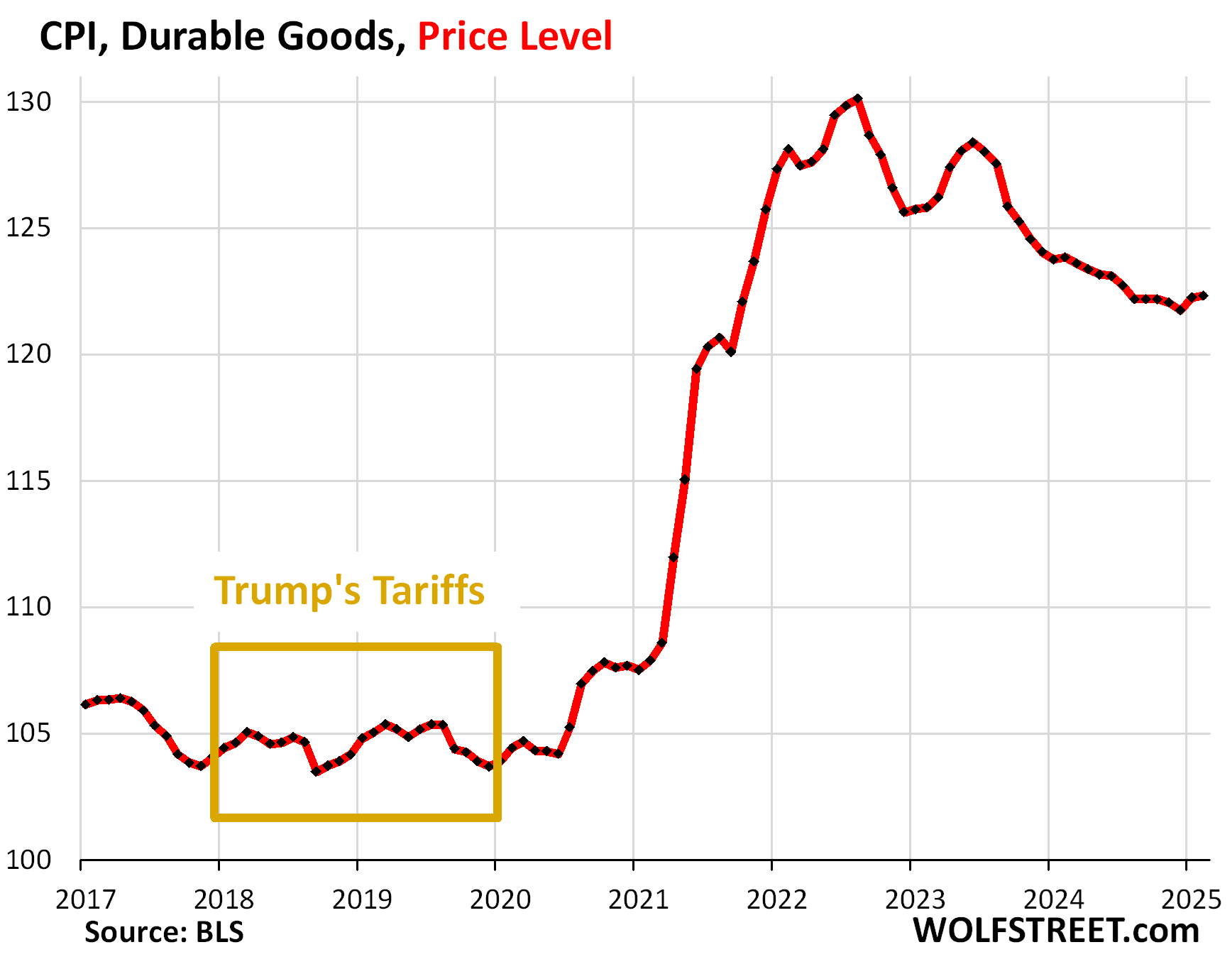
Even if a portion of the tariffs will get passed on to consumers, given that the economy is now in an inflationary environment, that portion, as Bessent said, will be a one-time bump.

When will a stock market rout trigger a recession?

Tariffs are a tax on corporate profit margins that may be difficult to pass on, so tariffs hit stocks, and they did last time: The S&P 500 tanked 20% in 2018. But it didn’t trigger a recession last time, not even close....

....MUCH MORE

So Scylla/Charybdis; rock/hard place.

Either scenario from our 2024 pre-election thinking:

"Hotshot Wharton professor sees $34 trillion debt triggering 2025 meltdown as mortgage rates spike above 7%: ‘It could derail the next administration’" if nothing is done or

This is the sort of stuff I was thinking about in the intro to March 6's "Michelle Obama's office says the former first lady 'will not be running for president' in 2024":

...On the other hand, I'm not sure you would want to be President during the next four years, there are so many problems that have been growing and metastasizing just beneath the surface of the daily news that the person in the hot seat could end up just plain reviled.

If I were a Democrat strategist I would propose letting Donald Trump win a second term while concentrating on House and especially Senate (to bottle up judicial, including Supreme Court, nominees) races.

A Trump win would give an excuse for riots (for the visuals) and if he is handcuffed by the Legislative branch to limit the range of possible responses, you go beyond polycrisis to the omnicrisis. Throw in a bit of Frances Fox Piven with her "overwhelm the system" and "motor voter" strategies and you could see one-party rule for thirty years....

Tuesday, January 21, 2025

Frances Fox Piven On President Trump: "Throw Sand In the Gears of Everything"

This is a repost from Inauguration Day 2017 because a quick search of the news doesn't return any rabble-rousing by Ms. Piven over the last year or so.

Of course, she is 92 years old and may have other concerns. We have also posted the article she did with her husband that made her bones in the poli. sci. and sociology arenas, link in the intro below.

Original post:

You may remember her name if you studied political science or the history of the U.S. in the 1960's.
She and fellow Columbia U. professor Richard Cloward proposed a plan to achieve their political goals, including universal basic income, that became known as the Cloward-Piven Strategy.

The strategy was laid out in the May 2, 1966 issue of The Nation magazine in an article titled "The Weight of the Poor: A Strategy to End Poverty" about which the copy hosted at Common Dreams says "The theory here, to force change through chaos, was among the most provocative of the 1960s."

A few years ago The Nation commissioned a new introduction from Ms. Piven, her husband Mr. Cloward having died in 2001, which the magazine published as part of their 150th anniversary issue.

Here's her latest, again at The Nation, January 18, 2017:

Throw Sand in the Gears of Everything
When it comes to stopping Trump, petitions aren’t going to do it.


https://www.thenation.com/wp-content/uploads/2017/01/FoxPiven-20170206_img.jpg
As many are saying, we woke from a nightmare to find it was our new reality. A gaggle of inflated far-right self-promoters and operatives, big businessmen and their toadies, and homegrown fascists will control the presidency and determine the Supreme Court majority, maybe for a generation or more. The Congress is firmly in Republican hands, save for the uncertain possibility that Senate Democrats will muster the gumption to filibuster. And that possibility could also evaporate with the 2018 midterm elections, when as many as 20 or more Democrats will have to defend their seats. No wonder that everyone I speak with searches for someone to blame—Clinton or Comey or white women or the white working class or the Bernie troops—and then asks plaintively: What do we do now?


There are lots of answers floating about. State governments should band together to pass laws that bind their representatives in the Electoral College to support the winner of the popular vote. Or we should begin the hard work of reconstructing the Democratic Party, finally purging the influence of the Democratic Leadership Council and its Wall Street allies, so that it speaks more convincingly to the aspirations of working people and minorities. Or we should push for the reforms that will somehow prevent gerrymandered districts after the 2020 Census. Or we should restore the Voting Rights Act and push for automatic voter registration. And of course—again, somehow—we should restrict the role of big money in elections.

I support all of these efforts, needless to say, and I sign the petitions and respond to the fund-raising appeals that their advocates generate. But I am not very hopeful that any of them can succeed, at least not in the limited time we have to protect the planet from global warming or nuclear catastrophe or both.

There is another impulse evident in the spontaneous reactions that followed Trump’s election in the streets of New York City, Los Angeles, San Francisco, Oakland, Baltimore, Kansas City, Milwaukee, Miami, Portland, and elsewhere. Lots of people—especially young people—gathered, made speeches, marched, shouted, and held up signs and banners. All of us who participated can report the lift to our morale the experience offered. We were performing the elementary rites of a social movement, rites that the influential historian Charles Tilly labeled “WUNC”—meaning that people gather together to demonstrate their worthiness, unity, numbers, and commitment.

Chanting crowds are the familiar insignia of movements. And I think movement politics may even make resistance to a Trump regime possible. But while the great movements of American history were the crucial determinant of our most important democratic reforms—from the basic electoral elements of representative democracy, to Emancipation, to labor rights, to women’s and LGBTQ rights—none of these movements achieved their successes simply through the gathering of people to show their commitment. People gathered, of course, but what makes movements a force—when they are a force—is the deployment of a distinctive power that arises from the ability of angry and indignant people to at times defy the rules that usually ensure their cooperation and quiescence.

Movements can mobilize people to refuse, to disobey, in effect to strike. In other words, people in motion, in movements, can throw sand in the gears of the institutions that depend on their cooperation. It therefore follows that movements need numbers, but they also need a strategy that maps the impact of their defiance and the ensuing disruptions on the authority of decision-makers.

The repercussions of such mass refusals can be far-reaching, simply because social life depends on systems of intricate cooperation. So does our system of governance. Perhaps the US government, with its famous separation of powers on the national level and its decentralized federal structure, is especially vulnerable to collective defiance. To be sure, the right wing has now taken over many of the veto points in the national government, and it dominates half of the state governments as well (although that could change in 2018, when many hard-right Republican governors will be defending their seats). But the big cities, where a majority of the population lives, have not been captured. Center-left mayors preside over cities like New York, Los Angeles, Boston, Seattle, and San Francisco, for example. And that fact can nourish urban resistance movements.

People don’t easily break the rules of institutional life, and especially not collectively and publicly, if only because of the punishments that can be visited on rule-breakers. Think of the possible responses of a Trump administration! And, in fact, movements from the lower reaches of society—whose members are often the most marginalized and vulnerable—usually don’t emerge if people think they’ll have no influence over the regime in power. People are much likelier to risk defiant collective action if leading politicians appear accountable to movement constituencies. The great strike movement among industrial workers arose under Franklin Roosevelt, who promised to speak for “the forgotten man” in the midst of the Great Depression. The civil-rights movement escalated at least partly because of the reluctant encouragement of Democratic presidents newly concerned about the loyalty of urban black voters, and it triumphed under a president who felt it strategic to echo the words of the civil-rights anthem “We Shall Overcome.
* * *
There’s a slogan among organizers to the effect that all organizing is local, meaning that people come together in local workplaces and communities to articulate their grievances and their hopes, and to develop the muscle to act. Local organizing against Trump’s initiatives will be bolstered by the support of local politicians, and movement organizing in turn can stiffen the backs of local politicians when the Trump administration threatens to cut funding to city governments. There would be many opportunities to play a role: Even ordinary householders can take in and shield immigrants. And all of us can render registries useless by insisting on registering ourselves as Muslims or Mexicans or Moldovians. A sanctuary movement gives lots of people a role that matters. Most important, in our complex federal system, where the policies of the national government depend on cooperation by state and local authorities, these local movements have the potential to block initiatives by the incoming Trump regime. ...MUCH MORE

Professor Piven's most impactful effort is the little acknowledged 1993 "Motor Voter" Act.

I've mentioned it a few times, here's one from last winter:

March 20 - "Hotshot Wharton professor sees $34 trillion debt triggering 2025 meltdown as mortgage rates spike above 7%: ‘It could derail the next administration’": 

If I were a Democrat strategist I would propose letting Donald Trump win a second term while concentrating on House and especially Senate (to bottle up judicial, including Supreme Court, nominees) races.

A Trump win would give an excuse for riots (for the visuals) and if he is handcuffed by the Legislative branch to limit the range of possible responses, you go beyond polycrisis to the omnicrisis. Throw in a bit of Frances Fox Piven with her "overwhelm the system" and "motor voter" strategies and you could see one-party rule for thirty years.

Here's Professor Piven back in the day:

Columbia University 1968 - Photo #38 - Elsewhere on campus

hayden
Tom Hayden helping Frances Fox Piven, a Columbia University School of Social Work professor and well-known author and activist, back into Math, April 1968. The young girl in the red-orange sweater is her daughter, Sarah. A couple days later I shared a cell in the Tombs with Tom.

Photo: Life Magazine, 10 May 1968.

Acknowledgment: Professor Holly Ackerman, University of Miami, Florida, formerly of the Columbia School of Social Work, for identifying Professor Piven, and Prof. Piven herself for confirmation.

Thursday, November 14, 2024

Jim Bianco: "It’s Time to Position the Portfolio for Rising Yields and a Stronger Dollar"

It is not often that we steal a march on Mr. Bianco but I think we were ahead of him on this one.

The seeds were planted many months if not years ago and the only question that matters is: 
Will the Fed buy the paper the Treasury will be forced to sell or will the Fed stand aside and let rates tank the new administration?

From Neue Zürcher Zeitung's TheMarket.ch, November 11:

Donald Trump’s election and the Republican red sweep are setting financial markets in motion. Jim Bianco, President and Macro Strategist at Bianco Research, believes that the change of power in Washington will give the US economy a fresh boost. However, it also poses the risk of inflation flaring up again, which will be a challenge for investors.

Deutsche Version

Things are about to change. Donald Trump won the US presidential election by a surprisingly large margin and Republicans have a good chance of taking full control of Congress next year. Accordingly, financial markets are bracing themselves for a policy shake-up in terms of taxes, regulation, immigration and trade.

A key question remains what will happen when it comes to inflation and interest rates. As expected, the Federal Reserve lowered the benchmark Federal Funds Rate to a range between 4.5% and 4.75% at its meeting last week. However, the extent to which monetary policy will be eased further remains anyone’s guess.

Stocks are reacting euphorically to the change of power in Washington. On Friday, the S&P 500 climbed above 6000 for the first time. Meanwhile, tensions in the bond market are increasing. The yield on ten-year Treasuries has risen rapidly since mid-September and shortly exceeded 4.4% last week, bringing back unpleasant memories of the turmoil in 2022-23.

«I think the uptrend in yields that started with the Fed cut in mid-September is very much intact,» says Jim Bianco, founder and president of the Chicago based research boutique Bianco Research. «Once the euphoria subsides, the focus will shift to interest rates and investors realize that we’re heading towards an inflation problem in 2025, with interest rates just going up and up,» he warns.

In an in-depth interview with The Market NZZ, which has been lightly edited, the investment strategist talks about the outlook for the US economy under Trump’s second term, the risk of inflation, the consequences for financial markets and how investors can prepare themselves.

«I don’t know if everybody is ready for the idea that by the end of the year the Fed’s whole interest rate cutting campaign will be mostly if not completely done»: Jim Bianco

The results of the US election have triggered meaningful moves across all asset classes; from equities, bonds and currencies all the way to commodities and crypto currencies. How do you think markets will behave in the coming weeks and months?

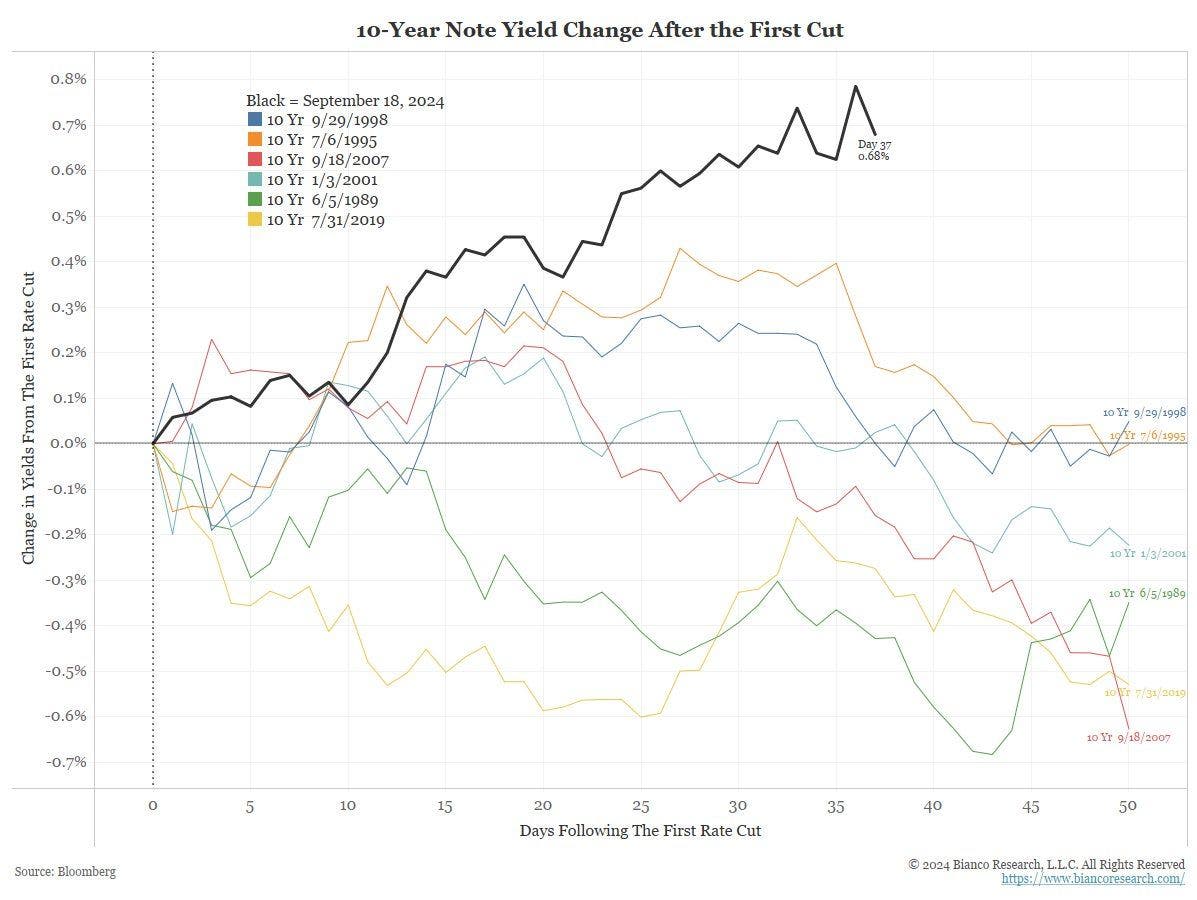
Let’s start with the big picture, let’s start where we were before election night. On September 18, the Fed started cutting interest rates and what followed was a rather interesting market reaction: We saw the fastest rise in the yield on 10-year Treasuries of any period after the first Fed cut on record, it was up almost 80 basis points in the next seven weeks. Inflation break-evens, a market measure of inflation expectations, rose by the most we’ve seen in at least 25 years. The Bloomberg U.S. Economic Surprise Index is at its highest level since February, indicating that economic data is much stronger than expected. All that suggests the economy is in a no-landing zone, growing at its potential, if not more, rather than in a soft-landing zone.

Bianco Research

In other words, the Fed must be careful not to lose control over inflation again?

Yes, cutting rates now might be even worse than the policy error when the Fed thought inflation was largely ‹transitory›. They started off with a 50 basis points cut, signaling a pivot towards further meaningful easing of monetary policy. Chicago Fed President Austan Goolsbee essentially confirmed this the week after in late September, indicating that interest rates must be slashed by hundreds of basis points to reach a neutral policy stance. So I guess the market already started thinking to itself that all these rate cuts aren’t really needed in light of the robust economic data, and if the Fed is following through, it’s time to worry about inflation again because they might overstimulate the economy.

Next, markets had a strong reaction in the aftermath of the election.

The real surprise wasn’t Trump’s win, because a fair number of people expected that. The big shocker was that he pulled off a red wave, even securing the popular vote. The Senate is now definitely Republican; the House is still undetermined, but most people think that it’s going to stay Republican as well. Adding all that up, it’s a mandate for things to change, and then you look at what Trump is all about from an economic standpoint. He’s not really interested in cutting spending, neither is J.D. Vance. They’re interested in cutting taxes, and that sounds like bigger deficits. I think that’s why the bond market had such a bad reaction in the immediate aftermath of the election: The economy is already strong, the Fed is signaling substantial rate cuts on the horizon, and now we’re piling on all this fiscal stimulus through tax cuts and deregulation.

The rally in equities is reminiscent of Trump’s first win eight years ago. To what extent does the 2016 playbook hold clues for market behavior in coming weeks and months?

Of course, everybody is looking at 2016. But you have to keep in mind that the only thing in common with 2016 is that Trump won. Beyond that, there are many differences: Then, the Fed was raising rates, they’re cutting them now; valuations in the stock market were a lot lower than they are today, and interest rates as well; the Fed’s target rate was still well under 1%, and bond yields were much lower; crude oil prices were in the $20 to $30 range in 2016, they’re in the $70 to $80 range now. Inflation wasn’t even a word we considered, whereas inflation was the driving reason people voted Trump in for a second term. So actually, there are more differences than similarities with 2016....

....MUCH MORE

Inflation was going to restart regardless of who was in the White House.

And that was the essence of our thinking in March 2024:

...On the other hand, I'm not sure you would want to be President during the next four years, there are so many problems that have been growing and metastasizing just beneath the surface of the daily news that the person in the hot seat could end up just plain reviled....  

Repeated and expounded upon two weeks later in "Hotshot Wharton professor sees $34 trillion debt triggering 2025 meltdown as mortgage rates spike above 7%: ‘It could derail the next administration’

...If I were a Democrat strategist I would propose letting Donald Trump win a second term while concentrating on House and especially Senate (to bottle up judicial, including Supreme Court, nominees) races. A Trump win would give an excuse for riots (for the visuals) and if he is handcuffed by the Legislative branch to limit the range of possible responses, you go beyond polycrisis to the omnicrisis. Throw in a bit of Frances Fox Piven with her "overwhelm the system" and "motor voter" strategies and you could see one-party rule for thirty years....

Both posts wrapped together in July 22's "Your Quick 'Intentions of the Democratic Party' Cheat Sheet". There are many posts both before and after these but that's the gist of it.

Tuesday, November 12, 2024

"How China reduced its reliance on US farm imports, softening trade war risks"

Smart. This is a pretty big deal and a pretty big change from 2017.

From Reuters, November 12/13:

Since the U.S. and China imposed tit-for-tat tariffs in their trade war during Donald Trump's first presidential term, Beijing has taken steps to reduce its reliance on American farm goods in a wider effort to bolster its food security.

That has put China in a better position to withstand tariffs of at least 60% on Chinese imports threatened by Trump, set to return to the White House in January, raising the prospect of Chinese retaliation again targeted at U.S. agricultural goods.
 
In his first term, Trump slapped duties on $370 billion worth of Chinese goods. Beijing retaliated with tariffs of up to 25% on over $100 billion worth of U.S. products, targeting soybeans, beef, pork, wheat, corn and sorghum.
 
In the years since, the share of China's soybean imports from the U.S. - the top American export to China - has dropped to 18% in 2024 from 40% in 2016, according to Chinese customs data, as China has turned instead to imports from Brazil, which has also replaced the U.S. as China's top corn supplier.
 
China's agriculture imports from the U.S. declined to $34 billion in 2023 from $43 billion in 2022, and are expected to drop further this year, according to Chinese customs data....
....MUCH MORE
 
The U.S. should maybe take the cue and wean itself off Chinese-manufactured medical products and pharmaceuticals to start.

Monday, October 21, 2024

Reminder, Re the Presidential Election: The Chicago Wing Of The Democratic Party May Not Be In It To Win It

Something we've thought about for the last seven or eight months. 

March 6 - "Michelle Obama's office says the former first lady 'will not be running for president' in 2024":

On the other hand, I'm not sure you would want to be President during the next four years, there are so many problems that have been growing and metastasizing just beneath the surface of the daily news that the person in the hot seat could end up just plain reviled....

March 20 - "Hotshot Wharton professor sees $34 trillion debt triggering 2025 meltdown as mortgage rates spike above 7%: ‘It could derail the next administration’": 

If I were a Democrat strategist I would propose letting Donald Trump win a second term while concentrating on House and especially Senate (to bottle up judicial, including Supreme Court, nominees) races.

A Trump win would give an excuse for riots (for the visuals) and if he is handcuffed by the Legislative branch to limit the range of possible responses, you go beyond polycrisis to the omnicrisis. Throw in a bit of Frances Fox Piven with her "overwhelm the system" and "motor voter" strategies and you could see one-party rule for thirty years.

July 22 - "Your Quick 'Intentions of the Democratic Party' Cheat Sheet":

If the powers-that-be, fronted by Barack Obama and James Clyburn representing the genteel wing of the Chicago mob, the Pritzkers and Crowns, put Michelle Obama forward as the party's nominee you'll know they are in it to win it.

If not, whoever the party puts forward will be a stalking horse for 2028 and we will know a longer term plan is in play....

Three events that could be seen as lending a bit of credence to the above:

1) Obama loyalist Susan Rice retiring from her position as Director of the  the Biden-Harris United States Domestic Policy Council. She did not want to be associated with the administration any further.

2) Barack Obama's "wingman", former Attorney General Eric Holder in charge of Vice-Presidential candidate vetting. Tim Walz? Really? 'Nuff said.

3) President Obama very uncharacteristically shaming (lightly/slightly) black men for not being enthusiastic about Vice-President Harris as the Democratic Party candidate.

This is something I can't recall him ever doing, whether reading about his community organizer days or watching him in Illinois and national politics. Neither he nor VP Harris are ADOS - American Descendants of Slavery and he had to know his mini-harangue would not be well-received by the African-American community. It was Joe Biden with the ‘If you have a problem figuring out whether you’re for me or Trump, then you ain’t black’ line, not his former boss.

There are other things that point in the same general direction, (David Plouffe inserted as Senior advisor to the Harris campaign yet part of a show that is a shadow of the 2008 and 2012 Presidential runs), that we are watching some sort of play-acting campaign but we always, always have to remember: human beings are so good at pattern recognition that we sometimes see patterns that aren't even there.

Maybe more over the next week or two on the investment implications of what could be a monumental set-up and rug-pull.

Sunday, August 4, 2024

James Grant (of the Interest Rate Observer) On Limitations, Inhibitions and PhD's (and fedoras)

From The Coolidge Review, July 15:

Gold: A Constructively Inhibiting Institution

By James Grant

This article appears in the Summer 2024 issue of the Coolidge Review. Request a free copy of the print issue.

I stand with anachronism. I like the low hum of cultured voices, great books, and the dead authors who wrote them. I believe in the fedora hat, which should be tipped in the open air and doffed in an elevator. I support the gold standard.

Nothing against progress. The sextant sailed us around the world and the slide rule got us up to the moon, but neither beats your pocket-sized GPS-cum-high-speed-computer-cum-Encyclopedia-Britannica.

I understand the imperative of creative destruction, but where has prudence gone?

It was nowhere to be seen in 2008, when a half dozen great American banks became wards of the state, triple­-A-­rated General Electric required a government bailout, and the edifice of subprime mortgages collapsed. “The greatest failure of ratings and risk management ever”—that’s what Doug Lucas, an executive director at the Swiss bank UBS, called this shameful episode when it was happening. And it was true.

Financial upheaval is as old as finance. Fractional reserve banking is inherently risky. But the so-­called Great Recession stands alone for the pedigree of the victims it claimed—or would have claimed except for the saving, smothering, costly federal intercession.

On Wall Street, the fear of loss is the best regulator. It inhibits the human tendency, especially marked in boom times, to overdo it. Zero percent interest rates and reams of paper money work in the opposite direction. They are the great disinhibitors.

“The creation of debt should always be accompanied with the means of extinguishment,” Alexander Hamilton said.

DRUNK ON CHEAP CREDIT
Recall, if you can, the dot-­com bubble of the late 1990s, its bursting in 2000–2001, and the Federal Reserve’s attempts to contain the damage. From 6.5 percent in 2000, the central bank slashed its policy interest rate to 1 percent in 2004.

The dot-­com bubble was indeed contained, but a new bubble, this one centered on fixed-income securities, especially mortgages, rose up in its place. It was titanic. And to contain the fallout of its bursting, in 2007–2009, the Fed slashed interest rates to zero. Its counterparts in Europe and Japan explored the new frontier of less-than-zero.

Ten years of ultra-­low rates, beginning in 2008, proved that money grew on trees. From Silicon Valley to Washington, D.C., from venture capital to private equity to cryptocurrency to private credit and the public debt, there was money for very nearly anything and everything.

Interest rates, arguably the most important prices in a market economy, inform. That is, market-determined interest rates inform. Manipulated interest rates misinform.

Observe, today, the immensity of the public debt. Note, especially, its accelerating growth. On Donald Trump’s inauguration day, it summed to slightly less than $20 trillion. Four years later, in 2021, it reached almost $28 trillion. In 2024, under President Joe Biden, it topped $34 trillion. The successive Republican and Democratic administrations boosted the debt by more than $14 trillion, as much as the totality of what the country owed as recently as 2011. Cheap dollars and artificial borrowing costs may not have made this dubious achievement inevitable. They certainly made it possible.

In the monetary vein, I think of the chaotic scenes at Cleveland’s Municipal Stadium, home of the old American League Indians, on the night of June 4, 1974. To draw fans into the cavernous ballpark, Indians’ management staged a ten-cent beer promotion. Before many innings had passed, spectators were wandering out on the field to introduce themselves to the players. The full moon didn’t help, but the underlying problem—the remote cause of the seven emergency-­room visits and nine arrests—was the mispricing of a substance nearly as intoxicating as artificially cheap credit....

....MUCH MORE 

Monday, July 22, 2024

Your Quick 'Intentions of the Democratic Party' Cheat Sheet

If the powers-that-be, fronted by Barack Obama and James Clyburn representing the genteel wing of the Chicago mob, the Pritzkers and Crowns, put Michelle Obama forward as the party's nominee you'll know they are in it to win it.

If not, whoever the party puts forward will be a stalking horse for 2028 and we will know a longer term plan is in play. As noted in June 30's "Michelle Obama for president? Ted Cruz thinks she could be the Democratic nominee":

Before we get to the headline story a comment on the character traits of President Biden's Cabinet officers. The nation is obviously in 25th Amendment territory where the President is not capable of executing the duties of his office but has not acknowledged what the entire world has seen and known for the last few years. And while the Chief Executive and Commander-in-Chief is right now incapacitated, Democrat honchos and mega-donors are talking about the November election, over four months away. This is where the Cabinet is supposed to live up to the power and place in society they have been elevated to, and execute section IV of the Amendment. And they haven't. More after the jump....

*****
That statement seems carefully worded, it's obvious she's not running. And it is not exactly General Sherman's "I will not accept if nominated and will not serve if elected."
It's also not another Sherman quote (my fave) regarding his friend and superior officer General Grant:  
"Grant stood by me when I was crazy, and I stood by him when he was drunk, and now we stand by each other."
but then again the former First Lady probably wouldn't say something like that regarding President Biden.

I wonder though if she would accept her party's nomination at the convention in Chicago.
President Biden would have a whole bunch of delegates he could release if he were to retire from the field.

On the other hand, I'm not sure you would want to be President during the next four years, there are so many problems that have been growing and metastasizing just beneath the surface of the daily news that the person in the hot seat could end up just plain reviled....

A couple weeks later in "Hotshot Wharton professor sees $34 trillion debt triggering 2025 meltdown as mortgage rates spike above 7%: ‘It could derail the next administration’" we took the idea a bit further:
....This is the sort of stuff I was thinking about in the intro to March 6's "Michelle Obama's office says the former first lady 'will not be running for president' in 2024".


If I were a Democrat strategist I would propose letting Donald Trump win a second term while concentrating on House and especially Senate (to bottle up judicial, including Supreme Court, nominees) races. A Trump win would give an excuse for riots (for the visuals) and if he is handcuffed by the Legislative branch to limit the range of possible responses, you go beyond polycrisis to the omnicrisis. Throw in a bit of Frances Fox Piven with her "overwhelm the system" and "motor voter" strategies and you could see one-party rule for thirty years.


There are probably a dozen ways things could come to a head, Joe steps down, Kamala is elevated, appoints Gavin or Michelle as Veep, steps down herself etc.

After Nixon resigned the country ended up with Gerald Ford and Nelson Rockefeller in the top two spots, with neither of them having run for their respective position. So all sorts of possibilities.
Stay tuned!