Friday, October 2, 2026

"The Chinese AI Infrastructure Boom..."

From SemiAnalysis, September 25:

...Introducing the SemiAnalysis China Datacenter Model
1,000+ facilities across 60+ operators mapped, built retail-first and flipped by AI, largest hyperscaler leases 1/5 national capacity, 100MW in 12 months, Eastern Data Western Compute 

China sits at the frontier of the global model race. GLM 5.3 and Kimi K3 are the latest in a run of striking open-weights releases. ByteDance's Doubao serves 345M monthly users as China's ChatGPT, and Seedance is the State-Of-The-Art video generation model.

Every one of those models runs on a datacenter, and China has been building them at a pace that has gone largely unmeasured outside the country. The biggest tenant files no 10-K. Several of the largest landlords have never listed. Most of the primary sources are in Chinese. So the market settled on two lazy assumptions: China is big, and China is empty. Published estimates of China’s datacenter capacity differ by 15x, and reports keep citing high vacancy rates.

As with our flagship SemiAnalysis Datacenter Model, we use building-level data to show which of the most widely cited narratives hold, starting with how large the market is.

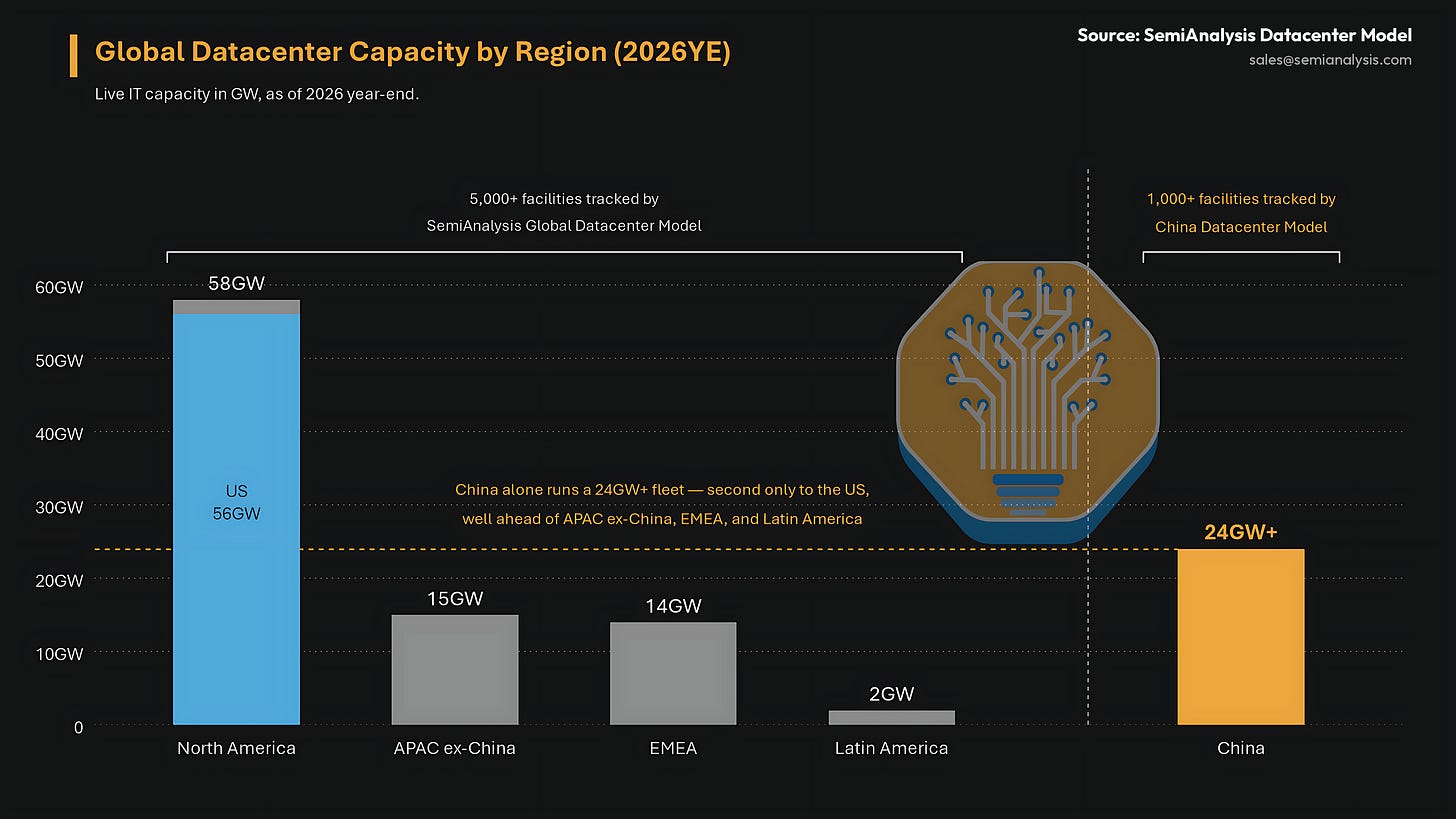
The global model tracks over 5,000 facilities across four regions. The US leads the world with 56GW of capacity as of 2026YE, followed by ~15GW for APAC ex-China, ~14GW for EMEA, and ~2GW for Latin America. Until now, it stopped at the border of China. Today we cross it.

Our tracking of 1,000+ datacenter facilities across over 60 players shows that China alone boasts a fleet of over 24GW. Bigger than EMEA. Bigger than the rest of Asia. This excludes ~20GW of dated pipeline and another ~30GW of announced projects.
 Growth is at an inflection point. In 2Q26, the combined capex of Alibaba, Tencent, and Baidu (“BAT”) reached $20B, more than doubling YoY, and for the first time on record, all three posted negative free cash flow. This is the largest capex step-up in the sector’s history. 
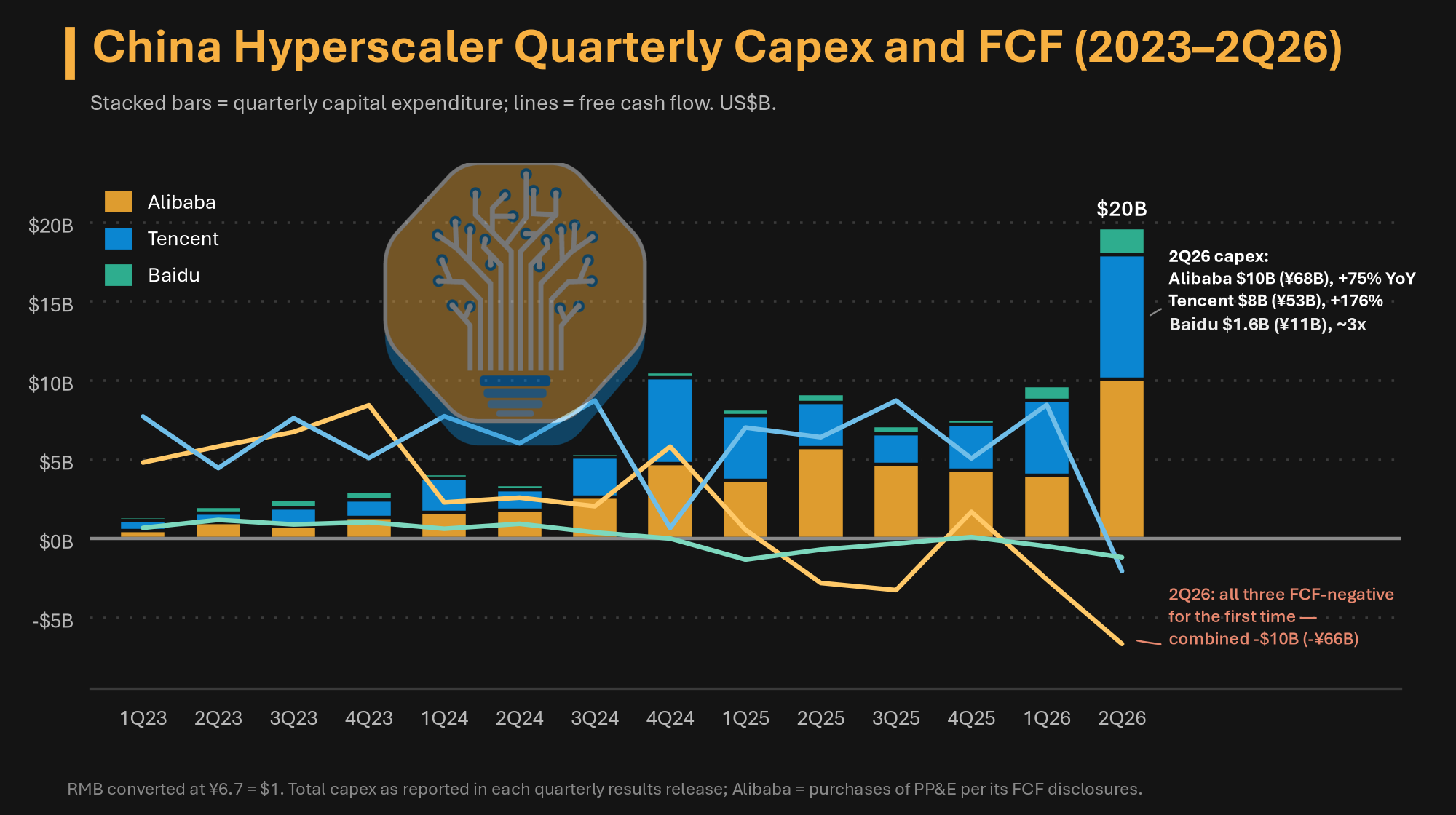
That total leaves out the largest spender of all, ByteDance, which remains private. According to our China Datacenter Model, ByteDance alone occupies roughly a fifth of delivered datacenter capacity in China, and it rents nearly all of it, making it the single most important customer for all wholesale colocation players in the country.
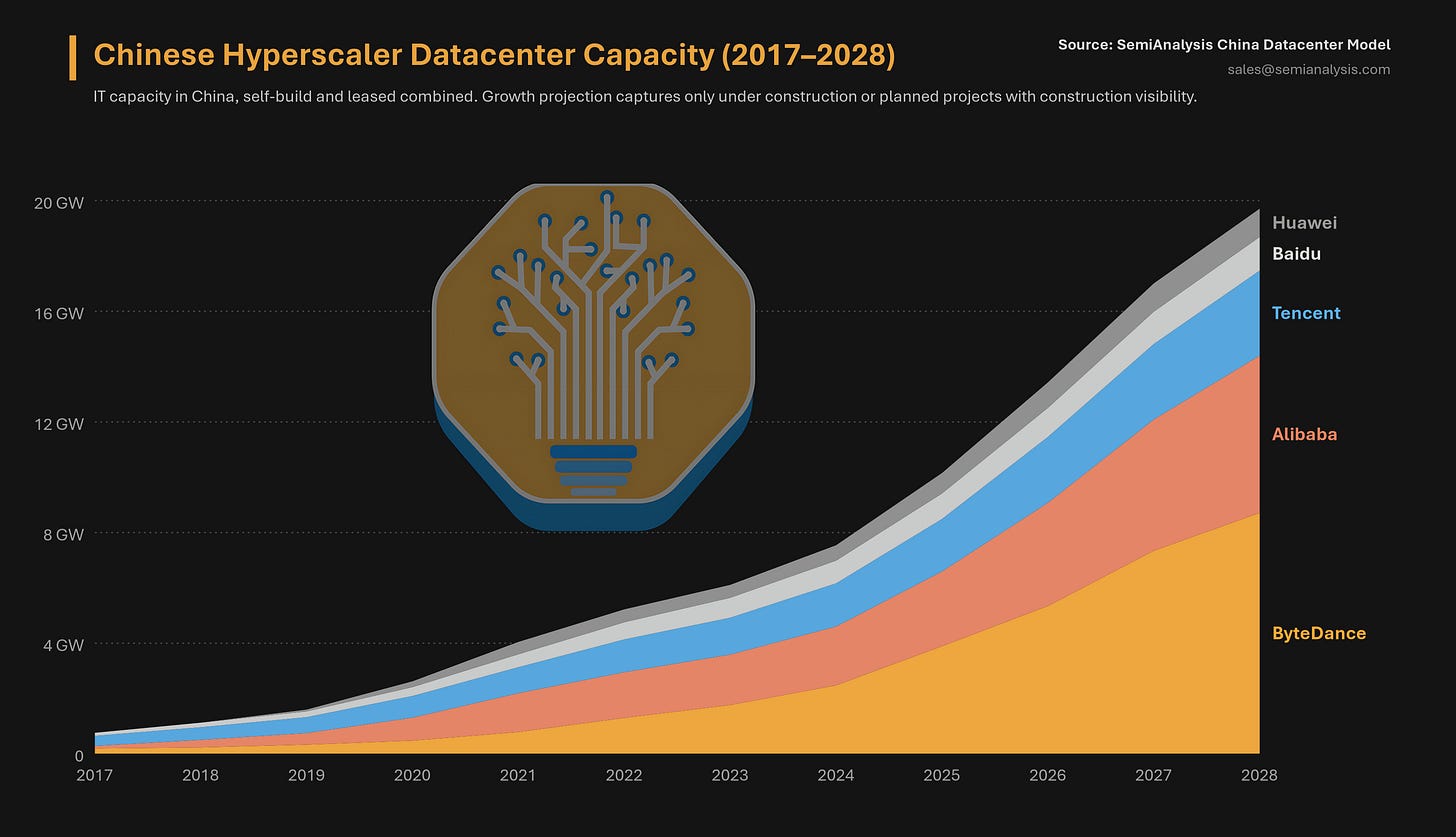
The listed players get the attention, but they are only the visible tip of the iceberg. This is also true for datacenter landlords. GDS and VNET, the only two Chinese datacenter landlords listed in the US, signed 1.3GW of wholesale orders in 1H26. But according to our China Datacenter Model, they captured barely a third of ByteDance and Alibaba orders in 2024–2026YTD.

The buildout is a nationwide effort, and the state-owned carriers are also part of it. China’s datacenter market was historically telecom-dominated. The state carriers held the majority of the market share in the 2010s, and still own a third of national capacity today. The national power grid companies invest aggressively too. Their combined capex accelerated from 2024, ending the 14th Five-Year Plan 24% over the original blueprint. The 15th plan (2026–2030) layers another 40% on top, to over $746B (¥5T).

Largely free of power constraints, labor shortages, and public protests, China routinely delivers 100MW datacenter facilities in under 12 months. Modular DCs are the standard playbook, which Tencent deployed its third-gen modular design in 2014. What is old news in China is only now being adopted at scale in America, as we detailed in The Wild Wild West of LEGO Datacenters.

The growth does not stop at China’s border. Overseas leasing by Chinese hyperscalers is set to double from 2026 to 2029 and approach ~4GW of leased capacity in our SemiAnalysis Datacenter Model. That number still understates their offshore compute, because it excludes the hundreds of thousands of GPUs they rent from Western clouds, which we covered at length in How Oracle Is Winning the AI Compute Market.

However, the market also faces some dark clouds. Vacancy rates are high, and datacenter developers compete heavily on price. Chip supply is also constrained, due to export restrictions. But as explained below, neither has stopped AI datacenters from being built and filled at a remarkable speed....

....MUCH MORE 

Thursday, October 1, 2026

"How GE Vernova has jumped into the lead in the nuclear race" (GEV)

GEV and Rolls-Royce were always in the lead. It just took the market a while to come around to that view. 

From Barron's, September 29:

The race to build new nuclear reactors in the U.S. is heating up, and GE Vernova looks like it’s in the lead.

The Nuclear Regulatory Commission approved a construction permit on Tuesday for a new reactor designed by GE Vernova and Japanese company Hitachi. The reactor, known as the BWRX-300, will be built in Tennessee at a site known as Clinch River controlled by the Tennessee Valley Authority, a government-owned utility.

The approval came after just 14 months, four months ahead of the expected schedule, according to the Nuclear Regulatory Commission, or NRC. The NRC has been under pressure from Congress and the Trump administration to speed up its reviews.

It’s just the second construction permit issued for a new kind of nuclear reactor in the U.S. in more than a decade.

The first was given earlier this year to TerraPower, a small-reactor developer founded by Bill Gates that’s building its first unit in Wyoming. TerraPower is still a private company.

Construction permits aren’t a guarantee that reactors will be built, but they open up the potential that these companies will start putting steel in the ground and not just issuing news releases.

GE Vernova Hitachi’s BWRX-300 reactor is a miniaturized version of a boiling-water reactor, which is a kind of reactor that GE has been building for decades in the U.S. The new version has 300 megawatts of power capacity, or enough for about 300,000 homes, versus the old versions, which often had more than 1,000 megawatts of capacity.

Customers seem to like the mini versions, which are designed to be cheaper and faster to build, because parts can be prefabricated and assembled more easily. Canada is already building a BWRX-300 in Ontario, with plans to build up to four of them. Earlier this month, nuclear developer Blue Energy applied for a construction permit to build a BWRX-300 in Texas.

The permit doesn’t mean the Tennessee reactor will definitely get built. The TVA is looking for partners to help offset the cost of building it, because the utility is concerned that greenlighting a new machine like this could be expensive, a spokesman said. The partner could be a data center or another large commercial customer that needs a lot of power....

....MUCH MORE  

$960.15 last, up $9.66 (1.1%) on the day, +47.3% year-to-date, +58.9% 1-year, +735.3% 3-years.

Vs. +11.36%;  +13.59% and +77.78% for the S&P 500 at YTD/1-year/3-year

January 2025 - "AI-exposed power stocks get crushed as fears about DeepSeek trigger stock market sell-off" (GEV; OKLO; PWR; CEG)

Referring back to the introduction to this morning's "GE Vernova hit with downgrade by Guggenheim (GEV)":

And though it is based on valuation rather than corporate or macro events the downgrade is, unfortunately, from Guggenheim who have been very timely in their calls.

See for example December 5's "GE Vernova shares see 33% target hike from Guggenheim, Buy rating upheld"

In pre-market action the stock is down $57.49 (13.67%) to $363.00.

The other "quality" name we have been touting, electric infrastructure contractor Quanta Services is down  $28.01 (7.82%) at $330.02. 

It is days like today that are the reason we prefer quality over super-spec lottery tickets: the good ones come back (eventually) the rest may, or may not....

The small modular nuke wannabes OKLO; SMR and the quantum computing stocks, RGTI, QBTS etc. are among the lottery tickets that may or may not come back.

Quanta and GE Vernova will survive and thrive. Even without AI. The U.S. and the world need to string more powerlines and need more generating capacity that will come on line faster than nukes or a baby nukes.

May 2025 - "Trump plots ‘Manhattan Project 2’ in nuclear power push" (CCJ; GEV):

The "set it and forget it" stocks are in the headline, Cameco among the miners and GE Vernova among the nuke reactor manufacturers.

However, as is so often the case the speculative lottery tickets are seeing a lot of enthusiasm for their shares. The problem with them as investments are 1) a lack of stuff like sales/earnings/cash flow and 2) our conviction that we will see at least one and possibly three bear markets before they have products.

And in bear markets it is the companies lacking in sales/earnings/cash flow that get hit hardest; as investors begin to question whether they may have made a big mistake. 

Addendum: I should have mentioned that with Cameco you also get 49% of nuke plant company Westinghouse. Brookfield owns the 51%.

June 2025 - "Trump plans executive orders to power AI growth in race with China" (PWR; GEV; CCJ): 

I think we're positioned correctly with the Quanta, GE Vernova, Cameco etc.

But until sales, earnings, and cash flow catch up to the news, valuations are getting stretched. 

But at least we have sales, earnings, and cash flow should the overall market tumble.

Money coming in the front door is comforting and a cushion against impulsivity, regret and all the other things that get in the way of big gains. 

July 2025 - ICYMI: "In Small Nuclear Reactors, There’s One Clear Leader Today" (GEV)

A bit of snark in November 2025:

"Will General Electric's New Canadian Nuclear Reactor Doom Oklo to Irrelevance?" (GEV)

There is something to be said for actually having a product....

And Roller?

June 2026 - BritTech: "Sweden's Vattenfall picks Rolls-Royce SMR for nuclear power project"

Bastards. 

Previously: 
August 2025 - When going Small, go big or go home: "Vattenfall Narrows SMR Field to Two Finalists: GE Vernova’s BWRX-300 and Rolls-Royce SMR" (GEV; RR.L)  
 
October 2025 -  "What Will Rolls-Royce Gain From the UK–US Nuclear Deal?"
Although this reads a bit like a Rolls-Royce promotional piece it is good background. The company will be popping up in more and more discussions of small modular reactors.*   
 
December 2025 - "Sweden's Vattenfall Seeks State Funding for New Nuclear Reactors" 
 
February 2026 at Yahoo News - Rolls-Royce drops plan for nuclear reactor on the moon  

April 2026 - "Reeves hands Rolls-Royce £600m to build mini-nukes in Britain"

Citadel's Ken Griffin Makes A Big Bet On Miami Tech

 From The Hill, September 30:

Ken Griffin donating $3B to Carnegie Mellon 

Citadel founder and CEO Ken Griffin is donating $3 billion to Carnegie Mellon University, according to an announcement from the institution on Wednesday. 

The donation is the largest individual gift in higher education history and the largest donation ever made by the hedge fund manager. 

“Carnegie Mellon University has made profound contributions to America’s preeminence in science, engineering, technology, and the arts and humanities,” said Griffin. “Since its founding, Carnegie Mellon has fostered remarkable talent, pioneered scientific breakthroughs, and expanded the frontiers of research — shaping global leaders and innovators.” 

One-third of the donation will be invested in Carnegie Mellon’s Pittsburgh campus, and the other $2 billion will go to building a branch campus in Miami.  

The Miami school will be built on 25 acres in the heart of the city with the goal of supporting 3,500 undergraduate, master’s and Ph.D. students. Construction is set to begin next year, with the hope of enrolling its first students in 2028, according to the university. 

“We are deeply grateful to Ken Griffin for his extraordinary vision, partnership and belief in what Carnegie Mellon can achieve,” said Carnegie Mellon President Farnam Jahanian.  

“Throughout our history, CMU has anticipated moments of profound technological change and responded with new ways of thinking and solving problems. Artificial intelligence represents one of the defining intellectual developments of our time, and it demands that we rethink how we educate students, conduct research and partner with others,” he added....

....MUCH MORE 

CMU has sort of a special place on the blog. Well, along with Stanford, CalTech and MIT.

November 2016 - the introduction to "Interview: Manuela Veloso Head of Machine Learning, Carnegie Mellon University":

Our readers probably know Carnegie Mellon more for the  top-ranked financial engineering program (Master of Science in Computational Finance) but artificial intelligence was pretty much invented at CMU by Herbert Simon and Allen Newell. Simon received the Nobel in Economics but it actually could have been for any of four or five subjects, he was quite the polymath.

Newell had to settle for the Turing award (along with Simon) from the Association for Computing Machinery, probably the root'in-tootin high-falootinest tchotchke in the computer biz.
The Association for the Advancement of Artificial Intelligence along with the ACM subsequently named an award in Newell's honor. Ditto for CMU.

The University's machine learning department was the first in the world to offer a doctorate and as far as I know is still the largest.
A department, for one branch of AI.

Carnegie-Mellon used to have a world class robotics Institute but Uber gutted it with a combination of cash and stock options leaving a Dean and a couple robots to rebuild.
One of the robots is said to be in advanced negotiations with the Ube-sters....
Anyhoo....
So You Want To Be A Quant: The Best Schools For Your Financial Engineering Degree
Archaeology: "Previously Unknown Warhol Works Discovered on Floppy Disks from 1985"
You Understand Why Mr. Son and SoftBank Are Circling Uber, Right?
"Uber Is Stealing Scientists, But Only So It Can Lay Off Drivers"
Big Money: Uber Guts Carnegie Mellon Robotics Lab To Hire Autonomous Car Developers
Raising money at a $600 illion zillion fafillion valuation allows you to buy pretty much anything.
The way this is going to pan out is: you won't be able to own the vehicle but its use will be mandated. The car is autonomous but the people aren't....

Capital Markets: "New Month, Same Market Dynamics"

From Marc to Market: 

A new month begins, but the market dynamics are familiar.  Rising oil prices and rising yields have lifted the greenback broadly.  The euro and Canadian dollar have been sold to new lows for the year. Interest rate premiums over Germany within the eurozone widen as the focus is on the French and Italian budgets.  The combination of the uninspiring Tankan Survey in Japan and record of the recent BOJ meeting saw the market downgrade the chances of a hike this month in Japan.  The dollar is above JPY158 for the first time this week. 

The dollar’s strength comes despite the futures market reducing the chances of a Fed hike later this month to about 40% from 70% at the beginning of the week. In yesterday’s update the Atlanta Fed GDP tracker estimate for Q3 GDP was cut to 3.7% to 5.0%.  Still, the US is seen best able to cope with the shocks.  At least seven Federal Reserve officials are expected to speak today.  Tomorrow sees Tokyo’s CPI and the US employment report....

....MUCH MORE  

"Lynas Rare Earths (ASX:LYC) A$968m [$672 million USD] Deal Doubles Down on the Heavy Rare Earths Race"

The acquirer's stock got walloped on the news of the price paid but the HREE focus is where LYC has a strategic advantage over the American standard-bearer MP Materials.

From Stocks Down Under, October 1:

Investment Case Summary

  • Caldeira adds the largest ionic clay rare earth resource outside China and lifts Lynas reserves by 26%.
  • The all-scrip structure preserves Lynas A$1.2 billion cash to fund the US$500m-plus Brazil build.
  • Brazilian regulatory approval under new critical minerals law is the key execution risk before March 2027. 

The deal doubles the resource base. The real question is whether Brazil approvals arrive on time.

Lynas Rare Earths (ASX:LYC) has agreed to acquire Meteoric Resources in an all-scrip scheme valued at A$968 million on a fully diluted basis. The deal hands Lynas the Caldeira Project in Minas Gerais, Brazil, the largest known ionic clay rare earth oxide resource outside China under the JORC Code.

The exchange ratio of 0.0207 Lynas shares per Meteoric share implies A$0.286 per Meteoric share, a 68.4% premium to the last close of A$0.17. Meteoric shareholders will end up owning roughly 5.9% of the combined group on a fully diluted basis.

The strategic logic is clear enough. Caldeira adds an estimated 802kt of NdPr oxides and 41kt of DyTb oxides to Lynas, lifts Measured and Indicated TREO resources by about 79% and Ore Reserves by 26% on a pro forma basis. It also diversifies Lynas from one tier-one orebody to two, pairing the hard rock Mt Weld deposit in Western Australia with a scalable ionic clay asset in a supportive mining jurisdiction.

Why is Lynas paying up for Caldeira now?

Because scale and heavy rare earths are suddenly the whole game. Caldeira contains both light and heavy rare earth elements, with life-of-mine production of around 3,862 tonnes of NdPr and 127 tonnes of DyTb a year under Meteoric’s definitive feasibility study.

DyTb is the strategic prize. Dysprosium and terbium are the heavy rare earths that go into high-performance magnets for EVs, wind turbines and defence electronics, and China still controls almost all commercial supply. A credible non-Chinese source of DyTb is scarce, and Caldeira is one of the few outside China that has moved through a DFS....

....MUCH MORE 

LYC was down 8.6% (-A$1.19) to A$12.64 on Thursday and year-to-date is up a measly 1.8%:


TradingView 

On the Heavy Rare Earth Elements, a couple mentions in the last year (we have dozens on LYC and MP going back to the 2009 - 2011 glory days): 

January 2026 - Rare Earths: "Australia's Lynas reports Q2 revenue surge on higher prices" (LYC.ax)

Our preference among the Western mines due to the heavy rare earth resource/reserves.

October 2025 - Why Did President Zelensky Come Away From His Meeting Without Tomahawk Missiles? Think Rare Earths

There are, of course, a few reasons that President Trump is reluctant to send the missiles to NATO partners for resale to Ukraine, the most commonly uttered example is a determination to not expand and extend the war.

However, there are a couple rare earth angles that are also behind the decision....

***

....One way for China to keep Russia in the fight is to pressure the U.S. generally on the critical minerals.

Another is to focus on the Tomahawks themselves. They cannot be built without the use of dysprosium magnets in the actuators that move the control fins.

Dysprosium is a Heavy Rare Earth Element (HREE) and America's only rare earth mine at Mountain Pass doesn't produce it. Australia's Lynas produces some but unlike the light rare earths, the HREEs are pretty much all found in Chinese geologies.

If interested see last week's reposted article from 2012 "The only five rare earth elements that matter": 

[Jack Lifton writing]....I follow four or five critical REEs that each have individual markets. One of them is neodymium, because it’s the most important REE used in permanent magnets. The others are heavy rare earth elements (HREEs), including europium, terbium, dysprosium and yttrium. The latter isn’t really an REE, but it’s associated with them. As the market corrects to reasonable prices, people are coming to understand this.... 

Neodymium magnets are not as robust as those made from dysprosium and are more likely to fail under thermal and physical stress, leaving you with an unguided missile flying hither and yon.

As things stand right now, China not only has one heck of a monopoly on the majority of the rare earth supply chains, from mine to fabrication but absolutely controls the one for the absurdly critical input into Tomahawk missiles.

Oh, and after lobbing a bunch of the Tomahawks at the Houthis in Yemen, we see this at ZeroHedge October 14: "Military Analyst Warns US Doesn't Have Enough Tomahawks To Send To Ukraine".

All because China found and exploited a point of maximum pressure to implement their geostrategic worldview.

*** 

MP has the backing of the U.S. Government while Australia's richest person, Gina Rinehart owns 8.2% of LYC, formerly worth around a billion U.S.

Fun fact:

Critical Minerals: "Mining tycoon Gina Rinehart buys over $1 billion SpaceX stake" (SPCX)

She also owns 8.4% of MP. 

"...Chinese refiners reportedly ban October fuel exports..."

Meanwhile Russia has extended its ban on diesel exports...hmmm. Not saying it's coordinated but...

From CNDC, October 1: 

  • Oil prices reversed earlier losses to jump more than 2% on Thursday, with Brent topping $100 a barrel.
  • It comes after a report that Chinese refiners suspended October fuel exports to protect domestic supplies.
  • Global energy markets remain constrained by the U.S.-Iran war and Russia’s war in Ukraine.

Oil prices rose on Thursday, reversing earlier losses, following a report that Chinese refiners have suspended October fuel exports, further squeezing war-constrained energy markets.

International benchmark Brent crude with December expiry was last seen trading 2.4% higher at $100.36 per barrel, having earlier traded 1% lower, while U.S. West Texas Intermediate futures with November expiry rose 2.5% to $92.70.

Reuters reported that China’s state oil major PetroChina canceled a handful of gasoline and jet fuel shipments that were planned for October, citing multiple unnamed sources, as Beijing looks to safeguard domestic supplies. CNBC could not independently verify the report.

Global energy markets have been grappling with supply disruptions from the U.S.-Iran war in the Middle East and Russia’s full-scale invasion of Ukraine.

Oil prices had moved higher earlier in the session as investors parsed a recovery in Middle East crude exports.

UOB in a note Thursday said that crude flows from Middle East were reportedly nearing pre-war levels, but fuel supplies, particularly gasoline, were lagging behind....

....MUCH MORE
*
And at OilPrice, September 30:

 Russia Extends Diesel Export Ban Through Oct. 31

World Bond Markets Hit Again, Analysts React

From Reuters, October 1: 

VIEW Bond markets take a drubbing again, 10-year Treasury yields highest since 2002. 

Borrowing costs from the US to France, Britain and Japan hit their highest in decades on Thursday, squeezing already pressured government finances, and threatening stocks, credit and other global assets.

The 10-year US Treasury yield, a yardstick for borrowing costs and ​asset prices globally, rose to 5.34%, its highest since 2002. 

COMMENTS:

TIMOTHY GRAF, HEAD OF MACRO STRATEGY FOR EMEA, STATE ‌STREET:

"I don't think there's a specific trigger. Moves like today feel like positions have been stopped out. If you look at energy prices, they are contained. But the reasons why we (yields) are here is clear - central bank rates are going up."
 
"French OATs are getting beaten up because it's budget time ​and it's messy. Italian bonds are also getting whacked."
 
FRED NEUMANN, CHIEF ASIA ECONOMIST, HSBC:
"There is more than inflation that ​has bond investors worried these days. Even a milder US inflation print, therefore, is not enough ⁠to turn the narrative. Beyond stubborn price pressures, large government deficits and enormous funding demand from the AI sector are also ​pressuring interest rates higher."
 
"Meanwhile, there are lingering doubts whether central banks will ever get ahead of the curve on inflation and bring ​it swiftly and sustainably back to target."
 
"The economic and political realities of highly imbalanced growth make it tough for monetary officials to deliver rapid and determined monetary tightening that would help to anchor bond markets."
 
"It would be unfair to lay the blame entirely on central bankers: in the end, it ​is expansionary fiscal policies that are equally to blame for persistent inflation. Plus, the demand for long-term capital has increased thanks ​to the AI boom, which marks a structural shift from the pre-pandemic period when the world was awash with surplus savings."
 
"Higher bond yields may ‌well ⁠be the new normal, and financial markets are in the midst of a discovery process to see where the new long-term anchor sits. A slight upside or downside surprise in a single inflation reading is thus not going to reestablish calmness in itself. It is a necessary, but hardly a sufficient condition to bring yields back down swiftly."
 
FIONA CINCOTTA, SENIOR MARKET ANALYST, CITY INDEX:
"The only way ​really I can see the ​market being calmed here is ⁠if we do see governments taking the hard decisions to cut spending and it doesn’t look like that is going to happen."

" I don’t think there has been a whiff of that ​from the (UK)Labour party conference, there hasn’t really been a sense that that is on the agenda ​and again in ⁠France quite the opposite, with the populist parties gaining traction, more spending may be coming."....

....MORE 

"French PM to present belt-tightening 2027 budget, including frozen wages and new taxes"

From France24, October 1: 

French Prime ​Minister ‌Sébastien Lecornu ⁠is due on Thursday to present a belt-tightening government budget for 2027, with savings predicted to come from freezing wages in the public sector and all but the lowest ‌pensions. A series of targeted tax measures, including on income revenues and VAT, are expected as well.  

France is due to present its 2027 budget bill on Thursday after 0930 GMT, seeking to enact unpopular belt-tightening measures that can lower its deficit and appease increasingly twitchy bond investors ​ahead of ‌next year’s presidential election.

As has become common in France, where the two ⁠previous prime ministers were toppled over their austerity plans, the legislation faces a tough ride in a deeply divided parliament, as political clans position themselves ‌for one of the country’s most consequential elections in modern times.

The vote is ⁠due to take place on April 18-May 2, with far-right leader Marine Le Pen far ahead in the polls amid a growing backlash against President Emmanuel Macron’s centrist legacy.

According to a plan seen by AFP, the government hopes to reduce the country’s ballooning deficit with €43 billion in "recovery measures”.....

....MUCH MORE 

Lecornu seems to be the only person in the French government that is taking the debt and deficit seriously. 

Wednesday, September 30, 2026

"Historians Still Unable To Determine How Americans Were Able To Build Hoover Dam."

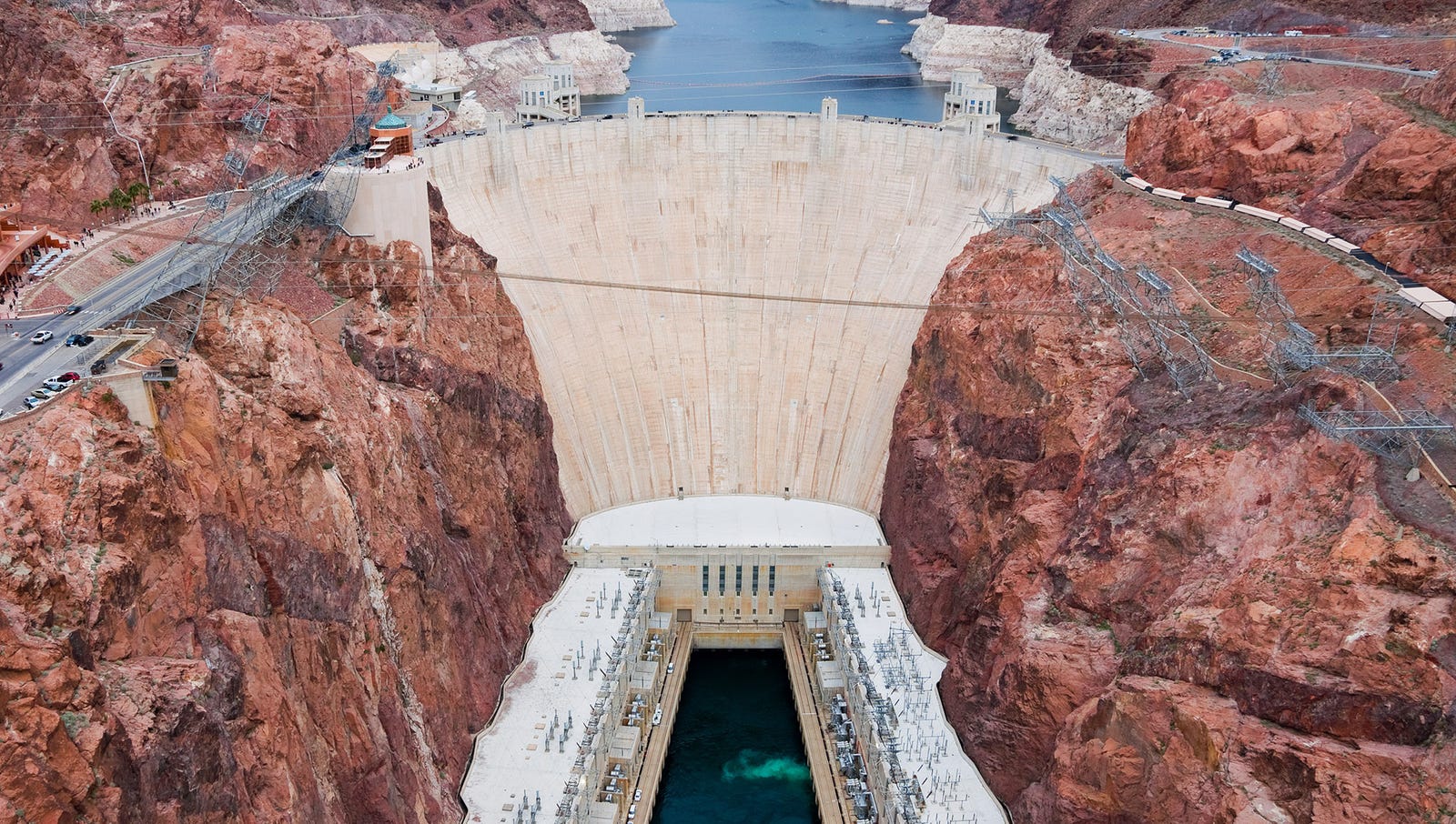
Today is the 91st Anniversary of the dedication of Hoover Dam.

First up, America's Finest News Source:

https://i.kinja-img.com/gawker-media/image/upload/c_scale,f_auto,fl_progressive,pg_1,q_80,w_1600/gkgzs7eexgwlihinqxlo.jpg
CAMBRIDGE, MA— Expressing continued bafflement at the practical knowledge and proficiency required to construct the massive structure, leading historians announced Friday that they remained unsure how Americans managed to build the Hoover Dam. “Decades into researching this tremendous feat of engineering, the question of how Americans ever mustered the ingenuity, determination, and resources to pull it off remains veiled in mystery,” said Harvard researcher Pritam Singh, noting that the enigmatic dam suggested Americans once possessed a level of competence, civic planning, and mastery of structural engineering far beyond what history would suggest....
....MORE

From the U.S. Bureau of Reclamation:

Hoover Dam
The Story of Hoover Dam - Essays 
Fatalities at Hoover Dam
Many people who visit Hoover Dam ask: 1) How many people died building the dam?; and 2) How many of those are buried in the concrete? The second question is the easiest to answer -- none! No one is buried in Hoover Dam.

The dam was built in interlocking blocks. Each block was five feet high. The smallest blocks were about 25 feet by 25 feet square, and the largest blocks were about 25 feet by 60 feet. Concrete was delivered to each block in buckets, eight cubic yards at a time. After each bucket was delivered, five or six men called "puddlers" would stamp and vibrate the concrete into place, packing it down to ensure there were no air pockets in it. Each time a bucket was emptied, the level of concrete would raise from two inches up to six inches, depending on the size of the block. With only a slight increase in the level at any one time, and the presence of several men watching the placement, it would have been virtually impossible for anyone to be buried in the concrete. So, there are no bodies buried in Hoover Dam.

The question about fatalities is more difficult to answer, because it depends in a large part on who is included as having "died on the project."

For example, some sources cite the number of deaths as 112. But this incorporates incidents that occurred before the dam was authorized, and well in advance of construction. This figure includes the first fatalities from 1922, when Reclamation employees J.G. Tierney and Harold Connelly -- who were conducting geological surveys from barges in the Colorado River -- fell into the river and drowned. That was 6 years before the dam was authorized, and 8 years before construction began!
Some references also include in the fatality count those who died from non-construction related causes. For example, men, women, and children who lived in Boulder City, but did not die at the dam site or as a result of working there, were included in these statistics because they were, technically, part of the Boulder Canyon Project effort, and worked for Reclamation, Six Companies Inc., or one of the many subcontractors involved in the project, or resided in Boulder City during the construction years.

In addition, some references include those who may have been injured at the dam site while working there, but did not die there, while others do not. Perhaps these individuals were being transported to a hospital, were in a hospital, or had been discharged from a hospital when they died. But since they were not on the job site at the time, they were not included in the "official" number.

The "official" number of fatalities involved in building Hoover Dam is 96. These were men who died at the dam site (classified as "industrial fatalities") from such causes as drowning, blasting, falling rocks or slides, falls from the canyon walls, being struck by heavy equipment, truck accidents, etc. Industrial fatalities do not include deaths from heat, pneumonia, heart trouble, etc.

The record regarding the number of fatalities that occurred at Hoover Dam during its construction is just not that clear. However, the following information comes from the Hoover Dam Project History, volumes 1 through 5, 1931 to 1935, and provides the best information Reclamation has available on this subject.

The information is presented in the same format as it is printed, with a separate web page for each year. Some of the information in the Project History was found to be inaccurate; in those instances, we have noted corrections in this on-line version.

Use the navigation bar located at the bottom of each page to move from page to page.

Introduction   |   1931   |   1932   |   1933   |   1934   |   1935

And finally, from IEEE Spectrum, July 10, 2024:

Edith Clarke: Architect of Modern Power Distribution
The first U.S. woman EE designed the Hoover Dam’s turbine system  

Edith Clarke was a powerhouse in practically every sense of the word. From the start of her career at General Electric in 1922, she was determined to develop stable, more reliable power grids.  

And Clarke succeeded, playing a critical role in the rapid expansion of the North American electric grid during the 1920s and ’30s.

During her first years at GE she invented what came to be known as the Clarke calculator. The slide rule let engineers solve equations involving electric current, voltage, and impedance 10 times faster than by hand.

Her calculator and the power distribution methods she developed paved the way for modern grids. She also worked on hydroelectric power plant designs, according to a 2022 profile in Hydro Review.

She broke down barriers during her life. In 1919 she became the first woman to earn a master’s degree in electrical engineering from MIT. Three years later, she became the first woman in the United States to work as an electrical engineer.

Her life is chronicled in Edith Clarke: Trailblazer in Electrical Engineering. Written by Paul Lief Rosengren, the book is part of IEEE-USA’s Famous Women Engineers in History series.

Becoming the first female electrical engineer....

....MUCH MORE 

Atlanta Fed GDPNow Estimate +3.7% For Q3, 2026

From the Federal Reserve Bank of Atlanta:

September 30, 2026

The GDPNow model estimate for real GDP growth (seasonally adjusted annual rate) in the third quarter of 2026 is 3.7 percent on September 30, down from 5.0 percent on September 25. After this morning’s releases from the US Census Bureau and the US Bureau of Economic Analysis, an increase in the nowcast of third-quarter real gross private domestic investment growth from 18.7 percent to 20.7 percent was more than offset by a decrease in the nowcast of third-quarter real personal consumption expenditures growth from 4.2 percent to 3.5 percent and a decrease in the nowcast of the contribution of net exports to third-quarter real GDP growth from -1.37 percentage points to -2.60 percentage points.

We've mentioned, having tracked this measure for years, that GDPNow tends to run hotter than the (eventually) reported figure, slowly converging into the month after the end of the quarter.

GDPNow home

Tomorrow is another update day 

Inflation: "Core PCE Prints Cooler Than Expected Due To Change In Methodology, As Savings Rate Plunges To 3 Year Low"

From ZeroHedge, September 30: 

Ahead of today's closely watched core PCE report - the Fed's (reportedly) favorite inflation indicator (although that will probably shift to Truflation after Kevin Warsh's task force is done with analyzing the data), which was seen by many as deciding whether the Fed will hike in October and December, or just December as NY Fed president John Williams strongly hinted yesterday, we warned readers that PCE may surprise to the downside: "the Bureau of Economic Analysis updated methodology for calculating inflation in three components is expected to trim August year-on-year change by a few tenths of a percentage point."

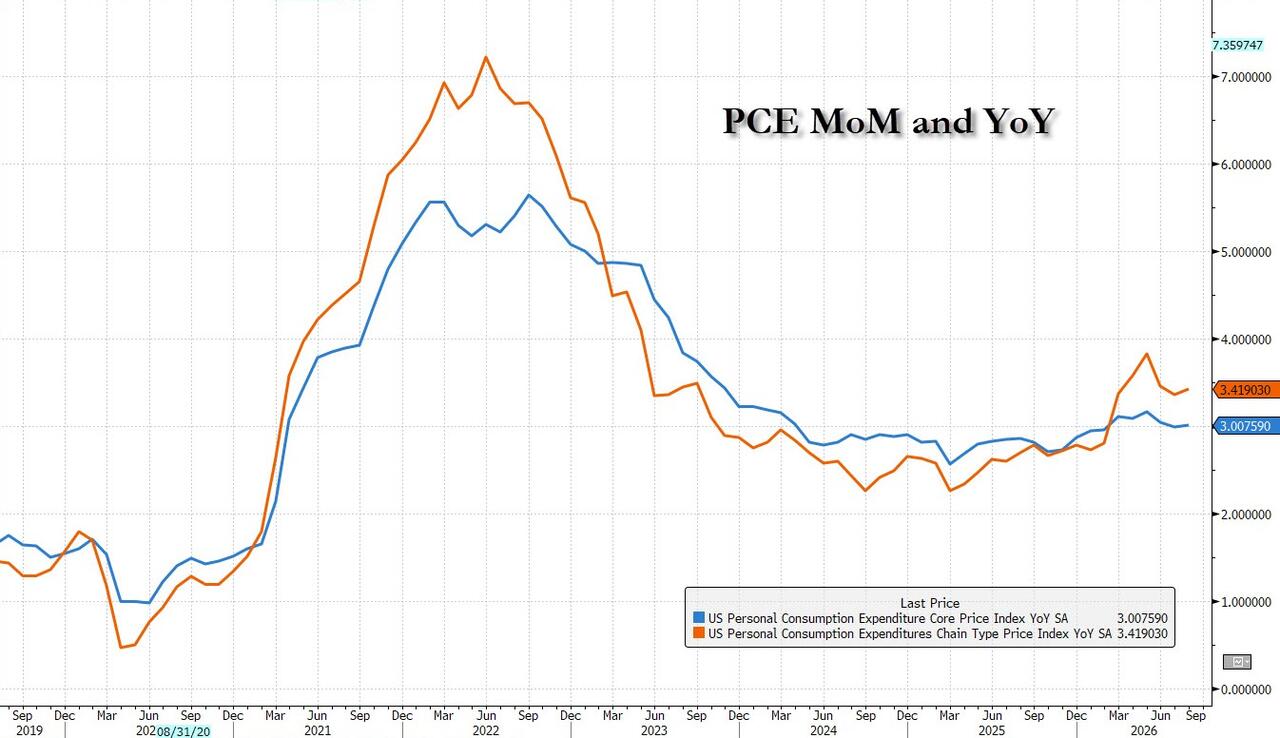
And surprise it did, because despite rampant energy inflation and record diesel prices, headline PCE came in line sequentially, printing up 0.3%, in line with expectations but coming in far cooler than expected on an annual basis, rising just 3.4%, vs expectations of a 3.7% print.

The MoM jump in headline PCE was driven by services, a reversal from last month's drop, largely due to the spike in communication and education services....

*** 

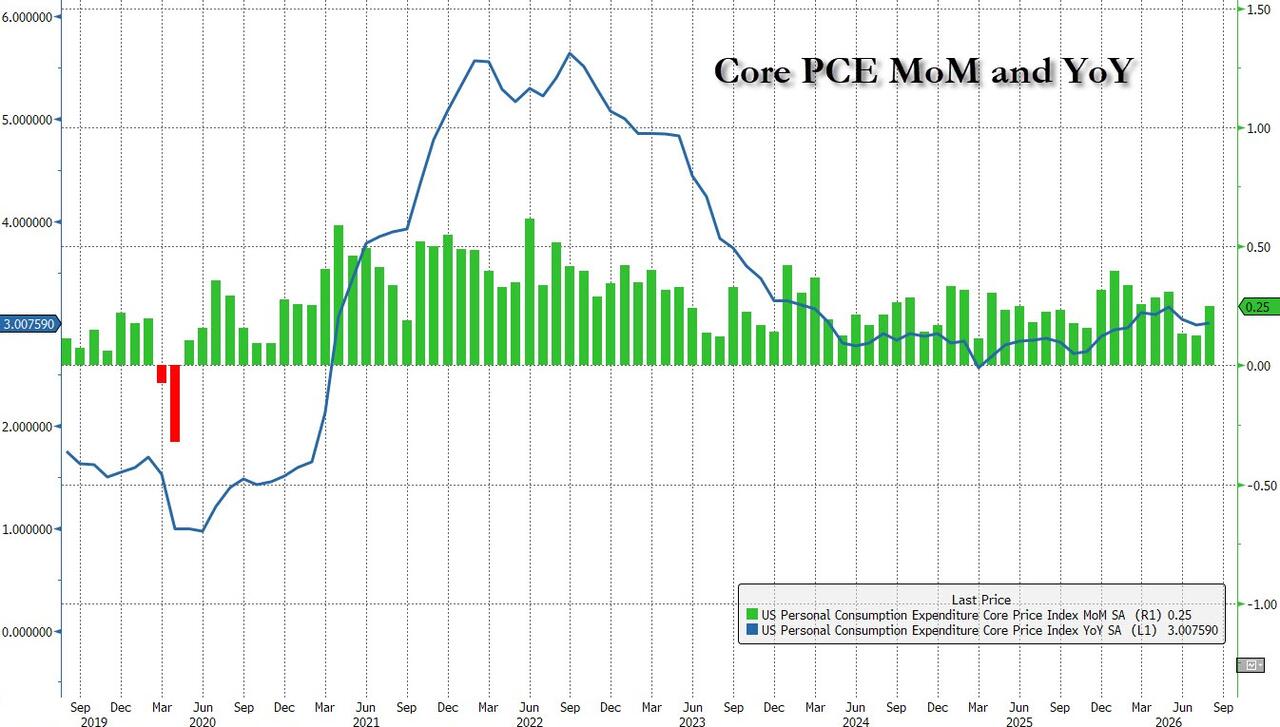
But it was the far more important core PCE, which strips out volatile energy and food prices, that rose 0.2% MoM (technically 0.247%, below the +0.3% MoM expected) with a notable miss in the YoY print, which dropped to +3.0% from the unrevised 3.3% (now revised to 3.0%), missing estimates of a 3.3% print.

Within core, the biggest jump was again communications and education services....

....MUCH MORE 

The market reaction to the release brings to mind Dr. Evil's demand, and more especially the reaction thereto, in the third Austin Powers movie (Goldmember):

"1 billion, gagillion, fafillion, shabolubalu million illion yillion....Yen."
about which Wikipedia says:
"This time his demand is met with simple confusion from the world leaders."

"Private Equity Is Buying Life Insurers, and the Public Bears the Heightened Risk"

There are entire law firm practice groups devoted to this stuff.

From the University of Chicago's Booth School of Business' ProMarket, September 20:

In new research, Pranjal Drall and Andrew Granato argue that the move of private equity firms into life insurance has increased the probability that insurers will go insolvent. If they do, under an obscure system of insurance guaranty funds, the losses will spread out beyond the insolvent insurer’s creditors to other insurers and, ultimately, taxpayers. 


Life insurance has long been considered one of the least exciting parts of finance. Policyholders, wanting to provide for their families in the event of tragedy, buy long-lasting policies that pay out money to their beneficiaries if they die early. Life insurers sell large quantities of policies, thereby pooling risk and spreading out potential financial losses. The insurers then invest the proceeds in safe, high-quality corporate bonds. The insurers earn a small spread and the beneficiaries can be confident that their life insurer will be solvent if and when it comes time to pay the bill.

As with many industries, the rise of private equity (PE) has fundamentally reworked this staid business model of life insurance. In about fifteen years, PE has grown from controlling no life insurers to controlling about 15% of the sector. In most industries, PE invests in private companies to boost profitability before selling or merging them with another company. In contrast, PE firms take control of insurers to combine the money from selling insurance policies with alternative private-credit lending, in part to finance their traditional buyout funds.

PE firms and some business commentators have hailed this strategy as a masterstroke that relies on the “permanent capital” of life insurers: policyholders who expect to pay the insurer upfront for long periods of time, even decades. These long-duration liabilities, they argue, make life insurers an ideal host for long-term, illiquid private credit, with efficiencies that allow insurers to hold these higher-yielding assets to maturity and enhance performance for policyholders and investors alike. We do not dispute that there are theoretical efficiencies in this structure. However, in our paper, we argue that its practical implementation has relied heavily on regulatory arbitrage that has the potential to shift large losses onto the public.

The current risk of the life insurance market

Risks within the life insurance market lie in the distinctive structure of insurance’s insolvency, tax, and financial-regulation law. Life insurance and annuity policyholders hold contracts that involve paying the insurer upfront, with the expectation of benefits that will materialize over the long run. To bolster policyholder confidence that the insurer will still be around to make payouts, all states implement “insurance guaranty funds” to backstop policyholders even if the insurer goes insolvent. The logic is somewhat similar to the logic of federal deposit insurance, which backstops banking depositors to maintain their confidence that they will have access to their money even if their bank goes out of business. 

Each guaranty fund functions as follows. Each insurance policyholder is guaranteed to have their policy remain in force up to a specific statutory cap, generally around $250,000-$300,000. When an in-state insurer becomes insolvent, the state regulator takes over the insurer’s operations. To make up the shortfall to policyholders, the regulator bills every surviving insurer in the state, proportional to how many insurance premiums each insurer sells in the state. In essence, the insurers pool their risk and insure one another. In 44 states, in the case that an insurer goes bankrupt and other insurers must bail out its policyholders, those insurers are permitted to take a tax credit against their assessment payment, usually over the course of the next five years. For these states, the taxpayer ultimately insures the insurers.

The core issue with such a guarantee is what economists call “moral hazard.” Insurance policyholders, like bank depositors, have little incentive to monitor what their banks and insurers do with their money, as other insurers or the broad public will bail them out. From the perspective of the insurers and their investors, since they have limited liability, they have increased ability to invest funds from their policies in riskier assets, as losses fall upon other insurers and the public. To restrain this behavior, banks and insurers are both subject to heightened financial-regulation standards, such as regulatory penalties for investing in assets that are considered to carry more risk.

The degree to which banking’s financial regulatory regime successfully restrains bank risk is debatable, and certainly it did not prevent the financial implosion of the industry in 2008. In addition, the design of insurance’s backstop entails even greater flaws than those present in banking. These design flaws sharpen the incentives for insurers to take on excessive risk, with more direct liability for taxpayers. 

How guaranty funds compare to deposit insurance

We argue that guaranty funds and their associated financial regulatory regime entail worse moral hazard issues than federal deposit insurance in several ways. First, unlike banks, which must pre-pay quarterly for deposit insurance, guaranty funds step in only after insolvency. This means that the insolvent insurer never makes a single contribution into the fund that rescues its policyholders. 

Second, while deposit insurance fees are measured by how risky a bank is, guaranty funds apportion payments purely by how much insurance an insurer sells. Essentially, safe insurers are subsidizing risky insurers. 

Third, deposit insurance only relies on public funding if the bank’s deposit fund is not enough to fully cover depositors. In the case of life insurance, taxpayers are the default reimbursement mechanism in all 44 states that permit guaranty-fund tax credits, as the insurers essentially pass on the bill through forgone corporate taxes....

....MUCH MORE 

And just to make things interesting, Senator Elizabeth Warren is pushing for Federal regulation of P.E. in insurance while the National Association of Insurance Commissioners is pushing back on behalf of their members with the argument that the historic role of state regulation has been and will continue to be what works best. Here's a letter the NAIC sent to the Senator last week:

September 24, 2026

The Honorable Elizabeth Warren
Ranking Member
Senate Banking, Housing,
and Urban Affairs
Washington, DC 20510

Dear Senator Warren:

Thank you for your interest in state insurance regulators’ oversight of the nexus between private investment firms and investment companies....

It's big money. Private Equity wants to goose the returns that their insurance companies are receiving by directly funding private credit.

From Insurance Business, September 25:

NAIC targets $1.2 trillion in insurer private credit with tighter solvency rules 

And once again just to make things interesting, in addition to plain vanilla private credit, the PE firms seem very attracted to structured products.

Capital Markets: "The Lack of Urgency Expressed by NY Fed President Williams Pushes Rates Lower and Weighs on the Greenback"

From Marc to Market:

The combination of lower oil prices yesterday and less hawkish comments by NY Fed President Williams helped steady US interest rates yesterday. Williams, who has a permanent vote on the FOMC as its vice chair, open speaks as part of the Fed’s leadership, and downplayed the sense of urgency. The Fed funds were discounting about a 70% chance of a hike at the October FOMC meeting, a few days before the midterm election.  The implied odds of a 25 bp cut are now nearer 40%. 

The dollar is trading with a heavier bias today against nearly all the G10 currencies.  A less than hawkish statement following yesterday hike by the Reserve Bank of Australia, and today’s slightly softer than expected August CPI has weighed on the Aussie today. Ahead of the week-long holiday beginning tomorrow in China, the PBOC unexpectedly set the dollar’s reference rate relatively sharply lower today (CNY6.7351), a new low since January 2023. New monetary and fiscal measures to support the economy have been unveiled over the last couple of days.....

....MUCH MORE 

"Somali pirates killed oil tanker crew before rescue, official tells BBC"

From the BBC, September 30: 

Five crew members of an oil tanker seized by pirates off the coast of Somalia were killed before local security forces retook the vessel, a senior regional official has told the BBC.

Puntland Deputy Information Minister Bile Qabowsade said the five were killed by pirates before regional forces boarded MT Hoarner 25.

He said the dead included three Pakistani nationals, one Indian and one national of Myanmar. Four other crew members were injured, including three Pakistanis and one Indian.

The tanker, which was carrying about 18,500 barrels of oil destined for the Somali capital, Mogadishu, was seized in April by six armed men while sailing off the coast of Somalia.

Sixteen suspected pirates have been arrested, while others escaped and were being pursued, officials said.

Qabowsade rejected suggestions that forces from Puntland, a semi-autonomous region of Somalia, had helped some of the pirates escape. The authorities have not given further details how the five crew members were killed or how the pirates took control of the vessel....

...MORE  

"Here’s How Delhi Achieved Its Epic Power-Grid Fix" (It slashed electricity losses from 50 to 5 percent)

From IEEE Spectrum, September 28:

It’s 6 a.m. on a cold January morning in 2002 in New Delhi. It’s still dark outside, and I’m in the kitchen preparing breakfast, packing lunches, and getting my two children ready to catch the school bus when, for the third time in a week, the power goes out. No lights, no mixer to finish my daughter’s puttu—her favorite rice dish—no kettle, no toaster. The bathroom is dark, and the kids are upset. 

It will probably be hours before the power comes back on, so I grab a flashlight and light the candles that are set up around the house for these occasions. We’re behind schedule now. We pack the food we have, bundle up as the house turns chilly, and head outside, leaving a mess in the kitchen. We make our way to the bus stop in the dark—the streetlights are out, too—only to discover my daughter has missed her ride. Again. I’ll be late for work at Jamia Millia Islamia, a university where I am a professor of electrical engineering and teach power systems and smart grids. I just hope the power is on there.

This was a common scene for my family and all of Delhi in the early 2000s. Power outages happened almost daily and lasted hours. When the power was on, the quality was so poor that it would dim lights, flicker screens, and wreak havoc on appliances. Customer service at the power utilities essentially didn’t exist.

These problems had been getting worse through the 1980s and 1990s. The cause: an aging distribution grid bereft of crucial technologies, and electricity providers with little accountability. The situation became so bad that the city was losing more than half of its power through obsolete equipment and theft. These staggering losses meant that utilities got paid for only a fraction of the electricity they were trying to deliver. And the lack of funds prevented them from investing in better grid infrastructure.

But over the last quarter century, a remarkable effort by the government and the city’s distribution utilities has turned Delhi’s grid into a reliable, modern system. Power losses have shrunk from over 50 percent in 2002 to 5 to 6 percent in 2026—on par with France and Belgium, and better than Greece and Serbia. Delhi’s grid reliability index, a measure of how often electricity can be counted on, stood at around 70 percent in 2002 and has now topped 99.9 percent.

With reliable power, businesses across the city have blossomed. The streetlights are bright. The number of electric vehicles, including city buses, is growing daily. Quality of life has improved. Today, my family is comfortable year-round in our home despite Delhi’s scorching summers and cold winters. The chaos of losing power no longer hinders me from getting to work. The city still has problems—pollution, overcrowding, noise—but thankfully, reliable power is no longer among them.

The transformation of Delhi’s grid can serve as a model for other cities that suffer from decrepit power infrastructure. Regions of Albania, Argentina, Bangladesh, Brazil, Estonia, India, Kenya, Pakistan, Sri Lanka, Uganda, and Venezuela are reeling from heavy losses in their distribution grids. Their problems look like Delhi’s 25 years ago. I believe it’s possible to improve electricity in these places by adapting the changes Delhi made. Here’s an inside look at how the city accomplished it....

....MUCH MORE 

Tuesday, September 29, 2026

Canada: "Volkswagen subsidiary delays opening of $7B St. Thomas, Ont., battery plant to 2029"

From the Canadian Broadcasting Corporation, September 24:

Conservative MP raises concerns about delay, citing federal subsidies and job promises 

The Volkswagen subsidiary building an electric vehicle (EV) battery "gigafactory" in St. Thomas, Ont., says the facility is now expected to begin operations in 2029, two years later than originally planned.

PowerCo Canada made the announcement in a news release about hiring Mississauga, Ont.-based EllisDon Corporation as the general contractor for construction of the factory.

"St. Thomas is now expected to begin operations in 2029 to accommodate next-generation battery technology, while retaining the flexibility to scale over time as market conditions evolve," said a news release.

PowerCo declined to make a spokesperson available for an interview with CBC News about the delay. 

Originally scheduled for a 2027 opening, the $7-billion factory — with a promise of up to $13 billion in subsidies from the federal government — was first announced in 2023. It was estimated it would result in the creation of 3,000 direct jobs and tens of thousands of indirect jobs in the region. 

To prepare for the arrival of the plant, surrounding municipalities and the provincial government have undertaken infrastructure projects to increase sewer and road capacity for the population boom that was expected in 2027....

....MUCH MORE 

Both the plant and the delay are pretty big deals. Unlike the U.S. where it seems there is something announced each week, Canada is not currently attracting a lot of foreign direct investment, particularly not on this scale. 

Here's hoping things turn around for both VW and Canada before the technology is rendered obsolete by some of the stuff coming over the horizon. 

Capital Markets: "The Dollar Remains Firm and the RBA Delivered its Fourth Hike of the Year, though Sounded Less Hawkish"

From Marc Chandler at Bannockburn Global Forex: 

The US dollar continues to trade with a firmer bias.  We are still struck by the over-bought technical momentum indicators, arguably encouraged by the aggressive pricing of the trajectory of Fed policy. In the Fed funds futures, the odds of an October hike six days ahead of the midterm election. In recent years, there is some precedent for a move six days before a national election (e.g., 2008, 2018, and 2022). The market is pricing in almost 100 bp of hikes over the next 12 months.  Sentiment seems vulnerable to any disappointment with the economic data in the coming days.  

Throughout the North American session today, no fewer than six Fed officials speak today.  Most has [sic] spoken recently and it seems clear, as the dot plot indicated, many are prepared to hike rates again this year.  The question is when. However, also recall that the dot plot less than two weeks old showed the median projection was for no hikes next year.  That said, it is possible the under new management, the Summary of Economic Projections are dropped next year....

....MUCH MORE  

If only there was some way to harness the energy in the Fedspeak wind. 

"Collateral damage: How Cognac is paying the price for Europe’s trade wars"

Well that and the fact that people in the West don't seem to be drinking as much as they did 50 or 100 or 150 years ago.

From EuroNews, September 27:

 French Cognac producers are battling falling sales as trade disputes with China and the US squeeze the export-dependent industry and leave growers seeking EU support.

As the Cognac harvest draws to a close in southwestern France, winegrowers already know they face another difficult year. 

Cognac makers are struggling. The 300-year-old amber brandy is only produced around the Charente River, but it has been caught in the trade wars between the EU and China, as well as by tensions with its top export market, the US.

For months, producers have watched largely powerless as access to both markets has been squeezed.

The industry has a historic connection to the EU. Jean Monnet, the French statesman regarded as one of the EU's founding fathers, came from a Cognac-producing family and worked in the family business.

Today, however, the sector is in disarray as sales plummet. Cognac is overwhelmingly dependent on foreign markets, with 98% of production exported outside the EU.

“Collateral damage” from trade wars 
Ironically, this year's drought has helped bring supply closer to falling demand.

“We thought the harvest was going to be promising, but in the end the drought took its toll,” Matthieu Augier, a winegrower in Gondeville, told Euronews. “Compared with a typical year, we’re looking at a 30 to 40% reduction in the harvest in economic terms. You could say in a way that nature helps regulate our surpluses.”

Since 2023, Cognac sales have fallen from 230 million to 140 million bottles. The four main trading houses – Rémy Martin, Hennessy, Martell and Courvoisier – had to slash their orders from winegrowers in the region after clients cancelled contracts....

....MUCH MORE 

In the U.S. the Baby Boomers are increasing both their "heavy" drinking and their "binge" drinking, the only age group to do so:

Time Magazine, September 21, 2026 

Physical AI: "AMD acquiring Fei-Fei Li’s World Labs AI firm in deal worth $8.2 billion"

There just might be something to this physical AI stuff.

From CNBC, September 28: 

  • AMD said it agreed to acquire World Labs, a San Francisco-based AI lab developing a so-called world model.
  • The chipmaker said it’s paying $8.2 billion in an all-stock transaction for World Labs.
  • AI researchers hope that world models can help develop robots and other physically grounded artificial intelligence applications.  

Advanced Micro Devices said Monday that it’s agreed to acquire World Labs, the San Francisco-based AI lab founded by industry pioneer Fei-Fei Li, for $8.2 billion.

The chipmaker, which previously invested in World Labs, said it’s paying for the startup in stock.

Li was a Stanford professor who previously worked for Google and led AI research. She will become AMD’s chief scientist and an executive vice president at AMD, which is chasing Nvidia in the market for AI processors.

World Labs is developing a so-called world model, which can be used to simulate 3D environments. In a demo presented by Li and AMD CEO Lisa Su earlier this year, the two executives showed a World Labs model called Marble creating a 3D scene out of a few images.

“Intelligent agents, whether it’s robots or vehicles or even tools, can learn inside very rich physics-aware digital worlds before they even need to be deployed into the real one, making them much safer,” Li said at the presentation....

....MUCH MORE 

 If interested, some of our prior links on Madame Li are in Saturday, September 26's AI: "World model companies are keeping a lot of secrets".

Our single-sentence opinion introducing January 2026's ""As artificial intelligence moves into real world, will physical AI pay off?":

Good question. Physical AI will probably pay off in ways that are measurable faster than chatbots will...

August 14 - "World Models Are AI’s Next Frontier"  

August 15 - More On Physical AI: "How world models became AI's next frontier"

Nvidia's Jensen Huang has been very serious about physical AI for the last three years. Here's a February 2025 post: 

Nvidia Plummets 8.5% On Ennui, Boredom (NVDA)

... On the other hand Observer jumps ahead to what will most likely be a theme for the next twelve - fifteen months and/or until Blackwell's replacement is rolling off TSMC's assembly lines. February 27:

Nvidia CEO Jensen Huang Predicts the Next Big Thing After ‘Agentic A.I’ 
"Now is the beginning of the agentic A.I. era...then there's physical A.I. after that."

Monday, September 28, 2026

Capital Markets: "War in Middle East Sends Oil Prices and Yields Higher, Underpins the Dollar"

From Marc to Market:

The US has rejected Iran’s latest offer and appears to be moving more force into the region. Oil prices have jumped, which is also serving to push up yields.  The dollar is firmer against most of the G10 currencies. New verbal intervention by Japanese officials, clinging on to the cooperation of the US, to warn against yen weakness. 

Yet, with rising US yields, it will be difficult to suppress the greenback. Perhaps, one of the most interesting developments today has been the PBOC’s sharply lower dollar fix.  Last week, the PBOC had cautioned against one-way moves in the yuan.  The dollar’s fix was lowered by the most since April.  Ironically, it does not appear that the currency was discussed by Trump and Xi, but the yen was reportedly discussed during Trump-Takaichi talks.  Trump and Xi will meet two more times this year (November APEC ins Shenzhen and December G20 at Trump’s golf club in Florida). The US and China agreed to reduce tariffs on $60 bln of goods imported from each other....

....MUCH MORE