Tuesday, August 4, 2026

"Hermès’ Scarcity Model Shields Europe’s Richest Family From the Luxury Slump"

From Observer, July 31:

The French house’s waiting lists, artisan production and defensive ownership structure have helped it outperform LVMH and Kering. 

On the heels of Hermès’ strong first-half 2026 results, it’s clear the French luxury house’s scarcity model and singular branding, built around icons like the Birkin and Kelly, have at least partially insulated it from the recent downturn in luxury spending. While ongoing Middle East conflicts and a lagging post-pandemic demand recovery in China have squeezed competitors like LVMH and Kering, Hermès’ distinct strategy shields both the company and the family that has led the brand for 179 years.

The Hermès family, comprising more than 100 heirs, ranks among the world’s richest, with an estimated combined fortune of $184.5 billion as of late 2025. They now stand as Europe’s wealthiest luxury dynasty. Last year, they overtook LVMH founder Bernard Arnault and his family as France’s richest, a title Arnault had held since 2017. 

From January through June, Hermès saw revenue rise 6 percent to €8.2 billion ($9.4 billion), driven mostly by the Americas, Japan and Europe. Beyond these regions, China continued to grow, including with a new store in Beijing’s Sanlitun district in early April, contributing to a 2 percent revenue bump for Asia. Despite a 4 percent decline in the Middle East, recovery began by the second quarter, the company said.

We have stability in our situation in China, but it still hasn’t recovered its past momentum,” Hermès CEO Axel Dumas said in a translated recording of the earnings call on July 29. “The Middle East was an area where there was double-digit growth, and there is now, of course, much less dynamic growth there. We do see, nonetheless, resilience in the Middle East.”

Hermès’ single, impactful brand contrasts sharply with LVMH, a conglomerate with 75 labels including Louis Vuitton, and Kering, which owns 30 brands including Balenciaga. LVMH’s revenue during the same period was up just 2 percent, with its Asia region seeing a 0.5 percent boost and the Middle East shrinking about 10 percent. Kering saw revenue increase 1 percent in total, with Asia and the Middle East shrinking 3.6 percent and 9.6 percent, respectively.

Hermès still faces market turbulence affecting the luxury sector, but its extreme scarcity model generates a consistent backlog of buyers, enabling the company to minimize the impact of broader consumer volatility. Production is inherently throttled by the company’s single-artisan model. Each Birkin bag, for example, requires upwards of 40 hours of craftsmanship by an artisan, with initial training taking 18 months. As a result, rapid expansion is practically impossible, but tactics like years-long waiting lists do serve as leverage for the brand in a fast-fashion world. In 2025, a Birkin bag sold for a record $10 million at auction.

Globally, Hermès continued to invest in store openings, renovations and production capacity expansions, with investments for the first half of the year totaling €344 million ($394 million, up nearly 9 percent year over year). Its flagship leather goods, saddlery, silk and textile products led demand while perfume, beauty and watch sales fell.

A family fortress against takeovers....

....MORE

If interested see also:

"The Hermès heist: how an heir to the luxury dynasty was swindled out of $15bn of shares"

"Bayer swings to net profit on smaller litigation charges"

From the Wall Street Journal via MSN, August 4: 

Bayer swung to a net profit for the second quarter after it booked smaller litigation charges, and said it is making progress toward its goal of resolving legal challenges.

The German agriculture and pharmaceutical conglomerate said Tuesday that net profit was 219 million euros, equivalent to $252.1 million, compared with a loss of 199 million euros for the same period last year, when its results were hit by litigation charges.

The company said it booked special charges, mainly due to litigation-related expenses, of 172 million euros, compared with 981 million euros a year before.

The results come weeks after the U.S. Supreme Court ruled in Bayer’s favor in a long-standing case related to its Roundup weedkiller.

“Overall, our containment strategy is in a strong place,” Chief Executive Bill Anderson said....

....MUCH MORE 

Monday, August 3, 2026

"Europe’s New Gas Geography in the 2030s"

Three from Modern Diplomacy.

August 3
Can North African gas replace Russian supplies? Explore Europe's post-Russian energy strategy, key pipelines, investment needs, and geopolitical risks. 

Europe enters the decisive years of its post‑Russian gas transition with a structural constraint that cannot be negotiated away. Political timelines move in short cycles while geological timelines do not. Deep‑basin non‑conventional gas in North Africa requires 5–7 years from licensing to commercial tie‑in and this temporal asymmetry shapes every initiative now underway. The Berlin–Algiers agreement of July 2026 illustrates this reality with clarity. It reallocates Algerian molecules through Italy’s SoutH2 corridor toward Germany, altering destinations but not volumes. Europe receives different gas, not more gas.

Across North Africa the bottlenecks are structural and persistent. Egypt has become a net importer. Zohr’s water‑related shut‑ins and rising domestic deficits force Cairo to rely on Israeli gas and floating regasification units. Algeria remains Europe’s most stable partner, but its exportable surplus is constrained by domestic electricity demand rising at roughly 4% annually. Subsidized power and desalination expansion intensify this pressure. Libya offers geological promise but political fragility. Greenstream’s physical capacity exists but its utilization depends on revenue‑sharing arrangements vulnerable to factional disputes. Morocco enters not as a producer but as a strategic transit actor anchoring a future Atlantic corridor linking West Africa to Europe.

Europe can cover one‑third of its Russian shortfall through North African volumes by 2027. The remainder will be bridged by American and Qatari LNG purchased at higher landed prices than pre‑2022 pipeline contracts. This introduces a structural diversification premium for European industry. Supply security increases and pricing advantage decreases. Diplomatic opacity reinforces this dynamic. By withholding volumes and pricing in the Sonatrach–VNG agreement, Berlin can claim a political win while obscuring the incremental scale of early deliveries.

If Libya’s budget framework holds and Algeria’s domestic demand grows as projected, Europe secures a manageable though costlier supply mix. If political instability disrupts Libyan exports or Algerian winter demand forces Sonatrach to prioritize domestic heating, Europe could face a sharp supply shock precisely as the full Russian gas ban enters into force in late 2027. Conversely an accelerated Trans‑Sahara pipeline, early unconventional output from Chevron and Exxon, or more competitive Libyan licensing terms, could unlock a considerable North African surplus granting Brussels pricing leverage against Gulf and American LNG suppliers. 

The Balance of Risks 

If Libya’s budget framework holds and Algeria’s domestic demand grows as projected, Europe secures a manageable though costlier supply mix. If political instability disrupts Libyan exports or Algerian winter demand forces Sonatrach to prioritize domestic heating, Europe could face a sharp supply shock precisely as the full Russian gas ban enters into force in late 2027. Conversely an accelerated Trans‑Sahara pipeline, early unconventional output from Chevron and Exxon, or more competitive Libyan licensing terms, could unlock a considerable North African surplus granting Brussels pricing leverage against Gulf and American LNG suppliers.

The Continental and the South-North Atlantic Corridors

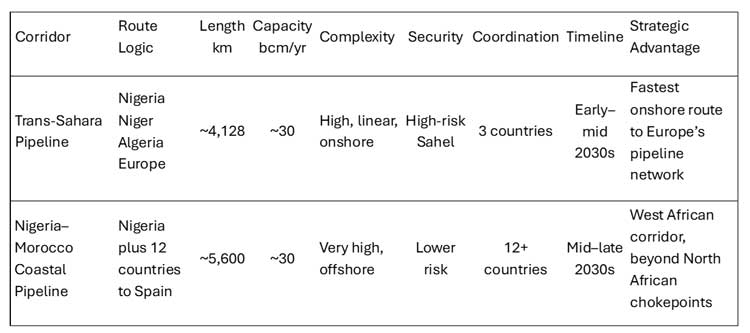
The Trans‑Sahara Pipeline represents the most ambitious continental gas artery ever proposed in Africa. It is designed to transport 30 bcm/yr from Nigeria through Niger into Algeria’s export system. Its logic is straightforward. Nigeria holds the continent’s largest proven gas reserves. Algeria possesses the most mature export corridors into Europe. Niger provides the geographic bridge. Feasibility depends on synchronizing technical execution, commercial bankability, and political stability across regions marked by insurgency and coup‑related volatility.


....MUCH MORE 

July 29
Can Europe Win the Energy Race Before High Costs Undermine Its Economy?

Europe has significantly reduced its dependence on Russian energy since the 2022 energy crisis, but it now faces a different and potentially more damaging challenge: persistently high energy prices that are weakening industrial competitiveness and threatening long term economic growth. 

Europe has significantly reduced its dependence on Russian energy since the 2022 energy crisis, but it now faces a different and potentially more damaging challenge: persistently high energy prices that are weakening industrial competitiveness and threatening long term economic growth.

The latest tensions surrounding Iran and the Strait of Hormuz have highlighted that Europe remains vulnerable to disruptions in global fossil fuel markets despite major investments in liquefied natural gas infrastructure, gas storage, and diversified energy imports. While Europe has largely avoided a repeat of the severe energy shock experienced after Russia’s invasion of Ukraine, rising geopolitical risks continue to expose structural weaknesses in the continent’s energy system.

As long as imported fossil fuels continue to determine electricity prices, every geopolitical crisis has the potential to translate into higher production costs for businesses and higher utility bills for households.

Energy Prices Continue to Burden European Industry

Although European natural gas and electricity prices had fallen substantially from their 2022 peaks by the end of 2025, they remained well above prewar levels. Gas prices were roughly 50 percent higher than before the Ukraine conflict, while electricity prices remained about 38 percent above historical averages....

....MUCH MORE 

July 31
7 Operators Offering the Best Arctic Cruise to Svalbard in 2026

Choosing an Arctic cruise to Svalbard means comparing operators whose actual ice access, passenger capacity, and wildlife programming vary more than their brochures suggest.... 

....MUCH MORE 

Capital Markets: Marc to Market's August 2026 Monthly

From Marc Chandler at Bannockburn Global Forex, August 1: 

(My X account, @marcmakingsense) was hijacked. The plumbing from the blog is still working but all other tweets are not me. While I work with X to see if I can regain control of the account, I have created another, @CapitalMarc. I am away this coming week but will have the next weekly out on August 8. Thank you for your patience and support.
Fifty-five years ago this month, US President Nixon closed the gold window. It was presented as temporary, but it became permanent and launched the dollar into a half-century of dominance nobody sitting in the room that weekend would have bet on. Now, on the anniversary, the cracks are getting harder to paper over.

Let's go back to the beginning because the origin story explains everything that follows....

....MUCH MORE 

"TD Cowen raises Quanta Services stock price target on strong earnings" (PWR)

 From Investing.com (Canada), August 3:

TD Cowen raised its price target on Quanta Services (NYSE:PWR) to $785 from $775 while maintaining a Buy rating.

The firm noted that Quanta Services shares rose 17% on the day of its second-quarter earnings release following a strong beat and an upgrade to the 2026 guidance. The stock, currently trading at $667.36, has delivered a remarkable 58% return year-to-date and 69% over the past year. According to InvestingPro data, 12 analysts have revised their earnings upwards for the upcoming period, while net income is expected to grow this year—two of 17 key insights available to subscribers.

The revised guidance included four acquisitions, but excluding mergers and acquisitions, second-half revenue was revised approximately 12% higher. The increase was supported by 5% quarter-over-quarter backlog growth excluding M&A activity....

....MUCH MORE 

In early pre-market trade the stock is up $18.03 (+2.70%) to $ 685.30

Among the acquisitions is this via the Cincinnati Business Courier, July 31:

Storied Cincinnati firm acquired by Fortune 500 company, plans HQ move

  • Quanta Services, a Houston-based Fortune 500 company, acquired Enerfab, a Cincinnati industrial contractor.
  • Enerfab will relocate its headquarters from Spring Grove Village to Blue Ash in December.
  • Quanta's $150 billion bonding capacity enables Enerfab to pursue larger industrial projects....
  • ....MUCH MORE  

    Recently on PWR:

    July 29 - Chartology: Ahead of Quanta Services July 30 Earnings Release (PWR)

    During July 29's trading action the stock completely filled a gap on the chart from April 7 - 8.

    July 30 - "QUANTA SERVICES REPORTS SECOND QUARTER 2026 RESULTS" (PWR)

    July 30 - "Earnings call transcript: Quanta Services posts big Q2 2026 beat, lifts outlook" (PWR)

    The stock is changing hands at $642.27 up $81.13 (+14.46%) after getting as high as $678.98 on a burst of enthusiasm or, more likely terror from someone caught short.

    As we noted introducing Jule 18's "Nice Words For Quanta Systems From The Dow Jones Empire (PWR)"

    Quanta has been a member of our hyper-concentrated electricity mini-portfolio for going-on three years. 3-Year performance: up 285.94% vs the S&P's +68.27%. 1-year performance: up 99.53% vs. +24.03% for the S&P 500. Year to date: up 69.45% vs. +8.39%.

    They are the class act of heavy-duty electrical contracting. 

    Sunday, August 2, 2026

    "Japan, Bretton Woods 2.0, & The End Of The Carry Era"

    From ZeroHedge, August 2:

    Japan, Bretton Woods 2.0, & The End Of The Carry Era 

    Japanese Finance Minister Satsuki Katayama is set to announce as early as Monday that Tokyo and Washington are coordinating on steps in the foreign exchange market to curb the yen’s weakness, a person familiar with the situation told Bloomberg.

    The content of the announcement is still being worked on but could happen as early as Monday morning, the person said, declining to be identified as the information isn’t public.

    Reuters earlier reported Katayama would confirm the joint action, and reinforce the two sides’ commitment to battle what they deem as excessive declines in the yen.

    Japanese authorities bought yen and sold dollars during New York trading on Friday, Bloomberg reported earlier, citing one person with knowledge of the matter. At the close of New York trading on Friday, the yen was quoted at 157.40 to the dollar, the strongest since early May.

    Just two days earlier, it was flirting around the weakest levels since 1986.

    The sharp gains were fueled by a combination of direct purchases of the yen, calls by officials to banks that trade the currency and jawboning from US Treasury Secretary Scott Bessent and Katayama.

    Bessent’s commitment to shoring up the yen was also shown when Reuters published a photograph of a notepad in front of him at a cabinet meeting in Camp David on Friday.

    Under a “To Do” title, it was written “Buy Japanese Yen (JPY) $5-10 bil.”

    Japan’s original plan appeared to have been to stick to a “no comment” line while the operation was underway, and offer only subtle hints of US support.

    The approach was kept to Thursday and Friday.

    But with multiple media reports emerging and Bessent’s to-do list on show, authorities may have decided to change course and make a clear public announcement.

    The operation on joint action is “still ongoing,” Reuters said, citing an unidentified government official.

    As James Thorne, Chief Market Strategist at Wellington Altus, explained via X, Bessent’s move toward the New York Fed matters because it signals that Treasury understands the long end is being driven by flows, not by the inflation scare Wall Street keeps recycling.

    Japan is now central to that story.

    If Tokyo must defend the yen, the Ministry of Finance may need to sell U.S. Treasuries, and when the largest foreign holder of U.S. debt becomes a seller, the long end will reprice.

    That is why this moment looks bigger than a routine currency episode.

    It has the feel of a new Plaza Accord and the opening phase of Bretton Woods 2.0.

    Since the 1980s, Japan has sat at the heart of the global yen carry trade, exporting savings, suppressing yields, and helping sustain a financial order built on cheap leverage and central-bank engineering. That order is now breaking down.

    The end of QE and the coming end of the yen carry trade mean capital markets, not central banks, will increasingly set rates.

    This is also why the inflation narrative is so weak....

    ....MUCH MORE 

    USD/JPY currently 156.31 with the Nikkei down 1,072.68 (-1.67%), outperforming the KOSPI, down 3.4%

    Here's the last month of the currency pair via TradingView:


    "The Curious Case of Stalin’s Wine Cellar"

     From Airmail, June 27:

    The international delegation included a few collectors and auction house representatives, a Russian father-and-son team specializing in bringing high-end Bordeaux to the Russian market (sanctions notwithstanding), a wine documentarian, and, as a guest of honor, the wine-world legend Pierre Lurton, president of Yquem and Cheval Blanc, traveling with his Brazilian journalist wife.

    Before the government’s official cellar opening ceremony, we were promised a taste of Georgian hospitality and some very good wine. So the evening before the unveiling, we found ourselves touring a hilltop vineyard near the snowcapped Caucasus Mountains. Our host, the affable middle-aged Irakli Gilauri—one of Georgia’s richest men and a former head of the Bank of Georgia—was bankrolling the opening festivities. “I call myself a terroir hunter,” he said, as mosquitoes swarmed the clearing where he’d soon break ground on a new winery. The first vintages of his Gilauri Wines will hit the U.S. market later this year. Georgia is the cradle of funky, amphora-made natural wine, but Gilauri has other ideas. With his pricey French wine consultant, he’s positioning his reds as serious, age-worthy collectibles. 

    Gilauri needed to get his new wine releases in front of the world’s most discerning palates, so we gathered for a blind tasting. His red blends held their own against young Bordeaux. For the opulent meal that followed, he channeled the spirit of Stalin’s wine stash, pouring 1948 Cheval Blanc and 1790 Madeira. “This will be the oldest wine any of you has ever tasted,” he announced proudly, as we drained his 236-year-old fortified wine.
    “I call myself a terroir hunter.”

    I sat between government officials at dinner that night. Across from me was David Songulashvili, Georgia’s minister of environmental protection and agriculture, the official overseeing Stalin’s cellar opening—and the man who stood to benefit most if the story held together. He would be using the proceeds from sales of the most expensive bottles to fund a new wine school. 

    “This is an incredible cellar,” he confided. “It’s Stalin’s collection. It was divided into three parts. One was taken to Siberia, the other somewhere in Russia—I don’t remember—and the third part was taken here. One of the biggest parts is here in Georgia.” The minister was overseeing the cellar’s unveiling, yet seemed hazy on some of the basic details. I didn’t think much of it at the time.

    Breaking the Seal

    The unveiling took place the following morning. Security was heavy outside the historic Wine Factory No. 1, where the bottles are held. Square-jawed men in black suits kept a suspicious eye on the crowd streaming into the chapel-like building, completed in 1896. (The year is etched into the floor.) Inside, across from a wine bar and a wine shop, Stalin’s secret cellar stood, lit in violet hues like a movie set, its dusty bottles secure behind a big iron gate. 

    Prime Minister Irakli Kobakhidze, of the ruling Georgian Dream party, approached a podium, facing a crush of photographers, and the cellar, a national treasure. “Alongside these Georgian masterpieces, the collection also preserves Joseph Stalin’s personal premium wine reserves and commemorative collections belonging to various world leaders,” he said.

     An antique lock was ceremoniously pried open. The prime minister walked arm in arm with wine legend Lurton into the cellar. Cobwebbed bottles with withered corks lined the iron shelves. Many were half empty. Few labels remained: the paper had long since turned to dust. It was impossible to identify anything. “This … is an amazing cellar,” Lurton told the local Reuters correspondent, who was filming inside. “It’s like a pantheon of wine here.”

    After the photo op, we joined Prime Minister Kobakhidze and his Cabinet for dinner nearby at the historic Writers’ House of Georgia, a center of literary life for more than a century. (John Steinbeck stayed in a room on the top floor in 1947.) A sumptuous supra, a classic Georgian feast, paired an overabundance of Château d’Yquem with creative dishes by chef Tekuna Gachechiladze, often called the godmother of Georgia’s food revolution. 

    Every supra has a toastmaster who waxes poetic between courses to keep the wine flowing. “To our good health,” announced Songulashvili, rising to the occasion at the start of the meal. “To our government,” he continued. “To Monsieur Lurton, who is supporting us for the identification of the Yquem bottles.” (Lurton didn’t authenticate any bottles of Yquem on this trip to Georgia. He has not responded to AIR MAIL’s requests for comment.) 

    The Reuters story hit the wires the next day. “Georgia uncorks the value of Stalin’s 40,000-bottle wine collection,” read the headline. The narrative was now official, circulating around the world as fact. There was only one problem: almost everything I’d learned in Georgia cut against the claim that the cellar was Stalin’s.

    Questions of Provenance

    Preliminary research, before my trip, had found nothing in the history books about Stalin’s secret cellar or a penchant for grand cru Bordeaux. If he cherished his collection, I wondered, why would he have abandoned it after the war? And hadn’t he turned his back on his homeland when he became the supreme Soviet leader? 

    As a wine drinker, Stalin had a well-known soft spot for semi-sweet Georgian reds, which, as the wine historian Stephen Bittner put it, were consumed in the “Russian fashion,” diluted with vodka. He never really acquired a taste for Burgundy or Bordeaux....

    ....MUCH MORE 

    "YOU HAVE been infected with a “demon germ”...."

    From The Economist, July 30:

    The terrifying threat of a genetically engineered plague
    Annie Jacobsen imagines the repercussions of a leak from a Russian laboratory 

    Biological War: A Scenario. By Annie Jacobsen. Dutton; 432 pages; $33. Torva; £22

    YOU HAVE been infected with a “demon germ”, but you do not feel monstrously bad just yet. In fact, you feel euphoric. The bacterium multiplying inside your lungs has been modified with an endorphin gene to trigger a neurochemical high—which encourages you to socialise, and thereby spread the pathogen about.

    Soon the ecstasy gives way to a fever and splitting headache. You start coughing up bloody sputum: evidence of rotting lungs and the onset of sepsis. Antibiotics help at first, but then activate virus genes engineered into the bacterium. That virus attacks your nervous system. You suffer tremors and seizures and soon you die.

    In “Biological War: A Scenario” Annie Jacobsen, a journalist and the author of several books on war and military affairs, lays out what would happen if a genetically modified bioweapon were unleashed. She reprises the format of her previous book, which offered a minute-by-minute account of a hypothetical nuclear attack on America. The result is a tale just as energetic, detailed and disturbing.

    In this imagined scenario, there is an explosion at an infectious-disease research facility in Siberia, where scientists genetically alter bacteria and viruses in ways that can make them more virulent, transmissible and resistant to antibiotics. In the blast, a scientist is infected with a modified pneumonic plague. Within minutes, American analysts are poring over intelligence indicating a potential lab leak. The American president is briefed but has few options. “By the time a pathogen escapes from a lab and gets seeded in the population”, Ms Jacobsen writes, “it is almost certainly already too late.”

    Russian officials obfuscate and blame contaminated marmot meat from a wet market for an outbreak of “atypical pneumonia-like illness” (one of many passages that will remind readers of covid-19). As the disease spreads, the faults in America’s biodefences are exposed. Detection technologies fail. Just 100 isolation beds exist in a country of more than 340m people.

    Crucial data are not shared across agencies. An outbreak of plague among California’s homeless population, for instance, is incorrectly treated as an overdose event, and not reported to the Centres for Disease Control and Prevention. The effects of the plague on its victims are described in stomach-churning detail.

    Soon emergency services are overrun. Social media stoke panic; the internet is shut off. Martial law is imposed. There is violent unrest. Cabinet officials are taken to remote locations to ensure continuity of government—or what is left of it. “What makes biological warfare so sinister isn’t just its ability to deliver mass casualties and deaths,” Ms Jacobsen writes, “but its capacity to create unbridled chaos.”

    It is an engrossing, plausible book—though it is surprising, given the subject’s timeliness, that ai barely features in it. The pathogen in Ms Jacobsen’s scenario is a cold-war relic built by Soviet scientists. But AI models, trained on virological and bacteriological information, can turn novices into bioweapons manufacturers. Frontier labs have admitted that AI tools are getting better and better at designing pathogens. Instances of rogue states and terrorist groups using bioweapons are mercifully rare. But with barriers to development falling, new and troubling scenarios are certain to emerge....

    ....MORE 

    "How smashing the NIMBYs created modern capitalism"

    From Works In Progress, June 18: 

    In 1688, England swept away the encrusted vetocracy that had held back economic growth for centuries. Could we do the same today?  

    Industrial modernity was invented in the English midlands around the end of the eighteenth century, kicking off an unprecedented global rise in living standards that continues to this day. But what made this revolution possible was a lesser-known political revolution that took place in the previous century: a period known in English history as the Glorious Revolution. 

    Today, the Glorious Revolution is remembered for having introduced the system of constitutional monarchy, which subordinated the power of the monarch to Parliament. What is really interesting, though, is how Parliament used its new power: to untangle excessively strong and complex property rights, making it possible for the first time for sustained investments to take place in infrastructure and agriculture across England. And unlike in most other political revolutions, this happened almost entirely peacefully and with the consent of the people whose rights were being redrawn. 

    Fragmented political and property rights have again become one of the Western world’s biggest problems, leading to the ‘vetocracy’ that paralyzes many developed countries. Could we foment a Glorious Revolution of our own?

    Multiple scleroses

    Seventeenth-century Europe was economically stagnant. Despite intellectual advances like the creation of patent systems, the flourishing of mathematical schools, and the founding of learned societies like the German Leopoldina and France’s Académie des Sciences, the physical world saw only plodding progress.

    Agriculture was practically the only game in town. Almost everyone lived in small rural settlements: fewer than ten percent of Europeans lived in towns of more than 5,000 people in 1500. By 1700 this had grown to just 12 percent; and by 1800, to 15 percent. In France, Europe’s most populous country, nearly 70 percent of the workforce worked in agriculture between 1695 and 1790. Germany was similar, and Scandinavia, Russia, Eastern Europe, Southern Italy and Spain were possibly more agrarian.

    The default was for countries to continue for centuries with virtually no growth. Spanish output per capita was flat for half a millenium between 1300 and 1800. Other areas saw temporary bursts of growth, followed by stagnation or reversion: Swedish and Portuguese incomes were lower in 1800 than in 1550, and the Italian efflorescence during the Renaissance was followed by steady decline for centuries. Even the Dutch golden age of 1500 to 1680, which saw the Netherlands buck the European trend with a large majority of its population working in industry or commerce and living in towns, was followed by more than a century of relative stagnation.

    Property ownership was so fragmented that nobody investing in improvements could expect to make a return. Splintered ownership of farmland discouraged the adoption of new crops and rotations. Rigid inheritance rules made it prohibitively difficult to invest in improvements to land or infrastructure. Roads were bad because nobody took responsibility for them, hindering the transportation of manure for fertilizer and preventing the trade that would allow different areas to specialize in different crops. Agricultural yields were so low that nearly everybody had to work to produce food instead of in other industries like mining or manufacturing.

    Many European states tried to solve these problems, and nearly all failed. The reason was usually the same: monarchs depended on the support of landowning aristocrats and clergy, and those landowners had no confidence that reforms would leave them better off....

    ....MUCH MORE 

    Saturday, August 1, 2026

    "Most countries will never have frontier AI. They’re the ones who should be worrying"

    From Asterisk Magazine, Issue 15, July 2026:

    Fear of AI disruption spreads in concentric circles. Outright frenzy inside the labs becomes intense distress in San Francisco becomes palpable anxiety on the East Coast — and once the sentiment has crossed an ocean, there’s only mild discomfort left when it washes upon the shores of the other side.

    An honest appraisal of the situation, however, should suggest the opposite response: It’s the employees of the labs, rich in equity and embedded in the most dynamic labor market there ever was, that should feel the least apprehension. Though the institutions of American government face much more immediate disruptions, it is the periphery of AI development — the other 193 countries in the world without a domestic frontier AI developer to tax and regulate — that confront the biggest risks to their economic welfare and physical security.

    These risks aren’t resolved even if the AI built in San Francisco is particularly safe or particularly aligned. In fact, the risk may cut the other way: The better AI goes for its makers and their country, the more it threatens to disrupt the countries that build no frontier AI themselves. If their institutions, from labor markets to governments, are unprepared for the coming transition, their citizens risk being consigned to lasting irrelevance. They face life on the permanent periphery of a new world. 

    The other 193 countries 
    If you’re reading this magazine, you too have probably been haunted by the specter of the “permanent underclass.” The San Francisco Bay Area is abuzz with concerns that AI will irreversibly calcify a stratified economic order. 

    Their concern trades on a fairly specific set of premises: AI progress will continue unabated, and perhaps even accelerate. The American frontier developers that reap most of the ensuing economic gains. And the end point of this progress will be a radical transformation, where AI comes to dominate economic affairs and strategic statecraft and power accumulates for those able to deploy the best AI most effectively.

    The rest of this piece accepts these premises — and makes the case that, if they are true, they imperil every nation without its own frontier AI. With vanishingly little economic and political leverage compared to AI powerhouses, these countries may permanently lose the ability to compete in global financial and political marketplaces. Rather than existing economic groups within nations being pushed into a permanent underclass, entire countries could be pushed to the periphery.

    From the innermost circle of AI development, it’s easy to be distracted by concerns that seem to imperil even in-the-know researchers and operators. But luckily, even under the above conditions, the real world might be a fair bit more complicated than these predictions assume. As the speculative post-AGI economy emerges from the very real constraints of our current political order, there are a few backstops that seem to make the emergence of a permanent underclass less likely.

    The first is that the would-be-underclass still wields considerable political power today. The U.S. government holds great power over the trajectory — and even the possibility — of AI development. It could tax or expropriate leading research labs, suppress automation by fiat, or even follow the guidance of the most radical voices and declare the Butlerian Jihad on artificial intelligence, shutting it all down. In the interest of preventing this outcome, technology firms and moderate policymakers will probably do their very best to assuage concerns through policy intervention.

    The second backstop is that the economics of AI labor replacement are far from settled science....

    ....MUCH MORE 

     Hence the one-line intro to July 18's AI/semiconductors/software: "Forrester Global Sovereignty Forecast: Despite Rising Geopolitical Tensions, Technology Sovereignty Will Advance Slowly Through 2030":

    Yesterday I found myself wondering how the Central African Republic was ever going to compete. Here Forrester raises the same question re: Europe.

    And outro: 

    Maybe after the July 27 full release of Moonshot AI's flagship model, everyone in the C.A.R. will just download Kimi K3. 

    Former Director Of The Centers For Disease Control: Covid Was Spreading In Wuhan In September or October 2019

    Re-using our introduction to December 2023's "Researcher Who Developed Chinese Covid Vaccine Probably Thrown Off Roof": 

    For the last 3 1/2 years  I've been keeping an eye open for hints that the lab leak (notice no one is talking about pangolins or bat soup any more?) was known to the NIAID/gain-of-function/state security organs gang before September 2019. Not searching it out but trying to be aware of the dates being pushed back to the fall and summer of 2019....

    From The Hill, March 28, 2021:

    Redfield says he thinks COVID-19 began spreading in Wuhan in September or October  

    Former Centers for Disease Control and Prevention (CDC) Director Robert Redfield said in an interview that aired Sunday that he thinks COVID-19 began spreading in Wuhan in September or October of 2019. 

    “If I was to guess this virus started transmitting somewhere in September, October in Wuhan,” Redfield told Sanjay Gupta for a CNN special report. 

    “That’s my own view,” he added. “It’s only an opinion. I’m allowed to have opinions now.”....

    ....MORE 

    Our focus/purpose is not the 'proximal origin', raccoon dog or Biosafety Level 4 Laboratory, but rather the date the virus was circulating.

    Possibly related, July 31's: Covid: China's Purchases Of PCR Test Kits Soared Months Before The First Cases Were Announced

    ""Canicule, fraîcheurs, vendanges (France, XVe–XIXe siècles)" Dog-days, cold periods, grape-harvests (France, 15-19th centuries)"

    Ahead of the grape harvest, a repost from January 2022.

    Original post:

    We will be referring to some research papers later this year, and fearing they might be lost in the link-vault, post them here so they are easily searchable (which was the original purpose of the blog).

    As with the English agricultural records*, the French extend far enough back that we can tease out patterns.

    First link, the headliner: 

    https://pubmed.ncbi.nlm.nih.gov/15810545/

    Abstract
    Dog-days, cold periods, grape-harvests (France, 15-19th centuries). The climate history can be based on several kinds of data. In the present paper, French records of grape-harvest dates in Burgundy from 1370 to 1890 were used for evaluate the climates at these various period of time. These results reveal that temperatures as high as those reached in the 1990s have occurred several times in Burgundy since 1370. Correlations between temperatures and historic data are presented.

    And: 

    https://www.researchgate.net/publication/222101676_The_climate_in_Burgundy_and_elsewhere_from_the_fourteenth_to_the_twentieth_century

    The climate in Burgundy and elsewhere, from the fourteenth to the twentieth century

    This paper reviews the climatic history of northern France from the grape harvest dates of the Burgundian vineyards. The grape harvest date is constrained by the mean surface air temperature during the growing season (April–August). At the start of the grape harvest dates series – during the 1380s and from 1415 to 1435 – the tendency is towards early harvest dates and warmer conditions, starvation due to crop scorching in 1420 included.

    During the second half of the ‘ Quattrocento’, there are later harvest dates and cooler springs/summers, exemplified by the 1481 famine, due to rain and cold. The 1500s, 20s, 30s and 50s are characterised by blasts of warmer summers. The ‘midsummer night’s dream’ (1596/7) can turn into a nightmare . . . Then, a cold ‘long seventeenth century’?

    This is quite pronounced from 1570 to 1630, with, however, a slight improvement around 1600–20. Major waves of hot summers were experienced during the 1630s, 60s and 80s. Is the Maunder minimum, between 1645 and 1715, responsible for a slight, synchronous, cooling? In this case, it would be mainly the Late Maunder Minimum (1675–1715), with the chill of 1675, the 1690s and 1709–1715. Then the great warming of the eighteenth century: the years 1704–07, 1718/9, the 1720s and 30s, 1757–65, the 1780s and above all 1778–81 all favour this interpretation, though we must not forget the cold, wet years 1725, 1740 and 1770. The years 1812–17 are not only snowy but also globally cold (due to the Tambora eruption in 1815 and the Dalton minimum?). And then there is the 1846 heatwave, so harmful to cereals. The Little Ice Age ends in 1860, with no return up to the present, the twentieth century warming from 1900, with an intensification of the phenomenon from 1976 and particularly the 1990s

    And

    https://link.springer.com/article/10.1007/s00704-011-0410-3

    Extreme grape harvest data of Austria, Switzerland and France from A.D. 1523 to 2007 compared to corresponding instrumental/reconstructed temperature data and various documentary sources

    And:

    http://citeseerx.ist.psu.edu/viewdoc/download?doi=10.1.1.568.7478&rep=rep1&type=pdf 

    An open-access database of grape harvest dates for climate research: data description and quality assessment 

    And

    The longest homogeneous series of grape harvest dates, Beaune 1354-2018, and its significance for the understanding of past and present climate

    Abstract. 
    Records of grape harvest dates (GHD) are the oldest and the longest continuous phenological data in Europe.
    However, many available series including the well-known (Dijon) Burgundy series are error prone, because scholars so far uncritically drew the data from nineteenth century publications instead of going back to the archives. The GHD from the famous vine region of Beaune (Burgundy) were entirely drawn from the archives, critically cross checked with narrative evidence. In order to reconstruct temperature, the series was calibrated against the long Paris temperature series comprising the 360 years from 1659 to 2018. The 664-year-long Beaune series from 1354 to 2018 is also significantly correlated with tree-ring and documentary proxy evidence as well as with the Central European temperature series (from 1500). The series is clearly subdivided into two parts. From 1354 to 1987 grapes were on average picked from 28 September on, whereby during the last 31 year long period of rapid warming from 1988 to 2018 harvests began 13 days earlier. Early harvest dates are shown to be accompanied by high pressure over western-central Europe and atmospheric blocking over Denmark. The extremely early harvests comprising the 5% percentile bracket of GHD are unevenly distributed over time. 21 of them occurred between 1393 and 1719, whereby this is the case for just five years between 1720 and 2002. Since the hot summer 2003, 8 out of 16 spring-summer periods were outstanding according to the statistic of the last 664 years, no less than 530 among them within the last 8 years. In the Paris temperature measurements since 1659, April-to-July temperature reached the highest value ever in 2018. In sum, the 664-year-long Beaune GHD series demonstrates that outstanding hot and dry years in the past were outliers, whereby they became the norm since the transition to rapid warming in 1988.
    And finally:

    https://link.springer.com/article/10.1007%2Fs10584-010-9810-0 

    Grapevine harvest dates in Besançon (France) between 1525 and 1847: Social outcomes or climatic evidence?

    *For more on other agricultural history, you may want to dip into the big daddy of price series:

    "A History Of Agriculture And Prices In England, From The Year After The Oxford Parliament (1259) To The Commencement Of The Continental War (1793)"

    by J. E. Thorold‐Rogers, 7 volumes, 1866-1887.

    Here's another bit o'price series scholarship:

    The paper constructs an annual price series for English net agricultural output in the years 1200-1914 using 26 component series: wheat, barley, oats, rye, peas, beans, potatoes, hops, straw, mustard seed, saffron, hay, beef, mutton, pork, bacon, tallow, eggs, milk, cheese, butter, wool, firewood, timber, cider, and honey. I also construct sub-series for arable, pasture and wood products. The main innovation is in using a consistent method to form series from existing published sources. But fresh archival data is also incorporated. The implications of the movements of these series for agrarian history are explored.

    "L’Oréal CEO Nicolas Hieronimus Bets on A.I. to Extend a Nearly $100B Family Fortune"

    From Observer, July 30:

    As L'Oréal posts strong first-half earnings and strikes a sweeping partnership with OpenAI, the reclusive dynasty behind the world's largest beauty company—already worth $95.6 billion—cements its next generation of control. 

    More than a century after chemist Eugène Schueller turned a hair-dye formula into the business that became L’Oréal, the beauty giant is still finding new ways to grow, with A.I. as its latest bet.

    L’Oréal’s Revenue rose 6.3 percent on a like-for-like basis, a key retail metric, to €11.6 billion ($13.2 billion) in the April-June quarter. For the first half of 2026, revenue increased 5.8 percent to €23.78 billion ($27.1 billion), while net profit climbed 4.7 percent to €3.96 billion ($4.5 billion) and the operating margin reached 21.3 percent. Growth extended across every region and division, from Maybelline’s mass-market makeup to La Roche-Posay’s dermatological skincare and Kérastase’s salon-grade haircare.

    CEO Nicolas Hieronimus credited that performance to e-commerce and L’Oréal’s innovation strategy, which now includes a partnership with OpenAI announced in June. “Our innovation engine is firing on all cylinders—and A.I. will help it maintain its pace,” he said in a statement accompanying the results.

    Few investors have more riding on that momentum than Schueller’s descendants. His granddaughter, Françoise Bettencourt Meyers, and her family own 34.79 percent of L’Oréal, making them the company’s largest shareholder. L’Oréal shares rose 3.6 percent to €397.15 in Thursday trading, adding roughly €2.5 billion ($2.9 billion) to the market value of the family’s stake. Forbes currently estimates the family’s collective fortune at $95.6 billion.

    L’Oréal is turning ChatGPT into a beauty counter

    L’Oréal’s e-commerce sales jumped 18 percent to €7.4 billion ($8.5 billion) during the first half of the year, almost twice the growth rate of the online beauty market, according to the company. L’Oréal now sees chatbots as a potential next storefront.

    On the earnings call, Hieronimus said younger consumers are “shifting massively” toward large language models for product questions and described beauty as one of the most conversational categories. L’Oréal’s brand recognition, scientific data and professional endorsements could help its products surface in A.I.-generated recommendations, he argued, although the channel remains a “moving target.”

    The shift could be lucrative well beyond L’Oréal. McKinsey estimated last year that generative A.I. could create $9 billion to $10 billion in annual value across the beauty industry, with marketing and sales among the largest opportunities.

    At VivaTech in Paris in June, L’Oréal outlined a two-pronged collaboration with OpenAI: turning ChatGPT into an interactive beauty assistant while putting its models to work behind the scenes....

    ....MUCH MORE 

    "Amazon's Q2 was great, but the earnings release is packed with baloney" (AMZN)

    Amazon is one of the two hyperscalers we think know where they are going with AI. 
    (GOOG being the other) 

    That being said, if AMZN is playing fast and loose with how they present their reality, they should be called out.

    From The Register, July 31:

    "Tell me lies, tell me sweet little lies" 

    Amazon reported its earnings today, and because I am professionally depressed I read the thing in full [PDF].

    "How long can I go before the red haze of rage sets in" is a fun game, and today I made it all the way to the bottom of the second page when I encountered a bullet point touting how AWS "made its spec-drive [sic] coding agent, Kiro, available on iOS."

    Yes, I was in the room when they announced it at the New York summit, six weeks ago. As of this writing, their website, which I have screenshotted says I can "request early access" because "We'll invite a limited number of people to try the app via Apple's TestFlight, and we'll send everyone a link when it's ready." So Kiro is "available" in the same way as I am available to play in the NBA. You can twist yourself into a pretzel and assert that this claim is technically true, but for all practical readings it's what we'd colloquially term "a lie." You need to be explicitly invited to Apple's developer beta testing tool, where a limited number of users can try out an unpublished version. You cannot download it on your phone, and there is no page in the App Store that showcases the product. 

    The delay is almost certainly due to Apple's byzantine App Store policies, which I have some sympathy for — but this is an earnings statement. If they're going to "shade the truth" like this, what else are they not being forthcoming about?

    Once you notice it becomes hard to stop

    There are a lot of other statements that one suspects might not stand up to scrutiny. Graviton boasts "up to 30 to 40% better price-performance," which I only accept because I have seen the numbers myself on customer workloads. The express statement that their AI business and chips business are each exceeding $25 billion run rates in consecutive bullets, with no word on whether those dollars overlap (we will come back to this point shortly). And their Bedrock statement: "customers spent more in Q2 than all prior quarters combined," which makes it sound like a rocket until you realize that they're saying the past 90 days exceeded the other 10 quarters for which Bedrock has been available. Without actual numbers tied to these, that makes it sound like for the first couple of years Bedrock was showing up wearing a party hat but no pants.

    Then there's the AWS operating margin of 39.4%, which came in above every published analyst estimate and which everyone will invariably cite as cherry-picked proof the AI buildout is printing money. On the call, CFO Brian Olsavsky disclosed that it includes roughly $600 million of mark-to-market gains on energy derivative contracts. By his math, AWS margins were up 650 basis points year over year, or 520 "if you exclude the derivative accounting gain." Strip that gain out yourself (behold the power of arithmetic!) and the blowout margin goes right back inside the range analysts had modeled. Amazon now hedges electricity the way an airline hedges jet fuel, and this quarter the hedges paid off directly. Olsavsky noted these adjustments "have not been significant in prior quarters." The first quarter they are significant, they land in AWS margin, and their Q3 guidance already assumes no impact from these remeasurements going forward. Amazon knows it's noise, but clearly saw no reason to turn down claiming the win.

    The chips business that sells no chips

    Back to those dueling $25 billion run rates I touched on; describing their "AI chips business" that way struck me as an incredibly odd thing to say.

    That business has revenue, growth, a triple-digit trajectory, sarcastic numbers of happy customers — but what it doesn't have is a product that you can buy. There is no Trainium price list, they will not ship you a socketed Graviton chip to put in your next desktop build, there isn't even an external part number. What Amazon books as "chips revenue" is EC2 instance rental (possibly filtered through higher level services like Bedrock, SageMaker, the half-baked agents that fail to properly explain your AWS bill to you, etc.), and an EC2 instance is not a chip. It's the chip, plus the nVME, plus the NICs (themselves built on Nitro, which uses Amazon's own silicon), plus some aspects of the data transfer that somehow aren't directly billed, plus the building the whole mess lives in—and then with AWS's margin layered on top. The silicon itself is a minority line item in the internal bill of materials that constitutes its business.

    You don't have to take my word for it; Amazon CEO and AI Marketing Manager Jassy spent last quarter's call lamenting that the cost of components, "particularly memory, has skyrocketed," so by his own testimony a growing slice of the "chips business" is memory revenue.

    Cynically, the category exists so that headline writers will talk about it in the same breath as Nvidia's data center numbers, which they of course will. But Nvidia's $25 billion is silicon sold in the form of physical packaged chips, shoveled out their loading dock. Amazon's is fully-loaded infrastructure rental. This is a hotel comparing its revenue to a mattress company's....

    ....MUCH MORE 

    Regarding the chips, most people who follow the company know they aren't yet selling Trainium and handing over title to the silicon. That's still on the come and should happen in the next six to nine months. As for the margins, this is the first analysis we've seen that highlighted the hedges. Not doing so is just lazy, something we used to see with Mexico's state-owned oil company and their hedges.

    Pemex runs a remarkably profitable hedge book and including those profits without highlighting the fact they are financial rather than operational income statement items gives a distorted view of how Pemex is actually performing. So kudos to the writer and to The Register for the highlight.

    Recently:

    July 30 - "Amazon beats Q2 earnings expectations, as AI, chip businesses see $25 billion run rate" (AMZN)

    The negative we will see tomorrow, pointed out in the Yahoo story, is the company is spending all their cash flow rather than returning it to shareholders.

    As our earlier GeekWire link, "Ahead Of Today's Amazon Report GeekWire Looks At The Behemoth (AMZN)", quoted:

    “We’re not investing approximately $200 billion in capex in 2026 on a hunch,” CEO Andy Jassy wrote in his April shareholder letter.

    The GeekWire article had the Bezos story at Fortune as a sidebar: 

    Jeff Bezos says this business is becoming Amazon’s next ‘pillar’

    Amazon’s next pillar could be built on a foundation of silicon.

    In a new interview with Fortune, Amazon founder and Executive Chair Jeff Bezos says the company’s custom chip business is on track to become one of Amazon’s most durable businesses, placing it alongside Marketplace, Prime, and Amazon Web Services as a core pillar of the company.

    “A few of our offerings have become durable pillars, things like Marketplace and Prime and AWS,” Bezos told Fortune. “What I see right now is that our chips business, our silicon business, is lining up to be our next pillar.”....

    ....MUCH MORE, including links to the Fortune article.

    Friday, July 31, 2026

    "A fundamental flaw leaves LLMs strikingly vulnerable to attack"

    From MIT Technology Review, July 30:

    It makes it easy to trick them into doing things they shouldn’t, such as telling you how to sabotage an aircraft’s navigation system. 

    It is impossible to make large language models fully secure against hacks because of a fundamental flaw in how they work, a team of researchers argue in a paper presented at the International Conference on Machine Learning, a top AI conference, this month. The claim has huge implications for the safety of this technology, which is being used in more and more applications, from government and military systems to online shopping and health care.

    By taking advantage of this flaw, which concerns how LLMs identify who or what is giving them instructions, the researchers were able to make popular LLMs spit out information they had been trained not to provide, such as how to synthesize cocaine and how to sabotage a commercial aircraft’s navigation system.  

    “There’s a real probability that this is going to be a problem that’s fundamentally unsolvable,” says Charles Ye, an independent researcher and coauthor of the ICML paper....

    ....MUCH MORE