Showing posts sorted by relevance for query freeports. Sort by date Show all posts

Monday, November 30, 2015

Art (and money laundering): Swiss Government's Tough New Controls On Freeports Effective January 1

As our readers are well aware, the future of freeports is in Delaware (and Luxembourg).

Geneva Freeports Photo via: Geneva-freeports.ch
Geneva Freeports
Photo via: Geneva-freeports.ch
From Barron's Penta:

Freeports in Freefall?
The crackdown has begun. After months of speculation, increased scrutiny among tax authorities and regulators around the globe, not to mention a major art fraud scandal that ensnared the opaque inner workings of the Geneva Freeport, the Swiss government just announced it was placing tough new controls on its freeports, those transit ports which have, in recent years, become maximum-security safety-deposit boxes with tax benefits.

The new regulations, which take effect in January, mark a radical departure for business as usual at the freeports where secrecy and anonymity have made them attractive destinations for art collectors storing their treasures while avoiding tax liabilities. But those very protections the freeports offer its clients have also made them vulnerable to a host of illegal activities and the stricter rules are part of the government’s broader clamp down on money laundering, tax evasion and black market trades. “With the introduction of the new amendment,” the Swiss authorities announced, “the legislature wishes to ensure the required transparency towards domestic and foreign authorities on the stored goods. In addition, Switzerland’s position in the fight against money laundering has been strengthened.”

In other words, for those who’ve secreted away their Picasso’s and Modigliani’s for years, using the freeports much like the art world’s Cayman Islands — the gig is up, at least in Switzerland. Under the new set of rules, goods stored for export will now have a six-month time limit while a host of new disclosure requirements come into play, including that owners must now declare their identity as well as the identity of anyone buying those goods destined to leave the freeports. Further, the Swiss have extended their reach, adding wine, cigars, cars, and furniture to the list of goods required for disclosure.

“This could be a total game changer,” says a former U.S. law-enforcement official who now deals with art market issues in private practice. “It could revert the use of the freeports back to how they were intended as furthering trade – instead of operating as tax-free stash houses.” Adding, “This raises the stakes considerably and will probably cause a number of collectors to rethink the ways in which they manage, store or transfer their assets....MUCH MORE
Offshore Onshore? Fritz Dietl On His New Delaware Freeport
The Delaware Freeport
(Photo by Fritz Dietl)

Okay, maybe not Delaware.
However, if interested here are some of the ins and outs of the tax implications from Art Law Report:
The New Domestic “Freeports”: Sales and Use Tax Opportunities and Risks
Your mileage (and billable hours) may vary, close cover before striking, etc.

Previously:

Art: War Between the 'Freeport King' and the Oligarch and How Dmitry Rybolovlev Made a Quick $300 Million
Super Wealth: Barron's Penta Calls For Avoidance Of Geneva-style Freeports
Update: "What's the Scam? Why Did Deloitte Set Up Their Art & Finance Practice In Luxembourg?"

Possibly also of interest:
If it were a museum, some say that it would probably be the best museum in the world
"Oligarchs and Orchestras: Inside Luxembourg’s Secretive Low-Tax ‘Fortress of Art’ Warehouse"
"(Sm)art Investing: Rich Move Assets from Banks to Warehouses" ($4 trillion in 'treasure' assets)

Wednesday, May 21, 2025

BlackRock Will Privatize The U.K. (Freeports, Special Economic Zones, the usual)

Two from artist/activist/lecturer at the Royal Academy, David Powell.

First up, via X, April 5: 

Daniela Gabor’s assertion in The Guardian that "BlackRock will privatise the UK" reflects a critical perspective on the growing influence of private finance, particularly BlackRock, in shaping Britain’s economic and social landscape. 

Add to this Labour's recent webinar that included 700 lobbyists where Starmer's spokesperson Lord Evermore stated that governance powers were to be handed over to the lobbyists, while the UK Govt takes a 'secondary position' and things get very dark, very quickly.

Starmer's announcement on Twitter that the Govt is now a partner with firms like BlackRock is not about rebuilding the UK’s public infrastructure, far from it, this is about facilitating Blackrock's ambitions to expand its financial portfolio by hoovering up housing, education, health, nature, and green energy, by exploiting public-private partnerships (PPPs) to the max. This should be immediately stopped.

The most lucrative line of business in the world right now is between governments and corporations
Starmer is subsidizing privatization with taxpayer money, as BlackRock leverages its $10 trillion in managed assets to expand its grip on public goods.

Subsidies for the rentier class or asset class are a destructive feature of globalisation, govt's dish out subsidies in the form of State aid which is public money at ever-increasing and alarming rates.  State aid is strictly regulated in the EU to prevent governments of member states from giving public money as profit motives for corporations. Subsidies induce corporations to take advantage of deregulation policy rollouts, nowhere are these more dangerous than in free zones such as Freeport's and Special Economic Zones, of which there are 74 SEZs and 12 Freeports currently nearing operational status in the UK.

BlackRock CEO Larry Fink’s pitch at the G7 summit in June 2024 saw him argue that rich nations need growth through infrastructure investment—estimated at $75 trillion globally by 2040—but public debt constraints limit state-led funding. Fink positions asset managers like BlackRock, which oversee vast pools of private capital (e.g., pensions and insurance funds), as the solution. This is a Trojan horse: BlackRock doesn’t just invest; it reshapes the social contract by turning public assets into profit streams, sweetened by public subsidies.

In the UK context, this aligns with Labour’s 2024 manifesto, which embraces "derisking" investments—essentially, the state absorbing risks to make projects attractive to private firms. BlackRock’s real-world moves, like its £1.5 billion-plus investments in UK housing (e.g., shared ownership with Heylo Housing and rental projects with Outpost Management), show it’s already active. Gabor’s critique amplifies this, warning that such partnerships could lock public goods into private hands, making renationalization harder and ceding control over critical sectors to finance giants.

The UK government will in its partnership with BlackRock privatise. BlackRock’s role is opportunistic: it invests where policy opens doors.

 Labour’s openness to PPPs, as Gabor notes, accelerates this. Its influence is real—owning stakes in major UK firms and advising on crises like 2022’s pension fund mess—but it’s a partner, not a puppet master. It would be Keir Starmer's Govt that privatises the UK with a criminally corrupt shadow bank with infinite capital and atrocious track records in just about every corporate crime under the sun
https://www.theguardian.com/commentisfree/article/2024/jul/02/labour-plans-britain-private-finance-blackrock

And at The Canary, April 8/May 6:

Freeports: what are they, and why did Labour sign off on them with the Tories? 

“Freeports represent a significant threat to the well-being of Britain” – Richard Murphy, tax expert and political economist.

“I think that for the most part, these zones are used quite candidly by political leaders to create areas of unaccountability or to accelerate economic activity for their own interests” – Quinn Slobodian, author of Crack Up Capitalism: Market Radicals and the Dream of a World Without Democracy.

Freeports: complex entities carving up the UK for corporations

Freeports and Special Economic Zones (SEZ) are variations on the same thing: deregulation, privatisation, tax evasion, and corporate governance.

Freeports and SEZs are complex entities. Complexity is their camouflage, and we must understand what they are, because they are carving up the UK into regions where corporations are protected from parliamentary and public scrutiny under secondary legislation.

A Freeport is privately owned, whereas a port is publicly owned.

Ports are traditionally used for container freight transhipment operations. Freight comes into a port area, and it is stored and/or processed before being re-exported. However, a Freeport can also be a warehouse, an inland location, or an airport.

Freeports carve out sections of the country by establishing a border around them. Within that border, companies have exceptional legal status, distinct from the rules and regulations applied to their surroundings.

Goods going into a Freeport are not subject to customs and tariff duties. After US president Donald Trump’s latest global tariff attacks, this begs the question, will the UK’s 12 free ports be exempt from Trump’s tariffs when exporting goods to the US?

BlackRock’s fingerprints all over Freeports, naturally

Blackrock has bought three British Freeports. In partnership with Terminal Investment Limited (TiL), a subsidiary of the shipping line MSC, it has acquired an 80% stake in Felixstowe, Harwich, and Thamesport, as part of a larger $22.8 billion deal with CK Hutchison.

This transaction, announced in early March 2025, involves Hutchison Port Holdings, which includes 43 ports across 23 countries. The deal encompasses the UK’s Port of Felixstowe, the country’s primary container hub, along with Harwich and Thamesport, as well as significant terminal operations in Europe, such as Rotterdam.

The agreement was finalised with an expected signing date of 2 April 2025, transferring control of these key UK freeports to the BlackRock-TiL consortium. This move has been noted in trade and freight industry reports, though broader mainstream media coverage has been limited as of the current date, 7 April 2025.

Freeports: the playgrounds of predatory capitalism....

....MUCH MORE 

We have quite a few posts on freeports going back to 2013, most often in regard to fine art storage. One, from Barron's Penta ($five million and up net worth) begins:

Freeports, a sort of maximum-security safety-deposit box with tax benefits, have become the vault of choice for global collectors, allowing them to securely and discreetly warehouse large stashes of art. But greater scrutiny is being paid to these opaque art strongholds, and straight­ shooters are advised to steer clear of freeports, ­despite their perceived attractions.... 

Saturday, October 24, 2015

Super Wealth: Barron's Penta Calls For Avoidance Of Geneva-style Freeports

From Penta:
Freeports, a sort of maximum-security safety-deposit box with tax benefits, have become the vault of choice for global collectors, allowing them to securely and discreetly warehouse large stashes of art. But greater scrutiny is being paid to these opaque art strongholds, and straight­ shooters are advised to steer clear of freeports, ­despite their perceived attractions. 
Established in Geneva over a century ago, freeports were originally designed as bonded warehouses to temporarily house commodities and other goods in transit, but have morphed into glitzy, high-tech, ­maximum-security storehouses, frequently used as a tax haven where the rich park their valuables in a kind of no-man’s land. 
Fueled by the $57 billion global art market and the arrival of a new breed of collector who views art as an investment as much as a passion play, a passel of new freeports have sprouted up in Singapore, Luxembourg, and Beijing, with more planned or under construction. These ­fortresses are open 24/7, and in the case of  Geneva, can offer about half a million square feet of storage. Not exactly your standard lockup. Freeports can offer clients sleek galleries and viewing rooms, offices, and amenities such as limousine service—with armed escorts upon request. Costs? According to one ­report, the Geneva freeport charges ­from $5,000 to $12,000 a year to fill a small room. 
Much like offshore financial hubs, they provide their users confidentiality, security, and a host of tax benefits. Because the goods are technically on the move, any VAT or customs taxes are “temporarily postponed.” And while a work remains inside a freeport’s fortified walls, it can be traded or sold tax-free with impunity. 
“At their most basic level, they are storage facilities,” says Karen Boyer, principal at the New York art advisory firm Elements in Play. “However, one of the attractions is that they are tax-free facilities. It’s an easy way to store money and not pay taxes,” she adds, noting that “tax dodging is a big factor in their growth.” 
While millions of artworks and other valuables are stashed away in the various freeports, given that they operate with a relative lack of transparency, nobody knows for certain what is being held, who owns the art, or even the value of such holdings. Filippo Guerrini-Maraldi, head of fine art at insurance broker R K Harrison in London, estimates that any single freeport might contain $20 billion to $30 billion worth of goods. But that’s a wild guess. Last year, for example, Switzerland’s Federal Audit Office estimated that goods worth some 100 billion Swiss francs ($103 billion) in total are held in the country’s various freeports and custom-free zones. 
The vast amounts of money sloshing around in the largely unregulated art market these days, coupled with the freeports’ secrecy, prompts claims that they’re vulnerable to a host of illegal activities, from tax ­evasion to money laundering to concealing stolen goods. There are plenty of signs that tax authorities and law-enforcement agencies in Europe and America are expressing more interest in knowing what’s crated up behind those fortified walls. Telling the Economist that freeports are a “very ­interesting” part of dirty-money activities, the head of one of Europe’s financial intelligence agencies called them “a black hole.” 
Last year, Switzerland’s Federal Audit Office called for more customs controls, ­including limiting the time period goods could be stored at a freeport. This year, Luxembourg began to reinforce its own anti-money-laundering laws with respect to companies operating at its freeport, known as Le Freeport....MORE
Update: "What's the Scam? Why Did Deloitte Set Up Their Art & Finance Practice In Luxembourg?"

Possibly also of interest:
If it were a museum, some say that it would probably be the best museum in the world
"Oligarchs and Orchestras: Inside Luxembourg’s Secretive Low-Tax ‘Fortress of Art’ Warehouse"
"(Sm)art Investing: Rich Move Assets from Banks to Warehouses" ($4 trillion in 'treasure' assets)

Friday, June 2, 2023

What Have The Etruscans Ever Done For Us? (looted treasure returned to Italy)

From The Art Newspaper, June 1:

Looted artefacts linked to disgraced British dealer Robin Symes returned to Italy
Restitution follows the return of 350 Neolithic and Byzantine objects from the same source to Greece
https://cdn.sanity.io/images/cxgd3urn/production/b1969954e28a3b3a7d6e9bd12f3d910de493f3c4-1332x852.jpg?rect=0,0,1331,852&w=1200&h=768&fit=crop&auto=format

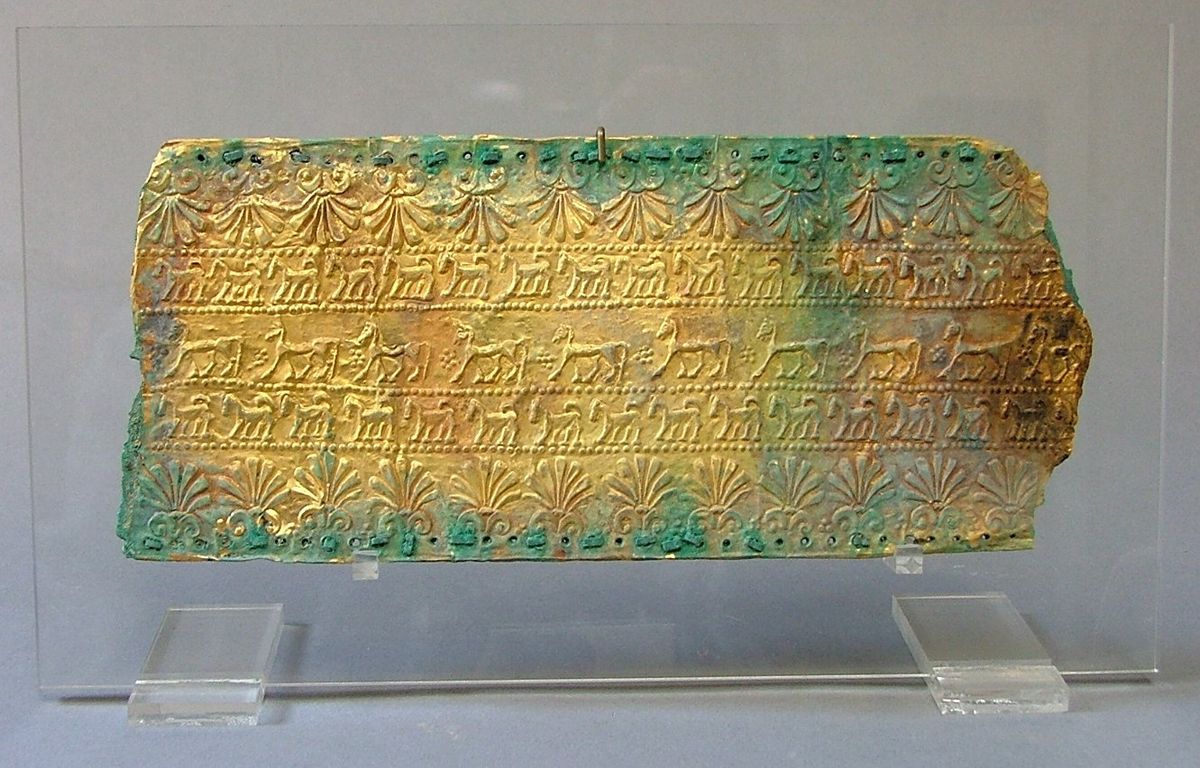
Etruscan fragment of gilt bronze sheet with embossed decoration of oriental motifs (seventh century BC)

Italy has recovered a haul of 750 archaeological artefacts with an estimated value of €12m following a lengthy legal battle with the disgraced British antiquities dealer Robin Symes (84).

The collection was unveiled yesterday at a press conference held at Rome’s National Museum of Castel Sant’Angelo and attended by both Italian and Greek officials. Dating from the eighth century BC to the medieval period, the artefacts include ancient marble busts, mosaic fragments, clay vases from Pompeii, a decorated lead sarcophagus and Etruscan jewellery made from gold, bronze and amber. After being looted in central and southern Italy, the objects had been stored in London facilities. They were transferred to Rome on 19 May.

The restitution marks the next stage in Symes's fall from grace. A legal conflict between the family of the dealer’s Greek partner, the late Christo Michaelides, led to the discovery of a vast collection of looted artefacts stored in nearly 30 facilities in London, New York and Switzerland. Symes was sentenced in 2005 for two years for contempt of court. A further investigation by Italian authorities in 2016 revealed that the dealer had hidden 45 crates of stolen Greek, Roman and Etruscan objects at the Geneva Freeport storage warehouse. Symes’s former company, Symes Ltd, is currently being liquidated....

....MUCH MORE

Previously on the Geneva Freeport:

And many more. If interested see also Zürich's and Luxembourg's freeports, search box upper left.

And Etruscans:

The Day the Mesozoic Died
So bye-bye Mr. Brontosaurii....
(yes, yes, double i pronunciation in Latin, and Apatosaurus rather than Brontosaurus but work with me people;
five, six, seven, eight: "A long, long time ago I can still remember....")

Wait. Sorry. Too far back.
Most of our posts on the Etruscans are just 'pre-Roman':

"...there has never been a better time to be a Roman historian...." (The Science of Roman History: Biology, Climate, and the Future of the Past)

Saturday, September 26, 2015

"Oligarchs and Orchestras: Inside Luxembourg’s Secretive Low-Tax ‘Fortress of Art’ Warehouse"

We'll have more on the art/finance nexus tomorrow or Monday, for now a primer.
See also links below for some stuff on the Geneva and Zurich free ports.
From the Wall Street Journal, Sept. 23:

Fraud allegations against Swiss entrepreneur Yves Bouvier have cast a shadow on Luxembourg’s Le Freeport, a high-security, low-tax warehouse for art
SENNINGERBERG, Luxembourg—Last year, David Arendt stood in a reinforced concrete warehouse at Luxembourg’s airport and welcomed wealthy collectors to his “fortress of art,” complete with high security, minimal taxes and discretion. Mr. Arendt warned that it would fill up quickly.

The 237,000-square-foot building, known as Le Freeport, opened its 10-ton doors, joining a global network of impenetrable warehouses where taxes are suspended and art can be stored and sold away from prying eyes.

As the international art market has boomed, so has demand for such discreet storage, particularly for costly art picked up as an investment and never intended for a living room wall. But a year after Luxembourg’s Le Freeport opened at a cost of nearly $60 million, the Monets and Picassos have been slow to arrive.

The reason: the protracted public-relations disaster of Le Freeport’s biggest investor, Swiss entrepreneur Yves Bouvier. Mr. Bouvier was briefly jailed in Monaco earlier this year, after he was accused of selling paintings to Russian billionaire Dmitry Rybolovlev at inflated prices.
On Sept. 14, Mr. Bouvier faced new charges. He was questioned in France by authorities investigating allegations by Catherine Hutin-Blay, the stepdaughter of Pablo Picasso, that works in her collection were pilfered and sold to Mr. Rybolovlev. Mr. Bouvier was freed after posting a €27 million ($30.5 million) bond.

In a statement, Mr. Bouvier denied the allegations in France and said the pieces in question were properly purchased on behalf of his Russian client. Some were meant for the walls of a chalet owned by Mr. Rybolovlev, while others, including the Picasso painting “Espagnole à l’éventail,” were deposited in a freeport in Geneva, he said. In an interview with The Wall Street Journal in Geneva earlier this year, Mr. Bouvier also denied the allegations of defrauding Mr. Rybolovlev.

Mr. Rybolovlev’s attorney said authorities were free to examine works in his collection believed to have been stolen. Mr. Rybolovlev hasn’t been accused of wrongdoing.

The legal issues have amplified the challenges facing Luxembourg’s Le Freeport, which was already contending with a chorus of critics who say the opaque nature of freeports makes them susceptible to illicit activity such as money laundering or harboring stolen goods. Earlier this year, lawmakers in Luxembourg responded to those concerns by bolstering the country’s anti-money-laundering laws to specifically apply to firms operating at Le Freeport—which now have a heightened legal responsibility to know what they are putting into storage and for whom.

Mr. Arendt, Le Freeport’s managing director, said the facility has safeguards to prevent illegal behavior and that he is confident Le Freeport isn’t used for money laundering. He also said the facility can adapt to the legal change—and perhaps even use it as a selling point for “honest art collectors.”

But Mr. Bouvier’s travails have hurt business. “We’re behind on our objectives, as a result of all of this mess,” Mr. Arendt said in an interview in May, as he sat in an empty showroom at Le Freeport. On Wednesday, Mr. Arendt sounded hopeful that the bad publicity had faded. “We’re more or less on track,” he said, though “we’ve had a lot of explaining to do.” Mr. Arendt said Mr. Bouvier has no role in running the freeport.

In the art market, “reputation is pretty much all you have,” said Harco van den Oever, who runs London-based Overstone Art Services.

About 60% of Le Freeport’s storage space has been rented to the firms that deal directly with collectors and store their art at the building, according to Mr. Arendt. The biggest of those firms, FineArt Logistics Natural Le Coultre SA, which accounts for roughly half of that rented space, is Mr. Bouvier’s company, and has so far only filled about 15% of its available square footage.

Freeports are an outgrowth of bonded warehouses, where commodities like grain in transit across borders could be stored, without incurring taxes. There are dozens of such warehouses around the world.

A few, like Le Freeport, are tailored to the needs of high-end art collectors. At Le Freeport in Luxembourg, artwork that remains inside its walls is exempt from value-added tax, which can be as high as 27% in Europe, and from customs duty. Art sales within the building are also tax-free. Art can remain in a freeport for years, through multiple transfers of ownership. Firms offering art-related services like restoration and financing set up shop on the grounds.

The value of the global art market reached a record €51 billion last year, according to a recent report published by the European Fine Art Foundation, the organizer of a major annual European art fair.
Nearly a third of art collectors and professionals surveyed last year by Deloitte Touche Tohmatsu Ltd. said they had used a freeport. Experts speculate that the freeport in Geneva, which traces its roots back to 1854 and is controlled by local authorities, may house the most valuable art collection in the world—although its holdings are generally secret.

Proponents say freeports allow art to be moved around the world without incurring punitive taxes. Critics say the warehouses can invite fraud. “I can’t see any better way for people to launder money than to go through a freeport,” says James Palmer, founder of Mondex Corp., which specializes in recovering art looted from its rightful owners....MORE 
See also, if interested:
"(Sm)art Investing: Rich Move Assets from Banks to Warehouses" ($4 trillion in 'treasure' assets)
"Secretive Swiss vaults may hold missing link in platinum price equation" or Why Didn't the Price Double During the Miners Strike?

and at Alphaville:
Roubini Vs the so-called “art” industry
Art as the sophisticated man’s Bitcoin 
“If it were a museum, some say that it would probably be the best museum in the world” 

Monday, May 26, 2025

"In the shadow economy, hidden wealth escapes the rules"

The headline for this review is "Competition is for losers" but I didn't want to have to note "not Peter Thiel 2014", not in the header anyway so that stuff is after the jump.

From The Times Literary Supplement, May 9: 

n an essay of 1946, George Orwell reminded readers that “to see what is in front of one’s nose needs a constant struggle”. In their complementary new books on the shadow global economy, the journalist Atossa Araxia Abrahamian and the sociologist Brooke Harrington assist us in this struggle. Starting from different points of origin, the authors seek to guide us around a world of financial skulduggery that determines much of our day-to-day lives in ways we rarely take the time to appreciate.

Abrahamian begins The Hidden Globe by reflecting on her upbringing in Geneva. Her narrative draws on China Miéville’s science fiction novel The City & the City (2009), with its portrait of twin cities that exist in the same geographical space, yet remain invisible to each other. The citizens of Besžel and Ul Qoma are trained from birth in the art of “unseeing”, so they cannot recognize what is immediately around them, and Abrahamian draws on this vision to consider how entire worlds can lie concealed within our urban geography.

In one chapter, named after Miéville’s novel, she posits Dubai as the model for how a lucrative special economic zone can be interwoven with the abuse of forgotten, precarious workers. In another, focused on the rise of the freeport, she considers how the image this entity might conjure up – of a bustling harbour of rogues and brigands – blinds us to its banal reality, and the extent to which the quotidian spaces that many of us navigate daily have been transformed invisibly into legal carve-outs from national law. “Freeports are all around us”, Abrahamian writes. They can be “stand-alone warehouses or industrial sites, entire districts, or one floor of an office building.” There are no signs as you enter the freeport notifying you that you are leaving one jurisdictional framework and entering another.

The deceptive subtlety of the twenty-first-century freeport is part of its appeal. So-called “wealth creators” treasure its ability to protect them from the taxes, regulations or labour protections that democratic polities tend to impose on them. As a result, many luxury assets and even daily commodities in economic circulation pass not from country to country, but from freeport to freeport. Abrahamian reminds us that “chances are, the car you drive, the appliances in your kitchen and the Amazon packages on your doorstep all spent time in a freeport of some kind before making their way to you”. We spend so much time arguing about how to push our governments to pass laws in different directions, but is it all futile when capital is passing in and out of these little escape routes? As the world descends into a trade war of reciprocal tariffs, The Hidden Globe reminds us that the wealthiest in society can easily circumvent such charges by moving their high-end art or luxury jewellery through freeports. If we want to understand how capital has become increasingly insulated from the pressures of the masses in the age of runaway wealth inequality, Abrahamian argues, we need to open our eyes to these loopholes that lie all around us.

Harrington follows Abrahamian down the rabbit holes that puncture our global system of state sovereignty in her punchy new book, Offshore. Where Orwell immersed himself among Europe’s indigent and homeless, as recounted in Down and Out in Paris and London, Harrington gains insight into the inequalities hidden in plain sight by finagling her way into the corridors of offshore wealth. Through her journey, she brings us face to face with the gatekeepers who guard access to the hidden financial hades flowing under our feet: the asset managers.

Her methodology is based on a key insight: while the wealthy are hard to reach, those who shepherd their riches are rather more accessible. Posing as a wealth manager in training, Harrington sneaks us into the luxury hotels where asset managers meet their aristocratic clients, the conferences where private wealth lawyers exchange tax avoidance schemes and the state department rooms where meetings take place between wealth managers and minor government officials of developing nations to ensure the given state’s laws are friendly to their clients.

Rather like Abrahamian, Harrington shows us that one prevailing image of the offshore world – of tropical islands filled with criminals and bags of dirty money – is woefully out of date. Both authors recognize that the operators of the hidden offshore economy do not run from the law, but turn towards it, using it as a weapon. As Harrington reminds us, “many uses of offshore are legal; the rest are often so complex that no one can prove that they are illegal”. Through the establishment of trusts, shell companies and layered ownership arrangements, all spread among multiple offshore jurisdictions whose governments have passed laws to ensure assets are protected from public scrutiny, the wealth managers ensure that their billionaire clients are protected from political volatility.

Harrington discovers that many of her subjects’ clients quite openly consider themselves “above nationality and laws”. For them, the countries that constitute such a key part of many peoples’ identities are little more than tools to be picked from a box and wielded for personal profit. As in The Hidden Globe, Harrington’s book shows us that the citizens of the offshore world are now escaping not just taxation, but also accountability. Many users of offshore services do not need to evade taxes: they already live in low-tax jurisdictions such as Switzerland or the Gulf states. Yet still they park their assets in the Cayman Islands or the British Virgin Islands to avoid paying debts to business partners, to hide secret assets during divorce proceedings or to try to appear less wealthy than they are in order to run for political office. Most valuable to them, Harrington writes, is “the secrecy they purchase”.....

....MUCH MORE

And an ungated version  of Peter Thiel's WSJ Op-Ed of the same name as the above review:

THE SATURDAY ESSAY

If interested see also August 2015s "Peter Thiel’s Pursuit Of Technological Progress; It’s Not About Democracy and It’s Definitely Not About Capitalism – Part 1"

It's by Francine McKenna. Here's her substack:

https://thedig.substack.com/

And here's her curriculum vitae:

https://faculty.wharton.upenn.edu/wp-content/uploads/2016/11/CV-McKenna-20220624-CV-1.pdf

Thursday, July 28, 2016

Big Money: "An Auction House Learns the Art of Shadow Banking"

From Bloomberg, July 27:
  • Lending by Sotheby’s tripled to $682 million in four years
  • Malaysian financier in money-laundering probe got a loan
A year before he got caught up in a U.S. money-laundering investigation, Malaysian financier Jho Low was looking to borrow more than $100 million without having to answer all the nosy know-your-customer questions required by U.S. banks such as JPMorgan Chase & Co.

“Prefer the boutique banks that can move fast vs the large ones like JPM,” Low wrote on March 13, 2014, to an employee of a private art dealership that had sold him a painting by Claude Monet for $35 million a few months earlier. The lender “can take all the art no problems,” he wrote the next day. “All in Geneva free port. Speed is the most important and one with a fairly quick and relaxed kyc process.”

Low got his money a month later, not from a bank but from Sotheby’s, an auction house that isn’t subject to the same money-laundering scrutiny by regulators. He pledged 17 works of art, valued between $191.6 million and $258.3 million, to secure a $107 million loan, according to a U.S. Justice Department complaint filed July 20 in an effort to seize more than $1 billion of assets allegedly siphoned from a Malaysian state fund.

As prices for art skyrocketed, Sotheby’s and other firms have become shadow banks, making millions of dollars of legal loans outside the regulated financial system and raising concerns that such financing could facilitate money laundering. Sotheby’s tripled lending to $682 million over the four years ended in 2015. Last year it almost doubled, to $1 billion, a revolving credit facility provided by banks including JPMorgan and HSBC Holdings Plc that it can use to make loans.

Art Crime
“One way to launder is to use art as a security for a loan,” said David Hall, who spent 10 years as a special prosecutor for the Federal Bureau of Investigation’s Art Crime Team and is now a partner at law firm Wiggin & Dana LLP. Hall, who wouldn’t comment about Sotheby’s or the Low case, said the aim is to use ill-gotten funds to purchase assets that can be used as collateral for a loan. “The level of scrutiny you’ll receive from a bank is much higher than you will receive from an auction house.”
Sotheby’s says it has a rigorous compliance program, and the firm hasn’t been accused of wrongdoing in connection with the government investigation. While the company underwrites loans on the basis of the value and title of the artwork, it has a parallel process that looks into a client’s source of wealth and evaluates risk in a manner analogous to banks, according to Lauren Gioia, a spokeswoman. The compliance program is headed by Jane Levine, a former federal prosecutor who worked with the FBI’s art-crime unit.

“This process was in place at the time the loan to Mr. Low was extended,” Gioia said. “As outlined in the complaint, Sotheby’s, like many other entities, including prominent law firms, major banks, real estate companies and corporations in other industries, fell victim to a complex web of transactions designed to hide and disguise the alleged illegal source of funds.”

Indeed, some of the money used to buy Low’s art flowed through a U.S. account at JPMorgan, according to the complaint.

Financing Lifestyles
Art financing has expanded not just at Sotheby’s but at banks including Bank of America Corp. and JPMorgan as well as boutique firms. Art-secured lending has increased by 15 percent to 20 percent annually over the past five years to become a $15 billion to $19 billion market in the U.S., according to Deloitte’s Art & Finance Report 2016....MORE
HT: Art News who also refer us to:

Taikang Life, one of China’s biggest insurers, now holds a 13.5 percent stake in Sotheby’s worth around $233 million. [CNN]
Here's our May post "Deloitte Luxembourg's Art & Finance Report 2016".

And some others that may be of interest:
Carlyle and Banque Pictet Hook Up For Art Financing Action
Art: War Between the 'Freeport King' and the Oligarch and How Dmitry Rybolovlev Made a Quick $300 Million
"Oligarchs and Orchestras: Inside Luxembourg’s Secretive Low-Tax ‘Fortress of Art’ Warehouse"
"(Sm)art Investing: Rich Move Assets from Banks to Warehouses" ($4 trillion in 'treasure' assets)
What's the Scam? Why Did Deloitte Set Up Their Art & Finance Practice In Luxembourg?
"Private Banks Boost Art Advisory Units"
Super Wealth: Barron's Penta Calls For Avoidance Of Geneva-style Freeports
If it were a museum, some say that it would probably be the best museum in the world
Art (and money laundering): Swiss Government's Tough New Controls On Freeports Effective January 1 
In "Liechtenstein Is Using One of the World's Finest Art Collections to Market Its Private Bank to the Chinese" I took the not-too-controversial position that "'Prince of Liechtenstein' is a very good gig."
I'm thinking that Grand Duke of Luxembourg ain't too shabby either.

Sunday, November 3, 2024

"The 20 greatest trading innovations"

 From The Trade, October 24:

In celebration of The TRADE’s twentieth birthday, editor Annabel Smith rounds up the 20 greatest trading innovations of the last few decades, exploring the solutions that have overhauled and reimagined the processes that traders depend on day in and day out to execute in the markets

  1. Order and/or execution management systems (OEMS)

Kicking off this whistle-stop summary as the number one most impactful innovation in the industry is the order and/or execution management system (OEMS) – the beating heart of trading desks around the world. Brought to market in the early 2000s, the sometimes combined and sometimes separated systems were designed to enhance the previously manual processes associated with managing and executing orders. They offer a nifty alternative to the previous plethora of both written records and later, excel spreadsheets that traders were previously forced to grapple with each day to keep things in order.

These systems touch upon all elements of the trading lifecycle throughout the front-to-middle-to-back-office including execution, order, risk and portfolio management. Traders’ order blotters sit within these systems and trading teams use these systems to consolidate data sources and research in one place to increase efficiency and speed when going about day-to-day activities. They also use them to access the market, connecting directly to counterparties to access liquidity. An EMS overlays an OMS by enhancing connectivity, aggregating data and being more flexible as it solely pertains to execution needs.

  1. Bloomberg Terminal

Up next and needing little introduction is the Bloomberg Terminal, Bloomberg’s data and proprietary trading platform. First brought to market in the early 80s the system has over the decades earned its title as the leading market data source and a must have for any financial institution looking to execute in the markets. This is reflected in its annual subscription now nearing $30,000. For this reason, the system is favoured by institutional investors as opposed to individual ones.

Its black background and computerised white text might seem a little out of date to individuals outside of the industry but its role in the financial markets has cemented this interface as a poster child for financial services. Home to Bloomberg’s central data services the interface offers users access to news, data, analytics, and multi-asset trading tools. Given its widespread adoption by institutions it’s also a people move source as users can see up to date contact details of peers. According to Bloomberg, it offers  sell-side and independent research from over 1,500 sources as well as proprietary research on various industries and markets.

  1. CLS

Coming in at number three is the multi-currency settlement system, CLS. While perhaps not one of the most exciting aspects of the trade lifecycle, settlement is a central process that acts as a pillar for the capital markets. The settlement period relates to the space of time between the trade date and the settlement date when a trade is considered complete. Within this window both the buyer and seller must undertake any necessary actions to ensure the transaction can be completed.

Established in 2002, the CLS network is designed to minimise risk and offer operational efficiency to institutions within the settlement window by avoiding bilateral settlement that is more likely to fail.

The settlement window has found itself in the industry spotlight as of late thanks to the recent decision from regulators in the US to move North American markets to a T+1 settlement period, down from T+2.

  1. Central limit order book (CLOB)

While it is easy to romanticise the sheer graft that went into trading a few decades ago, the introduction of central limit order books (CLOBs) and streamed pricing were much-needed innovations. The idea that in order to understand the changing price of an individual stock or security, one would have to study daily directories and newspapers is something that many of those starting out in the industry today will never understand. With no central directory of orders in the market, understanding pricing must have been a headache to say the least, leaving many individuals subject to arduous process of calling everyone in the phone book.

CLOBs allow for transparency of live orders that are prioritised by price and time. By seeing what is available on the order book, traders have an idea of how much volume can be executed at a specific price. Facilitated by exchanges, a CLOB allows buyers and sellers to submit their trading interests and then utilises a matching engine to match buy and sell orders based on specific requirements such as price time priority. Once a trade has been matched the buy and sell orders are removed from the order book and the bid and ask prices are updated accordingly to reflect the change.

CLOBs offer greater transparency and consolidated liquidity meaning participants have a greater chance of trading. They’re typically used in equities given that this asset class trades on exchange unlike fixed income and some foreign exchange assets. Thanks to huge leaps in technology, participants can hide their full amounts in what’s known as “iceberg orders” that replenish the order book once liquidity has been matched and removed from the book.

  1. Algorithmic trading

Rounding out the top five of The TRADE’s rankings of the most influential innovations to come to trading are algorithms and the concept of executing algorithmically or automatically. Most common for low touch and ‘easy flow’ algorithms are often used for small orders in highly liquid markets. Algorithms are a computer programmed trading workflow that follows a defined set of parameters. These parameters could be anything from liquidity seeking to volume dependant or venue-specific such as dark seeking.

Algorithms often offer traders a quick and easy route to market. They remove the opportunity for human error by taking away any manual processes and offer a low latency solution that will often achieve best execution and avoid any unwanted price changes.

While this all sounds fantastic and you may be wondering why they aren’t used for all flow, there are some downsides. Unpredictable activity in the markets such as Black Swan events can render algorithms that rely on historical data useless and result in losses for firms. At the other end of the spectrum, a lack of human judgement and intervention can sometimes result in lesser results in nuanced situations that require human intuition.

Buy-side institutions will often use a broker’s algorithmic suite for execution, with many sell-side institutions vying for the interest of clients with the launch of new and innovative products with flashy names. Less common is the development of proprietary algorithms inhouse on the buy-side given the cost, time to implement, and the speed at which priorities evolve. For more information on algorithmic trading providers, check out The TRADE’s annual survey....

....MUCH MORE

I'd have to go with pockets. Or more broadly, storage in all its guises:

Following Up On "Commodity traders superior to chimpanzees": The Importance of Pockets

Storage: Very Important To Roman Emperors and Commodities Market Manipulators

*****

....How can you not love a book whose very Preface begins:

How do you know an empire when you see one? One classic answer to this
comparative conundrum is to look at storage facilities. Empires, it is assumed,
extract and centralize resources from across their territories, a brute imperialism
that finds expression in massive, central storage complexes and a continuing
concern with the circulation of stuff. The dazzling archaeological remains of
storerooms at Rome's ports of Ostia and Portus are testimony that the Roman
empire fits this rather restricted bill. But what can storage do beyond this
exercise of identification? Storage has more to offer the student of the Roman
world: as a topic that is at once at the core of survival and prone to envy, strife,
and competition; as a practice that is both grounded in the matter of economics
and inhabiting the social imagination, as an acute concern for farmers and 
rulers alike - storage opens up an inquiry into the very anatomy of Roman 
socio-economics....
If interested see also at Cornell Research:

The Emperor’s Closet—Power and Storage

Previously on the Storage Channel:

"The Effect of Futures Markets and Corners on Storage and Spot Price Variability".
To Create A "1%" In A Social Hierarchy You Don't Need An Economic Surplus, Just A Storable Form Of Wealth 
The Golden Age of Commodities Market Manipulation: Corners, Storage and Squeezes

These days however, to purloin that wealth, you don't even need to be dealing with storables:
How to Manipulate Non-storable Commodities Markets

Remember, the spectrum runs from storage to hoarding to market corners.
And corners in commodities refers to physical, you can't corner a commod by simply buying futures or forwards, you also have to take up the physical supply.
Conversely, squeezes are accomplished in the futures..

A couple decent papers on this aspect of the abundance theory are:
"Large Investors, Price Manipulation, and Limits to Arbitrage: An Anatomy of Market Corners
and
"Market Manipulation, Bubbles, Corners and Short Squeezes"
The only way to combat abundance is with artificial scarcity, i.e. manipulation....

 And back to pockets:

 London Property Will Always Be Affordable

"The money is always there, it's only the pockets that change"
-Gertrude Stein,
Also attributed to Coco Channel as:
"Money is money is money, it's only the pockets that change".

Possibly related:

What Have The Etruscans Ever Done For Us? (freeports and other storage facilities) 

"The Myth of scarcity and its threats to human society" [it all began with the Quaternary Megafauna Extinction and explanatory journalism]

Saturday, November 21, 2015

Art: War Between the 'Freeport King' and the Oligarch and How Dmitry Rybolovlev Made a Quick $300 Million

From the Financial Times:

The Art Market: Feathers fly in Monaco
Bouvier/Rybolovlev lawsuits; Geneva tightens up on freeports; Paris Tableau folded into Biennale; lay-offs at Sotheby’s 
‘Tete’ by Amedeo Modigliani, which Dmitry Rybolovlev bought from ‘freeport king’ Yves Bouvier
The increasingly vicious dispute between “freeport king” Yves Bouvier and his former client, the Russian billionaire Dmitry Rybolovlev, has taken two new twists.

Rybolovlev and his lawyer Tetiana Bersheda were detained and questioned by Monaco police after Bouvier ally Tania Rappo accused them of tampering with police evidence and invasion of privacy. They were released without charge but Rappo’s lawyer Frank Michel believes that an inculpation will follow shortly.

Rappo was an intermediary for the numerous art sales Bouvier made to the Russian before the two men fell out almost a year ago. She accuses Rybolovlev and Bersheda of secretly recording a conversation during a dinner party at which she was present and then turning the recording over to the police. Bersheda said that she and Rybolovlev “refute [the] futile accusations of Mrs Rappo who continuously attempts to distract attention from charges of money laundering”.

Meanwhile the Monaco appeals court has denied Bouvier’s request to throw out the case brought by Accent Delight and Xitrans — companies connected to the Rybolovlev family trust. They have accused him of fraud, money laundering and complicity in money laundering in Monaco.

Bouvier’s spokesman maintains that the case should have been vacated because the accusation “violated impartiality . . . had particularly scandalous irregularities . . . and some of the witnesses were accompanied by an interpreter who is none other than the plaintiff’s lawyer”. However, Monaco’s court of appeal recently rejected an application to quash the proceedings.

Buying from Bouvier, Rybolovlev spent some $2bn on art over eight years. His lawyers said that the alleged fraud “caused losses to the plaintiff companies of close to €1bn”. He has also brought a civil lawsuit in Singapore, seeking damages for alleged fraud.

Bouvier’s side was quick to point out that, in the light of last week’s Modigliani record sale of $170.4m, “Thanks to Yves Bouvier, Dmitry Rybolovlev possesses a set of four nudes [acquired for about $200m] . . . today the most conservative estimate for the nudes would be $500m.”
. . .
LAFA (Luxembourg Art Law and Art Finance Association) was launched a month ago in Le Freeport in the Grand Duchy. The private initiative is the brainchild of seven people involved in the art and finance sector, which include Le Freeport managing director David Arendt and Deloitte’s Adriano Picinati di Torcello, and aims to be a “centre of competence in the fields of finance and art” with debates and conferences on the subject....MUCH MORE
See also (if interested): 

Wednesday, June 25, 2014

"Secretive Swiss vaults may hold missing link in platinum price equation" or Why Didn't the Price Double During the Miners Strike?

From Reuters via The Times (South Africa):

Underground vaults next to a Swiss farming village may reveal one reason for the platinum market's indifference to its biggest ever supply shock.

Most analysts and market players expected steep price increases for the precious metal as a record five month mining strike in South Africa, which ended on Tuesday, wiped out some 40 percent of global supply.
Yet values have been stuck in a $140 an ounce range gaining just five percent so far this year.

Estimates of total platinum stock value vary by billions of dollars, mainly because of uncertainty over how much metal is stored in off-shore vaults.

The Zurich Freilager, or freezone, has been used since the 1920s to store valuables, but very little is known about what goes in and out of the industrial park, advertised by precious metals brokers for the high level of privacy it offers.

Its vaults alone could hold around 20 percent of the total stocks of platinum in London and Zurich, the world's main two storage centres for the metal, market players said.

"Miners, refiners, investors, trade houses: they all hold stocks there," a German trader close to the car industry said.

He and other sources in the industry, the main consumer of the metal for catalytic converters, said this was a major reason prices did not shoot up with the strike.

"Every company knows how much it has but not how much the others have. But users know that there is metal there and therefore there was no panic buying," the trader said.

Storing metal in bonded warehouses is routine practice among purveyors of commodities and the companies involved have not come under the kind of international pressure for more disclosure felt by Switzerland's famously secretive banks.

The Swiss Federal Department of Finance (FDF), however, voiced concern over the Freilager system in a consultation paper in 2012 that is expected to lead to some reforms by the end of this year. Among issues it raised was the ease with which the stored goods can be sold in the vaults without tax consequences.
In April, the Swiss Federal Audit Office noted the warehouses' role in easing trade but asked the government to present a more comprehensive plan for them by the end of 2015 "that takes the economic and political stakes into account".

Its report noted issues such as "errors relating to the customs tariff, declaration of origin when declaring goods; inventory irregularities; a lack of traceability of the merchandise; and flaws in stock accounting".
The Swiss Union of Freeports which represents the industry was not immediately available to comment.

Privacy
Freilager's tax-exempt status means any platinum stored there does not appear in official import/export data and few people get to see it, let alone assess how much is there....MORE

Tuesday, January 23, 2018

"Sotheby’s to “vigorously challenge” Russian billionaire over legal action in UK" (BID)

From Antiques Trade Gazette:
Sotheby’s have said they will “vigorously challenge” any attempt by Russian billionaire Dmitry Rybolovlev to bring a claim against it in the UK.

Rybolovlev, the potash magnate and owner of AS Monaco football club, is involved in an intense legal battle after claiming he was systematically overcharged on a series of multi-million pound artworks by Swiss dealer and ‘freeport’ businessman Yves Bouvier. Bouvier has strenuously denied the allegations.

Around a third of the paintings, including Leonardo’s Salvator Mundi that later sold for $450m at Christie’s New York in November last year, were acquired by Bouvier via private sales brokered by Sotheby’s. Rybolovlev has previously threatened to sue Sotheby’s and the company’s vice chairman of private sales Samuel Valette after alleging that they were complicit in Bouvier overcharging him for the works.

After lodging claims in France, Monaco and Singapore, Rybolovlev’s lawyers recently secured a ruling in New York for the release of confidential documents that could now be used in British courts.

A spokesman for Rybolovlev said: "We are not arguing about the price of the paintings bought with the assistance of Bouvier. We are arguing about the method of deception he used to add margins that were fraudulent and completely hidden from his client. The process will show how he did this and who he worked with to do it."...
...MORE

Previously:
February 2017
"Big Money: What Geneva’s Art King Lost in Battle with Russian Billionaire": 
November 2016
Big Money: "What Did Sotheby’s Know And When Did They Know It"
Dirty deeds, not dirt cheap.
It's pretty well established that the punishment for an agent's breach of the duty of loyalty to his principal is death.
At least in Russia at any rate
July 2016
Big Money: "An Auction House Learns the Art of Shadow Banking"
Nov. 2015
Art (and money laundering): Swiss Government's Tough New Controls On Freeports Effective January 1
Nov. 2015 
Art: War Between the 'Freeport King' and the Oligarch and How Dmitry Rybolovlev Made a Quick $300 Million
Sept. 2015 
"Oligarchs and Orchestras: Inside Luxembourg’s Secretive Low-Tax ‘Fortress of Art’ Warehouse"
June 2008 
The Power of Potash: Russian Billionaire Part of Record Deal For Trump Mansion 

Wednesday, February 8, 2017

Big Money: What Geneva’s Art King Lost in Battle with Russian Billionaire

From Bloomberg, Feb. 7:
  • Spat with billionaire Rybolovlev runs from Monaco to Singapore
  • Battle has forced Bouvier to suspend Shanghai free port
As he described the two-year legal battle with the man who had been his best client, art dealer Yves Bouvier contemplated the damage that has left him down by nearly $1 billion.

“When something like this happens in your life, your outlook on life and on people changes, as do your priorities,” Bouvier said in an interview. “As to the future, I don’t know what I’m going to do.”

Bouvier, a minority shareholder in the Geneva Free Ports, created a network of tax-free art storage warehouses in Singapore and Luxembourg while discreetly acquiring dozens of works by Pablo Picasso, Claude Monet and Amedeo Modigliani to sell to Russian billionaire Dmitry Rybolovlev. Then, in February 2015, he was arrested on fraud charges by a team of eight Monaco police officers outside a seafront mansion owned by the Russian.

The fight between the two men has spurred a debate across the art world about whether Bouvier acted illegally or simply benefited from the lack of transparency in the art market, allowing him to generate enormous profits from his deals with the Russian. In the roughly $60-billion-a-year business of fine art, a central question has become what duty, if any, middlemen have toward collectors or sellers.

Rybolovlev, who made his fortune when he sold two Russian fertilizer producers in 2010 and 2011 for almost $7.5 billion, says Bouvier overcharged him by about $1 billion for a series of paintings that now make up one of the world’s great 20th century collections. Rybolovlev contends that Bouvier had a fiduciary duty to act in his clients’ interest, but instead misrepresented the prices at which he was able to secure paintings. That amounted to hidden markups of tens of millions of dollars on several canvases, Rybolovlev says.

Lost Revenue
Bouvier says there was no broker-client relationship between the two men and that Rybolovlev was merely a good repeat customer who willingly paid top dollar. Bouvier says that as a result of the hit to his reputation he’s foregone “many hundreds of millions of dollars” in revenue from art deals in each of the past two years as his networks dried up, leaving him with "insignificant" revenue from dealing art.

“Today, I can no longer discreetly buy a painting,” said Bouvier, 53, dressed in jeans and a blue-and-gray merino wool hoodie, after tucking into a lunch of leeks, steak tenderloin and fries at Geneva’s Hotel Kempinski. “Before, if I wanted to buy a canvas, people dealt with me normally. Now, after what’s happened, they’re twice as difficult to negotiate with or they don’t even want to negotiate with me because they’re afraid.”

In Monaco, the criminal probe is entering its third year and is now under a new investigating magistrate. Ron Soffer, his Paris lawyer, said in a separate exchange that he’s confident Monaco will decide not to formally charge Bouvier and close the case.

Rybolovlev also sued the dealer in a civil action in Singapore, where Bouvier is a resident, initially resulting a freeze of as much as $500 million of Bouvier’s assets in March 2015. That injunction was reversed five months later by the Singapore Court of Appeal. Judges there are set to deliberate at the end of this month on whether Singapore is the appropriate jurisdiction for the case....MORE
Previously:
Nov. 2016
Big Money: "What Did Sotheby’s Know And When Did They Know It"
Dirty deeds, not dirt cheap.
It's pretty well established that the punishment for an agent's breach of the duty of loyalty to his principal is death.
At least in Russia at any rate

From Art Market Monitor:
http://1uyxqn3lzdsa2ytyzj1asxmmmpt.wpengine.netdna-cdn.com/wp-content/uploads/2014/03/Leonardo_da_Vinci_or_Boltraffio_attrib_Salvator_Mundi_circa_1500.jpg
Perhaps you’ve heard of this lawsuit where the dealers who bought a $10,000 painting and sold it for $80m are upset that the buyer was representing another buyer who sold it for almost $50m more?...
July 2016
Big Money: "An Auction House Learns the Art of Shadow Banking"
Nov. 2015
Art (and money laundering): Swiss Government's Tough New Controls On Freeports Effective January 1
Nov. 2015 
Art: War Between the 'Freeport King' and the Oligarch and How Dmitry Rybolovlev Made a Quick $300 Million
Sept. 2015 
"Oligarchs and Orchestras: Inside Luxembourg’s Secretive Low-Tax ‘Fortress of Art’ Warehouse"
June 2008 
The Power of Potash: Russian Billionaire Part of Record Deal For Trump Mansion

Saturday, October 24, 2015

What's the Scam? Why Did Deloitte Set Up Their Art & Finance Practice In Luxembourg?

Following up on this morning's "Super Wealth: Barron's Penta Calls For Avoidance Of Geneva-style Freeports", we don't have the specific answer for the domicile, and are not intimating that Deloitte is scamming, but more generally, we'll let FT Alphaville's Matthew Klein explain:

The case against Luxembourg
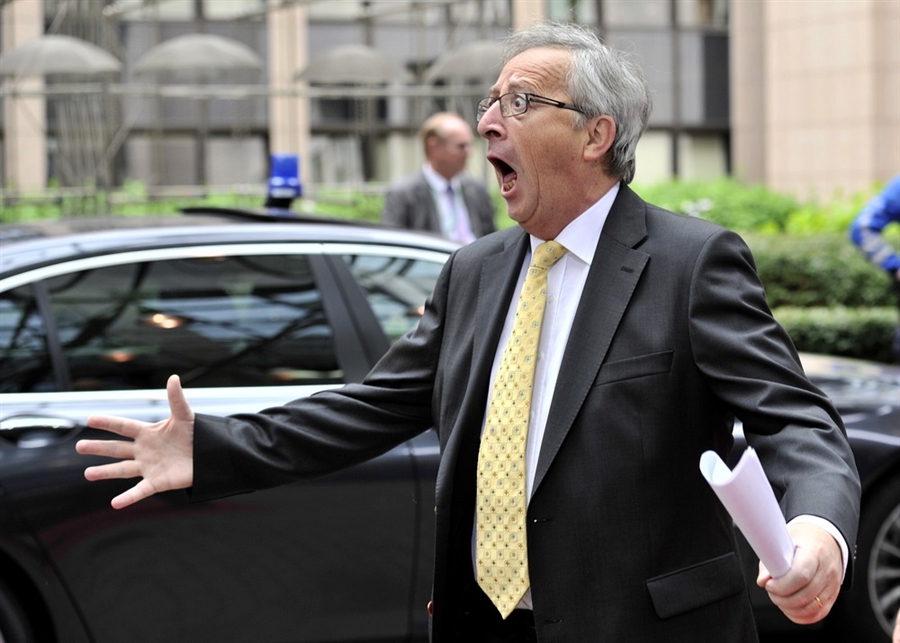
This is Jean-Claude Juncker, currently the president of the European Commission:
Before he got that job, he helped transform the Grand Duchy of Luxembourg into something of a rogue state that allegedly helps the ultra-rich steal trillions of euros from law-abiding taxpayers across the rich world. At least, that was one of the main takeaways we got after reading Gabriel Zucman’s excellent The Hidden Wealth of Nations this weekend (here’s the FT review).
Zucman:
An economic colony of the international financial industry, Luxembourg is at the heart of European tax evasion and has paralyzed the struggle against this scourge for decades…Imagine an ocean platform where the inhabitants would meet during the day to produce and trade, free of any law or any tax, before being teleported in the evening back home to their families on the mainland.
No one would dream of considering such a place, where 100% of its production is sent abroad, as a nation…If Luxembourg is no longer a nation, it no longer has a place in the European Union…Nothing in the treaties, in the spirit of European construction or in democratic reasoning, justifies allowing an offshore platform for the global financial industry to have a voice equal to that of other countries…It is essential that Luxembourg go backward.
Why is he so angry?
Each year financial secrecy — the lack of effective exchange of information between offshore banks and foreign authorities — deprives governments around the world of about $200 billion. It’s important to understand that we’re not talking about tax competition, but of theft pure and simple: Switzerland, Luxembourg, or the Cayman Islands offer some taxpayers who wish to do so the possibility of stealing from their governments. It is their choice, but there is no reason that the United States, Europe, or developing countries should pay the price for it. Financial secrecy — like greenhouse gas emissions — has a costly impact on the entire world, which tax havens choose to ignore.
The $200bn number is an annual estimate based on foregone tax receipts from capital income, inheritance, and wealth taxes, based on 5 per cent real returns on hidden assets worth about $7.6 trillion. That number, in turn, came from Zucman’s observation that the world’s financial liabilities are worth about $7.6 trillion more than the world’s financial assets. Roughly $6.1 trillion of these extra liabilities take the form of equity and long-term debt, with the other $1.5 trillion held in low-yielding deposits and money-market funds.

There are only three explanations: aliens have been accumulating trillions of dollars of claims against Earthlings, innocent mistakes by statistical agencies add up to an enormous gap, or, most believably, the world’s ultra-rich have squirrelled away trillions of dollars from the authorities to avoid paying tax.

If the distribution of the “errors” were random across countries, the gap between assets and liabilities could be blamed on measurement challenges and honest blunders. Yet the gap is concentrated in a handful of countries known for being tax havens.
For example, foreign investments in Luxembourg, as reported by the Luxembourgish statisticians, are worth trillions more than what you’d get from adding up what the rest of the world’s statisticians think their citizens have invested in Luxembourg. Add that to the gaps attributable to hidden investments in Ireland and the Cayman Islands, and you’ve explained much of the global imbalance between reported assets and reported liabilities.

Laundering it in Luxembourg
While Ireland does have legitimate attractions for multinationals looking for a European base, particularly its educated, English-speaking workforce and a developed pharmaceutical industry — no one is investing in Luxembourg or the Caymans because they are attracted by the risk-adjusted returns of stakes in local businesses. They’re just pass-throughs for investors keen on minimising tax. Zucman again:
Luxembourg does not owe the success of its conversion to its so-called stability or its highly qualified labor force, as its proponents claim. In reality, inflation there has been almost as high as in France since the 1970s and much higher than in Germany. Economic activity fluctuates violently depending on the jolts of international finance: between 2007 and 2009, the GDP per worker was lowered by 10% (as opposed to 2% in France); it has not gone up much since. The only stability is that of power…
As for the national labor force, it is ageing and has nothing unique to sell: not steel, not ancestral tradition for wealth management as in Switzerland, nor prestigious university diplomas as in Great Britain…GDP per worker has grown by only 1.4% per year since 1970, a very mediocre result that places Luxembourg at the back of the line of developed countries…Educational performance, according to PISA (Programme for International Student Assessment) surveys, is among the worst of the countries of the OECD and scholastic inequalities among the highest....

See also:


In "Liechtenstein Is Using One of the World's Finest Art Collections to Market Its Private Bank to the Chinese" I took the not-too-controversial position that "'Prince of Liechtenstein' is a very good gig."
I'm thinking that Grand Duke of Luxembourg ain't too shabby either.