But there simply isn't enough carbon dioxide on the planet to
allow the atmosphere to ever become habitable for humans, according to
new research. At best we could achieve only a fiftieth of what is
needed, and would only be able to raise the surface temperature by less
than 10 degrees Celsius, the study published in Nature Astronomy reveals.
Proponents of terraforming often suggest that we could use the greenhouse gases
that are stored in Mars' rocks and polar ice caps. If those were
released back into the atmosphere, it would make it thicker, heat up the
planet, and allow liquid water to remain on the surface.
That, in turn, would allow future Mars settlers to roam around the planet without dying, they suggest....MORE
While USDA continues to show corn and soybean conditions are
impeccable, some farmers say crop conditions reports don’t tell the full
story.
According to Monday’s USDA Crop Progress Report, 72% of
the nation’s corn crop is rated good to excellent. Last year only 61% of
the crop was rated good to excellent this same week. Soybeans are doing
well too, USDA says. This week’s report shows 70% of the soybean crop
is rated good to excellent.
Still, it’s clear by looking at USDA data that there are some problem
areas across farm country. Corn crops in Missouri, Kansas, North
Carolina and Texas continue to struggle from drought and less than 10%
of each state’s corn crop is rated excellent. For comparison,
Wisconsin’s crop is rated 31% excellent. The situation is similar for
soybeans. Soybean crops in Kansas, Michigan, Missouri, and North
Carolina continue to struggle.
According to Chip Flory, Farm
Journal economist and AgriTalk host, farmers at the Leading Edge
conference hosted by Pro Farmer last week say their corn and soybean
crops are either great or terrible. There aren’t many reporting average
crops.
“When we did the early bird session, and everybody was
talking about their crop conditions, there was a whole lot of ‘This is
going to be an eight to a 10 crop on a one to 10 scale.’ There were the
guys that said, ‘This is a three to five crop for us’ and there wasn't a
whole lot in the ‘Well this looks like it's going to be an average crop
right at five’ category,” Flory said on AgriTalk this week. “It seems
like they've either got a good crop or they're really suffering this
year.”...MORE
It does look like the markets are expecting a lot of corn, here's five years of prices:
The Japanese yen has been sold following the adjustments to policy and outlook by the BOJ that will allow the unconventional policies continue for an "extended period of time." Cross rate pressure and month-end demand have lifted the euro and sterling through yesterday's highs. A disappointing Q2 GDP report from the eurozone (0.3% instead of 0.4%) helped slow the euro's gains, while the preliminary CPI was firm. Reports that Canadian team was not invited to US-Mexico NAFTA talks today may be weighing on the Canadian dollar a little.
There had been much speculation in recent days over the BOJ's course, and it turns out that much of what was discussed found its way into policy. The BOJ announced several steps, each small, but together are a significant adjustment to policy. The zero target for the 10-year yield remains, but greater latitude was signaled, and rather than move in a +/-10 bp, a 20 bp movement will be tolerated. The negative rate will be applied to a smaller part of bank deposits at the BOJ. The ETF buying will continue, but as had been floated, the buying will shift more to the Topix from the Nikkei.
The BOJ cuts its inflation forecasts. This year's projection was reduced to 1.1% from 1.3%. Next year's inflation forecast was trimmed to 1.5% from 1.8% and in 2020 1.6% from 1.8%. Although the BOJ provided some explanation for the weakness in price pressures, like the entry of women and elderly into the workforce, the risk is that it still is too optimistic about inflation.
The BOJ updated its forward guidance. It indicated that the extraordinary policies are will be in place for an "extended period of time." This is a key way what the BOJ is doing is different than the Fed or ECB. The BOJ is not modifying its measures to gradually bring them to a halt. To the contrary, it is to allow them to be sustained for longer. The statement was issued under a title which sums up our assessment: "Strengthening the Framework for Continuous Powerful Monetary Easing."
The yen has been sold to its lowest level since July 20. The greenback has pushed a little above JPY111.50 in the European morning. A $456 mln option struck there is expiring today. There another $965 mln option at JPY112.00 and about $800 mln at JPY111.00. The euro has approached JPY131, which is an important retracement of the recent decline.
EMU economic news was mixed. The unemployment rate looked to have slipped to 8.3%, but the May estimate was reduced to 8.3% from 8.4%. Inflation was a touch firmer than expected. The headline rose to 2.1% from 2.0%, and the core rate rose to 1.1% from 0.9%. Disappointingly, GDP expanded by 0.3% in Q2, a little softer than the 0.4% seen in Q1. The year-over-year pace slowed to 2.1% from 2.5%.
While the euro is firmer, it continues to trade within the range seen last week on the day the ECB met. The high then was just shy of $1.1745. The euro has not been above $1.1750 since July 11. In addition to cross rate demand from the yen, we also see two other forces impacting the euro. First, month-end position and hedge adjustment are thought to be euro friendly. Second, and pointing in the opposite direction is the effect of today's Treasury redemptions, which the Fed uses to shrink its balance sheet. On such days, the euro has typically traded heavier.....MORE
Scoop: Bitcoin Mining Company Bitmain Hit $1.1 Billion in Profits in Q1 2018
The co-CEO of Bitmain Technologies, the world’s largest cryptocurrency mining company, recently revealed plans
to conduct an initial public offering in Hong Kong, or in an overseas
market with U.S. dollar-denominated shares. The IPO would give early
investors, including Sequoia Capital and IDG Capital, an opportunity to
cash out.
Term Sheet has obtained an email from a
source close to the company, which includes some of Bitmain’s latest
financials ahead of its planned IPO.
— Bitmain is raising further cash in addition to a $400M round reported in early June.
The new funding would value Bitmain at approximately $14 billion,
implying a 10 to 11x earnings multiple, according to the email. This is a
16.6% increase from the company’s most recently reported $12 billion valuation.
— The email cites a KPMG audit of the business and reports that
Bitmain produced $1.2 billion in net profit and an approximately 50% net
margin in 2017.
— Bitmain reportedly brought in $1.1 billion in net
profit just in the first quarter of 2018. According to the email, a
conservative estimate of what the company could earn in net profit for
the full year hovers at approximately $2 to $3 billion....
U.S. stock indexes stumbled Monday, as the Nasdaq led the way down for the third session in a row.
The Nasdaq composite dropped 1.4%, while the S&P 500 and the Dow
Jones industrial average each fell 0.6%. Small caps held up slightly
better with the S&P 600 dipping 0.5%.
Volume was lower on both major exchanges, according to preliminary data.
The Nasdaq closed mildly beneath its 50-day moving average, an area
where the index will be testing support. A bounce off the line would be
bullish. A slicing under would be bearish.
The S&P 500 has a small cushion above the 50-day line, but is testing previous resistance at the 2,800 price level.
FANG Stocks, Apple All Fall
All four FANG stocks were down. Facebook (FB) sank 2%. Amazon.com (AMZN) also lost 2%. Netflix (NFLX) skidded almost 6%. Alphabet (GOOGL) dumped 1.8%. Apple (AAPL), which some consider deserving a place in the same leadership group, trimmed 0.5%.
Apple reports fiscal Q2 results after the close on Tuesday. Please read this recent Stock Market Today column for details on the outlook for Apple stock.
Among IBD's 197 industry groups, software and computer stocks took
the day's hardest hits. Office supplies and oil stocks advanced.
Contrary to the story Uber, Lyft, and their peers like to tell,
ride-hailing services are not reducing traffic in American cities. Nor
will they, even if they meet their goals for converting solo passenger
trips to shared rides, according to new research from transportation analyst Bruce Schaller.
While ride-hailing companies add options for people to get around
without owning a personal car, Schaller shows that the overall effect of
their growth has been to jam more motor vehicle traffic onto crowded
city streets. Also known as transportation network companies, or TNCs,
Uber and Lyft haven’t just supplanted taxis, they’ve more than tripled
total for-hire vehicle mileage in the span of a few short years.
Most of this mileage is concentrated in the nation’s largest, densest
cities, where TNCs compete with transit more than personal cars. Fully
70 percent of Uber and Lyft trips are in nine major metropolitan areas,
adding 5.7 billion vehicle miles annually.
If cities don’t take steps to curb car traffic and prioritize
spatially efficient modes like transit and cycling, Schaller warns, Uber
and Lyft will continue to exacerbate urban traffic congestion and
weaken surface transit systems.
Schaller’s report, The New Automobility [PDF], augments previous research with newly available TNC trip data and thousands of interviews from the National Household Travel Survey.
The main conclusion is that TNCs are bound to generate more car
traffic in cities for two reasons: They mostly draw passengers who
wouldn’t have otherwise used a car, and each TNC trip includes
significant mileage with no passenger.
Travel surveys consistently reveal that only about 20 percent of TNC
trips replace personal car trips. Another 20 percent replace traditional
taxi services. The bulk of TNC trips — 60 percent — either replace
transit, biking, and walking, or would not have been made without the
availability of TNCs.
Uber and Lyft have pivoted to emphasize the growth of their
shared-trip services like UberPOOL and Lyft Line, but Schaller
demonstrates that even under the most optimistic scenarios for
shared-ride adoption, the net effect of the services is to generate more
traffic than a scenario in which they did not exist....MUCH MORE
Except for the gap up May1-2, $168.45 to $175.23 and the resistance-becomes-support line around $180 nothing really stands out. I do know the broader market does not need a complete fail from Apple. it is still the largest market cap in world meaning the cap-weighted S&P 500 and Nasdaq 100 in particular are sensitive because math. And in the DJIA and Nasdaq because price-weighting and psychology respectively. Here are the top 10 names in the hundo (11 symbols) as of the close on July 27:
Netflix and Facebook got hammered, GOOG and Amazon had stellar reports but traded down and Microsoft was boring but is also down 5% since reporting. Back to Apple, it's out of our wheelhouse but a couple percent beat would be positive. Maybe announce a takeover of the Federal Reserve or a mid-size country if guidance looks weak. Here's the earnings surprise history over the last year, via Nasdaq, you can see what excited the gap up: Quarterly Earnings Surprise History
Fiscal
Quarter End
Date
Reported
Earnings
Per Share
Consensus
EPS* Forecast
%
Surprise
Mar2018
05/01/2018
2.73
2.69
1.49
Dec2017
02/01/2018
3.89
3.82
1.83
Sep2017
11/02/2017
2.07
1.87
10.7
Jun2017
08/01/2017
1.67
1.57
6.37
Apple-ologists will be listening intently for comments on the next phone, parsing every umm and ah. We'll see what they've got to say on Wednesday. The stock, as the saying goes, is widely covered.
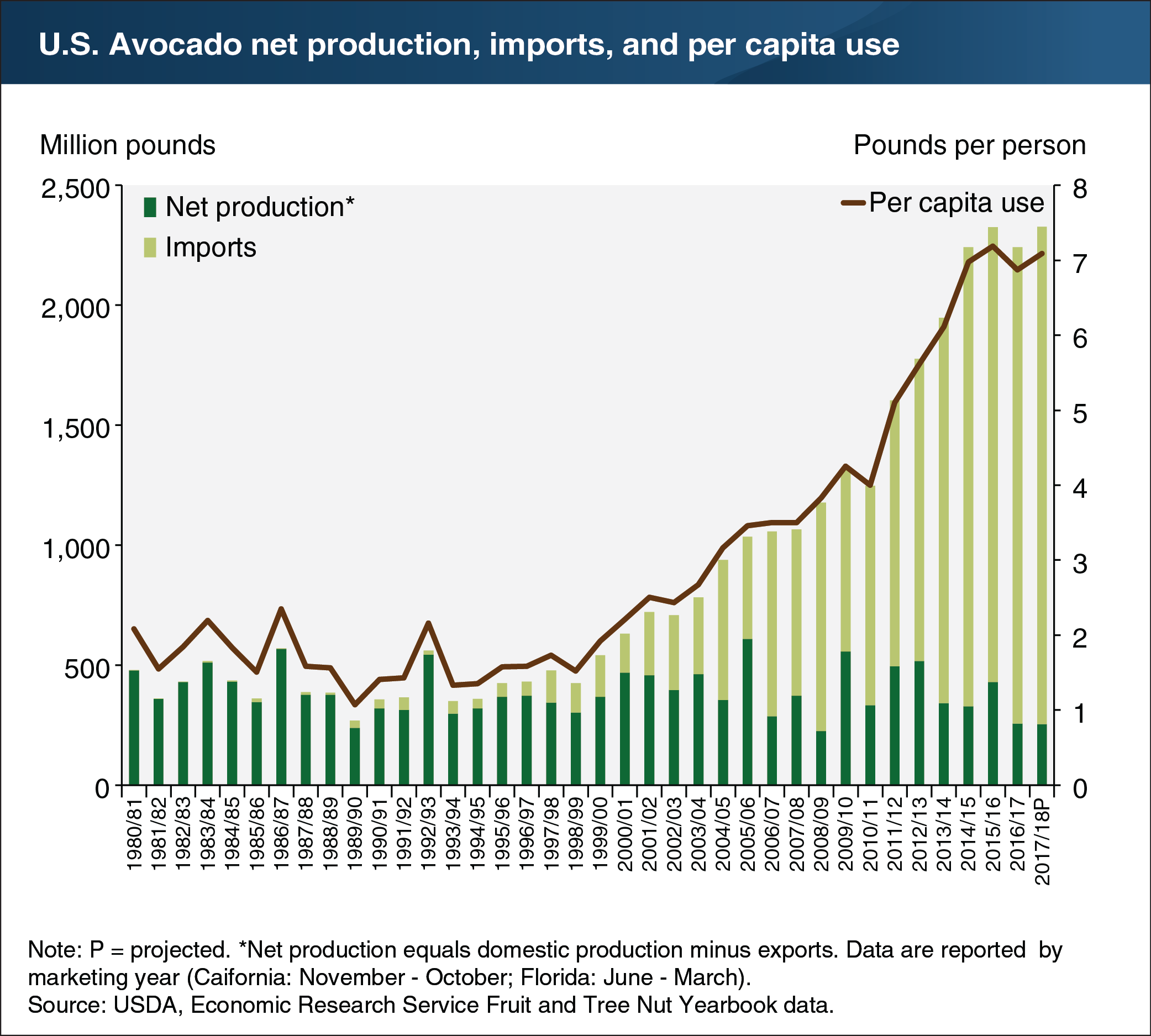
Per capita use of avocados has tripled since the beginning of the 2000s
and now totals just over 7 pounds per person annually in the United
States. In the 2017/18 marketing year, total domestic use, defined as
net production plus imports minus stocks in cold storage, is projected
to match the record high of 2.3 billion pounds set in 2015/16. The rise
of the fruit’s availability reflects its growing popularity for use in
foods like guacamole and in sandwiches. Increasing consumer awareness of
the benefits of “healthy fats,” like the monounsaturated fats found in
avocados, has also played a role in its growth. Domestically, avocados
are grown in Florida (on average, over 16 percent of total),
California
(over 80 percent), and Hawaii (less than 1 percent), but net domestic
production has not kept up with consumer demand. Nearly all of the
growth in per capita use since the mid-2000s has been satisfied by
imports, particularly from Mexico, which is the source of the vast
majority of total import volume. Chile once supplied a majority of U.S.
avocado imports, but it was surpassed by Mexico beginning in 2005. This
chart appears in the ERS Fruit and Tree Nut Outlook report released in March 2018.
Meanwhile, in Ethiopia: "Millennials Kill the Purpose in Life"
From AllAfrica:
Millennials Kill the Purpose in Life
By Eden Sahle Is Founder and CEO of Yada Technology
PLC. She Has Studied Law and International Economic Law. She Can Be
Reached At Edensah2000@gmail.com.
Laziness
and lack of realistic ambitions seem to be rampant among millennials.
They have unrealistic goals and poor workplace culture. They spend much
of their time on social media or watching movies and hope to lead their
lives in ways that are similar to fictional characters or the
virtualized versions of their peers.
They often struggle
to discover who they want to be in life. Many lack skills to engage in a
professional manner even during recruitment interviews. They demand
management roles and above-average salaries for skills and experiences
that they do not have.
Even
entrepreneurship has been devalued. In its name, millennials spend
unregulated time wasting valuable hours sitting around in cafes and
restaurants....MORE
Tomato, ToMacco: Farmers are elevating their crops with vertical farming
With more than 5.6 million articles, Wikipedia is an invaluable
resource, whether you’re throwing a term paper together at the last
minute, or doing legal research on whether it can really be considered
assault if your victim habitually made the “cows outstanding in their
field” joke. We explore some of Wikipedia’s oddities in our
5,690,195-week series, Wiki Wormhole.
What it’s about: Ah,
the farmer’s life. The smell of the soil, the green of the leaves, the
view from the 45th floor. Yes, like bathrooms before them, farms are
moving into the future by moving indoors. Hydroponic farming has made
vertical farms possible, in which floor after floor of a building is
devoted to growing food. One such farm in Buffalo, New York contains 17
million plans, and a “windowless farm” in Kyoto produces 6 million heads
of lettuce a year.
Biggest controversy: It’s an open question as to
whether vertical farms are actually beneficial. While they don’t use
pesticides or chemical fertilizers, their electricity needs are far
beyond that of a traditional farm. And while farms that don’t have to
deal with pests or changes in weather can be more efficient, the cost of
a large building in an urban center generally far outpaces the cost
savings of not having to transport food from country to city.
Strangest fact: The idea of vertical farms has been around a long time. Sir Francis Bacon first proposed growing plants without soil
in 1627, and by the mid-1800s, “soil-less cultivation” was being used
routinely. Gilbert Ellis Bailey coined the phrase “vertical farming” in
his 1915 book of the same name, but he used the phrase to consider
plants from top to bottom (i.e., from leaves to root). However, six
years earlier, Life Magazine published a concept drawing of a
tall building that cultivated food, and soon Bailey’s phrase was used to
describe what Rem Koolhaas called “the skyscraper as utopian device for
[food] production.”...MORE
Peak season sees freight rates more buoyant and carriers bullish on price hikes
Container freight rates on the major east-west deepsea trades are
beginning to lift as the peak season begins and price hikes scheduled
for next week make their presence felt in the market.
Today’s Shanghai Containerised Freight Index (SCFI), a basket of
rates quoted for the forthcoming week, saw its composite rate today up
8.8% week on week, with increases seen on almost every trade it tracks.
The rate on the Shanghai-North Europe grew 7.3% this week to finish
at $926 per teu, compared with $863 per teu last week, as the trade
edges towards the psychologically key $1,000 per teu point.
Meanwhile, the Shanghai-Mediterranean component showed the weakest growth, 2.8%, to finish the week at $893 per teu.
The transpacific trades to both the east and west coasts of North
America saw a continuation of several weeks of strong price growth: into
the US west coast up 16.4% to $1,877 per feu; and the Shanghai-US east
coast trade up 7.4% to $2,846 per feu....MORE
"And Rahm, you done, I'm expectin' resignation..."
Chancelor Bennett, known by his stage name, Chance the Rapper, recently announced that he is the proud new owner of Chicagoist. The purchase was announced in "I Need Security," one of four new songs that he released late Wednesday evening.
Chicagoist was part of the local news empire that started with New York City's Gothamist,
founded in 2003. The group of sites was purchased by billionaire Joe
Ricketts in 2017, who shuttered the suite later the same year after
employees voted to unionize. The closure affected 115 journalists,
including those who worked for Chicagoist, DCist, LAist, and similar city publications. Three of the publications affected—Gothamist, DCist, and LAist—were relaunched in February by New York public radio station WNYC.
According toGothamist, Chance's Social Media LLC purchased the Chicagoist website from WNYC.
"I'm extremely excited to be continuing the work of the Chicagoist,
an integral local platform for Chicago news, events and entertainment.
WNYC's commitment to finding homes for the -ist brands, including
Chicagoist, was an essential part of continuing the legacy and integrity
of the site. I look forward to re-launching it and bringing the people
of Chicago an independent media outlet focused on amplifying diverse
voices and content," he reportedly said in a statement. Or as he rapped
in song form, "I bought the Chicagoist just to run you racist bitches
out of business."
It would appear that Chance is already getting into the investigative
spirit with a set of lyrics directed to Chicago Mayor Rahm Emanuel:...MORE
Since Bachelier's thesis in 1900, when mathematical finance began, attempts
at understanding the nature of stock market prices and at predicting them have
not succeeded. Statistical models have only found minor regularities and
anomalies. Other approaches have failed or are illusory. To this day,
physicists and mathematicians working in economy consider that the evolution of
security prices is largely random, and, thus, not predictable. We show that not
only is the evolution of security prices not random but it is
semi-deterministic and, more remarkably, governed by a physical law.
The law
takes the form of a physicomathematical theory centered around a purely
mathematical function (not a model and unrelated to statistical methods). The
function, which can be described as an "isodense" network of "moving"
regression curves of an order greater than or equal to 1, can be conveniently
represented graphically. The graphical representation, called a "topological
network", reveals the existence of new mathematical objects, which emerge
spontaneously (they are not mathematically drawn).
What is remarkable is that
these objects, called "characteristic figures", mainly "cords", have the unique
property of attracting and repelling the price, so that the price bounces from
one cord to another. The direct consequence is that prices are driven by these
cords in a semi-deterministic manner (leaning towards deterministic). We can
say that we now understand the reason behind price movements and can predict
stock prices both qualitatively and quantitatively. Note that time series data
(not limited to financial) is input directly into the function without any
fitting. The function is universal (it is a one fits all function) and, thanks
to its extreme sensitivity, reveals the hidden order present in time series
data that other methods have never uncovered.
You may disagree with the premise—and there's enough anti-competitive behavior among the giants to back that disagreement— but it's hard to disagree with the illustration
From the Wall Street Journal, July 26:
Your suspicions are correct: The biggest companies in every field are pulling away from their peers faster than ever, sucking up the lion’s share of revenue, profits and productivity gains.
Economists have proposed many possible explanations: top managers
flocking to top firms, automation creating an imbalance in productivity,
merger-and-acquisition mania, lack of antitrust regulation and more.
But new data suggests that the secret of the success of the Amazons, Googles and Facebook s of the world—not to mention the Walmart s, CVSes and UPSes before them—is how much they invest in their own technology.
There are different kinds of IT spending. For the first few decades
of the PC revolution, most companies would buy off-the-shelf hardware
and software. Then, with the advent of the cloud, they switched to
services offered by the likes of Amazon, Google and Microsoft . Like the difference between a tailored suit and a bespoke one, these systems can be customized, but they aren’t custom.
IT spending that goes into hiring developers and creating software
owned and used exclusively by a firm is the key competitive advantage.
It’s different from our standard understanding of R&D in that this
software is used solely by the company, and isn’t part of products
developed for its customers.
Today’s big winners went all in, says James Bessen, an economist who
teaches at Boston University School of Law and who recently wrote a new
paper on the policy challenges
of automation and artificial intelligence. Tech companies such as
Google, Facebook, Amazon and Apple—as well as other giants including General Motors and Nissan in the automotive sector, and Pfizer and Roche
in pharmaceuticals—built their own software and even their own
hardware, inventing and perfecting their own processes instead of
aligning their business model with some outside developer’s idea of it.
The result is our modern economy, and the problem with such an
economy is that income inequality between firms is similar to income
inequality between individuals: A select few monopolize the gains, while
many fall increasingly behind. Might it eventually be the case that the
biggest firms aren’t just dominant, but all-encompassing?
The measure of how firms spend, which Mr. Bessen calls “IT
intensity,” is relevant not just in the U.S. but across 25 other
countries as well, says Sara Calligaris, an economist at the
Organization for Economic Cooperation and Development. When you compare
the top-performing firms in any sector to their lesser competition,
there’s a gap in productivity growth that continues to widen, she says.
The result is, if not quite a “winner take all” economy, then at least a
“winner take most” one.
That productivity gap correlates with the increase in spending on
proprietary IT, says Mr. Bessen. In 1985, firms spent on average 7% of
their net investment (which includes software, new buildings, R&D
and the like) on proprietary IT, according to data from the Bureau of
Economic Analysis. In 2016, about 24% of U.S. firms’ net investment went
into proprietary IT. That’s nearly $250 billion in a single year, and
almost matches their outlay for R&D and capital expenditures.
This also has implications for wages—the rise in the wage gap since
1978 is almost entirely attributed to an increase at more-productive
firms that occurred as pay at less-productive firms remained relatively
static, according to the National Bureau of Economic Research....MUCH MORE
Ahead of Wednesday's earnings release we have this odd little piece of news.
I'm not sure it will matter to the stock price, which marches to its own drummer. but it is something Musk & Co. have to fix, fast.
From Bloomberg, July 23:
Slow repairs in Norway hint at troubles as the automaker grows
After a fender-bender with his Tesla Model S last February, Tor
Havard Wiig figured he’d be back on the road within a week or two. Five
months on, he’s still waiting on parts—and he’s ready to sell the
two-year-old car.
The delay and scant communication from Tesla Inc.
show “there’s a lot lacking there,” said Wiig, a 43-year-old technology
consultant in the Norwegian coastal city of Bergen. “I never expected
it to take so long to fix such minor damage.”
As
Tesla sales boom in Norway, customers are grousing about a dealership
network and service operation that have failed to keep pace. Though
Chief Executive Officer Elon Musk says the level of output Tesla has
reached this summer means it’s finally become a real car company, the
experience in Norway suggests Tesla’s woes don’t stop at the assembly
line. Musk has struggled to ramp up production of a cheaper sedan, the
Model 3, and the company is said to have pressed suppliers to return cash paid for components.
In Norway, where plug-in hybrid and electric vehicles made up more
than half of new car sales last year, Tesla is the lowest-ranked
automaker on a list of brands for quality of service, and fourth-worst
among companies in all sectors.
Tesla
has slipped up as sales in Norway for its Model S sedan and Model X
SUV—with prices ranging from about $80,000 to $130,000 in Norway—more
than doubled last year and jumped another 70 percent through June. Its
repair staff, by contrast, has grown only by a third—highlighting the
potential troubles it may face as electric cars become more commonplace.
“You could probably call it growing pains,” said Christina Bu,
secretary general of the Norwegian Electric Vehicle Association, a group
that represents car owners. “They’re heading at full speed into a mass
market where customers will demand better service. Norway is the first
country where this is really happening.”
Musk has said Norwegians were right
to be upset, but blames authorities for not acting fast enough to
greenlight a plan to dispatch repair technicians to customers’ homes.
While some talks have taken place, Tesla hasn’t filed a formal
application for mobile service centers, Norwegian officials say....MORE
MONTPELIER, Vt. (AP) — As more students balk at the debt loads they
face after graduation, some colleges are offering an alternative: We’ll
pay your tuition if you offer us a percentage of your future salary.
Norwich University announced Tuesday that it will become the latest
school to offer this type of contract, known as an income share
agreement. Norwich’s program is starting out on a small scale, mainly
for students who do not have access to other types of loans or those who
are taking longer than the traditional eight semesters to finish their
degree.
“Norwich University is committed to offering this new way to help pay
for college in a way that aligns incentives and helps reduce financial
barriers to degree completion,” said Lauren Wobby, the school’s chief
financial officer and treasurer.
In contrast with traditional loans, in which students will simply pay
down the principal and interest until there is nothing left, students
with income share agreements pay back a percentage of their salary for a
set period of time. Those touting the programs say they give colleges
greater incentive to help students find high-earning jobs after
graduation, because a higher salary means the school may recoup its
investment in a shorter period of time.
For some students, income share agreements are seen as less risky,
especially if they end up in a lower-paying job or struggle to find work
after graduation. While students are unemployed or earning below a
certain threshold they don’t have to pay anything back.
“Taking on
the debt through a contract, where you don’t take on a debt per se but
instead will repay a portion of your future income, has a certain appeal
to students when the concept is fully explained to them,” said Clare
McCann, deputy director for education policy at the New America
Foundation.
But because employment and salary determine repayment, it’s possible
providers could be seen as discriminating against recipients who choose
lower-paying professions....MORE
On the other hand, the current system may be incentivizing more students into majors that are oversupplied and thus underpaid. In olden times the Psych/English major could end up as a very sharp assistant in business/philanthropy. Nowadays he's a chatty barista.
On the third hand, I could see a concentration in folklore/mythology having real-world payoffs for the class of 2018 entering the job market in 2022. Especially combined with a CS degree and a Silicon Valley address.
That's it. Mainz.
The rest of the series are after the jump. This one is via Economists View, we have the source below.
From The BBC, May 8, 2018:
How a German City Changed how We Read
The German city of Mainz lies on the banks of the River Rhine. It is
most notable for its wine, its cathedral and for being the home of
Johannes Gutenberg, who introduced the printing press to Europe.
Although these things may seem unconnected at first, here they overlap,
merging and influencing one another.
The three elements converge
on market days, when local producers and winemakers sell their goods in
the main square surrounding the sprawling St Martin's Cathedral.
Diagonally opposite is the Gutenberg Museum, named after the city’s most famous inhabitant, who was born in Mainz around 1399 and died here 550 years ago in 1468.
The printing press marks the turning point from medieval times to modernity in the Western world
It
was Gutenberg who invented Europe’s first movable metal type printing
press, which started the printing revolution and marks the turning point
from medieval times to modernity in the Western world. Although the
Chinese were using woodblock printing many centuries earlier, with a
complete printed book, made in 868, found in a cave in north-west China,
movable type printing never became very popular in the East due to the
importance of calligraphy, the complexity of hand-written Chinese and
the large number of characters. Gutenberg’s press, however, was well
suited to the European writing system, and its development was heavily
influenced by the area from which it came.
In the Middle Ages, Mainz was one of the most important cathedral cities
in the Holy Roman Empire, in which the Church and the archbishop of
Mainz were the centre of influence and political power. Gutenberg, as an
educated and entrepreneurial patrician, would have recognised the
Church’s need to update the method of replicating manuscripts, which
were hand-copied by monks. This was an incredibly slow and laborious
process; one that could not keep up with the growing demand for books at
the time. In his book, Revolutions in Communication: Media History from Gutenberg to the Digital Age,
Dr Bill Kovarik, professor of communication at Radford University in
the US state of Virginia, describes this capacity in terms of ‘monk
power’, where ‘one monk’ equals a day’s work – about one page – for a
manuscript copier. Gutenberg’s press amplified the power of a monk by
200 times....MUCH MORE
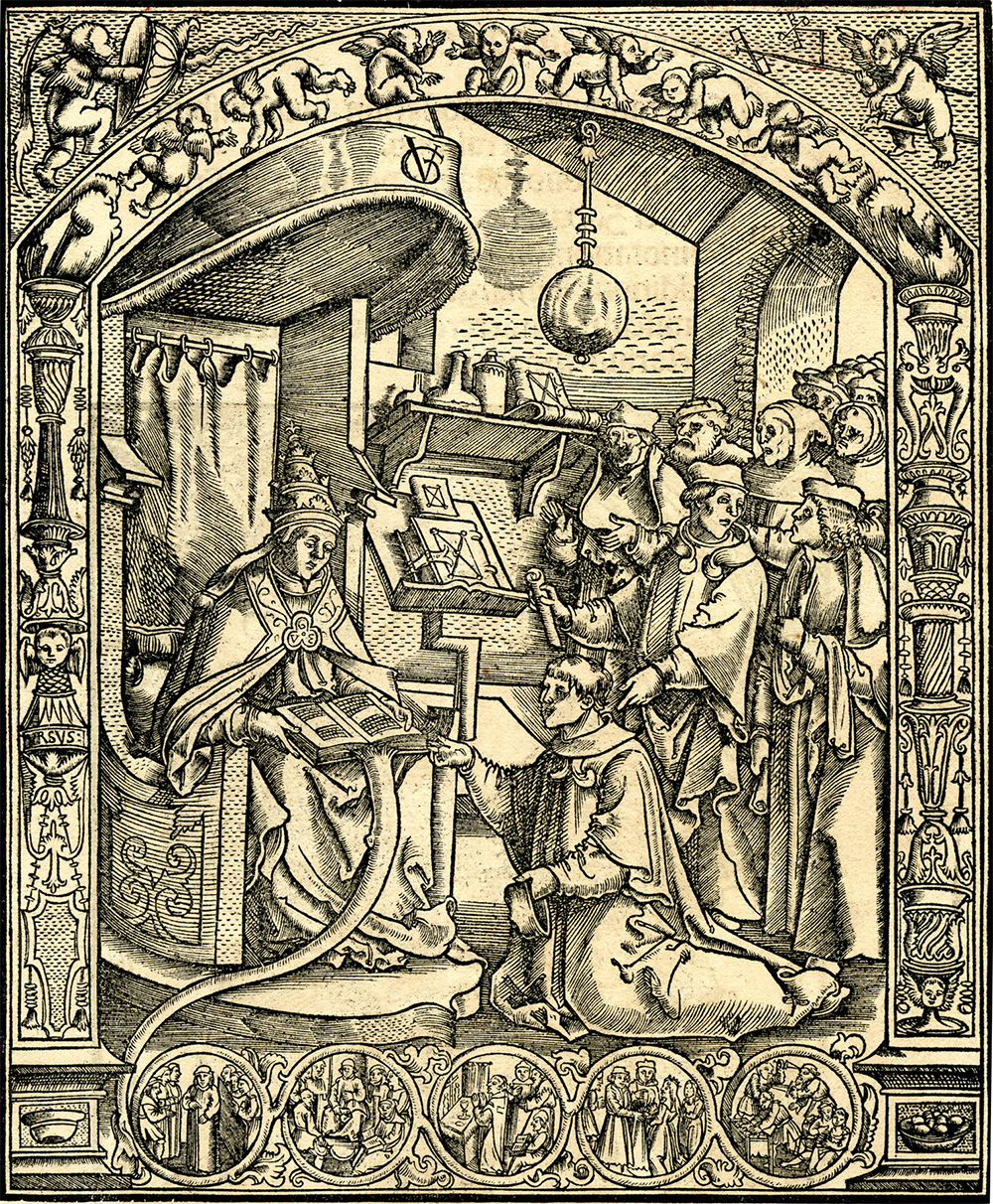
Sur le Pont d’Avignon On y danse, On y danse (On the bridge of Avignon, there we dance, there we dance)
—Fifteenth-century song and children’s rhyme
Beautifully sited on the Rhône
River, about fifty miles inland from the Mediterranean Sea, the town of
Avignon is undoubtedly one of the most alluring locales in Provence.
Underneath the towering Gothic heights of the fourteenth-century papal
palace, its charming streets and squares are lined with small boutiques
and cafés thrown open to the sun. Les Halles, the central food market,
brims with olives, fresh herbs and spices, oysters, and an enormous
variety of local cheeses, meats, and breads. In the surrounding
countryside, the Côtes du Rhône wine region produces some of the finest
varieties in France.
The indisputable sovereign of the southern Rhône wines is
Châteauneuf-du-Pape, a strong, earthy red that was among the first
French wines to receive an AOC (appellation d’origine contrôlée)
after the invention of the classification scheme in the early twentieth
century. Its distinctive terroir is centered around the village that
bears the same name, which translates to New Castle of the Pope. It thus
serves as a viticultural legacy of a brief yet pivotal era in the
history of France and the Catholic Church, known forevermore as the
“Avignon papacy.” It’s a tale replete with fantastic castles, poisonous
plots, and antipopes—legends that have endured for far longer than the
complicated politics that brought them into being.
If we return to the days of Philip the Fair, in the early 1300s, we may remember it was a newly elected French pope, Clement V,
who allowed Philip to suppress the Knights Templar. Clement had been
elected on the strength of his skills as a diplomat, at a time when
relations between France and the papacy were severely strained. As one
of his main tasks was to enact some sort of reconciliation with the
French king, he decided to take up residence in Avignon. Its location on
the Rhône, not far from the Mediterranean and Italian shores, made it a
convenient location for traveling around Europe. A large tract of
territory next to Avignon was actually owned by the papacy. And Rome was
a dangerous place at that time, torn apart by power struggles among its
leading families, leaving the pope extremely vulnerable. In fact, so
volatile was the capital that it was not unusual then for the popes to
reside outside of Rome. Clement broke new ground, however, in deciding
to reside outside of Italy entirely, and in leaving a long line of popes
after him in the same location. This era, in which seven consecutive
French popes remained ensconced in the pleasurable idyll of Provence, is
known as the Avignon papacy.
The Italians, needless to say, were not pleased by this papal
abandonment. Critics referred to the Avignon papacy as the “Babylonian
captivity,” arguing that the papacy had been subordinated to the French
kings and the spiritual integrity of the Church had been compromised. In
Dante’s Inferno, Clement V is depicted in the eighth circle of hell.
Yet this terrible sinner left a rather heavenly legacy here in the
earthly realm: Château Pape Clément, produced near Bordeaux. Before
becoming pope, Clement had been archbishop of Bordeaux, and there he
received a vineyard in donation. He cultivated it carefully and extended
its size. When he became pope, the vineyard became known as Vigne du
Pape-Clément. The vineyard still has a very good reputation today,
producing mainly rich and fruity wines. It can arguably claim to be one
of the oldest wine-producing establishments in the Bordeaux wine region.
After Pope Clement died near Avignon in 1314, rival factions in the
Sacred College of Cardinals were incapable of agreeing on a new pope.
After two years, the French king essentially forced them to a vote, and
they elected a frail, seventy-two-year-old French cardinal who became John XXII.
Their hope was that he would have a short reign, during which each
faction could strengthen its position for the next election. But their
hopes were dashed, as John XXII went on to reign for eighteen years
(some say his apparent ill-health had all been an act). He had
previously been the bishop of Avignon and was happy to stay in place,
given the continuing turmoil in Rome. His longevity was often attributed
to one of his strange eating habits: he preferred to eat mainly white
food products, such as milk, egg whites, white fish, chicken, and
cheese. A gastronomic specialty of Avignon known as papeton d’aubergines,
a sort of flan made with the (white) flesh of eggplants and originally
shaped like the papal hat, is sometimes said to have originated during
his reign.
The greatest gastronomic legacy of John XXII was not to be eggplants,
however. In an effort to periodically escape the intrigues of Avignon,
he established a summer residence in a small place now called
Châteauneuf-du-Pape, in the Rhône Valley north of the city....
I am really having trouble seeing how automation will create more jobs than it destroys. And especially at the entry-to-the-workforce level where folks would (hopefully) get on the first rung of an ascending (hopefully) ladder.
Coding! Isn't that what we tell people in coal mining and journalism and other dying businesses?
Coding!
First up, CNBC:
This weed-killing AI robot can tell crops apart
A slew of AI weed killers are on the horizon and
have the potential to disrupt the multibillion dollar pesticides
business. Among them is Swiss-company ecoRobotix and its weed-killing
robot.
It's solar-powered and can kill weeds
for 12 hours straight without an operator at the helm. Through
artificial intelligence, cameras and two robotic arms, the table-looking
robot sprays a dose of herbicide on weeds but not the crops. EcoRobotix
uses 20 times less herbicide than traditional methods that spray entire
fields.
Founded in 2011,
ecoRobotix develops autonomous weeding robots, which help farmers to
produce healthier food with a more efficient and sustainable use of
herbicides. The company carried out pilot projects in Europe and closed a
$10.7 million Series B financing round in May....MORE
And from LA Eater:
Pasadena’s Burger-Flipping Robot Will Now Fry Chicken at Dodger Stadium Flippy is quickly automating the fast food industry
The future of fast food automation comes ever-closer to reality today, as news is out that Flippy, the burger-loving robot worker attracting national attention, is heading to Dodger Stadium. According to USA Today, Flippy will start up in August, frying chicken tenders and making tater tots.
For those unfamiliar, Flippy is an automated robot
made up primarily of a multi-functional arm that’s capable of flipping
burgers at a pretty incredible sustained rate. The Pasadena-based Miso Robotics
company built Flippy to maximize production in the fast food sector,
and has been testing out its viability in the kitchen of local burger
restaurant CaliBurger. After a few
initial tweaks the robot has been flipping like mad, turning out
reportedly thousands of burgers with complete success.
Now Flippy is heading up to Dodger Stadium to try to revolutionize the stadium dining
industry. Sports and live events are notoriously hard on even the most
seasoned operators (the Dodgers use Chicago-based concessions company
Levy), as natural breaks in the show often lead to tens of thousands of
people wanting food all at once, making timing and precision a key
factor....MORE
Next year will be the 150th anniversary of one of the most astounding feats in science, Mendeleev's prediction of the properties of as-yet undiscovered elements. He was so convinced they would be found he left spaces for them in his 1869 periodic table.
Gallium, Scandium and Germanium were subsequently discovered, in 1875, 1879 and 1886 respectively.
That's what science does if you get it right, it allows you to predict.
With that longer-than usual-introduction here's some, more mundane but possibly more valuable, prediction stuff.
From 99% Invisible:
Four times every day, on radios all across United Kingdom, a BBC
announcer begins reading from a seemingly indecipherable script. “And
now the Shipping Forecast issued by the Met Office on behalf of the
Maritime and Coastguard Agency,” says the voice over the wire. “Viking,
North Utsire; southwesterly five to seven; occasionally gale eight; rain
or showers; moderate or good, occasionally poor.” Cryptic and
mesmerizing, this is the UK’s nautical weather report.
The Shipping Forecast is “part of the culture here,” muses Charlie Connolly, author of Attention All Shipping: A Journey ‘Round the Shipping Forecast. “It’s
a much loved institution. People regard it as poetry.” Connolly grew up
listening to the forecast. Even now, as an adult, he sets his alarm so
he can tune into the early morning forecast.
The story of this radio program starts (well before the BBC itself)
in the 1850s with a man named Admiral Robert FitzRoy. He was the captain
of the Beagle, the ship that brought Charles Darwin to the Galapagos.
HMS Beagle in the Straits of MagellanFitzRoy had a long, sometimes controversial career, but later in his
life he became fascinated with the study of weather prediction.
Barometric Prophecies
An Admiral Fitzroy’s Storm Stick Barometer, signed Negretti & Zambra, Instrument Makers to Her Majesty, via TennantsIn FitzRoy’s time, lots of ships sank at sea due to weather. People
were just beginning to understand the connection between air pressure
and storms, which piqued the captain’s interest. So when he was
appointed head of the nation’s new Meteorological Office, he poured all
his energy into the study of air pressure. He had a barometer, and he
would use it to try and figure out what was about to happen with the
weather.
Then, one day in 1859, a ship called the Royal Charter
was sailing from Australia to Liverpool. Many of the passengers on
board were miners, returning home from the Australian gold mines. A big
storm blew in and FitzRoy, who was sitting at home in London at the
time, saw on his barometer that the pressure had dropped, but had no way
to warn anyone. The Royal Charter sunk, and over 450 people drowned.
FitzRoy was filled with guilt. He wished he could have done more to warn
people, and decided to devote his life to saving lives at sea by
predicting the weather.
The Royal Charter sank in an 1859 stormWorried that people might associate his predictions with some kind of
esoteric witchcraft or superstition, FitzRoy avoided the term prophecy
in favor of forecast, and coined the phrase “weather forecast.” He
delivered his forecasts by telegraph around the United Kingdom, where
signal flags were hoisted in harbors to warn ships heading out to sea. Eventually
his forecasts were published in the newspaper, and while they were
often ridiculed by readers at the time, they were pretty accurate, and
they became indispensable for sailors and fishermen....
If you follow the link you'll be coming up on one of the readers of The Shipping Forecast, Peter Jefferson, who worked for the BBC for four decades and who we last visited in:
Netflix believes, algorithmically at least,
that I am the kind of person who likes to watch “Dark TV Shows
Featuring a Strong Female Lead.” This picksome genre is never one that I
that seek out intentionally, and I’m not sure it even represents my
viewing habits. (Maybe I fell asleep watching The Killing one
night?) It is an image of me that Netflix compiled from personal data it
gathers, and, like a portrait taken slantwise and at a distance, much
finer detail is missing. As it happens, television sometimes puts me to
sleep; other times I stream a movie as I work on my laptop, and by the
time I’ve finished typing and look back, the credits are rolling. Either
way, the idea offered of me after my data has been mined is curiously
off-base.
More than a decade ago, Netflix ushered in a cultural conversation
about big data and algorithms with stunts like the Netflix Prize—an open
competition to improve user rating predictions—and its eventual use of
subscriber data to produce and cast the show House of Cards.
Now, with Cambridge Analytica and driverless cars in the headlines, the
artless future that some technology critics forecasted back then—movies
cast by algorithms!—sounds quaint in comparison. For the time being, the
stakes are low (rifle through streaming titles to find something good
to watch), and the service declares the way it categorizes me—as a fan
of the “Strong Female Lead”—rather than clandestinely populating the
interface with lady detective shows. To be sure, there is plenty to
criticize about its micro-targeting practices, but now that
“surveillance capitalism” has eclipsed “big data” as the tech media
buzzphrase of choice, at least its subscriber-based business model
suggests the company has little incentive to partner with data brokers
like Acxiom and Experian, to determine whether mine is a BoJack Horseman household or more apt to stream 13 Reasons Why.
Netflix is an accessible example of the gap between an
algorithmically generated consumer profile and the untidy bundle of our
lived experiences and preferences. The reality of living a digital life
is that we’re routinely confronted with similarly less than spot-on
categories: Facebook ads for products you would never buy, iPhoto
tagging your house as a person’s face, false positives, false negatives,
and all the outliers that might be marked as red dots on prediction
models. Mix-ups like these might be laughable or bothersome; the octopus
of interlinked corporate and state surveillance apparatuses has
inevitable blind spots, after all. Still, I wonder if these blunders are
better than the alternative: perfect, all-knowing,
firing-on-all-cylinders systems of user tracking and categorization.
Perhaps these mistakes are default countermeasures: Can we, as users,
take shelter in the gaps of inefficacy and misclassification? Is a
failed category to the benefit of the user—is it privacy, by accident?
Surveillance is “Orwellian when accurate, Kafkaesque when
inaccurate,” Privacy International’s Frederike Kaltheuner told me. These
systems are probabilistic, and “by definition, get things wrong
sometimes,“ Kaltheuner elaborated. “There is no 100 percent. Definitely
not when it comes to subjective things.” As a target of surveillance and
data collection, whether you are a Winston Smith or Josef K is a matter
of spectrum and a dual-condition: depending on the tool, you’re either
tilting one way or both, not in the least because even data recorded
with precision can get gummed up in automated clusters and categories.
In other words, even when the tech works, the data gathered can be
opaque and prone to misinterpretation.
Companies generally don’t flaunt their imperfection—especially those
with Orwellian services under contract—but nearly every internet user
has a story about being inaccurately tagged or categorized in an absurd
and irrelevant way. Kaltheuner told me she once received an
advertisement from the UK government “encouraging me not to join ISIS,”
after she watched hijab videos on YouTube. The ad was bigoted, and its
execution was bumbling; still, to focus on the wide net cast is to
sidestep the pressing issue: the UK government has no business judging a
user’s YouTube history. Ethical debates about artificial intelligence
tend to focus on the “micro level,” Kaltheuner said. When “sometimes the
broader question is, do we want to use this in the first place?”
Mask Off
This is precisely the question taken up by software developer Nabil Hassein in “Against Black Inclusion in Facial Recognition,”
an essay he wrote last year for the blog Decolonized Tech. Making a
case both strategic and political, Hassein argues that technology under
police control never benefits black communities and voluntary
participation in these systems will backfire. Facial recognition
commonly fails to detect black faces, in an example of what Hassein
calls “technological bias.” Rather than working to resolve this bias,
Hassein writes, we should “demand instead that police be forbidden to
use such unreliable surveillance technologies.”
Hassein’s essay is in part a response to Joy Buolamwini’s influential work as founder of the Algorithmic Justice League.
Buolamwini, who is also a researcher at MIT Media Lab, is concerned
with the glaring racial bias expressed in computer vision training data.
The open source facial recognition corpus largely comprises white
faces, so the computation in practice interprets aspects of whiteness as
a “face.” In a TED Talk about her project, Buolamwini, a black woman,
demonstrates the consequences of this bias in real time. It is alarming
to watch as the digital triangles of facial recognition software begin
to scan and register her countenance on the screen only after
she puts on a white mask. For his part, Hassein empathized with
Buolamwini in his response, adding that “modern technology has rendered
literal Frantz Fanon’s metaphor of ‘Black Skin, White Masks.’” Still, he
disagrees with the broader political objective. “I have no reason to
support the development or deployment of technology which makes it
easier for the state to recognize and surveil members of my community.
Just the opposite: by refusing to don white masks, we may be able to
gain some temporary advantages by partially obscuring ourselves from the
eyes of the white supremacist state.”...MUCH MORE