Monday, December 4, 2017

"Europe Is Pouring a Staggering Amount of Cash Into New Cryptocurrencies"

Angst, it's gotta be angst. And geopolitics Maybe a spirit of inquiry and adventure and I'm starting to realize I have no idea why organizations based in Europe raised coin funds at  almost twice the EU's percentage contribution to world domestic product.

From Reuters via Fortune:
Nearly half of the cash that has poured into newly issued cryptocurrencies in recent years has been raised in Europe, research published on Thursday showed.

The report by Atomico, one of Europe‘s leading venture capital firms, found European-based entities have raised $1.76 billion through so-called initial coin offerings, or ICOs, since 2014, representing 46% of funds raised globally.

ICOs have become a bonanza for digital currency entrepreneurs. They have provided the fuel for a rapid ascent in the value of cryptocurrencies this year that has raised fears of a bubble that could burst, with bitcoin soaring more than 1,000% since the start of 2017.

Atomico’s research is based on data compiled by California-based TokenData and stretches back to 2014, although more than 90% of ICO activity has taken place this year, researcher Ricky Tan said.
Switzerland drew in nearly half of Europe‘s total – $828 million or 47% of ICO funds in the region, mainly through firms registered in Zug, a low-tax region near Zurich that is also the domicile for many top commodities traders, Tan said.

By contrast, North America drew in $1.08 billion of ICOs, or 28% of a global market thatraised around $3.8 billion through the issuance of new types of digital currency.

The report predicts that larger European venture firms will begin to participate in ICOs next year, reversing their historic resistance to what many have seen as unregulated competition to traditional venture funding....MORE

"Shipping Magnates Shock Industry With Huge Orders"

From Bloomberg via gCaptain:
A shopping spree by two billionaires is shaking up a shipping industry still recovering from years of falling rates and overcapacity.

Jacques Saade’s CMA CGM SA, the world’s third-largest container line, announced an order for nine massive vessels in September, after a year of tepid sales for new ships. Within days, Gianluigi Aponte’s Mediterranean Shipping Co., the No. 2 container line, confirmed it had lobbed in an order for 11 behemoths, each of which can hold 22,000 shipping containers, enough capacity for 44,000 cars or 8.8 million 50-inch TVs.

The orders amounted to almost $2.9 billion combined, according to London-based Vessels Value, an online ship-valuation database. Longer than 3 1/2 football fields, the container ships will be among the largest ever built.

Some analysts, however, say it’s the last thing the market needs right now.
“The problem with the industry as a whole is that there are just too many ships,” said Toby Yeabsley, an analyst at Vessels Value. “It’s a struggle to see where these are going to fit in.”

Ferry Captain
But brash bets are characteristic of ship owners, in a volatile and cyclical industry. Aponte, an Italian-born former ferry captain, started operating cargo ships in 1970 and amassed a fleet of 490 container vessels, ferries, cruise ships and stakes in port terminals. His son Diego became chief executive officer in 2014. Saade formed CMA in Marseille after he moved from Lebanon in 1978. He built it into what has become France’s largest shipping company, helped by a 1992 bet on China’s economic growth. His son Rodolphe is now CEO.

Their success means Aponte has a net worth of $8.9 billion and Saade $4.4 billion, placing both men on the Bloomberg Billionaires Index, a daily ranking of the world’s 500 richest people. Both companies declined to comment on their founders’ net worth....MORE

"An hypothesis about European stock performance"

David Goldman at the Asia Times:

Looks as though an error in the EUR/USD ‘fair value’ model has a significant relationship with DAX
The appreciation of EUR in excess of what the rate structure would predict can be understood as gauge of market expectations of eventual ECB tightening. I observe that the error in the “fair value” model relating EUR/USD to the rate structure appears to have a significant relationship with DAX.

EUR is rich to the rate structure.

euro forecast by US-German 10-yr spreak
Source: Bloomberg
The chart below separates the euro into two components: One predicted by the rates structure, and the model’s error.....MORE

Sunday, December 3, 2017

Next Month's SpaceX Launch Will Try to Reach Mars with Elon Musk’s Tesla Roadster On Board

From Next Big Future:
Space Heavy test launch next month will try to reach Mars with Elon Musk’s personal Tesla Roadster....

...MORE

Attention Rainmakers, Here's Your Prospect List: The 2017 ARTnews Top 200 Collectors

From ARTnews:
The world's top collectors in 2017—among whose recent acquisitions are a record-breaking Basquiat and Anicka Yi's video from the Whitney Biennial—include newcomers like Laura Arrillaga-Andreessen, the founder of Stanford University's Center on Philanthropy and Civil Society, and her husband, Silicon Valley VC Marc Andreessen, comedian and Chicano art aficionado Cheech Marin, and Iranian financier Mohammed Afkhami. And media mogul David Geffen is back!

Art collectors at the uppermost echelons can be a secretive coterie. In an age when some are throwing open doors to gleaming new private museums and revealing their holdings with great fanfare, there are others whose names will never appear on a list like this—because they want no one outside their inner circle to know of their exploits.

That is why it was so striking when Yusaku Maezawa posted on Instagram about the Jean-Michel Basquiat painting he purchased for $110 million at Sotheby’s in May. He did not, like many others have in the past, whisper about it to fellow collectors who then passed it down to the chattering classes. He did not grant a news-making exclusive about it to the New York Times or the Wall Street Journal. He revealed it—just like that—to anyone who might have been looking at one of the world’s most popular social-media platforms.

In that spirit, for the 28th edition of the ARTnews “Top 200 Collectors” list, we asked the connoisseurs in our survey—some of them veterans and others new to the enterprise—to tell us a bit about themselves. What are some of the pieces they have acquired over the past year? Who inspired them to start collecting? Was there ever an artwork that got away? The answers we received are grand.

In the past year, in addition to a six-panel canvas by David Hockney (Woldgate Woods, 24, 25, and 26 October 2006, dated 2006), David Geffen acquired four pieces by midcareer painter Marc Grotjahn. The New York Times recently reported that Geffen owns six of the artist’s paintings and lost out on one that sold privately for $22 million. His devotion to Grotjahn is clear: “He’s the most important artist of his generation,” Geffen told the Times....MORE
Roman Abramovich
London; Moscow; New York
Steel; mining; investments; technology; professional soccer (Chelsea Football Club)
Impressionism; modern, postwar, and contemporary art
Haryanto Adikoesoemo
Jakarta, Indonesia
Energy; logistics; real estate
Indonesian, Asian, and Western modern and contemporary art
Mohammed Afkhami
Dubai; Gstaad, Switzerland; London; New York
Private equity; real estate; commodities
Modern and contemporary Iranian and international art
Paul Allen
Seattle
Investments; philanthropy
Impressionism; Old Masters; modern and contemporary art
Laura Arrillaga-Andreessen and Marc Andreessen
Palo Alto, California
Philanthropy; entrepreneur
Postwar and contemporary art
María Asunción Aramburuzabala
Mexico City
Beverages; investments
Modern and contemporary art
Hélène and Bernard Arnault
Paris
Luxury goods (LVMH)
Contemporary art
Laura and John Arnold
Houston
Hedge fund
Modern art; African art; Old Masters
Laurent Asscher
Monaco
Investments
Modern and contemporary art
Hans Rasmus Astrup
Oslo
Shipping; finance-related activities
Contemporary art
...190 MORE

Additional ARTnews Top 200 Collectors pages 

"The Neurochemistry of Smartphone Addiction"

It's early days, I mean this is a first-of-its-kind study, and a small one to boot, but the use of magnetic resonance spectroscopy (MRS) and functional (the f in fMRI) MRI's on this topic should take off over the next six months or so and if I were a punter I'd bet the other neurotransmitters, including our old pal dopamine, will be shown to be affected.
So, we're putting these ideas together on the fly and they come out disjointed but there is an ultimate rationale (or, method to the madness).

As stated in the introduction to last month's "Early Facebook investor compares the social network to Nazi propaganda, likens its workers to Goebbels and claims it is creating a climate of 'fear and anger'":
We visited Elevation Partners' Managing Director Roger McNamee on Sunday for a TL;DR version in: "Climateer Line of the Day: Bono's Guy Talks Regulating Facebook and Google".

In that piece I noted our point of attack has been the neurochemistry of deliberately trying to addict your users. The thinking being, this is where the giants are most vulnerable and is the argument most amenable to soundbite journalism/attention - grabbing/framing. Turnabout being fair play and all that....
And today's piece of the puzzle from Psychology Today, Nov. 30:
Smartphone addiction is correlated with neurochemical imbalances in the brain, according to a first-of-its-kind study presented today at the 103rd Scientific Assembly and Annual Meeting of the Radiological Society of North America (RSNA) in Chicago.

This research was led by Hyung Suk Seo, who is a professor of neuroradiology at Korea University in Seoul, South Korea. The co-authors of this soon-to-be-published paper are Eun-Kee Jeong, Sungwon Choi, Yunna Kwon, Hae-Jeong Park, and InSeong Kim.

For this study, the neuroradiologists used magnetic resonance spectroscopy (MRS)—which is a specialized type of MRI that measures the brain's chemical composition—to gain unique insights into the brains of people who are believed to have developed addictive patterns in their use of digital technology. Interestingly, another study from July 2017 by researchers at Ben-Gurion University in Israel found that heavy smartphone users display changes in social cognition, impaired attention, and reduced right prefrontal cortex (rPFC) excitability.
To identify the severity of smartphone or internet addiction, the South Korean researchers used a standardized smartphone-internet addiction questionnaire. The questions were designed to elucidate the extent that excessive screen time affects someone's daily activities, face-to-face social connectedness, productivity, sleeping patterns, and feelings.

"The higher the score, the more severe the addiction," Dr. Seo said in a statement. Notably, Seo et al. found that smartphone-addicted teenagers had significantly higher scores in depression, anxiety, insomnia severity, and impulsivity....MORE
Depending on which way the causality flows—it might be that the test subjects were driven to excessive phone/app use by pre-existing neurotransmitter imbalances rather than vice versa, we'd then want to look at policy options such as (from the intro to that TL;DR mentioned above):
"Society regulates products that create addiction. We have laws to prevent discrimination and election manipulation. None of these regulations and laws has yet been applied to Facebook and Google.
The time has come."
 Or, from The Automatic Earth's "Tax Them Until They Bleed" post:
Industries that are not productive, but instead only extract money from society, need to be taxed so heavily they have trouble surviving. If that doesn’t happen, your economy will never thrive, or even survive. The whole service economy fata morgana must be thrown as far away as we can throw it. Economies must produce real, tangible things, or they die.
 Just sayin'.

"Why a Hedge Fund Started a Video Game Competition"

From Nautil.us, Nov. 30:

The chief technology officer of one of the world’s largest hedge funds talks data. 
There’s a weird way in which a hedge fund is a confluence of everything. There’s the money of course—Two Sigma, located in lower Manhattan, manages over $50 billion, an amount that has grown 600 percent in 6 years and is roughly the size of the economy of Bulgaria. Then there are the people—financiers, philosophers, engineers—all applying themselves to unearthing inscrutable patterns that separate fortune from failure.

And there is the science and engineering, much of it resting on a towering stack of data. In principle, almost any information about the real world can be relevant to a hedge fund. Employees, so the stories go, have camped out next to harbors noting down tanker waterlines, and in retail parking lots counting cars. This data then has to be standardized, synthesized, and made accessible to the people who place bets on the market.

Building the tools to do this is part of Alfred Spector’s job. As the chief technology officer of Two Sigma, he is responsible for the engineering platforms used by the firm’s modelers. A former vice president at IBM and former professor of computer science at Carnegie Mellon, Spector has seen software transform one industry after another, and made more than a few contributions of his own along the way.

He sat down with us for a conversation at Two Sigma’s headquarters earlier this month.

Why would a company like Two Sigma run a public game competition?
We started the Halite AI Programming Competition because we want to be known in the tech community for doing things that the tech community likes. Game competitions are one of those things. Programmers like interesting programing challenges—particularly ones that are contained enough that they can do off-hours. Plus we open-source everything so that the programmers can actually see the game environment and learn everything about the game. That gives programmers a lot of opportunities for creativity as to how the game can be played, and it becomes more fun.

What effect did you notice the competition having on the Two Sigma brand?
What we noticed is that when we go to campuses, people have heard of us more. We also hired someone that was at the top of the ranking.

What was the goal of the game?
Both this year and last year’s games are turn-based strategy games. In Halite 1 last year there were between two and six bots on the board to start. In the game, each bot starts with a single piece, which it can move up, down, left, or right. It can also stay still, in which case the piece gains strength. If it moves, it leaves behind another piece where it was, so the number of pieces on your side grows. All the players are doing this on a grid that’s maybe 40 or 50 squared pieces, so a bot can make a huge number of different moves. This year’s game, Halite 2, is in many ways similar, but it uses a space war theme, where a ship can move to a planet and take over the planet. When you put all this together, people come up with incredibly interesting winning strategies.

What’s an example of an interesting strategy that came out of the games?
There was an interesting, unanticipated strategy that emerged in the final week of last year’s game. It was a non-aggression strategy. Some players determined that if they hung loose for a while, and didn’t try to defeat other players, and just tried to gain space and stay out of trouble, it could help them. Remaining aggressive players would actually sort of hurt themselves, while the players that were being non-aggressive would actually then be in a position that, with moderately high probability, could win.

How was machine learning relevant to game strategy?
...MUCH MORE

Big Money: T. Boone Pickens Puts His Ranch Up For Sale

From The Real Deal:

BP [Capital] CEO and chairman’s Texas ranch hits the market at record-setting price
T. Boone Pickens explains his reasons for selling of the property he built over almost five decades
One of the biggest listings in U.S. history, the Texas Panhandle ranch is on the market for $250 million.

Built over 46 years by current owner T. Boon Pickens, chairman and CEO of BP Capital Management, the nearly 65,000-acre property consists of a private airport, a chapel, newly-built residences, Pickens’ childhood home — which he had moved from its original site in Oklahoma — a tennis court and golf course, among so much more, the Wall Street Journal reported.
Notably, Pickens preserved the land to become a natural habitat for the game he loves to hunt: bobwhite quails. (Forty bird dogs and their 11,000-square-foot stone kennel come with the sale as well.) After heavy investment in wildlife management plans, the property now resembles “pristine prairie conditions, much as it has been in centuries past,” according to Pickens’ personal statement which he posted on LinkedIn.

Known as the Mesa Vista ranch, Pickens’ post also explains why he’s selling the property he spent much of his life creating....MORE

"The Bouvier Affair: How an art-world insider made a fortune by being discreet"

From the New Yorker, Feb. 15, 2016:

The Geneva Freeport, which may be the world’s most valuable storage facility, consists of seven beige warehouses and a large grain silo in La Praille, an industrial zone a short tram ride from the city’s lakeside panorama of banks and expensive hotels. One recent morning, rain was falling on the chain-link fence that runs through the property, and snow was visible on the mountains to the south. Iris scanners, magnetic locks, and a security system known as Cerberus guard the freeport’s storerooms, whose contents are said to be insured for a hundred billion dollars, but the facility retains a blue-collar feel. There were signs to the showers. Men stood around in aprons and smoked. Everything about the place tells you to look the other way.

The freeport began, in 1888, as a group of sheds near the waterfront. It was one of countless similar spaces around the world, where customs authorities allow duties and taxes to be suspended until goods reach their final destination. In time, however, the Geneva Freeport became legendary. It grew very large, and its official status—the freeport is eighty-six per cent owned by the local government—and kinship with the opaque traditions of Swiss banking made it a storage facility for the international élite. Under the freeport’s rules, objects could remain in untaxed limbo, in theory, forever. Treasures came and they did not leave. A generation ago, these goods were cars, wine, and gold. More recently, they have been works of art.

Yves Bouvier was among the first to see the potential of the freeport as an adjunct to the art market. A blond, compact man of fifty-two, Bouvier is the owner of Natural Le Coultre, a moving and storage company and the largest tenant in the complex. For more than a hundred years, the firm shipped everything from citrus fruit to industrial machinery; during the First World War, Natural Le Coultre supplied prisoners of war with Red Cross food parcels. Since 1997, however, when Bouvier took over the firm from his father, it has handled only paintings and sculpture. Bouvier refurbished the company’s premises at the freeport, which include two showrooms, and encouraged a framer to open a workshop in the building. Since 2013, Natural Le Coultre has rented more than twenty thousand square metres in storage space and has had well over a million objects in its care.

Every item passes through a single packing room, where it is unwrapped, photographed, and studied for damage. On the morning I visited, a Bob Dylan painting had arrived, along with a Picasso bronze from Greece. There were hammers hanging in order of size, and a stack of crates containing works by Léon Pourtau, a minor Impressionist. Ramon Casais, who has worked in the freeport for the past thirty years, agreed to show me a corridor of locked storeroom doors only after he had gone ahead to make sure there was absolutely nothing to see.

Specialist logistics companies, like Natural Le Coultre, are the quiet butlers of the art world. They operate deep inside it but are not quite of it. When an artist has made a sculpture out of butter, or scalpels, or half a passenger jet, it is up to a shipper to get it from Hong Kong to Miami in the same condition as when it left, and to make no fuss. To do their work, shippers must know many things. They are given records of private sales and the names of collectors, in order to navigate customs. In the course of a typical day, stopping by the homes of dealers and the back rooms of galleries, they learn who answers the door and the phone number of the assistant, and see the other pictures on the walls. The shippers’ professional indifference means that they are often in the room at moments of extreme commercial sensitivity. “Imagine that I am in Basel and I need to show a client a painting,” Thomas Seydoux, a dealer and a former chairman of Impressionist and modern art at Christie’s, told me. “Ninety-nine per cent of the time, you are going to show it with a transit agent.”

This intimacy means that, once you find your shipper, you tend to stick with him. Relationships last for decades, built on trust and a sense, usually unspoken, of absolute limits. In sixteenth-century Venice, diplomats were instructed to employ illiterate valets, who would be unable to read any secret documents they were asked to carry. A transit agent “should by default be a blind man,” Seydoux told me. “That is the very nature of his job.” Everything works fine, as long as people stay within their allotted roles. Seydoux said, “You can’t win somebody’s trust by saying you are blind and then open your eyes.”

Yves Bouvier started handling art in his late teens. He worked at Natural Le Coultre during his vacations, earning money in order to ski. When I asked him recently to describe himself as a child, he replied, “Turbulent.” He grew up in Avully, a small village on the border with France. He had a sister, who was born disabled and later died. As a boy, Bouvier was withdrawn. He spent most of his time outdoors, where he was brave—reckless, almost—when it came to physical activities. “Any kind of sport that was extreme, he liked,” Tony Reynard, a friend of Bouvier’s since he was twelve, told me. He skied like a maniac and raced go-karts on the roads at night. He dreamed of opening a bar and ski shop in the mountains.

Bouvier’s father, Jean-Jacques, started as an apprentice at Natural Le Coultre in 1953. In 1982, he was able to buy the company. Yves, having dropped out of college, joined him, and brought his appetite for risk to the unlikely domain of freight. Bouvier combines a Calvinist reserve with a delight in doing the unthinkable. “If you tell me it is not possible, I will say, O.K., I will do it,” he told me once. He took on spectacular jobs—the transport of an eighty-five-ton industrial furnace, a U.B.S. office move in Geneva—but was also drawn to what was fragile, beautiful, and expensive. Bouvier speaks an imperfect, gestural English, but he explained that becoming a shipper allowed him to immerse himself in “the feeling and the difficulty of art.” He had no formal training, just what passed through his hands. “It started with the touch,” he said. “You have all the panoply: small, huge, it’s with value, with no value. You have everything, so you learn.”

Shipping also introduced Bouvier to the complicated lives of the rich—their taxes and their divorces—and the other ancillary trades that help the art world go around: restorers, framers, hired experts, operators of tiny galleries in Paris clinging on from sale to sale. He realized they all had needs of their own. When he took over the running of Natural Le Coultre from his father, at the age of thirty-four, Bouvier sold off the company’s general moving business and specialized in art. Unlike other shippers, however, he never considered stopping at logistics....MUCH MORE

"Anna and the Apocalypse is everything the words 'Scottish Christmas zombie musical' imply"

Best headline of the month (so far)
From the Verge:

This dark, demented comedy plays out like a cross between Glee and a George Romero movie

https://cdn.vox-cdn.com/thumbor/zv0i3JvzyESUJD9jxv-p4ZuimDg=/0x0:5760x3840/920x613/filters:focal(2420x1460:3340x2380)/cdn.vox-cdn.com/uploads/chorus_image/image/56822327/Anna_and_the_Apocalypse.0.jpg
There are two kinds of people in the world: people who hear the words “Scottish Christmas zombie musical comedy” and start scouring the internet for showtimes, and people who hear those words, roll their eyes, and mutter about the ridiculous extremes of mash-up culture. The latter group will want to skip Anna and the Apocalypse, which is exactly as advertised: a low-budget, high-energy independent musical comedy made in Scotland, and centering on how a group of angsty high-schoolers on the cusp of graduation deal with a sudden outbreak of living-deadism....MORE 

Saturday, December 2, 2017

Carlota Perez et al. "Are We on the Verge of a New Golden Age?"

From Strategy+Business, August 28, 2017:

A long-wave theory of technological and economic change suggests the financial malaise that began in 2007 may be about to end.
History doesn’t exactly repeat itself, but it does run in cycles. One of the most robust theories of such cycles was articulated by economic historian Carlota Perez, in her influential book Technological Revolutions and Financial Capital: The Dynamics of Bubbles and Golden Ages (Edward Elgar, 2002). It suggests that humanity can get through the current period of upheaval and economic malaise and enter a new “golden age” of broad economic growth, if the world’s key decision makers act in concert to help foster one.
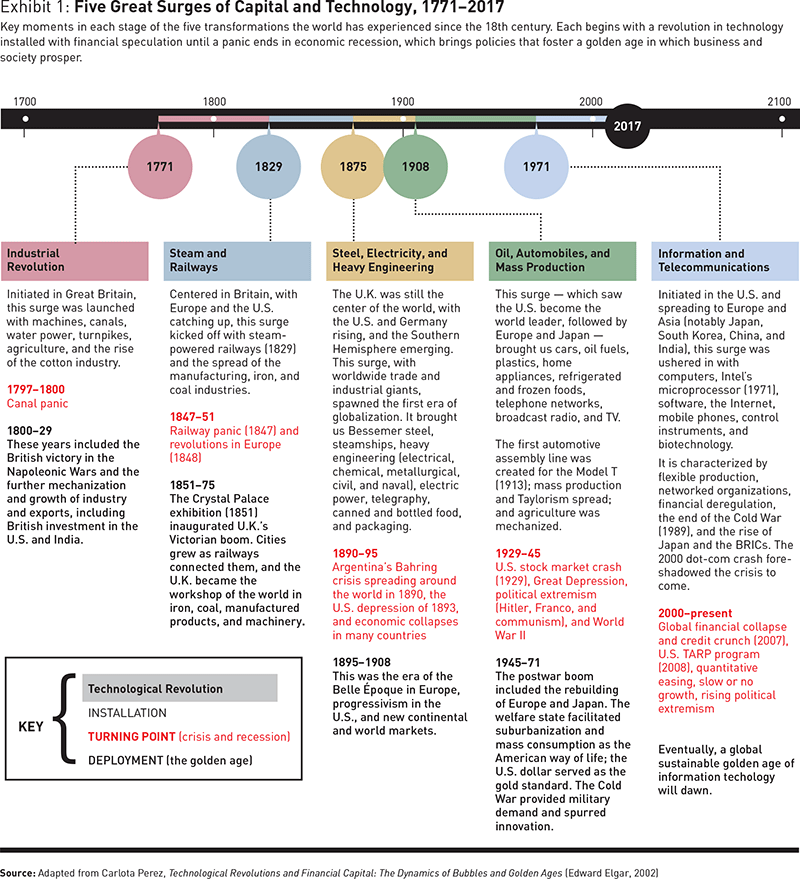
This may seem far-fetched, but it’s happened four times before. We are in the midst of the fifth great surge (as Perez calls them) of technological and economic change since the Industrial Revolution. The last one, the age of oil, automobiles, and mass production, lasted most of the 20th century and still shapes many people’s attitudes. Our current surge started around 1970 and has rolled out information and communications technology around the world: It is the age of the computer and the Internet (see Exhibit 1).
https://www.strategy-business.com/media/image/39153130_ex1b.gif
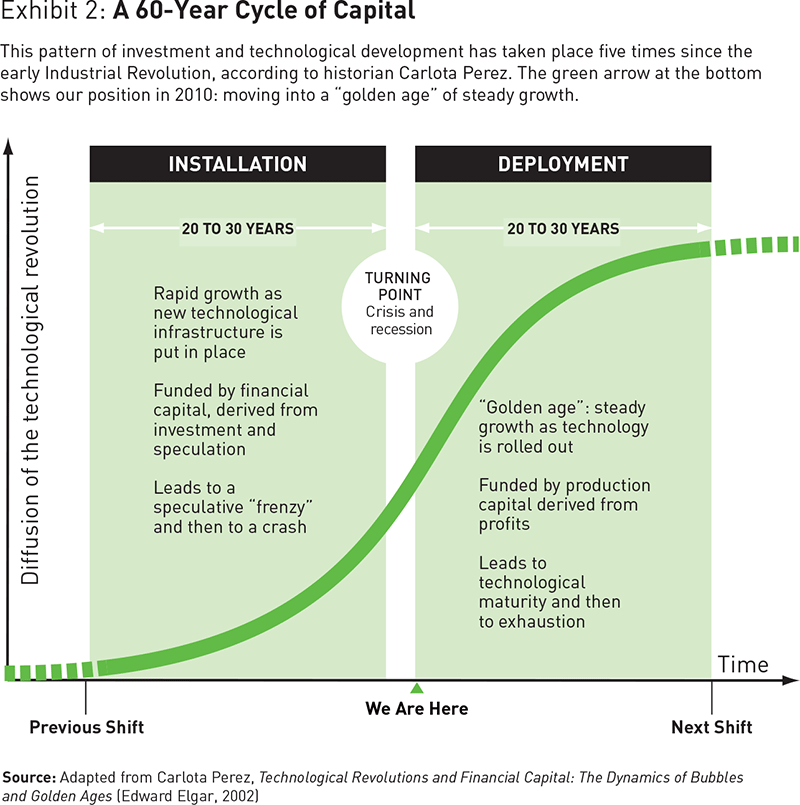
Each of these surges follows the same broad pattern. First, there is a wave of major new technologies, leading to dramatic changes in industrial production and daily life. For about 20 to 30 years, in a period that Perez calls installation, these technologies are funded largely by speculative investment chasing rapid returns. This age of widening wealth disparity leads to a bubble, which bursts in spectacular fashion, and is followed by a crisis period that Perez calls the turning point. This phase of economic and social turbulence has varied in length from two years to 17. Many efforts to get back to normal are made, usually involving the regulation of financial excesses or the stimulation of production and employment. When the crisis ends, the third part of the cycle begins; it consists of 30 years or so of stable economic growth, with a high level of genuine return on investment, and an economy funded by production capital, not speculation. Perez calls this period deployment. It is experienced as a golden age: a wave of prosperity, lifting everyone’s fortunes, including those who felt left behind just a few years before. Eventually, the technological opportunities reach exhaustion, markets become saturated, and the cycle starts all over again (see Exhibit 2).
https://www.strategy-business.com/media/image/39153130_ex2b.gif
Of course, these are broad observations, and nothing guarantees that the pattern will continue. But its overall logic is compelling. To Perez, the dramatically powerful technologies of Wall Street, Silicon Valley, and Industry 4.0 have provoked, in effect, a worldwide economic revolution, starting in the 1970s, challenging the equally powerful technologies of the fourth surge: oil, automobiles, and mass production. To turn the corner from crisis to golden age would require a major economic and political consensus: an intelligent global policy framework giving a convergent direction to investment and innovation, ensuring the growth of profitability and jobs around the world, including most major national economies. Not an easy task!

The participants in this roundtable were three longtime observers of the Perez hypothesis — including Carlota Perez. We met recently to consider this question: Given today’s political turbulence, after at least 10 years of being in the crisis phase, what would have to happen for a new golden age to begin?
—Art Kleiner
Causes of the Current Crisis

KLEINER: Carlota, according to your theory, we’re now about 45 years into a surge that began in the early 1970s. That’s the longest such cycle we’ve seen — and the longest period of crisis.

PEREZ: It’s probably also the deepest transformation of everyday life, and the one that has gone the furthest globally. Also, given our longer life span, the older generation has taken longer to hand over power — in this case, to younger digital natives. Even after 40 years, the information and communications technology (ICT) revolution is far from complete. It hasn’t fully changed our way of life, as previous technological revolutions had done. And it has brought a dangerous political shift, the separation of the interests of major global corporations from interests of the national societies where they are based.

During the golden age of mass production, in the 1950s and early 1960s, the interests of business and society converged. With the welfare state and suburbanization, working-class people in many Western countries could become homeowners and consumers. Therefore, when companies paid high salaries and high taxes, it all contributed to increasing domestic demand. Government support for education and health services freed up discretionary cash for people to spend on consumer products. High demand for these products created conditions for growth and profit. It was a robust positive-sum game, a super win-win between business and the majority of the population, resulting in good profits and decent livelihoods.

Then, in the 1970s, the mass production revolution hit a maturity ceiling. New products were less viable; productivity fell; markets were saturated. The welfare state became unsustainable, and national solidarity broke down. Since then, many businesses have seen their cost advantage and their customer demand migrate abroad, away from their home countries. Low salaries no longer harm business as in the past, so living standards have been declining for decades. This, together with unemployment from offshoring, goes far in explaining the Brexit referendum and the fervor of the U.S. elections in 2016.

JOHNSON: A factor that may intensify those tensions is the nature of today’s technology. We have an amazing arsenal of innovations on the threshold of realization: synthetic biology, quantum computing, blockchain, drones, autonomous vehicles, and private-citizen space travel. Potential breakthroughs are dangled before us....MUCH MORE

"Contracts and Trust"

From Elaine's Idle Mind, June 10, 2016:
Two nights ago, I was convinced to watch 50 Shades of Grey. Not the whole movie, thank god, just the contract negotiation scene.

******

I don’t get it, I said. Two adults are about to engage in sexual relations. Why do they need a contract? Don’t they trust each other? And if they don’t trust each other, why don’t they walk away?

The same question applies to pre-nups. Or even the institution of marriage! Unless one party poses a significant flight risk, why would willing participants need a legal contract to compel each other to stay?
To better understand this, let’s start with a simpler contract.

Loan contracts.
Suppose you apply for a mortgage with the best of intentions. The loan is approved thanks to your impeccable credit score and 10% down. It’s a large mortgage, but your salary is five times the monthly payment so you should pay it off no problem.

Fast-forward half a decade. The housing market has collapsed, your dog needs kidney dialysis, and to top it all off, a robot just took your job.
How motivated are you to continue paying that mortgage?

While you may be a trustworthy individual at time of loan application, it’s future-you that can’t be trusted. As long as the cost of defaulting on the contract (loss of home equity) is greater than the opportunity cost of mortgage payments, repayment can be coerced.
funny-wedding-cake-topper-remarkable-and-no-running-again-funny-wedding-cake-toppers-rwdreview-com
Much like a consumer loan agreement, marriage is an institution founded on mistrust. Sure, things are going great right now, but it is a cruel fact of nature that most humans do not age well.

What will compel you to stick around after she doubles in size and succumbs to the effects of gravity? And what happens after you become a balding couch ornament with the gut of a ruminant?

This is why marriage contracts were invented. Conjugal bliss can exist when both parties follow similar rates of decay, but this symmetry is rare. Discord arises when one party decays more rapidly than the other. Or, worse, when one party’s income substantially increases....MORE

"Assessing the iPhone effect in economic data"

Following on last week's BoE's Bank Underground on Cellphones: "Is the economy suffering from the crisis of attention?", another heavyweight looks at a different aspect of the impact of technology.

From the BlackRock blog:
Jean Boivin, PhD Head of Economic and Markets Research 
at the BlackRock Investment Institute
It’s no secret that the iPhone is a revolutionary technology, but is this obvious in key economic data? Jean weighs in.
It’s no secret that the iPhone is a revolutionary technology. One would expect key economic data to reflect major efficiencies gained from such technologies in our jobs and everyday lives.
Yet such an impact is hard to see in aggregate economic data, despite the apparently obvious surge in technology around us. Aggregate data show overall economic performance since the crisis has been mediocre, and even measures of productivity appear modest at best. This is puzzling.
Using a microscope, we can get a sense of how significant the impact of technology can be.
The iPhone, for instance, clearly shows up in a subset of world trade flows. The two charts below show how the September release of a new iPhone model coincides with apparent spikes in both Japanese imports of telephones from China (see the chart on the left) and Taiwanese export orders for communications equipment (see the chart on the right). The navy dots signify the first release date of each iPhone model. It’s difficult to tie the spikes conclusively to the iPhone, but it does appear that this seasonal pattern of a spike around September did not occur before the iPhone’s first introduction in 2007, our analysis shows.
chart-BII-iphone-v4
Our analysis focused on export data from Taiwan and China because they are the two countries most significantly involved in iPhone production. Taiwan makes many iPhone parts; China assembles the final phone. We also focused on import data from Japan, since Japan’s data break out telephone products. Other countries’ import data, such as that of the U.S., don’t have that kind of granularity.
The iPhone constitutes only a small fraction of trade flows and can easily get lost in larger datasets. For instance, telephone equipment makes up less than 20% of Japan’s imports from China in a typical iPhone release month, and imports from China make up less than 30% of Japan’s total imports for a given iPhone release month. And seasonal adjustment of aggregate trade data may mask the blips from iPhone releases, given that these have tended to occur around September.

But the economic impact of technology is not about the number of devices traded. The real puzzle is why we don’t see the broader efficiency impact technology should bring. It has been argued that this disconnect may reflect some mismeasurement in official statistic calculations, as the ever-improving quality of technology has been difficult to capture. Keeping up with the measurement of quality improvements is challenging, but statistical agencies are making ongoing adjustments, and we expect their progress on this front will continue....MORE

"The Cash Comeback: Evidence and Possible Explanations"

People like cash.
Except the Swedes, but they're weird.
And dying out.

From VoxEU:
Clemens Jobst, Helmut Stix 29 November 2017

"Amazon may have patented the next big thing in online shopping" (AMZN)

The headline doesn't lie, this is big.
And probably terrifying for retailers whose names aren't Amazon.
From Quartz:
User-generated Amazon reviews are one of the most important ways that consumers find products and decide what to buy. So much so that Amazon has consistently shown itself to be Google’s competitor in e-commerce search. Almost all Amazon product reviews are written but, as business research firm L2 wrote, Amazon is now pivoting to video.

It’s a broad strategy with Amazon inviting some of its 2 million merchant partners to join the test program, where videos will be posted to the site in mid-December. According to L2, “this feature is a logical step given how often consumers watch how-to and product review videos before making purchases. By adding the feature, Amazon clearly aims to keep shoppers on its own site, preventing them from migrating to YouTube or social media platforms.”

There’s potentially another reason for Amazon to promote the use of video in e-commerce. It now has a way to offer customers discounts for watching ads. In October, Amazon was awarded a patent for “content-based price reductions and incentives.” The patent says that “customers in an electronic environment can be presented with the option to receive advertising, such as audio, video, or interactive content, in order to receive discounted pricing or similar benefits.”

One example of how Amazon sees this working is that a customer can watch a video ad on an item’s detail page, such as a product review. As the customer watches more of the ad, the displayed price for the item drops....MORE

Pethokoukis: "Should Washington break up Big Tech?"

From the AEI:

Video and transcript: Should Washington break up Big Tech?
On Monday this week I hosted a panel conversation to discuss America’s major technology firms — Amazon, Apple, Facebook, Google, and Microsoft — and whether the federal government should regulate or break them up. You can watch the full conversation below, and find the transcript of our conversation here.
...MORE (video)
PANEL DISCUSSION
Participants: 
Ryan Hagemann, Niskanen Center
Andrew McAfee, Massachusetts Institute of Technology
Michael R. Strain, AEI
Luigi Zingales, George J. Stigler Center for the Study of the Economy and the State at the University of Chicago

JAMES PETHOKOUKIS:
Welcome.
Thanks for coming here on the first working day after Thanksgiving.
Of course, I had a great fear nobody would show up, being the first working day after Thanksgiving, so I’m especially grateful everyone made it here for our panel, which we have a great panel here who I’ll introduce in a moment. 

A decade ago, the world’s five largest companies by market value were Microsoft, Exxon Mobile, General Electric, Citigroup and Shell Oil.
Today, Microsoft is still there, but the rest are all tech firms: Apple, Alphabet (the parent company of Google), Amazon, and Facebook, though, on some days, I think Facebook swaps with Alibaba.
So those are now the top five.
And combined, they have a market value of $3.5 trillion. 

They have powered the market’s rally this year, leaving some to wonder if owning these stocks is all you really need to do when investing.
But it’s not just their size and market performance that’s been impressive.
It’s also their market dominance.
Google has 76 percent of the search ad market; 80 percent of total searches worldwide are done through Google.
Facebook and its subsidiaries own 77 percent of mobile social traffic.
Amazon has three-quarters share of the e-book market. 

And when some people look at those statistics, as well as the overall size of these companies, they think that, well, if America has a corporate concentration problem or a monopoly problem, then these super platforms look like the most obvious and serious examples of that concentration issue.
And there’s criticism—perhaps it started on the left, but certainly is now coming from the left and the right.

And there have been calls for various sorts of regulation and antitrust actions with maybe the extreme being to turn some of these firms into public utilities or break them up in some fashion.
Yet these remain very popular companies along with the services and products. They’re a source of innovation, high-paying jobs. 

And with perhaps the exception of the shale revolution, it’s just about the only bright spot in the US
economy over the past decade. 

And, again, public opinion surveys, so they are—you know, well, if Congress only had these kind of ratings that that these tech firms have. 

You know, 80 percent favorability rating, 77 percent for Amazon, the most widely admired companies by young Americans.
And even over the past year, in which there have been a lot of rough headlines, whether it’s the Russians using Facebook to try influence the election or free speech issues at Google or sexism at Uber, yet these remain very popular companies.

So what’s going on and why do some people have such a problem with these big mega-platforms?

To discuss whether the rise of the tech giants has become problematic in some way that requires a policy solution, as I said, we’ve assembled a really excellent panel.
I’m going to do them in alphabetical order.

We have Ryan Hagemann, who is director of technology policy at the Niskanen Center, where he specialized in issues at the intersection of sociology, economics, and technology. 

Right next to me is Andrew McAfee, principal research scientist at MIT, where he studies how digital technologies are changing business, the economy, and society.
He’s also coauthor of the recent book“Machine, Platform, Crowd: Harnessing Our Digital Future” with his compatriot, Erik Brynjolfsson. 

At the far end is Michael Strain, director of economic policy studies here at AEI. His research focuses on labor economics, public finance, and social policy. 

And last but not least, Luigi Zingales, director of the George J. Stigler Center for the Study of the Economy at the University of Chicago.
His research focuses on regulatory capture, crony capitalism, and the various forms of subversive competition by special interest groups. 

Again, everyone, thanks for coming. 

And I want to start with Professor Zingales, who earlier this year hosted a conferenceat the University of Chicago titled “Is there a concentration problem in America?”
And I watched a good chunk of that conference over my Thanksgiving weekend, sitting there for those hour-and-a-half-long panels.

MICHAEL STRAIN:
Giving thanks forthe American economy.

MR. PETHOKOUKIS:
Yes.
Yes.
Yes.
Giving thanks.
Well, I was not doing that. 

And during that conference, a good bit of it focused on the tech industry, which, again, maybe to at least some people the most obvious examples.
If you believe there is a concentration monopoly problem, I guess it would be hard to talk about this issue without talking about the tech industry.
So I want to start with you to sort of give me what the theory of the case is that these big platforms, super platforms, whatever you want to call them, that they’re —I mean, my bias is to see these companies as, gee, they’re, you know, as something that’s gone right with America, great national assets, remain (popular ?). 

What is the case that they’re problematic in some way, their size and scope and influence?

LUIGI ZINGALES: 
OK. So, first of all, I want to make sure that at least we have one common ground, which is we believe that for free markets to work well, we need to have an antitrust authority. We need to have some government intervention. 

We’re not in a laissez faire butopia,but at least we are a more —(inaudible) —society where antitrust plays a role. 

And then the question is what role and when. And, of course, the question of cost and benefits. 

This said, I think that—and I would like to set aside, even if it’s a big issue, but I would like to discuss later, this platform as media industry. Because I think when you talk about media, we need to talk—there is another set of concerns that plays a role. 

But even if we did not consider them media, and I don’t know why we shouldn’t consider media, but imagine for a second we don’t consider them media, I think that especially when I think of Google and Facebook, the issue about network externalities comes big. And I think it’s sort of something that deviates from our standard notion of markets and also our standard notion of antitrust.

If I sell my main product at price zero, what it means to have a market share,
OK?
That’s a pretty basic thing, but it’s quite important.
And so the question is then, however, if we have a sort of market share—(inaudible)—
I offer a glass a wine to whoever uses Bing that does not use Google.
And I generally go around, and I make this offer and never pay any price because nobody, unless you are in China, where you are prohibited from using Google, everybody in the United States, uses Google.
So in terms of market share of searches that represent in the United States is above 90 percent....
...MUCH MORE

Transcript (22 page PDF)

"The opening of a canal in 1848 led to the birth of modern financial derivatives, and the early demise of some of the men who traded them"

From Damn Interesting:

Death by Derivatives
In April of 1873, an unhappy man walked along Clark Street in downtown Chicago. His name was Aymar de Belloy. There was a gun in his pocket, and a nickel – enough for one final glass of beer.

He entered Kirchoff’s tavern and sat at a table, then changed his mind about the beer. He drew his gun, pointed it at his forehead, and pulled the trigger.

The bullet careened along the inside of his skull like a speed skater on a banked turn. It stopped at the left temple, sparing his brain. Belloy rose and staggered to the bar, shaking hands with the horrified men he passed along the way. Upon reaching the bartender, he apologized in all sincerity for the inconvenience he had just caused. Then he collapsed.

Belloy was a speculator, or “plunger” as they were then known, at the Chicago Board of Trade, where traders negotiated contracts for the future sale of wheat and other such goods. The value of these contracts was based on, or derived from, the current price of wheat. Hence they would one day take the name we use today: derivatives.

In the 1870s, with few rules in place, a man could make a fortune plunging wheat. He could also lose a fortune, and with it the will to live. Indeed, the string of early derivative traders taking their own lives grew long enough that one writer gave it a name: the “crimson thread of suicide.”

The scale of today’s derivatives market is almost too vast to comprehend. It’s measured in trillions of dollars. Traders, aided by the most sophisticated software money can buy, place bets — billions per second — on the future prices of every manner of stuff. The market hardly exists in any tangible physical sense; most trading takes place across a network of countless devices at data centers around the world.

But in 1873, the global derivatives market was centered in one building on LaSalle Street in Chicago. And it would not have existed at all were it not for the digging of a very long ditch some 25 years earlier.

In 1848, an army of Irish immigrants finished digging the Illinois and Michigan Canal. It was ninety-six miles long and surprisingly shallow—a tall man could stand on the bottom and not dampen his bowler. The canal connected the Chicago River with the Illinois River, which in turn fed the mighty Mississippi, opening an inland waterway from New Orleans to New York. 1848 was also the year Chicago saw its first railway, and stockyard. Its first telegraph and steam-powered grain elevator? Same year.

Indeed, a city’s annus mirabilis (“wonderful year”) doesn’t get much more mirabilis than Chicago’s 1848. These advances would soon turn the city into, well, Chicago, simply by making it so much easier for stuff to move between east and west.

And boy oh boy did stuff thus move: grain, lumber, salt, sugar, pigs, and cattle began floating or rolling into this town on the southern tip of Lake Michigan like never before. There it was unloaded, weighed, graded, sold, stored, and reloaded onto boats or trains heading the other way.

In March of 1848, a dozen or so businessmen gathered to form an alliance of business interests, or what we would today call a trade association. It was a brilliant idea whose only problem was the apparent lack of anything for these fellows to actually do. Founders of the Chicago Board of Trade were determined to find something, but interest soon began to wane. To persuade members to show up for meetings, the founders began offering a free lunch of crackers, cheese and ale. Lines soon formed at the door, filled with men from all walks of life who were only too happy to attend meetings in exchange for free booze—or what we would today call, well, a trade association. The Chicago Board of Trade hired a bouncer to keep the freeloaders at bay, but this still left the nascent organization with very little to do. That would soon change....MUCH MORE

Friday, December 1, 2017

"Google’s Artificial Intelligence Built an AI That Outperforms Any Made by Humans"

That's it, we're all dead.
"It" being the Grey Goo scenario but using AI rather than molecular nanotech.

From Futurism:
In Brief 
Google's AutoML project, designed to make AI build other AIs, has now developed a computer vision system that vastly outperforms state-of-the-art-models. The project could improve how autonomous vehicles and next-generation AI robots "see."
An AI That Can Build AI
In May 2017, researchers at Google Brain announced the creation of AutoML, an artificial intelligence (AI) that’s capable of generating its own AIs. More recently, they decided to present AutoML with its biggest challenge to date, and the AI that can build AI created a “child” that outperformed all of its human-made counterparts.

The Google researchers automated the design of machine learning models using an approach called reinforcement learning. AutoML acts as a controller neural network that develops a child AI network for a specific task. For this particular child AI, which the researchers called NASNet, the task was recognizing objects — people, cars, traffic lights, handbags, backpacks, etc. — in a video in real-time.

AutoML would evaluate NASNet’s performance and use that information to improve its child AI, repeating the process thousands of times. When tested on the ImageNet image classification and COCO object detection data sets, which the Google researchers call “two of the most respected large-scale academic data sets in computer vision,” NASNet outperformed all other computer vision systems.
https://futurism.com/wp-content/uploads/2017/12/image2-1200x799.jpg
 Image Credit: Google Research
According to the researchers, NASNet was 82.7 percent accurate at predicting images on ImageNet’s validation set. This is 1.2 percent better than any previously published results, and the system is also 4 percent more efficient, with a 43.1 percent mean Average Precision (mAP). Additionally, a less computationally demanding version of NASNet outperformed the best similarly sized models for mobile platforms by 3.1 percent....MUCH MORE

"MIT Study Suggests the U.S. Is Vastly Overstating Its Oil Output Forecasts"

From Bloomberg, Dec. 1:
  • Estimates from EIA exaggerate impact of fracking technology
  • New well output could undershoot EIA forecasts by 10% in 2020
Turns out, America’s decade-long shale boom might just end up being a little too good to be true.
There’s no denying that fracking has turned the U.S. into a force in the global oil and gas markets, which has more than a few people abuzz about the prospect of energy independence.

But now, researchers at MIT have uncovered one potentially game-changing detail: a flaw in the Energy Department’s official forecast, which may vastly overstate oil and gas production in the years to come.

The culprit, they say, lies in the Energy Information Administration’s premise that better technology has been behind nearly all the recent output gains, and will continue to boost production for the foreseeable future. That’s not quite right. Instead, the research suggests increases have been largely due to something more mundane: low energy prices, which led drillers to focus on sweet spots where oil and gas are easiest to extract.

“The EIA is assuming that productivity of individual wells will continue to rise as a result of improvements in technology,” said Justin B. Montgomery, a researcher at the Massachusetts Institute of Technology and one of the study’s authors. “This compounds year after year, like interest, so the further out in the future the wells are drilled, the more that they are being overestimated.”

‘Same Dynamic’
Extrapolating from field studies Montgomery and his colleague Francis O’Sullivan conducted in North Dakota’s Bakken shale deposit, the research suggests that total U.S. oil and natural-gas production from new wells could undershoot the EIA estimate by more than 10 percent in 2020. Things would get progressively worse each year after that as wells in various sweet spots are exhausted and technology fails to close the gap.

“The same forecasting methods are used in other plays in the U.S., and the same dynamic is likely to be present,” Montgomery added.

Margaret Coleman, the EIA’s leader of oil, gas and biofuels exploration and production analysis, said in an email “the study raises valid points” and the administration is looking at ways to give its estimates a tighter focus. She added that many shale fields lack the detailed well data that informed the MIT study, which means EIA forecasters have to use known geologic information and assumptions about prices and technology to come up with estimates....MUCH MORE
Related at Oilprice:

Russian Oil Minister: U.S. Shale Production Jump Was No Surprise
Russia’s Energy Minister Alexander Novak told CNBC the increase in U.S. shale oil production since the start of the OPEC/non-OPEC production cut was expected, adding that it would have been worse for OPEC and its partners if they hadn’t agreed the extension they did yesterday.

Evidently irritated by a question he says he is being asked all the time, Novak said “This is not news for us. For some reason when people ask this question they seem to believe that we didn't think that shale oil would grow. Either you underestimate us or you think we lack professionalism. I think that if you think we are professional you need to understand that we are including all this in our calculations."....MORE

Marketing: David Rockefeller's Art Goes On Display in Hong Kong

As noted in the look at Mr. R's townhouse a couple months ago:
Possibly of more interest to our readers is the art collection which will hit the block next year....
We're getting close. Christie's whisper number for the collection is $1 billion.

From Art Market monitor:
With the Salvator Mundi sale receding into the past, Christie’s is getting geared up for the big event of 2018, the sale of David Rockefeller’s art and collectibles which promises to deliver exciting revelations. Hong Kong is the next stop on Christie’s sales calendar as the Autumn auction cycle begins this weekend. There Christie’s will put works from the Rockefeller estate on display including a Matisse they will be asking the highest price ever for:
The first highlights include masterpieces of Impressionist and Modern Art, including a Rose Period Picasso selected by Peggy and David Rockefeller from Gertrude Stein’s collection (estimate in the region of $70 million)
...MORE

"Why Silicon Valley wants you to text and drive "

Maybe not so much drive as lounge.

From The Conversation:
As self-driving cars come closer to being common on American roads, much of the rhetoric promoting them has to do with safety. About 40,000 people die on U.S. roads every year, and driver errors are linked to more than 90 percent of crashes. But many of the biggest advocates of autonomous vehicles aren’t car companies looking to improve the safety of their existing products. Huge backing for self-driving technologies is coming from Silicon Valley giants like Google and Apple.

Those of us who have studied the relationship between technology and society tend to look more carefully at the motivations behind any technological push. In this case, it’s clear that in addition to addressing safety concerns, Silicon Valley firms have a strong incentive to create a new venue for increasing the use of their digital devices. Every minute people spend on their mobile phones provides data – and often money – to tech companies.

At present, digital devices and driving are in conflict: There are serious, often fatal, consequences when drivers use smartphones to talk or to text. Regulators and safety advocates look to resolve that conflict by banning phone use while driving – as has happened in virtually every state. But the tech companies are taking a different approach. The obvious answer for Silicon Valley is creating an automobile in which continuous cellphone use no longer poses a threat to anyone.

Not a new idea
The idea of a car so capable a driver is not needed isn’t new. As far back as the 1950s, the Saturday Evening Post ran an illustration imagining a family playing a board game (in a convertible!) as the car conducts itself down the road. When self-driving cars actually take to the streets in large numbers, today’s families likely won’t be playing Scrabble – though Words With Friends and other mobile games are a near certainty. Every passenger is likely to be using a mobile device.
https://images.theconversation.com/files/195880/original/file-20171122-6027-1syyjk2.png?ixlib=rb-1.1.0&q=45&auto=format&w=1000&fit=clip
A self-driving car depicted in the 1950s. Saturday Evening Post
In recent years, the amount of time adults spend on their mobile devices (beyond actual phone calls) has grown rapidly. At the moment, it’s around four hours a day for the average adult in the U.S. However, that rapid growth is likely to slow down as people run out of time that’s available for them to use their devices.

Unless, of course, there’s a new block of time that suddenly opens up. The average American now spends about 48 minutes in a car every day, a sizable opportunity for increased cellphone use....MUCH MORE

$300 Looks Like an Important Line For Tesla's Stock (TSLA)

When TSLA didn't rebound (much) yesterday we thought it time to take a look at the chart.
This is one of those times the big round number actually does matter, a decisive break below and there's not much support until the stock gets back to the March launching pad, down around $240.

TSLA Tesla, Inc. daily Stock Chart
Up only 0.43% on Thursday, the stock is changing hands at $304.25 down $4.60 (-1.49%) in early premarket trade.

"Why Scandinavia's Biggest Bank Is Setting Up Its Own Fintech Startup Fund"

Janteloven?
No? Then I give up, why is Scandinavia's [+Finland+Iceland] largest bank investing in potential competitors?

From Forbes:
Why would Nordea, the largest bank and third largest corporation in the Nordic region, decide to set up a business to invest in other businesses that might be competitors?

The bank has announced that it’s setting up Nordea Ventures, to make strategic investments in fintech start-ups.

“ We’re recognising that we don’t have the monopoly on good ideas, and sometimes others do ” says Ewan MacLeod, Chief Digital Officer at Nordea, from a slushy Helsinki. “But we can partner with them. Fintechs can work at lightning speed. Sometimes it can be very effective if we provide the financing to make a dream come true.”

A case in point is Tink the Swedish-based fintech company, where Nordea provided capital and advice and integrated some of Tink’s own technology into its own digital products while preserving Tink’s name and brand.


Tink’s app helps consumers to aggregate financial transactions in one place, to compare and switch mortgages to a partner bank or open a savings account, for instance. Another Tink app for banks and payment services like Klarna provides account aggregation and payment capabilities.

The new venture will focus on investments offering a mutual strategic advantage, according to  MacLeod. There will inevitably be a Nordic focus, but investment won’t just be in Nordic fintech. Nordea will get to see new ideas early on and be able to decide whether to integrate them into their own brand or to back them as independent entities, and influence their development....MORE
Here's Nordea's English language press release page. They do indeed seem to be busy.