Showing posts sorted by date for query tokenization. Sort by relevance Show all posts

Thursday, May 28, 2026

MAJOR Market Infrastructure News: Depository Trust Chooses A Second Blockchain For Tokenization

From Ledger Insights, May 27:

DTC tokenization service to add Stellar as second public blockchain 

The Depository Trust & Clearing Corporation (DTCC) and the Stellar Development Foundation announced plans to enable DTC tokenized assets on the Stellar network, with availability expected in the first half of 2027. Stellar becomes the second public blockchain to connect to the service after the Canton Network, and notably neither chain is Ethereum compatible despite DTCC’s own AppChain running natively on EVM infrastructure.

The announcement advances DTCC’s multi-chain strategy following the December 2025 SEC no action letter that allowed DTC to tokenize custodied assets. The service covers highly liquid securities including Russell 1000 constituents, major index ETFs, and U.S. Treasuries. Limited live transactions are planned for July 2026 with a full launch in October 2026, although Stellar will not be ready at launch.

Stellar handles tokens as native base layer primitives rather than as smart contracts, which is the standard approach on Ethereum and EVM-compatible chains. That distinction matters for DTC’s compliance requirements. The no action letter requires all supported chains to restrict token movements to registered wallets, and the ability for DTC to force transfer or burn tokens when needed to address errors, lost tokens or malfeasance.
Article continues …[Paywall] 

At CoinDesk May 28:

DTCC plans to bring tokenized assets to Stellar in latest Wall Street blockchain push
The U.S. market infrastructure giant targets connecting tokenized stocks, ETFs and Treasuries to Stellar in the first half of 2027.... 

Here's the DTCC's Tokenization page. 

They go out of their way to stress:

"Our new tokenization service will serve as the bridge between TradFi and DeFi and, importantly, offer the same investor protections and ownership rights as traditional book-entry securities currently held in custody by DTC."  

Previously: 

February 2016 -  Depository Trust & Clearing Corporation Issues White Paper On Blockchain (DTCC)
I'm a week late getting to this but wanted to have it available for future ref....

May Day 2025 - "The ‘Amazonification’ of Trading"
It is good to understand the framework in which you are operating.

May 18, 2025 - "Tokenization’s trillion dollar promise: Wall Street leaders make their case to the SEC" 

December 15, 2025 - Updated—It Looks Like Depository Trust (DTCC) Is Getting Into Tokenization
Update below....

***** 

If I recall correctly, in the event of a major market dislocation, DTCC would be considered the actual owner of the assets, which would surprise quite a few people.

I should probably look it up.

UPDATE: it appears I mis-remembered. It is the creditors of a clearing company that end up with the asset. UCC:

(c )If a clearing corporation does not have sufficient financial assets to satisfy both its obligations to entitlement holders who have security entitlements with respect to a financial asset and its obligation to a creditor of the clearing corporation who has a security interest in that financial asset, the claim of the creditor has priority over the claims of entitlement holders.

—Uniform Commercial Code Law Section 8-511
Priority Among Security Interests and Entitlement Holders

As of the last balance sheet (March 31, 2025) net assets of DTCC were $4,460,400,000.

So if one of DTCCs Central Clearing Counterparties gets stuck guaranteeing a big fail, that's it, that's what the whole system rests upon.

I only bring this up because I can't get the image of an upside-down pyramid out of my head.

And we'll just pile more/faster on top (bottom). 

It's probably nothing to worry about. 

December 18, 2024 - U.S. Cybersecurity and Infrastructure Security Agency Releases National Cyber Incident Response Plan Update

For now just a personal bookmark. Although I hope we won't have to, I fear we will be referring back to this post.

From CISA.gov....

*****

As a side note, if registering securities in certificate form is part of your risk mitigation strategy be prepared to pay $500 and more per cert. 

DTCC (DTC and Cede & Co.) strongly discourages use of the Direct Registration System.

Friday, May 22, 2026

SEC "Commissioner Hester Peirce has told the crypto industry to cool its expectations about a potential 'innovation exemption'” (also Michael Saylor on buying all Bitcoin production)

From CoinTelegraph, May 21: 

SEC's Peirce tempers expectations over tokenized stocks exemption

An executive at tokenization platforms Superstate said the stricter approach suggested by Hester Peirce would enable DeFi to expand without compromising rules in traditional capital markets. 

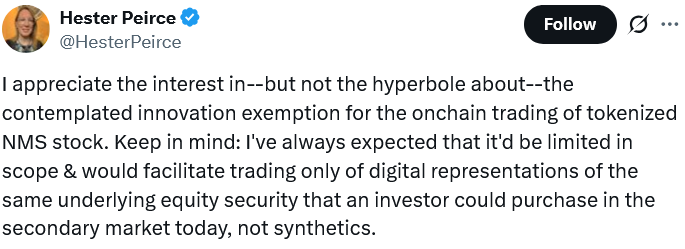
US Securities and Exchange Commissioner Hester Peirce has told the crypto industry to cool its expectations about a potential “innovation exemption” to allow tokenized stock trading after a report earlier this week about what it could entail. 

Her comments were made after a Bloomberg report on Monday. Brett Redfearn, president of tokenization platform Securitize, expressed concern following the report, arguing that enabling third parties to tokenize stock “without an issuer at the table” could lead to fragmentation issues. 

In a post to X on Thursday, Peirce said her expectation has always been that any exemption would be “limited in scope” by only permitting “digital representations of the same underlying equity security that an investor could purchase in the secondary market today.”

Peirce said she doesn’t expect synthetic tokens to be included, which would make it more challenging for third parties to offer stock-price tracking tokens under the exemption.


Data from RWA.xyz shows that $1.48 billion worth of stocks are tokenized onchain, including shares linked to stablecoin issuer Circle, Bitcoin buying firm Strategy and Google (GOOG). 

However, it hasn’t boomed as rapidly as some financial institutions have expected, including Citibank and McKinsey & Co, which predicted in 2022 and 2024 that the tokenization sector would become a trillion-dollar market by or before 2030....

....MUCH MORE 

Unrelated:

Tuesday, February 24, 2026

SEC: "Number Go Down and Other Schadenfreude"

Our introduction to a June 2025 speech from one of the speakers, S.E.C. Commissioner Hester Peirce:  

    Commissioner Peirce is a bit of a wild child and more willing than most commissioners, past and present, to experiment in the areas of market structure and securities regulation.

    Here she addresses the Investment Company Act of 1940... 

I believe that is the only time I have described a Commissioner as a 'wild child." 

From the Securities and Exchange Commission, 

ETHDenver
Denver, CO

Commissioner Peirce: I am honored to be on stage today with Chairman Paul Atkins. Before we begin, let me remind you that my statements and his are our own in our official capacities and do not necessarily reflect the views of the Commission or our fellow Commissioner. Chairman Atkins needs little introduction, but let me give you a brief bio for him.

Paul S. Atkins was sworn into office as the 34th Chairman of the Securities and Exchange Commission on April 21 of last year. Prior to returning to the SEC, Chairman Atkins was most recently chief executive of Patomak Global Partners, a consulting firm he founded in 2009. Chairman Atkins previously served as a Commissioner of the SEC from 2002 to 2008. During his tenure, he advocated for transparency, consistency, and the use of cost-benefit analysis at the agency. Chairman Atkins began his career as a lawyer in New York, focusing on a wide range of corporate transactions for U.S. and foreign clients, including public and private securities offerings and mergers and acquisitions. He was resident for 2½ years in his firm’s Paris office and admitted as conseil juridique in France. A member of the New York and Florida bars, Chairman Atkins received his J.D. from Vanderbilt University School of Law and his A.B., Phi Beta Kappa, from Wofford College in 1980. Originally from Lillington, North Carolina, Chairman Atkins grew up in Tampa, Florida. He and his wife Sarah have three sons.

One other interesting fact about Chairman Atkins is that he speaks German and French fluently. He likely is looking for another language to add to his repertoire. Mr. Chairman, have you considered learning Solidity?

Chairman Atkins: No need. Vibe coding works just fine. It is a big step up from the BASIC-PLUS and COBOL I used in college.

Commissioner Peirce: Fair point, Mr. Chairman, but if the smart contract your AI writes starts saying everything is a security, we’ll suspect AI hallucination. A few years ago, if someone had told me that I would be standing at a crypto conference with the Chairman of the SEC, I would have thought that person was hallucinating. But we’re here, so let’s get to some substance. During the past year, the SEC under the leadership of Chairman Atkins and Acting Chairman Uyeda in the early part of the year has taken a lot of steps toward crypto clarity. We have:

  • Sought and received written responses to multiple sets of difficult questions covering a wide range of crypto topics;
  • Held several in-depth roundtables on discrete topics including the definition of a security, trading, custody, tokenization, DeFi, and privacy;
  • Met with many developers and builders in Washington D.C., virtually, and in crypto-on-the-road meetings in cities across the country;
  • Provided technical assistance to Congress as it works on crypto legislation;
  • Launched a new initiative with the Commodity Futures Trading Commission (CFTC) to build a lasting basis for coordination and cooperation in regulating areas of joint interest, including crypto;
  • Ended regulation by enforcement;
  • Issued multiple staff guidance documents and frequently asked questions to help people understand what the SEC staff thinks is and is not within the SEC’s jurisdiction (including on issues like mining, staking, meme coins, and stable coins), and how regulated entities engaging with crypto can comply with our existing rules;
  • Got rid of unhelpful staff guidance, such as SAB 121;
  • Published a staff statement on the custody of crypto asset securities by broker-dealers;
  • Issued a cross-divisional staff statement outlining a taxonomy for tokenized securities;
  • Approved exchange generic listing standards for crypto ETPs;
  • Issued staff no-action letters to several projects, including on tokenization and DePIN; and
  • Began the process of designing rules, exemptive relief, and Commission interpretations, which will help to form the basis for a durable regulatory framework.

Mr. Chairman, can you give us a preview of what to expect this year on the crypto regulatory front?....

....MUCH MORE 

Also from the Commissioner, July 9, 2025:

SEC Commissioner Peirce: "Enchanting, but Not Magical: A Statement on the Tokenization of Securities"

Monday, December 15, 2025

Updated—It Looks Like Depository Trust (DTCC) Is Getting Into Tokenization

Update below. 

From The Trade, December:

DTCC receives SEC no-action relief to launch tokenisation service 

The SEC authorisation covers an initial three-year period, spanning instruments including securities within the Russell 1000 index, ETFs linked to major benchmarks, and US Treasury bills, notes and bonds.

The Depository Trust & Clearing Corporation (DTCC) has been cleared by the US Securities and Exchange Commission (SEC) to move ahead with a new tokenisation service, following the issuance of a no-action letter.   

The letter allows its subsidiary DTC to tokenise its real-world assets and make those digital representations available on pre-approved blockchains.  

The SEC authorisation spans an initial three-year period and covers a defined range of highly liquid instruments, including securities within the Russell 1000 index, ETFs linked to major benchmarks, and US Treasury bills, notes and bonds.  

The service is expected to go live in the second half of 2026 and will initially operate in a controlled production environment for DTC Participants and their clients. 

Digital versions of these assets will carry the same investor protections, rights and entitlements as their traditional forms, with the same operational safeguards applied across DTC’s existing infrastructure. 

Frank La Salla, president and chief executive of DTCC, said: “I want to thank the SEC for its trust in us. Tokenising the US securities market has the potential to yield transformational benefits such as collateral mobility, new trading modalities, 24/7 access and programmable assets, but this will only be achievable if market infrastructure provides a robust foundation to usher in this new digital era.”....

....MUCH MORE 

If I recall correctly, in the event of a major market dislocation, DTCC would be considered the actual owner of the assets, which would surprise quite a few people.

I should probably look it up.

UPDATE: it appears I mis-remembered. It is the creditors of a clearing company that end up with the asset. UCC:

(c )If a clearing corporation does not have sufficient financial assets to satisfy both its obligations to entitlement holders who have security entitlements with respect to a financial asset and its obligation to a creditor of the clearing corporation who has a security interest in that financial asset, the claim of the creditor has priority over the claims of entitlement holders.

—Uniform Commercial Code Law Section 8-511
Priority Among Security Interests and Entitlement Holders

As of the last balance sheet (March 31, 2025) net assets of DTCC were $4,460,400,000.

So if one of DTCCs Central Clearing Counterparties gets stuck guaranteeing a big fail, that's it, that's what the whole system rests upon.

I only bring this up because I can't get the image of an upside-down pyramid out of my head.

And we'll just pile more/faster on top (bottom). 

It's probably nothing to worry about. 

Tuesday, December 2, 2025

"Larry Fink and Rob Goldstein on how tokenisation could transform finance" (BLK)

From The Economist, December 1:

Larry Fink is BlackRock’s chief executive. Rob Goldstein is the investment firm’s chief operating officer. 

Ledgers haven’t been this exciting since the invention of double-entry book-keeping

Fifty years ago money moved at the speed of mail. When one of us (Larry) started his career in 1976, trades were placed over the phone and settled with paper certificates sent by courier. In 1977 a technology called swift brought standardised electronic messaging between banks, cutting transaction times from days to minutes. Today, trades between New York and London execute in milliseconds.

Now finance is entering the next major evolution in market infrastructure—one that could move assets faster and more securely than systems that have served investors for decades. It started in 2009 when Satoshi Nakamoto, a pseudonymous developer, launched bitcoin as a shared digital ledger that could record transactions without intermediaries. A few years later that same technology—the blockchain—sparked something even more transformative: tokenisation.

Tokenisation involves recording ownership on digital ledgers. It makes it possible for almost any asset, from real estate to corporate debt or currency, to exist on a single digital record that participants can independently verify. At first it was hard for the financial world—including us—to see the big idea. Tokenisation was tangled up in the crypto boom, which often looked like speculation. But in recent years traditional finance has seen what was hiding beneath the hype: tokenisation can greatly expand the world of investable assets beyond the listed stocks and bonds that dominate markets today.

Tokenising assets brings two broad benefits. First, it offers the potential to settle transactions instantaneously. Today’s markets operate on different settlement timelines, exposing buyers and sellers to the risk that one side might not fulfil its obligations. Standardising instantaneous settlement across global markets would be a leap beyond what swift ever made possible.

Second, private-market assets still rely heavily on paper—manual processes, bespoke settlements and records that haven’t kept up with the rest of finance. Tokenisation can replace paper with code, reducing the frictions that make assets costly and slow to trade. It can turn large, unlisted holdings such as real estate or infrastructure into smaller, more accessible units, broadening participation in markets long dominated by large institutions.

Technology alone won’t remove every barrier. Regulation and investor safeguards will remain essential. But by lowering cost and complexity, tokenisation can give more investors more ways to diversify.

There are early signs of progress. Tokens that represent “real-world” traditional financial assets (stocks, bonds and so on) remain a tiny share of global equity and fixed-income markets but are growing fast—up roughly 300% in the past 20 months.

Much of the early adoption is happening in the developing world, where banking access is limited. Nearly three-quarters of crypto holders live outside the West. Meanwhile, the economies that built modern finance—America, Britain and the eu—are falling behind, at least when it comes to where the trading is happening. It’s true that many of the companies best placed to lead the shift to a tokenised financial system, including the dominant players in stablecoins, are American. But that early advantage isn’t guaranteed.

If history is any guide, tokenisation today is roughly where the internet was in 1996—when Amazon had sold just $16m-worth of books, and three of the rest of today’s “Magnificent Seven” tech giants hadn’t even been founded. Tokenisation could advance at the pace of the internet....

....MUCH MORE 

Previously on BlackRock and tokenization:

And on double entry bookkeeping: 

In 1994 there was great gaiety and celebration to mark the 500th anniversary of the publication of Luca Pacioli's treatise on, well, everything, hence the title: Summa. Accounting nerds around the world paid homage to the section on bookkeeping. You had to be there.

Unfortunately Benedikt Kotruljević had plowed the ground 36 years earlier with his Delia Mercatura et del Mercante Perfetto (Of Trading and the Perfect Trader) and the accounting profession had actually missed the quincentenary of the presentation of double entry bookkeeping to the world....

Wednesday, November 26, 2025

Tokenization: "On-Chain Stocks Could Misprice Over Weekends, Triggering Arbitrage Risks: RedStone"

First off, it is not an arbitrage if you can't execute simultaneously. At best you've got a dirty hedge and more realistically a pair trade. Okay, off with the academic hat and on to CoinDesk, November 23: 

This gap could create a "price dislocation" between on-chain and traditional markets, leading to potential losses or arbitrage opportunities. 

What to know:

  • The growing trend of real-world asset (RWA) tokenization may be overlooking a critical risk: the "weekend gap" between 24/7 crypto markets and traditional markets that are closed on weekends.
  • This gap could create a "price dislocation" between on-chain and traditional markets, leading to potential losses or arbitrage opportunities.
  • Oracle providers' weekend price feed freezes could exacerbate the issue, highlighting the need for more robust oracle architectures to manage the gap between open protocols and closed traditional markets. 

As real-world asset (RWA) tokenization surges, the crypto industry is entering unfamiliar territory, bringing traditional equities, private credit, and commercial paper onchain and uncovering potential critical risks along the way.

Marcin Kaźmierczak, co-founder of oracle provider RedStone, says a risk is potentially being overlooked: the weekend gap, where crypto trades 24/7, while Wall Street does not.

In traditional finance, if disaster strikes a company over the weekend, the market is closed and then the stock "gaps down" when the opening bell rings on Monday. Meanwhile, in the crypto market, trading never stops. As more stocks are brought onchain, the gap in weekend trading on the blockchain for traditional equities versus when the market opens on Monday could pose a risk, according to Kaźmierczak....

....MUCH MORE 

Friday, September 19, 2025

"BlackRock Seeks to Tokenize ETFs After Bitcoin Fund Breakthrough"

From Bloomberg, September 11:

BlackRock Inc. is exploring how to give one of Wall Street’s biggest investment products a digital makeover.

The world’s largest asset manager is weighing ways to make exchange-traded funds available as tokens on the blockchain, according to people familiar with the matter, who declined to be identified citing confidential information. The New York-based firm is working on tokenizing funds tied to real-world assets, such as stocks, subject to regulatory considerations, the people said.

In 2024, BlackRock launched a tokenized money-market fund, known as BUIDL, which has grown to more than $2 billion and is popular on crypto platforms. It also follows the blockbuster debut of its spot Bitcoin ETF, which quickly became one of the most popular such funds in history. A BlackRock representative declined to comment.

Tokenization involves creating a digital version of a traditional asset that can move on blockchain systems. For ETFs, it could mean trading beyond Wall Street’s set hours, making US products easier to access abroad, and creating potential new uses as collateral in crypto networks.

That idea is drawing increased attention across the industry. Tokenized share classes of funds are seen as an early step toward a broader migration of markets onto blockchain, a shift proponents say could enable instant settlement, fractional shares, and more. Money-market funds from the likes of Franklin Templeton and BlackRock opened the door. Next, ETFs, already designed as flexible wrappers, may emerge as a proving ground for this transition.

BlackRock has been a big booster of digital assets. Beyond BUIDL, the firm has tested tokenized fund shares in trades on JPMorgan’s Onyx, now known as Kinexys, infrastructure and has positioned itself as an early adopter of digital-settlement models. The firm’s bullish posture is underscored by Chief Executive Officer Larry Fink, who has said every financial asset can be tokenized. He reiterated the view in his 2025 annual letter to investors.

It comes as exchanges like Kraken and Robinhood offer tokenized stocks overseas and as startups pilot similar services in controlled settings.

Such a shift faces big hurdles. ETFs today settle through Wall Street’s clearinghouses, while blockchain-traded tokens move instantly and around the clock. Reconciling those systems raises questions for regulators and custodians. Still, the climate has grown more permissive, with policymakers under the Trump era signaling openness to programs that allow firms to test blockchain-based markets in contained environments....

....MORE 

Possibly also of interest: 

February 2024 - "Tokenized, Inc: BlackRock's Plan To Own The Fractionalized World"

July 2024 - BIS: "Finternet: the financial system for the future" 

January 2025 - "BlackRock CEO wants SEC to ‘rapidly approve’ tokenization of bonds, stocks: What it means for crypto" 

May 2025 - "Tokenization’s trillion dollar promise: Wall Street leaders make their case to the SEC"

May 2025 - BIS/New York Fed: Hell Yes We Can Run Monetary Policy In A Tokenized World 

May 2025 - Boston Consulting Group, Ripple Predict Tokenization To Reach $18.9 Trillion by 2033
And pretty soon you're talking real money....

June 2025 - "Coinbase seeks SEC approval for ‘tokenized equities’ — Report"  

June 2025 - "Dinari granted first broker-dealer registration to offer tokenized stocks"

July 2025 -"Robinhood's CEO on the Plan to Tokenize Everything" (HOOD)

 July 2025 - SEC Commissioner Peirce: "Enchanting, but Not Magical: A Statement on the Tokenization of Securities"

August 2025 - "S&P Global and JPMorgan Partner to Tokenize Carbon Credits"

And many, many more.

Sunday, August 24, 2025

"S&P Global and JPMorgan Partner to Tokenize Carbon Credits"

Now that Larry "Tokenized Inc." Fink is interim co-chair of the World Economic Forum, let us take a look at where some of this stuff is going.

From CarbonCredits.com, July 2/3: 

S&P Global and JPMorgan’s blockchain division, Kinexys, launched a pilot to tokenize carbon credits. They aim to use blockchain and smart contracts to improve voluntary carbon markets (VCMs), make them more transparent, trustworthy, and liquid.

Their initiative is important because the global carbon credit market is worth about $933 billion in 2025, and can grow to over $16 trillion by 2034. This move could unlock major climate finance opportunities by tackling key issues that have held the market back.

From Blocks to Credits: The Digital Carbon Evolution 
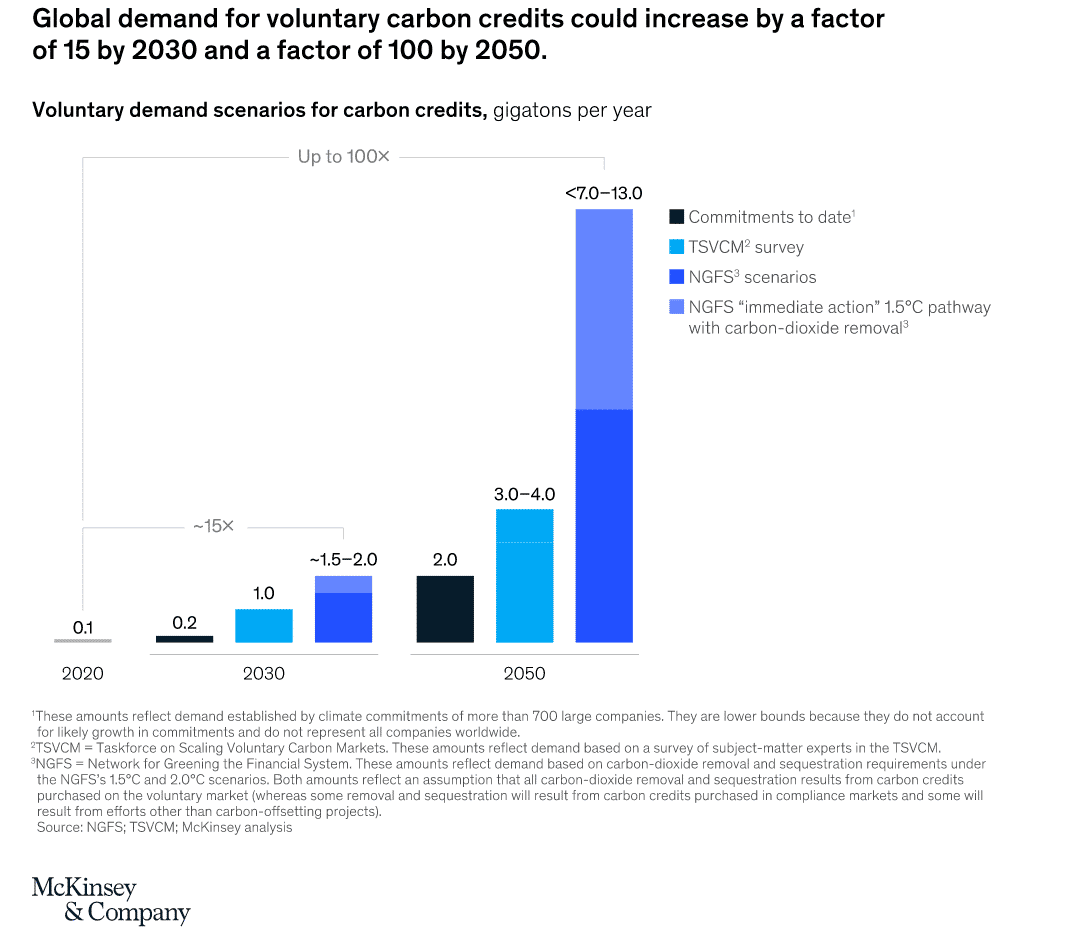
The voluntary carbon credit market is worth about $4.04 billion in 2024. It could grow to $24 billion by 2030 with an annual growth rate over 35%. However, this market has many flaws. Multiple registries make it hard to compare credits.

https://carboncredits.com/wp-content/uploads/2021/07/global-demand-for-voluntary-carbon-credits-increase-by-factor-of-15-by-2030-and-factor-of-100-by-2050.png 

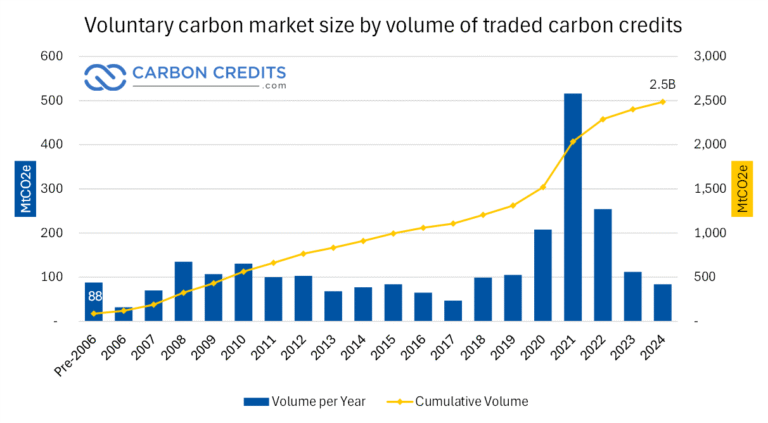
Transparency issues continue to raise concerns about fraud and double-counting—when the same carbon credit gets sold or claimed more than once—in carbon markets. Ghost credits, which are fake reductions, hurt market integrity. Overstated impact claims and double-counting also damage investor confidence, as shown in the chart below.

https://carboncredits.com/wp-content/uploads/2025/07/VCM-market-size-traded-volume-2024.webp 

Estimates show that in 2021, hundreds of millions of tonnes of CO₂ equivalent credits faced issues. As the market grows, this number could rise significantly. To improve transparency, organizations are using blockchain tracking and better verification. These efforts aim to cut risks as the VCM grows. By 2030, analysts expect trade around 1.5 billion tonnes of CO₂ equivalent.

Low liquidity turns off big investors. Plus, no central exchange or standard contracts splits the market. This limits growth and makes it hard for institutions to join in.

These weaknesses undermine trust and prevent big capital from entering the market. By tokenizing credits, S&P and JPMorgan aim to fix these problems and transform carbon credits into reliable digital assets.

How Tokenization Changes the Game 
The joint pilot combines the Environmental Registry from S&P Global Commodity Insights with JPMorgan’s Kinexys blockchain platform. Together, they can turn carbon credits into digital tokens. These tokens are stored on an unchangeable ledger that everyone can access.

This system performs the following:

  • Standardizes credits across different projects—such as reforestation or direct air capture—to make them comparable.
  • It ensures transparency by permanently logging the issuance, transfers, and retirement of each credit. This helps tackle fraud and double-counting issues that have affected the market.
  • Enables smart contracts that automate tasks. For example, credits retire when purchased, which cuts transaction times from months to minutes.
  • Enables cross-chain transfers, which lets tokens move smoothly between platforms and registries. It boosts interoperability and market depth.... 

....MUCH MORE 

When Vlad Tenev was quoted as saying ""Robinhood's CEO on the Plan to Tokenize Everything" (HOOD)"he probably wasn't thinking of tokenized water but that is coming too.

It's all a quieter, more whiz-bangy take on this from 2022:

Big Money Financial Engineering: Saving The Planet By Securitizing Earth
This is happening right now and if you want in on the action you have to know the game is being played....

Six months later we saw: "Securitize The Earth: Oil Trader Mercuria Creates A "Nature-Based" Investment Platform" 

And another six months to: "Forget Carbon Credits, It's Time For Biodiversity Credits, Come Get You Some" 

Wednesday, July 23, 2025

"Goldman Sachs and BNY Mellon Team Up for Tokenized Money Market Funds"

From CoinDesk, July 23:

The Wall Street banking giants are joining to a growing roster of traditional financial firms to offer tokenized versions of assets. 

Bank of New York Mellon (BNY) and Goldman Sachs (GS) are rolling out tokenized money market funds for clients as digital asset adoption is accelerating.

BNY, which is one of the oldest and largest custody banks in the world overseeing $53 trillion of assets, announced on Wednesday to start offering institutional investors token versions of money market fund share classes via its LiquidityDirect platform. Ownership records and transactions are recorded on Goldman Sachs Digital Asset Platform's blockchain. Institutions that have signed up include BlackRock, Fidelity among others.

BNY acts as the shareholder servicer and custodian for the funds, new role of tokenization manager, responsible for triggering the minting and burning of tokens that mirror fund shares on BNY’s books, according to the offering's website.

"The step of tokenizing is important, because today that will enable seamless and efficient transactions, without the frictions that happen in traditional markets," Laide Majiyagbe, BNY’s global head of liquidity, financing and collateral, told CNBC.....

....MORE 

Here is Goldman's press release:

BNY and Goldman Sachs Launch Tokenized Money Market Funds Solution 

If interested, here is our tokenization series including the ever-popular "Tokenized, Inc: BlackRock's Plan To Own The Fractionalized World" 

Wednesday, July 9, 2025

SEC Commissioner Peirce: "Enchanting, but Not Magical: A Statement on the Tokenization of Securities"

From the U.S. Securities and Exchange Commission, July 9:

Blockchain technology has unlocked novel models for distributing and trading securities in a “tokenized” format. Tokenization may facilitate capital formation and enhance investors’ ability to use their assets as collateral. Enchanted by these possibilities, new entrants and many traditional firms are embracing onchain products. As powerful as blockchain technology is, it does not have magical abilities to transform the nature of the underlying asset. Tokenized securities are still securities. Accordingly, market participants must consider—and adhere to—the federal securities laws when transacting in these instruments.

Sometimes an issuer tokenizes its own security. For example, an operating company or an investment company could tokenize its shares. Alternatively, an unaffiliated third party with custody of securities issued by another entity might, for instance, issue a new tokenized security tied to the securities it holds or may tokenize the “security entitlements” that investors hold against the custodian. Purchasers of these third-party tokens may face unique risks, such as counterparty risks.

Distributors of tokenized securities must consider their disclosure obligations under the federal securities laws and may wish to refer to the Division of Corporation Finance’s recent staff statement on this topic.[1]

Market participants who distribute, purchase, and trade tokenized securities also should consider the nature of these securities and the resulting securities laws implications. For example, depending on the particular facts and circumstances, a token could be a “receipt for a security,” which is itself a security but is distinct from the underlying security held by the distributor of the token. Alternatively, a token that does not provide the holder with legal and beneficial ownership of the underlying security could be a “security-based swap” that cannot be traded off exchange by retail persons. While blockchain-based tokenization is new, the process of issuing an instrument representing a security is not. The same legal requirements apply to on- and off-chain versions of these instruments....

....MORE 

The last time we visited Commissioner Peirce, June 16's "U.S. SEC: "Remarks by Commissioner Peirce at the Third Annual Conference on Emerging Trends in Asset Management", I described her as:

Commissioner Peirce is a bit of a wild child and more willing than most commissioners, past and present, to experiment in the areas of market structure and securities regulation.

Here she addresses the Investment Company Act of 1940...

Related, earlier today:

"Robinhood faces regulatory scrutiny over tokenized private company stock" (HOOD) 

"Robinhood faces regulatory scrutiny over tokenized private company stock" (HOOD)

From Ledger Insights, July 8:

Robinhood last week launched tokenized stock offerings to European retail investors, making more than 200 US listed companies available for trading. The platform also provided $1.5 million in token giveaways for unlisted companies OpenAI ($1 million) and SpaceX ($500,000), with trading available 24/5 including weekdays outside Nasdaq hours.

OpenAI quickly distanced itself from the offering. “We did not partner with Robinhood, were not involved in this, and do not endorse it. Any transfer of OpenAI equity requires our approval—we did not approve any transfer. Please be careful,” the company posted on X.

The tokens are technically derivatives rather than actual stocks, though Robinhood says it holds the underlying securities in custody in the United States. While OpenAI and SpaceX are privately held, secondary market platforms like Forge allow accredited investors to trade their shares. Robinhood CEO Vlad Tenev has promoted tokenization as giving retail investors access to AI stocks that would otherwise be unavailable to them.

Following OpenAI’s statement, Tenev responded that other private companies have approached Robinhood about offering similar tokens.

Regulatory questions emerge...

....MUCH MORE 

Most recently in the hood:

"Robinhood Debuts New Service to Deliver Cash to Your House, Because That Seems Good, Right?" (HOOD)

"Robinhood's CEO on the Plan to Tokenize Everything" (HOOD)

Wednesday, July 2, 2025

"Robinhood's CEO on the Plan to Tokenize Everything" (HOOD)

From Joe Weisenthal and Tracy Alloway at Bloomberg, July 1:

Here comes 24-hour stock trading. 

Robinhood, the company known for first introducing commission-free trading, has now become behemoth with all kinds of different business lines including credit cards, savings vehicles, crypto, and wealth management. 

This week it's announced further expansion with news that it's launching its own chain, as well as tokenized stock trading (that for now is only available in the EU). 

On this episode, we speak with founder and CEO, Vlad Tenev, about its new endeavors, as well as the legacy of the 2021 meme stock mania, the evolution of the YOLO traders, the changing regulatory environment, and when we can expect to have 24/7 on-chain stock trading in the US....

....MORE 

And at Investor's Business Daily, July 1:

Robinhood Target Hiked 83% On Tokenized Stock Launch 

Robinhood Markets' (HOOD) introduction of tokenized stock trading and other crypto offerings at a Monday event spurred a series of Wall Street price target hikes reported on Tuesday, including a massive 83% boost from KeyBanc. HOOD rose modestly, after surging to an all-time high to start the week.

In a research report distilled by investment news site The Fly, KeyBanc took note of Robinhood's increased product breadth/depth and velocity in rolling out innovative new features that contribute to an expanded market opportunity. 

Robinhood Tokenized Stocks
Robinhood's launch of tokenized stocks is initially just for customers in the European Union. In an explainer, the commission-free trading platform said that the Robinhood Stock Tokens are blockchain-based derivatives, "giving you exposure to the U.S. market."

"You can buy, sell, or hold stock tokens — but you cannot send them to other wallets or platforms at this time."

Robinhood said that the transactions are done in U.S. dollars. "When you place a trade, we automatically convert your euros" — plus a 0.1% FX fee that "covers everything."
The market for stock tokens is open 24 hours, Monday to Friday....

...HOOD
KeyBanc hiked its target on HOOD shares to 110 from 60, keeping an overweight rating. Deutsche Bank raised its HOOD price target to 96 from 85, keeping a buy rating.... 

....MUCH MORE 

The outro from June 28's "Dinari granted first broker-dealer registration to offer tokenized stocks": 

If interested see also June 19's "Coinbase seeks SEC approval for ‘tokenized equities’ — Report" 

Here's the whole tokenization series, basically tokenize everything in the world. 

Thursday, June 26, 2025

"Dinari granted first broker-dealer registration to offer tokenized stocks"

From Reuters, June 26:

  • Dinari is first tokenized equity platform to get US approval
  • Coinbase, Kraken also exploring blockchain-based stocks
  • Proponents say tokenized stocks could reduce trading costs
June 26 (Reuters) - Dinari, a startup that offers blockchain-based U.S. stocks, has secured a broker-dealer registration for its subsidiary, a move the company says makes it the first tokenized equity platform to secure such approval in the U.S.

The move allows San Francisco-based Dinari to offer stock trading via blockchain technology for the first time to investors in the U.S., an offering that crypto companies like Coinbase and Kraken are also actively exploring as firms look to capitalize on an evolving U.S. regulatory stance toward cryptocurrencies.

Tokenizing equities is a process in which shares of a company are converted into digital tokens, similar to how cryptocurrencies are traded. Instead of holding the securities directly, investors hold tokens that represent ownership of the securities.
Proponents have said that tokenized equities could reduce trading costs, enable faster settlement, and facilitate around-the-clock trading....
....MUCH MORE 

If interested see also June 19's "Coinbase seeks SEC approval for ‘tokenized equities’ — Report" 

Here's the whole tokenization series, basically tokenize everything in the world. 

Thursday, June 19, 2025

"Coinbase seeks SEC approval for ‘tokenized equities’ — Report"

From CoinTelegraph, June 17: 

If approved by the US regulator, the investment offering could have Coinbase competing against other stock trading platforms. 

Cryptocurrency exchange Coinbase is reportedly looking for the green light from US financial regulators to offer tokenized stock trading to its users.

According to a Tuesday Reuters report, Coinbase's chief legal officer, Paul Grewal, said the company was seeking Securities and Exchange Commission (SEC) approval to offer “tokenized equities,” potentially competing with other trading platforms like Robinhood. Grewal reportedly said the plan was a “huge priority” for Coinbase.

As of June, tokenized equities such as stocks are not available for trading in the US. However, US-based digital assets companies have been able to offer similar services to non-residents through partnerships. Crypto exchange Kraken announced a plan to launch tokenized US stock trading in May....

....MORE

Larry Fink may be on to something with this tokenization trend. 

Wednesday, June 18, 2025

Ummmmm—Tokenized Real World Assets: Reinsurance Products Targeting 20% And 42% Returns

Grandmother always said "If you are getting more than the risk-free rate of return you are taking on risk somewhere." She was really emphatic about that.

From Oxbridge Re via Globe NewsWire, March 4:

Oxbridge / SurancePlus Announces Two RWA Tokenized Reinsurance Offerings for its 2025 - 2026 Season: Targeting Returns of 20% and 42%

GRAND CAYMAN, Cayman Islands, March 04, 2025 (GLOBE NEWSWIRE) -- Oxbridge Re Holdings Limited (Nasdaq: OXBR) (“Oxbridge Re”), together with its subsidiary SurancePlus, is engaged in the tokenization of Real-World Assets (“RWAs”), initially with tokenized reinsurance securities, and in providing reinsurance solutions to property and casualty insurers in the Gulf Coast region of the United States, today announced the launch of its 2025 tokenized reinsurance offerings.

For the first time, investors can choose their preferred risk-return profile with two distinct options:

  • EtaCat Re – 20% (Balanced Yield)
  • ZetaCat Re – 42% (High Yield)

Invest now at SurancePlus.com/invest

These blockchain-powered offerings open access to an asset class that was previously exclusive to institutional investors and ultra-high-net-worth individuals. Now, a wider range of investors can access SurancePlus' tokenized reinsurance securities, targeting high-yield returns backed by Real-World Assets (RWAs) through real-world reinsurance contracts.

How It Works

Investors in EtaCat Re have a targeted annual return of 20%, while investors in ZetaCat Re have an annual targeted return of 42%.

Each security-backed token is priced at $10 per share, with funds used to invest in reinsurance contracts. Investors will receive 3.5% APY on their invested funds until contracts go live on June 1, 2025. Returns are then distributed annually based on underwriting performance.

These tokens provide exposure to RWA-collateralized reinsurance contracts through its licensed Cayman Islands reinsurance entity, Oxbridge Re NS.

Investment opportunities are available to U.S. investors under SEC Rule 506(c) and to non-U.S. investors under Regulation S of the Securities Act of 1933....

....MUCH MORE 

Ummmmm....the current (June 17) risk-free rates are 4.23% for 1-month T-bills and 4.42% for 3-month T-bills.

https://home.treasury.gov/resource-center/data-chart-center/interest-rates/TextView?type=daily_treasury_yield_curve&field_tdr_date_value=2025 

And even using these instruments you are taking on a risk, reinvestment risk.

Monday, June 16, 2025

U.S. SEC: "Remarks by Commissioner Peirce at the Third Annual Conference on Emerging Trends in Asset Management"

Commissioner Peirce is a bit of a wild child and more willing than most commissioners, past and present, to experiment in the areas of market structure and securities regulation.

Here she addresses the Investment Company Act of 1940. 

From the Securities and Exchange Commission via Harvard Law School's Forum on Corporate Governance, June 10:

Thank you, Natasha [Vij Greiner]. Good morning and welcome to the Third Annual Conference on Emerging Trends in Asset Management. Before I begin, I must remind you that my views are my own as a Commissioner and not necessarily those of the SEC or my fellow Commissioners.

Today’s four panels take us on a tour from the beginning of the ’40 Acts up to the most recent developments in asset management, and on to the developments likely to come in the near future. These panels are in keeping with the asset management industry, which is an iterative one in which new developments are rooted in the old. I am looking forward particularly to hearing from our “Forever Young” panel of former IM Directors who will reminisce on 85 years of the Investment Company and Investment Advisers Acts.

Thinking back to my arrival at the Division of Investment Management as a wide-eyed staff attorney 25 years ago makes me feel anything but young. But happy memories linger from my four years in the Division: Immersing myself in Division history with the well-worn green binder “bibles,” wrestling through current issues in a rulemaking, or imagining the future of asset management through the eyes of the red book. My colleagues, of course, were the highlight of that experience. Paul Roye as Division Director, Hunter Jones as remarkably patient supervisor, Bob Plaze as master rule-drafter, Martha Peterson as consummate mentor, and countless colleagues who only recently left the staff, including: Bill Middlebrooks, Beckie Marquigny, Chris Chow, Penelope Saltzman, Jennifer McHugh, Jennifer Sawin, Janet Grossnickle, and Nadya Roytblat, to name a few. These and other members of the Division staff poured themselves into administering the statutory framework within which the asset management industry has flourished.

Although I am not feeling it personally, the first panel’s “Forever Young” title is an apt reminder that the regulatory framework must retain nimbleness and flexibility even though these characteristics typically wane with age. As the panel embodies, however, the wisdom of the past should guide our exercise of that flexibility. The asset management industry is in the midst of an age of innovation, a topic which will occupy the last three panels. Continued product proliferation, increased retail access to private markets, and tokenization will expand the menu of investment options available to investors. Accompanying that expansion should be education, including the innovative use of new technological tools to educate investors and their financial professionals about innovative product offerings.

For the sake of portfolio diversification, retail investors need access to a broad range of investment opportunities. The breadth of the public markets, where retail investors do most of their investing, has suffered as the number of listed companies has declined,[1] companies wait longer to attempt an IPO, and several large companies dominate the public market indices. The Commission should work on reforming public company regulation to help address this decline. But some asset classes are not fit for the public markets. Accordingly, retail investors and the financial professionals that serve them also are looking for additional diversification in the private markets.

Commission rules and regulations along with Commission staff positions have contributed to keeping retail investors out of the private markets. We should consider how to amend the “accredited investor” definition in the Commission’s rules so that more people are eligible to invest in the private markets. In August 2020, the Commission supplemented slightly the existing net income and wealth categories for qualifying natural persons, a change the Commission admitted was marginal.[2] I would like to see more meaningful expansions as would many retail investors who resent being cut off from an increasingly large segment of the market. The Commission staff can take other steps at once to allow retail investors greater access to private markets. For example, as Chairman Atkins recently noted, since 2002, Commission staff has taken the position that closed-end funds investing 15% or more of their assets in private funds should impose a minimum initial investment requirement of $25,000 and restrict sales to investors that meet the accredited investor standard.[3] Neither the statute nor Commission rules require such limitations. Removing them would allow retail investors greater access to private investments through a closed-end fund wrapper with the benefit of professional management. I support the Chairman’s directive that the staff address this situation, including by ensuring that funds are making adequate disclosure regarding conflicts of interest, illiquidity, and fees for closed-end funds that trade on exchanges. We also should work with fund sponsors that want to experiment with interval funds.

Some retail investors also want to add digital assets to their investment portfolios. Until recently, the Commission mostly stymied their efforts to do so through convenient and cost‑efficient securities products. Some ’40 Act funds afforded investors indirect exposure to crypto assets, but only when pushed by the courts did the Commission greenlight the trading of spot bitcoin (and later spot ether) exchange-traded products under the 1933 Act. The Trading and Markets staff is working diligently through many applications to list a whole range of digital asset ETPs. A standardized approach for such ETPs could ease the burden for the industry and the SEC staff. Asset managers are also creating new products under the ’40 Act. Just as a reminder a fund that invests primarily in spot crypto assets that are not securities cannot register as an investment company under the ’40 Act....

....MUCH MORE 

If interested, here is the conference agenda, panelist bios (seriously heavy hitters) and webcast archive. 

Also, if interested, a remix of Alphaville's Forever Young: 


Previously:

SEC, May 12: "Tokenization: Our Field of Dreams? Remarks at the Crypto Task Force Roundtable on Tokenization" 

May 18: "Tokenization’s trillion dollar promise: Wall Street leaders make their case to the SEC"

Friday, May 30, 2025

"Dubai government launches tokenized real estate platform"

From Ledger Insights, May 26:

Dubai has become the first city in the Middle East to implement government backed real estate tokenization, with the Dubai Land Department (DLD) launching its pilot platform through Prypco Mint. The real world asset (RWA) tokenization initiative involves putting property deeds on a blockchain, allowing investors to purchase fractional shares in Dubai properties starting from AED 2,000 ($545). The project operates through a strategic partnership between Dubai Land, Prypco, and Ctrl Alt Solutions, with regulatory oversight from the Virtual Assets Regulatory Authority (VARA) and the Central Bank of the UAE....

....MUCH MORE 

Starting to think there may be something to this whole tokenization thing.

Here's a quick search of the blog, most recent on top.

Tuesday, May 27, 2025

Boston Consulting Group, Ripple Predict Tokenization To Reach $18.9 Trillion by 2033

And pretty soon you're talking real money.

From Ledger Insights, April 8:

Yesterday Ripple published a tokenization report developed by Boston Consulting Group (BCG), which predicts tokenized assets will reach $18.9 trillion by 2033, including stablecoins and tokenized deposits.

The report outlines three stages of adoption. It describes the first phase as low risk adoption, including pilots involving money market funds and corporate bonds. BlackRock’s BUIDL tokenized money market fund launched in 2024 is given as an example, alongside Singapore’s Project Guardian. Rather than attempting to scale, the goal of this phase is institutional readiness.

Phase two starts to involve more complex assets such as private credit, structured finance and corporate bonds. The aim is to earn a return, enhance liquidity and enable composability, as opposed to the simpler transactions in the earlier phase. This is when institutions start to move beyond private blockchains to explore permissioned public blockchains. However, BCG observes some reluctance from institutions to collaborate to reshape markets as they want to defend existing revenue streams.

Market transformation is achieved in phase three. The tokenized asset classes expand to include private equity, hedge funds, infrastructure and real estate-backed debt. This step requires secondary markets with sufficient liquidity, as well as the willingness to accept tokenized assets as collateral. We’d observe that aspects of each phase are currently in evidence, although the current market status fits closest with the early steps of phase two.

Profitable tokenization use cases....

....MUCH MORE

Most recently: 

Also at Ledger Insights:

April 30 - BlackRock to issue DLT shares in Treasury fund via BNY 

BlackRock recently filed a registration statement about plans for the issuance of DLT shares in its $143 billion Treasury Trust Fund (TTF). The shares will only be available via Bank of New York Mellon (BNY), which will use blockchain to mirror the share ownership on-chain. Institutional investors are the primary target with a minimum investment of $3 million, which is the same across the whole fund.

While BlackRock has leaned into tokenization with its BUIDL tokenized treasury fund issued on permissionless blockchains via Securitize, the target market (for now) is primarily crypto institutions. Stablecoin and tokenized money market fund (MMF) issuers are the primary BUIDL token holders....

May 6 -  Citi plans to tokenize private companies on SIX Digital Exchange

May 12 - Hong Kong arm of China’s largest broker to launch tokenized securities

May 13 - VanEck launches tokenized money market fund with Securitize

May 16 - Franklin Templeton unveils Singapore tokenized money market fund

The outro from that post on the SEC roundtable: "It's all happening right now and as the kids used to say, ya snooze, ya lose"

Previously on the commercial side of things:
"Tokenized, Inc: BlackRock's Plan To Own The Fractionalized World"

Thursday, May 22, 2025

Treasury Management: HSBC Hong Kong To Offer Tokenized Deposits

 From PYMNTS.com, May 22:

Ant International Helps HSBC Hong Kong Offer Tokenized Deposits  

Ant International has teamed with HSBC on the bank’s tokenized deposit service in Hong Kong.

The service is designed to support treasury management via real-time, “always-on” Hong Kong and U.S. dollar payments between corporate wallets held by an HSBC Hong Kong client, according to a Thursday (May 22) press release.

In addition, the service is also Hong Kong’s first bank-led, blockchain-based settlement service, and follows a pilot test between HSBC and Ant International on Ant’s Whale platform.

“We are very excited to work with an industry leader like HSBC, who shares the belief that tokenisation is the key to bridging the stability of traditional banking with the efficiency of blockchain, to enable real-time treasury management,” Kelvin Li, general manager of platform tech at Ant International, said in the release.

“As a tech connector in the fast-evolving financial services industry, our banking partnerships are expanding from tokenization to AI-driven global FX and liquidity initiatives. We look forward to working with more public and private-sector partners to unlock more transparent, accessible and efficient treasury management solutions for businesses worldwide.”

The partnership is happening at a moment when, as covered here last month, money and assets are experiencing a transformation thanks to tokenization on the blockchain.

“On-chain tokenization is moving from concept to practice, with players like Visa, Mastercard, J.P. Morgan, and other commercial banks exploring or piloting real-world tokenized payment and financial systems,” PYMNTS wrote.

“For chief financial officers and corporate treasurers, tokenization isn’t just a tech issue; it could represent a capital strategy shift.”

BlackRock CEO Larry Fink also wants all assets to be tokenized and tradable online, telling shareholders: “Every stock, every bond, every fund — every asset — can be tokenized.”....

....MORE

As the old-timers used to say: "Pay attention or pay the offer." 

Sunday, May 18, 2025

"Tokenization’s trillion dollar promise: Wall Street leaders make their case to the SEC"

Following on last week's SEC, May 12: "Tokenization: Our Field of Dreams? Remarks at the Crypto Task Force Roundtable on Tokenization". 

From Ledger Insights, May 13:

During one of yesterday’s panels at the U.S. Securities and Exchange Commission (SEC) roundtable on tokenization, incumbents were urged to avoid attempting to hamstring new technology players. BlackRock’s Robert Mitchnick said that rather than forcing startups to comply with obsolete regulations, there’s a need to modernize. This tension between innovation and regulation set the tone for the discussion that followed. A key goal of the roundtable was to find out what regulatory issues need addressing.

Five of the nine panelists work for major asset managers: Apollo, BlackRock, Fidelity, Franklin Templeton and Invesco. These institutions stand to benefit most from embracing public blockchains, by exploiting efficiencies and reducing layers of intermediaries. Two of the panelists represented intermediaries: the DTCC and Nasdaq. While they gave fairly balanced perspectives, they advocated for the most caution, particularly Nasdaq.

The key topics covered were how to define tokenization, interoperability, practical use cases and the need for regulatory changes.

Concrete opportunities – collateral

The tokenization opportunity most discussed currently in the traditional finance (TradFi) sector is tokenized collateral management, and the panel was no different.

BlackRock’s Mitchnick described the current process of using money market funds for collateral without tokenization. “You first have to liquidate it (the money market fund), deliver cash, and then instruct reinvestment into a money market fund, which is obviously a very inefficient and friction filled system, which can also add sell pressure in times of market stress,” he said. That’s because liquidating funds to meet margin calls ends up creating a sell spiral, requiring more margin calls.

By contrast, with a tokenized money market fund, you don’t have to wait for daily redemptions. You can sell it in the secondary market and post stablecoins as collateral in real time. Alternatively, you can instantly transfer the money fund as collateral. And collateral plays an important role for derivatives, repo and securities lending.

Franklin Templeton’s Sandy Kaul pointed to the potential to not just tokenize the fund, but also the underlying Treasury securities. She emphasized how important this can be in a crisis. Lehman Brothers lawsuits took years to figure out who owned the collateral.

She explained, “If we could immediately move from the tokenized money market fund and into the tokenized assets that sit within that fund, we can immediately get the collateral and begin to unwind all of the obligations in the marketplace.”....

....MUCH MORE 

Also at Ledger Insights:

April 30 - BlackRock to issue DLT shares in Treasury fund via BNY 

BlackRock recently filed a registration statement about plans for the issuance of DLT shares in its $143 billion Treasury Trust Fund (TTF). The shares will only be available via Bank of New York Mellon (BNY), which will use blockchain to mirror the share ownership on-chain. Institutional investors are the primary target with a minimum investment of $3 million, which is the same across the whole fund.

While BlackRock has leaned into tokenization with its BUIDL tokenized treasury fund issued on permissionless blockchains via Securitize, the target market (for now) is primarily crypto institutions. Stablecoin and tokenized money market fund (MMF) issuers are the primary BUIDL token holders....

May 6 -  Citi plans to tokenize private companies on SIX Digital Exchange

May 12 - Hong Kong arm of China’s largest broker to launch tokenized securities

May 13 - VanEck launches tokenized money market fund with Securitize

May 16 - Franklin Templeton unveils Singapore tokenized money market fund

The outro from that post on the SEC roundtable: "It's all happening right now and as the kids used to say, ya snooze, ya lose"

Previously on the commercial side of things:
"Tokenized, Inc: BlackRock's Plan To Own The Fractionalized World"

"BlackRock CEO wants SEC to ‘rapidly approve’ tokenization of bonds, stocks: What it means for crypto"

And the regulatory: BIS/New York Fed: Hell Yes We Can Run Monetary Policy In A Tokenized World