Wednesday, April 3, 2024

Uranium—"Epic Fail The New Junta in Niger Tells the United States to Pack Up Its War and Go Home"

Readers of a certain age, say 30 and older, may remember the Niger yellowcake hoax used as a precursor to the Weapons of Mass Destruction hoax which was used as a casus belli by the Western powers, the New York Times and other media minions* to invade Iraq. For our younger readers here's 

IRAQ’S WEAPONS OF MASS DESTRUCTION
THE ASSESSMENT OF THE BRITISH GOVERNMENT

The Forward by the Rt. Hon. Tony Blair, MP, Prime Minister, would be funny if it weren't for the hundreds of thousands of dead and wounded (including five American quadruple amputees) and trillions of dollars thrown into the wind.

Anyhoo, enough history, here's the headline story from Nick Turse at TomDispatch:

Dressed in green military fatigues and a blue garrison cap, Colonel Major Amadou Abdramane, a spokesperson for Niger’s ruling junta, took to local television last month to criticize the United States and sever the long-standing military partnership between the two countries. “The government of Niger, taking into account the aspirations and interests of its people, revokes, with immediate effect, the agreement concerning the status of United States military personnel and civilian Defense Department employees,” he said, insisting that their 12-year-old security pact violated Niger’s constitution.

Another sometime Nigerien spokesperson, Insa Garba Saidou, put it in blunter terms: “The American bases and civilian personnel cannot stay on Nigerien soil any longer.”

The announcements came as terrorism in the West African Sahel has spiked and in the wake of a visit to Niger by a high-level American delegation, including Assistant Secretary of State for African Affairs Molly Phee and General Michael Langley, chief of U.S. Africa Command, or AFRICOM. Niger’s repudiation of its ally is just the latest blow to Washington’s sputtering counterterrorism efforts in the region. In recent years, longstanding U.S. military partnerships with Burkina Faso and Mali have also been curtailed following coups by U.S.-trained officers. Niger was, in fact, the last major bastion of American military influence in the West African Sahel.

Such setbacks there are just the latest in a series of stalemates, fiascos, or outright defeats that have come to typify America’s Global War on Terror. During 20-plus years of armed interventions, U.S. military missions have been repeatedly upended across Africa, the Middle East, and South Asia, including a sputtering stalemate in Somalia, an intervention-turned-blowback-engine in Libya, and outright implosions in Afghanistan and Iraq.

This maelstrom of U.S. defeat and retreat has left at least 4.5 million people dead, including an estimated 940,000 from direct violence, more than 432,000 of them civilians, according to Brown University’s Costs of War Project. As many as 60 million people have also been displaced due to the violence stoked by America’s “forever wars.”

President Biden has both claimed that he’s ended those wars and that the United States will continue to fight them for the foreseeable future — possibly forever — “to protect the people and interests of the United States.” The toll has been devastating, particularly in the Sahel, but Washington has largely ignored the costs borne by the people most affected by its failing counterterrorism efforts.   

“Reducing Terrorism” Leads to a 50,000% Increase in… Yes!… Terrorism

Roughly 1,000 U.S. military personnel and civilian contractors are deployed to Niger, most of them near the town of Agadez at Air Base 201 on the southern edge of the Sahara desert. Known to locals as “Base Americaine,” that outpost has been the cornerstone of an archipelago of U.S. military bases in the region and is the key to America’s military power projection and surveillance efforts in North and West Africa. Since the 2010s, the U.S. has sunk roughly a quarter-billion dollars into that outpost alone....

....MUCH MORE

*Okay, a bit more history. After Bush, Cheney, Rumsfeld, Colin Powell, Rice, and Bolton et al, this article at The Intercept last year, "The Architects of the Iraq War: Where Are They Now?—They’re all doing great, thanks for asking." mentions:
....David Frum

Frum was a speechwriter in the Bush White House. He famously coined the phrase “axis of evil,” consisting of Iraq, Iran, and North Korea, for Bush’s 2002 State of the Union address. Iraq and Iran were a peculiar axis, given that they were mortal enemies, but Frum was not hobbled by such concepts as “making sense.”

After leaving the White House, Frum co-wrote a book called “An End to Evil: How to Win the War on Terror.” Sadly, we did not follow his advice, and evil still besets us.

In “An End to Evil,” Frum reported that “there is overwhelming evidence that Saddam had extensive chemical and biological weapons programs.” You may not be surprised to learn that this was absolutely false.

Frum was rewarded for this performance by The Atlantic with a job there as a staff writer. This week, Frum wrote a 20th anniversary piece for the magazine, which led off with the revelation that Iraq possessed “an arsenal of chemical-warfare shells and warheads.” 

You might wonder: Given that Bush and Cheney were totally vindicated by this arsenal, why did they never mention it? Are they just super-modest? This is exactly the kind of question asking that will destroy your career in the prestige media.

David Brooks

Journalist Brooks contributed an article to the Weekly Standard just after the start of the war called “The Collapse of the Dream Palaces.” You absolutely must read it; it’s one of the most bonkers things ever to appear in the English language. Its core argument is that opponents of the Iraq War had been “unable to achieve enough emotional detachment from their own political passions to see the world as it really is,” and their fantasy world was about to meet cold, hard reality. North Korean propagandists would have rejected it as too embarrassing.

The New York Times saw the quality of this work and soon afterward hired Brooks as a regular columnist.

Jeffrey Goldberg

Goldberg, then a staff writer at the New Yorker, was one of the most influential proponents of the invasion of Iraq outside of the government. His work was entered into the Congressional Record during the debate on the authorization to use military force in fall 2002. In the New Yorker, Goldberg wrote that “there is no disagreement that Iraq, if unchecked, will have [nuclear weapons] soon.” And of course, everyone knew it already had “stocks of biological and chemical weapons.”

In October 2002, Goldberg argued, “The administration is planning today to launch what many people would undoubtedly call a short-sighted and inexcusable act of aggression. In five years, however, I believe that the coming invasion of Iraq will be remembered as an act of profound morality.” You may recall that October 2007 came and went without a lot of celebration of this profound morality.

Jeffrey Goldberg is now the editor-in-chief of The Atlantic.

Judith Miller

Miller wrote or co-wrote many of the hilariously credulous New York Times articles warning readers of the terrifying threat of Iraq’s weapons of mass destruction. Perhaps the funniest piece of her oeuvre was published soon after the invasion, headlined “Illicit Arms Kept Till Eve of War, An Iraqi Scientist Is Said to Assert.”

It wasn’t based on Miller ever talking to this scientist. However, Miller reported, “While this reporter could not interview the scientist, she was permitted to see him from a distance.” This is always how the best journalism has always been done: watching from a distance. She soon went on TV to declare this was “more than a smoking gun. What they’ve found is a silver bullet.” Whoops!

Interestingly, Miller is one of the only people on this list to ever suffer any career damage over Iraq. She resigned/was fired in 2005, but it had more to do with her entanglement in the prosecution of Scooter Libby than her cataclysmic WMD work.

Don’t feel too bad for her, however. She went on to work for Fox and is currently a member of the Council on Foreign Relations. The CFR, you see, is devoted to helping Americans “better understand the world and the foreign policy choices facing the United States.”

Joe Biden

Biden was a Democratic senator from Delaware in the run-up to the war and chair of the Senate’s Foreign Relations Committee. He ran hearings making the case for the invasion and became one of the most significant Democratic voices supporting it.

Biden remains prominent in American politics.

Plus a Cast of Thousands....

One of the reasons we don't link to the Atlantic that much, they are liars.

I would be remiss if I didn't point out that Pierre Omidyar, co-founder and sugar daddy of The Intercept (along with Glenn Greenwald) basically financed the 2014 Maidan coup in Ukraine which led directly to the current horrific war and devastation:

November 2020 Glenn Greenwald's Co-Founder of "The Intercept", eBay Billionaire Pierre Omidyar Co-funded Ukraine Revolution Groups With US Government

January 2017 "My next book won’t be the non-fiction Silicon Valley exposé we desperately need (but here’s what it will be)"

Similarly, when Mark Ames showed me a document proving that eBay founder Pierre Omidyar had funded opposition groups in Ukraine right before the Maidan revolution, I assumed Omidyar – the Pez dispenser guy! – must have been duped by his friends in the State Department. Tech founders simply didn’t go around instigating military coups.

Perhaps I saw the first glimmer of the real story when I dug out the White House visitor logs and saw how many times Omidyar’s name appeared, and who he met. Or when I noticed the growing line of tech billionaires leading to the Oval Office, the Kremlin and various Saudi royal palaces....

"BYD lost its EV crown to Tesla after just one quarter as China’s EV market slumps" (TSLA)

 We didn't link to the story in "Goldman Hints That Tesla May Have Some Negative FCF Quarters Ahead (TSLA)" just for grins and giggles. This is serious business.

From Fortune, April 3:

The Chinese EV giant BYD only got to be the world's top EV seller for a single quarter. On Tuesday, following the release of Tesla’s first-quarter deliveries, the U.S.-headquartered carmaker reclaimed its status as the world’s top seller of battery electric vehicles, after losing to the Warren Buffett-backed BYD at the end of last year.

BYD has recently tried to use price cuts and new model releases to spur demand. Last month, it cut the price of its cheapest model, the Seagull, by 5% and marked down its top-selling Qin Plus sedan by 20%. Yet sales still fell: BYD sold 300,114 battery electric vehicles for the three months ending March, compared to 526,409 in the previous quarter. Tesla sold 386,610 cars in the same period, compared to 484,507 in the last quarter of 2023.

BYD shares fell 2.2% in Hong Kong trading on Wednesday, as the broader Hang Seng Index dropped 1.2%. Tesla shares plunged around 5% in U.S. trading Tuesday following the release of its first-quarter deliveries data.

Slowing sales in China
Sales for both BYD and Tesla dropped quarter-on-quarter as growth in China’s EV market, the world’s largest, slows down. (The weeklong Lunar New Year holiday may also have hit sales, compared to the previous quarter.)

The sector is also locked in a fierce price war between BYD, Tesla, and other Chinese car brands. The China Passenger Car Association has warned that price cuts could lead to consumers delaying their purchases in the hope of future discounts.

BYD previously surged on the back of Chinese consumers flocking to its affordable EVs. Yet the company’s reliance on China, unlike Tesla, could leave it more exposed to changes in the Chinese EV market.

The Chinese market accounted for over 85% of BYD’s automobile-related revenue in 2023, according to figures from BYD’s annual report. By comparison, China accounted for 22% of Tesla’s revenue. (Tesla generates 47% of its revenue from the U.S.)....

....MORE

"Intel discloses $7 billion operating loss for chip-making unit" (INTC)

 Pity they don't have that $110 billion they spent buying-back stock.

This buyback nonsense has actually reduced national security.

Well, buybacks and management so clueless that the CEO said NVIDIA just got lucky with artificial intelligence.

From Reuters, April 3:

Intel on Tuesday disclosed deepening operating losses for its foundry business, a blow to the chipmaker as it tries to regain a technology lead it lost in recent years to Taiwan Semiconductor Manufacturing.

Intel said the manufacturing unit had $7 billion in operating losses for 2023, a steeper loss than the $5.2 billion in operating losses the year before. The unit had revenue of $18.9 billion for 2023, down 31% from $27.49 billion the year before.

Intel shares were down 4.3% after the documents were filed with the U.S. Securities and Exchange Commission (SEC).

During a presentation for investors, Chief Executive Pat Gelsinger said 2024 would be the year of worst operating losses for the company's chipmaking business and that it expects to break even on an operating basis by about 2027.

Gelsinger said the foundry business was weighed down by bad decisions, including one year ago against using extreme ultraviolet (EUV) machines from Dutch firm ASML. While those machines can cost more than $150 million, they are more cost-effective than earlier chip making tools.

Partially as a result of the missteps, Intel has outsourced about 30% of the total number of wafers to external contract manufacturers such as TSMC, Gelsinger said. It aims to bring that number down to roughly 20%.

Intel has now switched over to using EUV tools, which will cover more and more production needs as older machines are phased out.

"In the post EUV era, we see that we're very competitive now on price, performance (and) back to leadership," Gelsinger said. "And in the pre-EUV era we carried a lot of costs and (were) uncompetitive."....

....MORE

Tuesday, April 2, 2024

Chips: "TSMC Evacuates Production Lines After Major Taiwan Quake"

From Bloomberg via Yahoo Finance, April 2:

Taiwan Semiconductor Manufacturing Co. evacuated factory areas after a major earthquake rocked its home island Wednesday, endangering production at the world’s largest maker of advanced chips. 

The chipmaker to Apple Inc. and Nvidia Corp. moved staff out of certain areas, spokeswoman Nina Kao said in a text message, without elaborating. The world’s biggest contract chipmaker is still assessing the impact of a temblor measuring 7.4 in magnitude off the east coast, which triggered tsunami warnings....

....MORE

And from Nikkei Asia, April 3:

Taiwan rocked by earthquake; tsunami warnings in Japan and Philippines  

A powerful earthquake struck in the ocean near Taiwan on Wednesday morning, triggering tsunami warnings for coastal areas in the Japanese prefecture of Okinawa as well as part of the Philippines.

The quake registered at 7.2 off the coast of Hualien, according to Taiwan's central weather administration, which said it was the biggest temblor to hit the island since September 1999. It was not immediately clear how much damage the quake caused, but pictures showed severely tilted buildings and damaged train tracks. In Taiwan's crucial tech sector, many facilities were evacuated.

Power was out in several parts of Taipei, according to Reuters, while the metro system was suspended for safety checks. On Taiwan's stock market, the Taiex Weighted Index fell to 20,388.84 at the opening, down 77.73 points or 0.38% from the previous day's close. The fall extended to 0.77% a minute after the bell.

The local governments of Hualien and New Taipei City announced they were suspending work and school classes for the day.

In Japan, the Meteorological Agency measured a preliminary magnitude of 7.5, warning of a tsunami that could reach as high as 3 meters in Okinawa. At 9:18 a.m., a tsunami of up to 30 cm was observed at Japan's Yonaguni Island, near Taiwan....

....MORE

"An unusual bar is coming to San Francisco. Only 'quality' people will be let in"

From SFgate, March 28:

Do you think you are a quality person? A private, members-only cocktail lounge in San Francisco’s Financial District might tell you that you are not.

The Bank at Amador is a new bar set to debut this summer on the ground floor of Amador Club at 550 Montgomery St. inside the old Bank of Italy building. Prominent turn-of-the-century financier A.P. Giannini founded the Bank of Italy in 1904, and four years later, he was able to set up shop at 550 Montgomery St.; in 1930, Giannini converted the name to Bank of America.

A little background: The Amador Club, formerly Wingtip, a haberdashery with a barber shop and wine cave that was geared toward wealthy Silicon Valley and FiDi finance workers, plans to offer seasonal oysters and caviar bumps alongside craft cocktails. Although it allowed women to join since its inception, Wingtip always had the perception of a high-end men’s club, according to the website. And it’s desperately trying to change that....

Pro tip: When handing your vehicle's keys to the valet, make sure it's a valet. 
The streets are really quiet these days, just you and the criminals.

"FBI to bury ‘Whitey’ Bulger’s file, agency rejects Herald public records request"

Robert Mueller breathes a sigh of relief.*

From the Boston Herald, March 28:

'There’s no way in hell they shouldn’t tell all’ 

The FBI is closing the book on the agency’s “corrupt” handling of James “Whitey” Bulger — forever.

The feds are refusing to make any further installments of Bulger’s case file public, saying the records are “investigative” and no longer subject to the Freedom of Information Act.

“The records responsive to your request are law enforcement records; there is a pending or prospective law enforcement proceeding relevant to these responsive records, and release of the information could reasonably be expected to interfere with enforcement proceedings. Therefore, your request is being administratively closed,” the FBI stated in a letter to the Herald Monday.

They did not divulge what investigation Bulger’s case could still be linked to, considering the former Southie mobster was murdered while in a West Virginia prison in August 2018 by two fellow inmates. He was 89 and wheelchair-bound at the time of his death.

It has also long been speculated that Bulger hid millions of dollars in foreign bank accounts that have yet to be discovered.

Bulger’s former FBI handler, John “Zip” Connolly, is also back in Massachusetts on a compassionate release and is appealing his case. He was given only years to live.

Other former Winter Hill gang associates — including Stephen “The Rifleman” Flemmi — are alive, but Flemmi’s Florida parole date is set for 2218.

Still, the FBI does not want Bulger’s secret file to “interfere” with whatever case may or may not be percolating, the letter states. The Herald is appealing the decision.

“It’s a joke,” said Steve Davis Wednesday. “There’s no way in hell they shouldn’t tell all. It’s not right to all of the loved ones of victims still looking for answers.”

Davis has fought for victims’ rights ever since his sister, Debra, was reportedly slain by Bulger in 1981 – when Connolly was Whitey’s FBI handler.

Bulger was found guilty in August of 2013 in federal court in Boston for the murder of 11 people, as well as numerous counts of extortion, money laundering, drug dealing, and firearms possession. But he took to his grave the dirty dealings he had with the Boston branch of the FBI when he was killing with impunity.

“The whole thing was corrupt from the get-go,” said Janet Uhlar, a juror on Bulger’s 2013 trial. “They put out a lie. He was never an informant, he bought information from the FBI.”

Uhlar, who added she shared 70 letters with Bulger after the trial, said she still wonders what role the CIA had with the serial killer while he was locked up early in his life and submitted to an LSD experiment.

“His mind was manipulated by the CIA and he shouldn’t have been let out into the public,” she said Wednesday. “The other guys were as dirty as dirty could be.”

In an addendum to the FOIA denial sent to the Herald, the FBI states “Congress excluded three categories of law enforcement and national security records” from the public records law. That includes “records of intelligence sources, methods, or activities.” And, they add, the FBI “can neither confirm nor deny the existence of records pursuant to FOIA exemptions.”

It’s as if Bulger never existed....

....MORE
*Also at the Herald, five years ago:
Howie Carr: Mueller’s hands dirty in old FBI frame-up

Roger Stone keeps talking about Special Counsel Robert Mueller’s reprehensible behavior with the FBI in Boston way back when.

But I don’t think he or most people understand how bad Mueller’s actions were – “chilling,” is how a Clinton federal judge in 2006 described the former FBI director’s attempts to cover up a massive frame-up by Boston G-men decades earlier.

For the record, Mueller did not railroad four innocent men into prison – two onto death row – for a Chelsea murder they did not commit back in 1965.

That frame job was handled by the Boston office of the FBI, where at one point at least six G-men were taking payoffs from organized crime. That information came from serial killer Stevie Flemmi, who last summer admitted in federal court to taking part in 50 murders.

Everyone knew the four men were innocent, but the FBI wanted them to rot in prison, so the scandal would not be revealed. In the 1980s, two U.S. attorneys in Boston wrote letters to the state demanding that the innocent men not be released, but Mueller, an interim U.S. attorney in 1986-87, did not write one. (At least I couldn’t find one.)

Making sure the innocent men remained in prison was mostly handled by two of the G-men on the mobsters’ payroll, Zip Connolly and John “Vino” Morris, who made sure they left no paper trails. They were hit men with badges — Morris set up a double murder for Whitey Bulger in 1982 in Southie, after which Vino was promoted to director of the FBI training academy in Quantico.

Meanwhile, Zip is doing 40 years in a Florida prison for another gangland hit, in Miami, set up by the same crooked fed who set up the 1965 frame-up.

This is the world of “law enforcement” that Robert Mueller operated in. Not everyone was crooked – just everyone who mattered.

Fast forward to 2006. Mueller is now the FBI director.

After 35 years in the can, two of the four innocent men are dead, the other two have finally been freed. The four men or their estates are suing the feds for wrongful imprisonment. It is not a frivolous lawsuit – they will eventually win a judgment of $102 million.

The plaintiffs – the victims – are trying to get the necessary information from the crooked FBI now run by Mueller about how they were framed. But Mueller absolutely stonewalls the release of the information.

Here’s a show-cause order I discovered last year from U.S. District Judge Nancy Gertner, who presided over the civil case. The FBI was refusing to turn over the exonerating evidence to either the plaintiffs or the Justice Department, which was defending the FBI after its frame up....

....MUCH MORE

 Appropriately enough the report of the U.S. House committee investigation into the set-up of the 'innocent' mobsters by the FBI and rival faction hitman Joseph "The Animal'' Barboza is entitled:

London Policeman Tells Jewish Woman Swastikas At Anti-Israel Rally Have To Be Taken 'In Context'

First up Fox News:

And the Met response:

Very civilized, refined, almost academic in it's abstract acceptance of pluralism of thought.


Did you perchance study at Heidelberg Uni?

"Bloomberg wins contracts to supply European Central Bank electronic trading platforms"

Some people call it the borg. None call it the gangster of love.

From The Trade, April 2:

The trading venue will supply electronic platforms for Euro, US Dollar (USD) and Japanese Yen (JPY) denominated government bonds and USD and JPY interest rate swaps, as well as USD and JPY denominated Futures contracts.

Bloomberg has won its bid to provide the European Central Bank with electronic trading platforms (ETPs) for the trading of certain instruments.

The platform provider has been awarded three framework agreements in relation to the European Central Bank and other Eurosystem National Central Banks (NCBs)....

....MUCH MORE

Also at The Trade:

 Tradeweb wins bid to supply electronic trading platforms to European Central Bank

"AWS owned 17.7m sq ft of property, leased 20.4m sq ft in 2023...plans $150bn data center build-out" (AMZN)

Too funny. Over the weekend a friend had recalled this from March 2019:

"Nvidia bags Amazon Web Services in its latest data-center chip push"
Data centers, very important to NVIDIA's future. See after the jumps....

Her comment was "Data centers, very important. That's some incisive analysis" 

I can see her point.

And from Data Center Dynamics, April 2:

Amazon Web Services (AWS) operated a total of 38.2 million square feet (3,549,000 sqm) of data center and office space in 2023.

The company owned some 17.77 million sq ft (1,651,000 sqm) and leased another 20.434m sq ft (1,898,500 sqm), it revealed in its 10-K filing.

The combined figure represents a 14 percent increase over 2022. That year (33.48m sq ft) was itself a 28 percent increase over 2021 (26.1m sq ft).

As for 2021, it was the largest percentage yearly increase in footprint since the company began reporting, with a 44 percent increase over 2020's 18.1m sq ft.

The filing does not disclose how much of that is actually data center white space, rather than all the other additional parts of data center, sales, and other property. However, it does not include corporate facilities or headquarters.

It also does not take into account changes in data center density - AWS could theoretically operate a significantly larger IT load without changing the footprint it owns or leases (although that would require similarly significant upgrades to the data centers).

The company currently operates 105 Availability Zones across 33 regions, with more on the way. It does not disclose the location of its data centers, nor which wholesale data center companies it partners with....

....MUCH MORE

"A Million Simulations, One Verdict for US Economy: Debt Danger Ahead"

As noted in the introduction to February's "‘Black Swan’ Author Nassim Taleb Is Feeling Gloomy, Says U.S. Is In A Death Spiral":

It's not the debt, it's the interest. 

Well, the debt too but the terrifying question is "What price will investors demand for giving their money to the U.S. government?"

The problem gets serious when the price (interest rate) becomes unsustainable and the Federal Reserve has to resume their bulk buying of treasuries, actually monetizing the Federal deficit. That's where hyper-inflation comes from, issuing debt to pay the interest.
Just ask Rudy Havenstein, president of the Reichsbank during the Weimar hyperinflation.

Coincidentally, Havenstein, like Jerome Powell was an attorney, not an economist, though J-Pow will have left the Fed by the time the monetizing starts in earnest, sometime early in the next decade....
*****
This bringing in new money to repay maturing debt is pretty much the definition of a Ponzi scheme and brings to mind the comment of another Fed head, Herbert Stein in the context of trade:
"What economists know seems to consist entirely of a list of things that cannot go 
on forever, and this may be one of them. But if it can’t go on forever it will stop."

—Wall Street Journal, May 1985, via Quote Investigator and a variation earlier that year at

A symposium on the 40th anniversary of the Joint Economic Committee : hearings before the Joint Economic Committee, Congress of the United States, Ninety-ninth Congress, first session, January 16 and 17, 1986 via the Hathi Trust.

We don't use the word hyperinflation very often because, in the literature, it is defined very precisely as a 50% or greater general price increase, per month. Still a ways off for the U.S. but no longer unimaginable.

And the headline story from Bloomberg, April 1:

Bloomberg Economics ran a million forecast simulations on the US debt outlook. 88% of them show borrowing on an unsustainable path.

The Congressional Budget Office warned in its latest projections that US federal government debt is on a path from 97% of GDP last year to 116% by 2034 — higher even than in World War II. The actual outlook is likely worse.

From tax revenue to defense spending and interest rates, the CBO forecasts released earlier this year are underpinned by rosy assumptions. Plug in the market’s current view on interest rates, and the debt-to-GDP ratio rises to 123% in 2034. Then assume — as most in Washington do — that ex-President Donald Trump’s tax cuts mainly stay in place, and the burden gets even higher.

With uncertainty about so many of the variables, Bloomberg Economics has run a million simulations to assess the fragility of the debt outlook. In 88% of the simulations, the results show the debt-to-GDP ratio is on an unsustainable path — defined as an increase over the next decade.

The Biden administration says its budget, featuring a slew of tax hikes on corporations and wealthy Americans, will ensure fiscal sustainability and manageable debt-servicing costs.

“I do believe we need to reduce deficits and to stay on a fiscally sustainable path,” Treasury Secretary Janet Yellen told lawmakers in February. Biden administration proposals offer “substantial deficit reduction that would continue to hold the level of interest expense at comfortable levels. But we would need to work together to try to achieve those savings,” she said.

Trouble is, delivering on such a plan will require action from a Congress that’s bitterly divided on partisan lines.

Republicans, who control the House, want deep spending cuts to bring down the ballooning deficit, without specifying exactly what they’d slash. Democrats, who oversee the Senate, argue that spending is less of a contributor to any deterioration in debt sustainability, with interest rates and tax revenues the key factors. Neither party favors squeezing the benefits provided by major entitlement programs.

In the end, it may take a crisis — perhaps a disorderly rout in the Treasuries market triggered by sovereign US credit-rating downgrades, or a panic over the depletion of the Medicare or Social Security trust funds — to force action. That’s playing with fire.

Last summer provided a foretaste, in miniature, of how a crisis might begin. Over two days in August, a Fitch Ratings downgrade of the US credit rating and an increase of long-term Treasury debt issuance focused investor attention on the risks. Benchmark 10-year yields climbed by a percentage point, hitting 5% in October — the highest level in more than one and a half decades....

....MUCH MORE

So keep an eye out for a buyers strike in treasuries leading to the Federal Reserve basically funding the government by creating money to buy treasuries.

Related, March 20:

"Hotshot Wharton professor sees $34 trillion debt triggering 2025 meltdown as mortgage rates spike above 7%: ‘It could derail the next administration’"

"Stock market today: Dow sinks nearly 400 points, yields rise to 2024 highs" (TSLA)

Weighing in with some commentary:

And from Yahoo Finance, April 2: 

US stocks opened lower on Tuesday, signaling another day in the doldrums as healthcare insurers tumbled and investors faced up the chances an interest rate cut will come later than hoped.

The Dow Jones Industrial Average (^DJI) slipped almost 1%, or over nearly 400 points, setting the blue-chip index back from a bid to reach the key 40,000 level. The S&P 500 (^GSPC) shed 0.8%, while the tech-heavy Nasdaq Composite (^IXIC) fell 1.2%.

US bonds continued to struggle, as the yield on the benchmark 10-year Treasury (^TNX) rose to around 4.38%, hovering at its highest levels of 2024.

Stocks have made a lackluster start to the second quarter after racking up a string of records in the first months of 2024. Hotter-than-expected manufacturing readings, which came alongside increases in prices paid, have given weight to growing doubts the Federal Reserve will cut rates in the first half of the year as the US economy shows surprising resilience.

An update on job openings data later Tuesday should provide food for thought in the countdown to Friday's jobs report, a key input in the Fed's decision making. The market will also listen out for commentary from Fed officials Michelle Bowman, Loretta Mester, and Mary Daly for clues to whether its inflation problem could derail the three rate cuts planned.

A pullback in health insurer stocks dragged on the markets early on Tuesday, after US regulators surprised the industry by failing to boost payments for private Medicare plans as usual. Humana (HUM) shares fell about 10%, while CVS (CVS) shed almost 6%.

In single stock moves, Tesla (TSLA) stock stumbled about 6% after the company delivered fewer cars than expected in the first quarter.....

....MUCH MORE

 The industrials are off 463 while Tesla is down $9.57 (-5.46%) at $165.65.

Here's the Tesla story, also at Yahoo Finance:

Tesla stock slides following big Q1 delivery miss

"Why on Earth Is Adam Neumann Trying to Buy Back WeWork?"

I think it's called an idée fixe.

From Curbed New York, March 28:

Adam Neumann has put together a bid of more than $500 million to buy WeWork, the bankrupt co-working company, The Wall Street Journal reported this week. The co-working start-up’s co-founder and once–chief executive has spent the last several months trying to find his way back to the company he helped create in 2010 before being ousted in 2019, but WeWork doesn’t seem to want him back. In response to the news of Neumann’s offer, WeWork basically pulled an I don’t know her, telling the Journal that it receives “expressions of interest from third parties on a regular basis.” One might have a few questions here. Like: Does it make sense to get back into the office-space-leasing hustle at a moment when no one seems to be going into the office like they used to? And why would Neumann, a billionaire twice over who is currently running a similarly hype-y residential start-up called Flow, even want to?

Here’s what we know.

Wait, who wants to rent office space right now?
While there is a glut of office space available at the moment, the office is not, as was once feared and hoped, dead. Most of New York’s office workers settled into some kind of hybrid schedule over the last few years — on any given day, 52 percent of office workers are at their desk, but just 9 percent come in five days a week, according to the Partnership for New York City. Companies still want and need office space, but those needs are different than they were before the pandemic. Which is where co-working space, or as experts are now calling it, flexible office space, comes in.
So co-working is still a thing?
Yes. Commercial brokers say that as companies have shrunk their overall footprints after COVID, the demand for co-working space has only increased.
Okay, then it makes sense Neumann wants WeWork back.
Co-working can be a viable business, and so, too, could WeWork. But it seems doubtful that Neumann, of all people, would be the one to finally make WeWork a going concern. The business of co-working has also changed from what it once was, says Julie Whelan, who leads a research team at CBRE. The aughts-era idea of co-working popularized by WeWork — a bunch of 20-somethings paying monthly fees for individual desks in shared offices where they could meet other entrepreneurs and drink free craft beer — has shifted to a more à la carte office model many different types of businesses are interested in using. Flexible workspaces — smaller, built-out offices with shorter lease terms — allow younger companies to lease spaces without long-term commitments and more established companies to access extra space if they need to accommodate visiting workers, rent extra conference rooms, or open satellite offices with lower overhead. While office leasing is muted right now, the demand for spaces under 20,000 square feet is higher than ever, according to Whelan.

What are the details of the bid?....

....MUCH MORE

Please, please let them come public. I miss the days of:

WeWork:“Our valuation and size today are much more based on our energy and spirituality than it is on a multiple of revenue."
Roger that, energy and spirituality. Over.

Maybe it's me with the WeWork idée fixe

"Crazed CEOs Adding AI to Home Appliances"

From Futurism's The Byte, March 31:

Can we just not?

Wild-eyed execs have been eager to inject AI all over the workplace, drawing jeers from naysayers who think the tech is overblown, imperfectly implemented, and that ultimately it's a tool being cruelly used to replace human workers with no benefit to customers.

Well, get ready for more AI because CEOs at appliance companies want to put AI in your oven and other household items, Forbes reports, which sounds like a privacy and functionality hellscape waiting to happen.

"Generative AI in your oven? Why not?" writes tech influencer and self-proclaimed futurist Bernard Marr in a Forbes column dripping with AI enthusiasm. "After all, AI has been creeping into our homes for years (think smart lightbulbs and Alexa) — but thanks to generative AI, these interactions will become even more human and more personal."...

....MUCH MORE

AI could make better beer. Here’s how.

The important stuff. Following on "How Beer Revolutionized Math — and Just Might Save Humanity".

From MIT's Technology Review, March 26:

AI models were better than human experts at predicting the ratings Belgian beers received on a popular review site, researchers found.

Crafting a good-tasting beer is a difficult task. Big breweries select hundreds of trained tasters from among their employees to test their new products. But running such sensory tasting panels is expensive, and perceptions of what tastes good can be highly subjective.  

What if artificial intelligence could help lighten the load? New AI models can accurately identify not only how highly consumers will rate a certain Belgian beer, but also what kinds of compounds brewers should be adding to make the beer taste better, according to research published in Nature Communications today.

These kinds of models could help food and drink manufacturers develop new products or tweak existing recipes to better suit the tastes of consumers, which could help save a lot of time and money that would have gone into running trials. 

To train their AI models, the researchers spent five years chemically analyzing 250 commercial beers, measuring each beer’s chemical properties and flavor compounds—which dictate how it’ll taste. 

The researchers then combined these detailed analyses with a trained tasting panel’s assessments of the beers—including hop, yeast, and malt flavors—and 180,000 reviews of the same beers taken from the popular online platform RateBeer, sampling scores for the beers’ taste, appearance, aroma, and overall quality.

This large data set, which links chemical data with sensory features, was used to train 10 machine-learning models to accurately predict a beer’s taste, smell, and mouthfeel and how likely a consumer was to rate it highly....

....MUCH MORE

Also at Technology Review:

Capital Markets: "Gold, Oil, and Interest Rates Rise"

From Marc Chandler at Bannockburn Global Forex:

Overview:  The market put more weight on the rise in the US ISM manufacturing survey than the downward revision to the manufacturing PMI and the unexpected back-to-back decline in construction spending. US rates shot up and lifted the greenback. The Dollar Index made a new high for the year, a little above 105, which had been anticipated by the new lows recorded by the Bannockburn World Currency Index (a GDP-weighted basket of the currencies of the 12 largest economies) last week. The two-year Treasury yield surged almost 9 basis points to settle above 4.7%, its highest in two weeks. It is slightly lower now. 10-year yield jumped 11 basis points, the most since January CPI was reported on February 13. It is slightly firmer today to approach the Q1 24 high (on March 18) near 4.35%. The dollar bloc and Scandis have been joined by sterling, posting minor gains against the dollar. With a soft manufacturing PMI and soft CPI due Thursday, the Swiss franc has been sold the hardest and is off around 0.5%. Most emerging market currencies are softer, but the Turkish lira is extending yesterday's recovery and the South African rand, and the Mexican peso are firmer.

The Hand Seng and mainland shares that trade there rallied more than 2% today, even though the CSI 300 was off 0.4%. Taiwan's Taiex rallied 1.2%, led by the semiconductor sector. European markets re-opened from the extended holiday and the Stoxx 600 resumed where it had left off and extended its advance for the fifth consecutive session. US index futures are trading a little softer. The jump in US rates and the firmer European final manufacturing PMI readings are pushing up European 10-year rates by 5-7 bp, with UK Gilt yields jumping nearly 11 bp. The firm dollar and higher rates have not deterred gold buying. It reached new record high slightly below $2267. May WTI is also taking another leg higher, encouraged perhaps by the better PMIs but also news that Mexico will be cutting Mayan crude exports to boost domestic gasoline and diesel output. It is a sour crude and the cut in exports comes as the US reimposes sanctions on Venezuela, which also is a source of sour crude. May WTI is rising above $85, last year's high....

....MUCH MORE

Monday, April 1, 2024

"Military exercises with the participation of the USA and Romania started in Moldova"

From Front News Ukraine, April 1:

International military exercise JCET 2024 (Joint Combined Exchange Training) started in Moldova on April 1.  

This was reported by the country's Ministry of Defense.

Military personnel from the USA and Romania will take part in the training of the Moldovan National Army and Special Forces. The exercises will last until April 19.

"The aim of the exercise is joint training and exchange of experience between Moldovan, Romanian and American special forces, as well as to increase the level of interoperability between the participating contingents....

....MORE

"Top China Lithium Firms Look Past Profit Slump and Vow Expansion"

The last time we looked at these two was on January 31:

Two of China’s Biggest Lithium Companies Warn Of Plunging Profits Due To Battery Metal Price Collapse
These are major, major players. Ganfang is the world's second largest lithium processor and Tianqi via its stakes in SQM and Talison mines around half the world's lithium.

They are so big and so important to China's plans that it is sort of their job to look past the slump and capture as much market share in their respective niches as they can.

And the headline story from Bloomberg, March 31:

  • Tianqi and Ganfeng post sharp drops in 2023 net income
  • Consolidation beckons as high-cost producers struggle

Undeterred by slumping profits, China’s lithium giants are planning to grab a bigger slice of the market.

Tianqi Lithium Corp. and Ganfeng Lithium Group Co. reported sharp drops in 2023 net income last week after prices plunged more than 80% over the year. Both said they’ll continue to acquire global reserves of the key battery material and increase production capacity, as bigger firms look beyond near-term weakness to the promise of rising demand in the years to come.

Improved supply prospects and slowing demand growth from electric vehicles have forced a number of companies from Australia to the US to rein in output and spending. But Chinese firms are bucking that trend.

 Tianqi is looking for partners to explore high-quality lithium sources, and will accelerate work at its Yajiang mining and processing project in Sichuan province, according to its earnings report. Ganfeng’s expansion includes plans to “gradually collect and develop” low-cost resources such as lithium derived from brine, as well as ramping up processing facilities in China and Argentina....

....MUCH MORE

Hey, Remember Those Wacky Dutch Scientists Who Weaponized Bird Flu To Kill Half The World's Population?

The Texas Department of State Health Services announced a second case of human H5N1:

Health Alert: First Case of Novel Influenza A (H5N1) in Texas, March 2024

Summary
The Texas Department of State Health Services (DSHS) is reporting the first human case of novel avian influenza A(H5N1) in Texas. The patient became ill following contact with dairy cows presumed to be infected with avian influenza. The patient’s primary symptom was conjunctivitis. This is the second case of avian influenza A(H5N1) identified in a person in the United States and is believed to be associated with the recent detections of avian influenza A(H5N1) in dairy cows announced by the Texas Animal Health Commission. DSHS along with local, regional, state, and federal partners, is investigating this ongoing situation. Avian influenza A(H5N1) viruses have only rarely been transmitted from person to person. As such, the risk to the general public is believed to be low; however, people with close contact with affected animals suspected of having avian influenza A(H5N1) have a higher risk of infection....

....MORE

The CDC says the risk to others is currently low (MedicalXpress), in part because Fouchier was called out on, not just his research on weaponizing the virus but also on his plan to publish the recipe.

Here's a post from June 2021:

 I had forgotten about Ron Fouchier until a friend sent an article from the journal Science. But sure enough we had November 2011's "UPDATED--"Dutch Scientists Have Genetically Altered the H5N1 Bird Flu Virus to Make it More Contagious" (could kill half humanity)" and then when they wanted to publish the recipe and the U.S. said no: "Psychotic Dutch Scientists: "Killer flu doctors: US censorship is a danger to science".

Our outro from that long ago post was 

"The U.S. National Institutes of Health funded the research. They own it. If Fouchier doesn't understand the implications of publication the NIH had to step in. This is just nuts." 

And the article from Science?

March 9, 2012
Surprising Twist in Debate Over Lab-Made H5N1


Ron Fouchier (left) and Anthony Fauci urged people
to rethink threat posed by engineered bird flu at a
recent meeting in Washington, D.C.
CREDIT: MICROBEWORLD.ORG

For the past several months, the media, the public, scientific groups, and a key U.S. government advisory panel on biosecurity have wrestled with how to deal with two unpublished studies they thought described the creation of a bird flu virus capable of triggering an influenza pandemic with the potential to kill millions of people. The New York Times even billed it as a “doomsday virus.” But now, a researcher who created one of the H5N1 mutants and a leading U.S. health official say the threat has been blown out of proportion, offering what they said were clarifications and “new data” to better gauge the risk it presents. Contrary to widespread reports, the researcher, Ron Fouchier of Erasmus MC in Rotterdam, the Netherlands, revealed that the virus made in his lab does not kill ferrets infected by the aerosol route. And it is more difficult to transmit the virus than Fouchier previously described....

.... At the ASM meeting, NSABB acting chair Paul Keim of Northern Arizona University in Flagstaff led the discussion with Fouchier; fellow NSABB member Michael Osterholm of the University of Minnesota, Twin Cities; Science Editor-in-Chief Bruce Alberts; and Anthony Fauci, who heads the U.S. National Institute of Allergy and Infectious Diseases, which funded both experiments.... 

....MUCH MORE

My friend said he had one of my trademarked—slow-on-the-uptake—"Saaaaayyy" reactions.

Thank you so much, friend who shall not be named.

The status as of  13 months ago:

February 15, 2023
"Bird flu may mutate to kill more than 50% of humans who catch it, as a result of 'unprecedented' outbreak sweeping mammals, experts fear"

From the Daily Mail [as if you couldn't tell from the 600-word headline], February 14:

  • Cases of killer H5N1 strain have already jumped from birds to foxes and mink
  • It has sparked concern that pathogen is one step closer to spreading in humans
  • Experts warn a new variant could arise that is 'more harmful' to humans

...MUCH MORE

No longer "one step closer."

As I was typing Fouchier I kept thinking of Fournier but Fournier was the Doctor who described the type of necrotizing fasciitis of the genitals that Harvey Weinstein had.

If you are thinking of looking for pictures of the gangrene, don't. It's nasty. You don't want to see necrotizing anything.

But it is what I think of when I see Fouchier's name. 

Electric Vehicle Maker Canoo Flags Substantial Doubt About Future, Discloses CEO's Airplane Self-dealing Cost 2x Revenue (GOEV)

First up, from PYMNTS.com, April 1:

Electric Vehicle Maker Canoo Discloses ‘Substantial Doubt’ About Its Future 

Electric vehicle manufacturer Canoo disclosed in a Monday (April 1) annual report that its management has identified “substantial doubt” about the company’s ability to continue as a going concern.

The company requires additional capital but has found that its ability to raise it could be impaired, according to the annual report.

“Our management has performed an analysis of our ability to continue as a going concern and has identified substantial doubt about our ability to continue as a going concern,” the company said in its annual report. “If we are unable to obtain sufficient additional funding or do not have access to capital, we may be required to terminate or significantly curtail our operations.”....

....MUCH MORE

And from TechCrunch, also April 1:

Canoo spent double its annual revenue on the CEO’s private jet in 2023

....Still, one only needs to look at what Canoo is paying to rent the CEO’s private jet to put those “wins” into perspective. Under a deal reached in November 2020, Canoo reimburses Aquila Family Ventures, an entity owned by the CEO, for use of an aircraft. In 2023, Canoo spent $1.7 million on this reimbursement — that’s double the amount of revenue it generated. Canoo paid Aquila Family Ventures $1.3 million in 2022 and $1.8 million in 2021 for use of the aircraft.

Separately, Canoo also paid Aquila Family Ventures $1.7 million in 2023, $1.1 million in 2022 and $500,000 in 2021 for shared services support in its Justin, Texas, corporate office facility, according to regulatory filings....

"The wrangling over a second wave of DC chipmaking money is already underway"

From Yahoo Finance, April 1:

A vigorous debate has already begun about whether the US semiconductor sector will need a second wave of support from Washington in the years ahead—as well as what it might look like.

Intel (INTC) CEO Pat Gelsinger, one big beneficiary of the 2022 CHIPS and Science Act, weighed in on the topic earlier this month as he announced his company's $8.5 billion government grant for a range of new chip projects.

"I don't think CHIPS 1 is the end of what we need to do to rebuild the industry," he said.

He is far from the only one. Commentary is piling up among business officials, Biden cabinet members, think tank roundtables, and on Capitol Hill as the different players signal their interest as well as the elements they might like to see in a potential second round.

Senator Mark Kelly is an Arizona Democrat who helped negotiate the first bill. He first wants to help chipmakers cut red tape as they build new projects. Then he is open to more after that.

He recently told Yahoo Finance "we need to do things that will make our supply chain stronger, so we're going to assess how this is going and we will figure out what else is needed."

The chatter comes as the current law is just getting underway. But it's a conversation some say needs to happen soon, with most muscular provisions due to expire in a few short years and Washington not known for moving quickly.

"My view is that if they wait 3 to 5 years before they start talking about it, it's going to be way too late," says Caitlin Legacki. She is a former senior advisor to Commerce Secretary Gina Raimondo and notes that the demand for grants has already far outstripped the $50 billion available.

More than 18 months transpired between when the bill that became the CHIPs and Science Act was first introduced and when President Biden signed it into law. And it was another another year and a half with the law on the books before grants began rolling out in earnest.

"In government time, that's like yesterday," Secretary Raimondo joked recently.

In addition to Intel, three smaller manufacturing awards have been announced for BAE Systems (BAESY), Microchip Technology, and GlobalFoundries (GFS).

Giants like Taiwan Semiconductor Manufacturing Company (TSMC) and Micron (MU) are still waiting but are expected to formalize their government awards in the weeks ahead.

The debate over what a second round could look like
The current law covers a range of areas, with $39 billion earmarked for grants to manufacturers and $11 billion set aside for research and development.

There are also significant new tax credits around capital improvements that could add billions more to company bottom lines. Other provisions include funds for workforce training efforts, scientific research, and more.

Count Secretary Raimondo as likely to be on board with a second round of support. At a recent Intel foundry event, Gelsinger pushed her on the question. "I suspect there will have to be — whether you call it CHIPs 2 or something else — continued investment," she responded....

....MUCH MORE

If interested see also:
My Little Crony: Intel, The Buyback Scam And $19.5 Billion From The Chips Act (INTC)

"Amid Canada’s Huge Immigration Surge, Population Growth Hits 3.2%, Fuels 10% Rent Inflation, even as Home Prices Drop"

 From Wolf Street, March 27:

The record 1.27 million immigrants that arrived last year have to live somewhere.

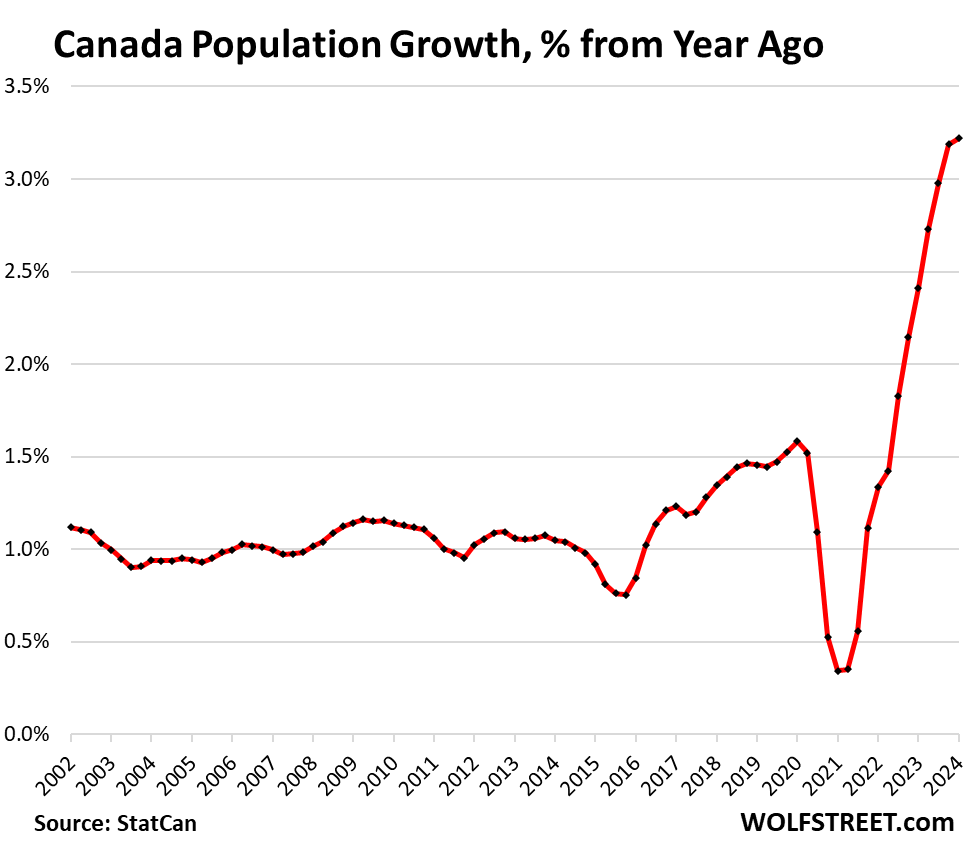
Canada’s population jumped by 1.27 million people in 2023, to 40.77 million by January 1, an increase of 3.2% from a year ago, the highest year-over-year growth rate since 1957 (3.3%), Statistics Canada said today in its report on the exploding growth of Canada’s population, driven by a huge wave of immigrants; 98% of the population growth came from immigration.

And this sudden population growth has been putting enormous strains on the rental housing market, where rents have spiked, and continue to spike. And it has had a number of other effects that pressure Canadians in their daily lives.

https://wolfstreet.com/wp-content/uploads/2024/03/Canada-population-2024-03-27-people.png

“Since the end of 2020, demographic trends in Canada have shifted significantly. The fertility rate reached a record low of 1.33 children per woman in 2022. Millennials now outnumber baby boomers in Canada, and the labour market has changed, with some sectors experiencing shortages. Many permanent and temporary immigrants came to Canada, including many workers and international students,” StatCan said in the introduction of its press release.

The government of Canada has now responded to the outcry over its immigration policies and the effects they produce, including the spiking rents, by proffering to dial back the number of temporary immigrants allowed into the country.

The year-over-year increases in the past two quarters, at around 3.2%, and even the growth rates in 2022, were complete outliers that no one in the economy was prepared for, and rental housing doesn’t get built from one day to the next suddenly like this.

https://wolfstreet.com/wp-content/uploads/2024/03/Canada-population-2024-03-27-yoy.png

Of the 1.27 million immigrants added to the population in 2023, 471,800 were permanent immigrants and 804,900 were non-permanent residents (NPRs).

StatCan estimated that 2.66 million NPRs were living in Canada on January 1, 2024, including 2.33 million permit holders and their family members, and 299,000 asylum claimants with or without work or study permits.

And they all have to live somewhere. And this huge and sudden surge in demand for rental housing has caused rents to spike in a historic manner.

Rents spike.
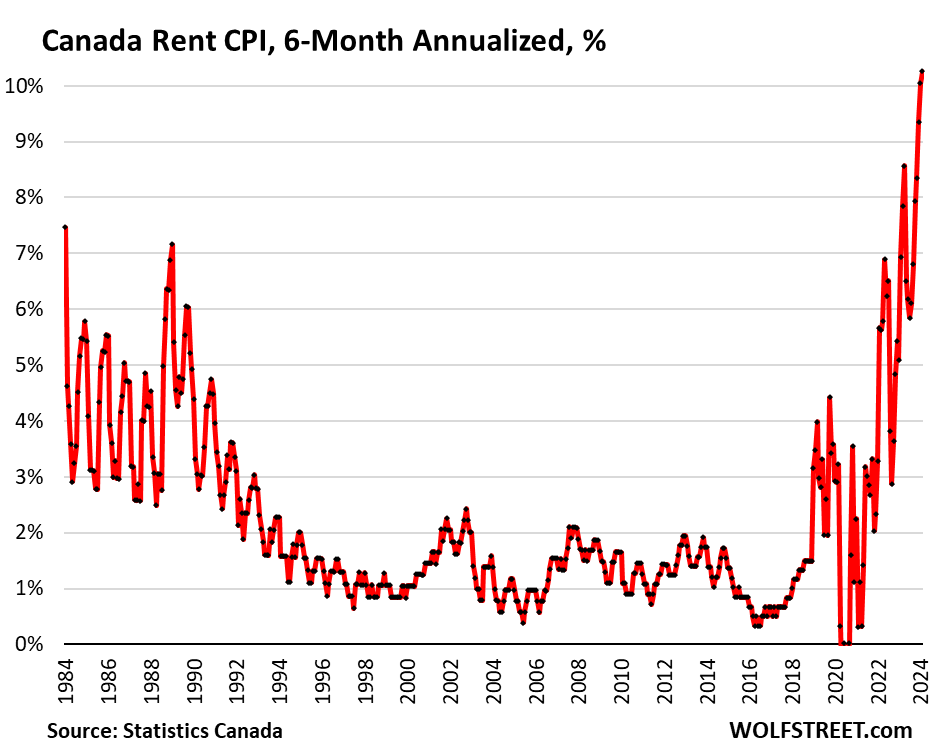
The CPI for rent in February spiked by 10.0% annualized from January. The six-month annualized rent CPI, which irons out the large month-to-month variability, spiked by 10.3%, the worst since 1983.

The rent CPI is a measure of what tenants actually pay in rents, not a measure of asking rents, and includes rents paid by tenants in rent-controlled markets.

 https://wolfstreet.com/wp-content/uploads/2024/03/Canada-CPI-inflation-2024-03-27-rent-6-month.png

The chart below shows the Rent CPI in terms of price level, not percentage change. Compared to a year ago, the rent CPI in February was up 8.2%. Since January 2022, in line with the boom in population growth, the Rent CPI has shot up by 15.8% and has been accelerating sharply in 2023 and so far in 2024, as shown in the chart above:....

....MUCH MORE

"OpenAI and Microsoft Plan $100 Billion AI ‘Stargate’" (MSFT)

From PYMNTS.com, March  31:

OpenAI and Microsoft are reportedly working on a $100 billion data center project.

The center, the subject of a Friday (March 29) report by The Information, would involve an artificial intelligence (AI) supercomputer dubbed “Stargate” that is scheduled to launch in 2028.

According to the report — which cities sources involved in discussions of the project — Microsoft would likely finance the effort, expected to dwarf the cost of even the largest data centers. The Stargate would be the largest in a series of supercomputers the two tech firms hope to build.

The report said that the development of Stargate will depend largely on OpenAI’s ability to roll out the next major upgrade, due out sometime early next year.

PYMNTS has contacted both companies for comment but has not yet gotten a reply.

Last week, PYMNTS examined the “battle for generative AI” that kicked off when OpenAI released its ChatGPT model. Among the possible competitors for the crown is Google, John Licato, an assistant professor of computer science and engineering at the University of South Florida, told PYMNTS in an interview.

He said this was down to the company’s “institutional expertise” and “access to compute power and data,” noting that Google’s Gemini models, particularly Gemini 1.5 Pro, offer a context window of up to a million tokens, allowing for longer contexts compared to GPT-4’s 128,000 token limit.

Licato added that Google also holds vast experience with transformers — the technology at the heart of ChatGPT — alongside access to data that few entities can rival. Other strong contenders, he said, include Meta and Anthropic.

“At this point, perhaps the most significant factor is access to a tremendous amount of computing power,” Licato said. “Companies like Google and OpenAI have millions (perhaps billions) of dollars of GPU processors, as well as more advanced computing technologies like TPUs (tensor processing units).”....

....MUCH MORE

"E.U. Regulations Created a Port Wine Black Market"

From Reason Magazine, April 2024 issue:

Over 1,500 types of wine are protected by European Union regulations.

People have been making wine in the verdant hills of northern Portugal's Douro Valley for nearly 2,000 years. Nowadays, the region is home to more than 19,000 grape farmers and 1,000 companies tending terraced vineyards that tower above the Douro River below.

Hundreds of these vineyards are small, often family-owned, properties called quintas, many of which produce port: a syrupy, sweet fortified wine. As a European Union–protected designation of origin product (similar to French Champagne or Italian Parmigiano-Reggiano), the production, labeling, and sale of port are heavily regulated—sometimes to the detriment of the small-scale operators keeping the cultural practice alive.

When I visited the Douro Valley this fall, one quinta owner shared that she couldn't officially sell port because of burdensome government regulations. All port sellers are required to keep at least 75,000 liters in reserve at all times, she explained—a standard that large producers can meet, but one that might bankrupt a small quinta like hers. In effect, she could only participate in this important cultural heritage as a black market seller.

Francisco Montenegro, owner of the Douro Valley–based Aneto Wines, notes that would-be port sellers have to grapple with several regulations that make it difficult for them to enter the market. On top of the 75,000-liter stock minimum, port producers are allowed to sell or market only one-third of their output, "thus forcing the producer to let [two-thirds] of their wines age." They have to register under a specific tax status "as they work with spirits," which requires them to "pay more customs taxes." Government regulations also mandate that producers "wait at least 3 or 4 years if they want to bottle a normal tawny" port, Montenegro says.

A vast regulatory regime dictates the kinds of grapes producers may use, the number of grapes they may harvest in a year, and when they may bottle and sell so-called vintage ports. These regulations largely come from the Instituto dos Vinhos do Douro e do Porto (IVDP), or Port and Douro Wines Institute. The IVDP says it is a government body that "upholds the quality and quantity" of port and Douro Valley wines through "binding specifications."....

....MUCH MORE