Wednesday, April 4, 2018

"Nvidia's Slightly Terrifying Metropolis Platform Paves the Way for Smarter Cities" (NVDA)

Although this article is 11 months old it is a good introduction to one piece of what we were foreshadowing with Tuesday's "NVIDIA Wants to Be the Brains Behind the Surveillance State (NVDA)". In fact the camera surveillance integration AI is only one part of the Metropolis platform which is itself only one part of what the rest of NVIDIA's offerings will consist of.

From New Atlas, May 9, 2017:

https://img.newatlas.com/nvidia-metropolis-ai-city-1.jpg?auto=format%2Ccompress&fit=max&h=670&q=60&w=1000&s=7869ac9f9ab5c3381ceb61eba4667a1c
Nvidia's Metropolis is an intelligent video analytics platform that can process enormous amounts of security camera footage looking for patterns and usable data(Credit: Nvidia)
Nvidia has a vision for the city of the future, and it takes the always-on surveillance we're becoming accustomed to and pushes it to whole new levels. The company's Metropolis intelligent video analytics platform applies deep learning to constantly process and contextualize the masses of data streaming from the ever-increasing number of cameras watching us every day.

It's one thing to have cameras watching at all times, but another altogether to do something useful with the giant stack of data they're producing day and night. Manpower costs make sitting and watching it all unfeasible, but computers taking advantage of machine learning and artificial intelligence could. And this perfectly lines up with the new direction Nvidia has been pushing in for the last few years.

No longer just a graphics card manufacturer aiming to push more pixels in the latest first person shooter, Nvidia's video processing and machine learning chips are starting to become benchmarks in a number of growing industries. For example, in industrial drones they're helping to automatically recognize and track assets on large work sites, and in self-driving cars they're taking a "watch and learn" approach to figuring out how traffic works.
Now Nvidia believes there's an opportunity to use AI, deep learning and a gushing firehose of data to monitor and optimize the entire organism of a city. And it's working toward that goal with Metropolis. This platform encompasses a number of Nvidia products all operating on a unified architecture, which can come together to analyze and make sense of video in real time.
https://img.newatlas.com/nvidia-metropolis-ai-city-2.jpg?auto=format%2Ccompress&fit=max&h=670&q=60&w=1000&s=1feef6484bebf4aa166d7687c55b4e42
Nvidia's Metropolis platform encompasses a number of Nvidia products all operating on a unified architecture(Credit: Nvidia)
Through partner businesses, Nvidia's technology is set to take things even further, enabling autonomous aerial systems streaming video back from the sky, security robots driving themselves around looking for trouble spots, and ultra high resolution, super-wide panoramic cameras that capture a whole scene instead of needing to track and follow objects.
And instead of just recording and storing footage, every camera's output would be constantly analyzed and crunched into useful data points. We're talking facial recognition, vehicle recognition, and pattern tracking in road and pedestrian traffic.

Clearly this will be useful in a law enforcement and security sense, and several Nvidia partners are working along these lines. BriefCam, for example, is demonstrating technology that tracks individuals and vehicles through security footage, then produces super-quick review videos in which all events in a given time frame can be made to happen in a condensed format where a bunch of them are on screen at once.
It's a smart system, too. You can ask it to show you a condensed video montage of just the red cars that came down a given street, or just the bicycles that turned right at a given intersection within a given time period. It's extraordinary to watch and a huge time-saver, and it does a good job highlighting unusual behaviours....MUCH MORE
And more to come.

Crypto M&A: "Three Startups Coinbase May Have Its Eye On"

As we've noted* elsewhere, this is Andreessen Horowitz's 'good' cryptocurrency investment (at least in comparison with 21.co, now renamed Earn.com which just seems sad) and could go public pretty much any time they choose to.

From PitchBook, March 28:
Coinbase, the cryptocurrency trading startup that brought bitcoin to the masses, looks ready to rev up its M&A activity with the recent hiring of Emilie Choi, who joins the first unicorn in the crypto space after an eight-year stint at LinkedIn as vice president and head of corporate development—a period that included its $26.2 billion acquisition by Microsoft in 2016.

Coinbase has raised $225 million in equity funding to date and was valued at $1.6 billion following its $108 million Series D last August. Choi has herself said that, in addition to cash and equity in the company, Coinbase could also throw cryptocurrency assets into the acquisition financing mix. Indeed, 40% of its current employees already get a slice of their compensation package meted out in bitcoin.

Earlier this year, Coinbase picked up most of the Memo engineering squad that created a Slackbot used by product development teams to organize notes and directives. Little wonder, then, that Choi (pictured) has floated further acqui-hires as her primary mandate. So, who might she have her eye on?

Past is prologue
The first two options could well be a pair of companies—dYdX and Basecoin-creator Intangible Labs—backed by former Coinbase product manager and Runa Capital principal, Nick Tomaino. His fund, 1confirmation, launched last summer and secured buy-in from Mark Cuban to back cryptographic assets. The third possibility, Radar Relay, provides a decentralized trading platform for Ethereum tokens.

When it comes to M&A, the general rule of thumb is to buy what you know. In the rapidly evolving world of crypto, that makes it more a matter of buying who you know, with the assumption that acquiring the right experience can lead to unlocking the mysteries of what the industry's future might look like.

For Choi, Tomaino's pair of investments could make for enticing purchases on that front.

In December, 1confirmation joined the likes of Chris Dixon at Andreessen Horowitz, Olaf Carlson-Wee at Polychain Capital and Coinbase's own CEO Brian Armstrong to back a roughly $2 million seed round for dYdX, which is looking to create the first-of-its-kind decentralized derivatives exchange. Among their goals for the funding: hiring engineers, designers and business operators. Leaving it to dYdX to positively ID talent in those areas could complement Choi's acqui-hire mission.

Earlier last year, 1confirmation joined a16z along with Bain Capital Ventures, Digital Currency Group, MetaStable Capital, Pantera Capital and Polychain Capital to back the startup behind the Basecoin token. The aim: Bake in central bank-like policy supports to create a crypto free from the notorious volatility of bitcoin and others. Access to that asset, and the team behind it, is likely too good to pass up. ...MUCH MORE
*See:
"Coinbase Strategy Teardown: How Coinbase Grew Into The King Midas Of Crypto Doing $1B In Revenue"
"Chaos Ensued. The Masseuse Panicked and Jumped Onto the Jet Ski with the Captain."

A Look At Einhorn's Greenlight Capital, A Terrible Reflection On Hedge Funds

Yeah, when your longs go down and your shorts go up, you got some 'splainin' to do, Lucy.
From FT Alphaville:

David Einhorn, in search of lost time
David Einhorn's hedge fund Greenlight Capital is having a difficult year. To date, the storied fund has returned -13.6 per cent net of fees and expenses versus the -0.8 per cent return of the S&P 500.
Seemingly befuddled by the performance, Mr Einhorn struggled to ascribe blame to any fundamental errors or systematic issues in his Q1 letter sent to investors yesterday;
In our history, we've had five other quarters with a greater than 5 per cent loss. In four of those, there were clear world or market events that provided a simple explanation, and in one, a few positions in our portfolio went wrong at the same time. This period has been like any of those.
Mr Einhorn goes onto explain the performance by focusing on the 20 largest long and short positions, and how they performed after missing or beating their respective earnings expectations:
...the longs that met or exceeded expectations (representing 89 per cent of capital) advanced around 2 per cent and those that missed (17 per cent of capital) fell about 8 per cent. For the shorts, those that met or exceeded expectations (representing 29 per cent of capital) rose 7 per cent and those that disappointed (28 per cent of capital) fell almost 5 per cent.
All good then?

Well not quite, after performing well post-earnings these positions reversed dramatically. For instance car-creator General Motors, the largest long position in the fund at 19.2 per cent of capital, according to Greenlight's last 13-F filing, beat earnings before suffering a 18 per cent draw-down over the quarter....MUCH MORE

HBR: "Why the Automation Boom Could Be Followed by a Bust"

Bain & Co. writing at the Harvard Business Review, March 18:
You may not be sharing your office with a robot yet, but the next wave of automation has begun. Humanoid service robots, machine learning algorithms and autonomous logistics will replace millions of service workers in the coming decade. Experts are rushing to forecast the likely impact on jobs. But most projections overlook two powerful forces that will combine with automation to reshape the global economy by 2030: rapidly aging populations and rising inequality.

The collision of these three forces sets the stage for a 10- to 15-year economic boom followed by a bust. An aging workforce, advances in automation, and growing income inequality point to an era of rapid and volatile change—and greater economic disruption than we have seen over the past 60 years. In the coming decade extremes are likely to become more extreme.

How would this boom-bust cycle likely play out? As populations age, labor force growth will slow, triggering labor scarcity in a growing number of industries. Faced with labor shortages, companies will accelerate their investment in automation technologies. Our research shows incremental capital investment in automation could reach $8 trillion in the US by 2030. That translates to about $5 trillion in net accumulation to the US capital stock, increasing capital per worker to a net figure nearly 1.5 times higher than today.

The magnitude of the investment in automation in the coming decade is likely to be greater in scale than in previous periods because it will primarily affect the service sector, and it will spread through advanced economies as well as parts of the developing world. An $8 trillion investment boom would result in average annual US growth of about 3% and roughly 60% more economic output in 2030 than in 2015.

Typically, in an investment boom of this kind, supply growth creates the demand for more supply—a virtuous cycle of growth. In the early 2020s, rapid investment in automation would likely offset a little more than half the negative impact of automation on employment, easing the demand constraint on growth and potentially mitigating the immediate displacement of millions of workers. But by the end of the 2020s, automation could eliminate 20% to 25% of current US jobs—40 million workers—hitting middle- to low-income workers the hardest. At the same time, many of the companies that invested heavily in automation will be saddled with assets that are out of step with demand.
That’s the crucial pivot between boom and bust. As the investment wave recedes, it risks leaving in its wake deeply unbalanced economies in which income is concentrated among those most likely to save and invest, not consume. Growth at that point would become deeply demand-constrained, exposing the full magnitude of labor market disruption temporarily hidden from view by the investment boom.

Consumers who have lost their jobs to automation will spend less, putting further downward pressure on demand. By the late 2020s, unemployment and wage pressures may exceed levels following the Great Recession in 2009. Income inequality, having grown steadily for a decade, could approach or exceed historical peaks, choking off economic growth....MORE
Here is the February 7, 2017 issue of Bain's 'Insights":

Labor 2030: The Collision of Demographics, Automation and Inequality
Executive summary

Demographics, automation and inequality have the potential to dramatically reshape our world in the 2020s and beyond. Our analysis shows that the collision of these forces could trigger economic disruption far greater than we have experienced over the past 60 years (see Figure 1). The aim of this report by Bain's Macro Trends Group is to detail how the impact of aging populations, the adoption of new automation technologies and rising inequality will likely combine to give rise to new business risks and opportunities. These gathering forces already pose challenges for businesses and investors. In the next decade, they will combine to create an economic climate of increasing extremes but may also trigger a decade-plus investment boom.

In the US, a new wave of investment in automation could stimulate as much as $8 trillion in incremental investments and abruptly lift interest rates. By the end of the 2020s, automation may eliminate 20% to 25% of current jobs, hitting middle- to low-income workers the hardest. As investments peak and then decline—probably around the end of the 2020s to the start of the 2030s—anemic demand growth is likely to constrain economic expansion, and global interest rates may again test zero percent. Faced with market imbalances and growth-stifling levels of inequality, many societies may reset the government's role in the marketplace.
The analysis and business insights in this report can help leaders put these changes in context and consider the effects they will have on their companies, their industries and the global economy....MORE 
And the January report (68 page PDF):
LABOR 2030: THE COLLISION OF DEMOGRAPHICS,  AUTOMATION AND INEQUALITY 

"Why China's Soybean Tariff Changed Everything"

I was asked why we didn't cover last week's USDA grains and soyabeans inventory and planting intentions report when it was so bullish for corn and especially beans. We didn't understand how the market could be so enthusiastic with the sword o'Damocles trade war potential hanging over things. So we said nothing.
Here's the last couple week's action via FinViz:


And the headline story from ZeroHedge:
While markets are being somewhat drama queen-ish this morning, China's trade war retaliation was telegraphed well in advance, and as we reported nearly two weeks ago, "China About To Launch "Tens Of Billions" More In Tariffs." As such it should not have come as a surprise that China did just that overnight, when it announced 25% tariffs on $50 billion in 106 US imports.
What was a surprise, was the unexpected announcement that China would also include US soybean exports in the list of items impacted by tariffs, something which we noted earlier opens up the door to a new, third round of tariffs by the US, which would assure that a "nuclear" trade war has indeed broken out.

It is the presence of soybeans in the tariff list that has startled China watchers and analysts, such as Capital Economics' Julian Evans-Pritchard, who writes that "China’s rapid and aggressive response to the proposed US tariffs has raised the stakes for both sides."

What makes the inclusion of soybeans so surprising?
Perhaps nothing more than the fact that while China is seeking to hurt US exporters, it will also substantially and materially impair its own domestic producers and supply chains, will struggle to replace U.S. soybean supplies "inflicting severe financial pain on domestic companies, analysts and executives at feedmakers said" according to Reuters, and potentially risk sparking runaway food inflation as surging feedstock prices send pork prices through the roof.

To be sure, from a trade war perspective the inclusion of soybeans makes perfect sense: for China, the world's top importer of the oilseed in the world, soybeans are considered one of the most powerful weapons in Beijing’s trade arsenal because a drop in exports to China would hurt Iowa and other farm states that backed U.S. President Donald Trump. As the chart below shows, soybeans were the biggest U.S. agricultural export to China last year at a value of $12 billion.
https://www.zerohedge.com/sites/default/files/inline-images/agri%20imports%20china_0.jpg?itok=8PhP6fkD
Incidentally, for those who wish to trade, either buy or sell, the biggest corporate suppliers of soybean to China, here is a list of the top sellers, courtesy of Bloomberg:
  1. Bunge
  2. Marubeni
  3. Cofco
  4. Cargill
  5. Dreyfus
...MORE

We'll have more on the ag commodities.This was Agrimoney's coverage of the market's reaction to the March 29 USDA report:
Corn, soybean prices soar as US farmers plan sowings cutbacks

Tuesday, April 3, 2018

"Even without Cambridge Analytica (or Facebook), was the internet always meant for surveillance?"

From Scroll (India), March 31:

Yasha Levine’s ‘Surveillance Valley’ provides a frightening history of the dark side of the internet. 
When it was recently revealed that Cambridge Analytica had managed to grab the Facebook data of millions of people and used the information it gathered inappropriately to construct psychological profiles which were utilised to influence elections, there were a few predictable reactions. The first was from the world of digital media itself, now wholly beholden to the social media giant for publicity and outreach.

While publishing news of the leak by Cambridge Analytica, news media like Time and The Guardian were quick to argue that this was owing to an unethical practice they named “data harvesting”. Companies like Cambridge Analytica, they said, had taken advantage of Facebook’s laxity to steal the private information of users and sell it to the highest bidder. Mark Zuckerberg, CEO of Facebook, in an interview given to CNN, and in full page ads published in all major American newspapers, apologised for a “breach of trust” and promised to keep data safe in the future.

In all of this there was an emphasis on what CNN’s interviewer Laurie Segall called “bad actors”, who were exploiting Facebook’s features allowing app developers to collect users’ and their friends’ data to go as far as destabilising election processes across the world. A visibly nervous Zuckerberg – spooked at least in part by sharp drops in his company’s market capitalisation and, by extension, his personal wealth – promised that Facebook would double the number of people working on review and security by the end of the year.

Built for surveillance?
But what remained unvoiced was a niggling doubt: of all the “bad actors” out there, could Facebook and the other big tech companies by the biggest, baddest actors of them all? Surveillance Valley, Yasha Levine’s new book, posits an unsettling new thesis: the internet, and all that is in based on it, is not only a tool developed under the aegis of the US military and intelligence agencies, but is also a worldwide surveillance network that clothes itself in the garb of individual freedom and apolitical technocratism.

In the popular imagination, the story of the internet is restricted to the creation of a data sharing centre at the National Science Foundation’s (NSF) Networking Office by Stephen Wolff in 1986. The NSF was a federal agency, and Wolff’s creation of the NSFNET was a way to link the supercomputers of five universities to form the first public network of connected computers. Within the next five years the NSFNET backbone connected thirteen regional networks and 170 more colleges. The internet, as we know it, was officially born with the privatisation of the NSFNET.
There is a secret history of the Internet, however, which belies this heartwarming story of academic networks going commercial. What preceded the NSFNET was, as Levine tells us, “...a convoluted story. Wade in deep enough and you find yourself in a swamp of three-letter federal agencies, network protocol acronyms, government initiatives, and congressional hearings filled with technical jargon and mind-numbing details. But on a fundamental level it was very simple: after two decades of lavish funding and research and development inside the Pentagon system, the Internet was transformed into a consumer profit centre.”

That this consumer profit centre is still massively beholden to the military-intelligence complex that engendered it is the primary thrust of Levine’s book. Cloaked and swaddled in libertarianism and radical revolutionary discourse, the internet as we know it is thoroughly co-opted by all agencies of the state. Drawing on an immense trove of resources that go back to the 1950s, Levine has attempted to delineate this secret history in a way that is both easily accessible to lay readers, while still appending over one hundred pages of notes that cite all his sources in great detail.

Starting from the secretive Project Agile of the Vietnam War, and ending with the false promises of internet privacy and freedom advanced by companies like Tor and Signal, Levine patiently deconstructs all the major narratives that make up the myth of the golden digital age.

Deconstructing the beginning
Right after Soviet Russia launched the first satellite, Sputnik, into space in 1957, the American President Dwight D Eisenhower hired a new secretary of defence, Neil McElroy, a marketing expert and president of Procter & Gamble, to cook up a perfect public relations project called ARPA or the Advanced Research Projects Agency. ARPA was supposed to be an organisation that would “cut through government red tape and create a public-private vehicle of pure military science to push the frontiers of military technology and develop vast weapon systems of the future.”

What ARPA effectively created, under the supervision of William Godel, was a vast data collection and storage agency that collated “interviews, polls, population counts, detailed anthropological studies of various tribes, maps, available weapons, migration studies, social networks, agricultural practices, dossiers…out of ARPA’s centres in Vietnam and Thailand.” Drowning in this immense treasure trove of data, the administrators of ARPA realised that they had to construct a system that was capable of handling all the information and presenting it with a simple graphic user interface and the ability to interact with other computers in real time.

The first developers of ARPANET, JCR Licklider, got this idea of a vast information processing network that functioned just like any organic of ecological system, from his association with the famous thinker and mathematician Norbert Wiener’s ideas on cybernetics. Wiener, who was a distinguished professor at MIT, had a revolutionary idea that the world could be defined for all intents and purposes as a giant computational machine that ran on the exchange of information. Wiener himself had been spurred on to develop this discipline by his time in the military, building anti-aircraft cannons that could predict the trajectory of a plane based on its pilot’s actions so as to effectively destroy it....
...MUCH MORE

Will Quantitative Tightening (QT), which is deflationary in theory, be inflationary in practice (continued)?

From 13D Research:
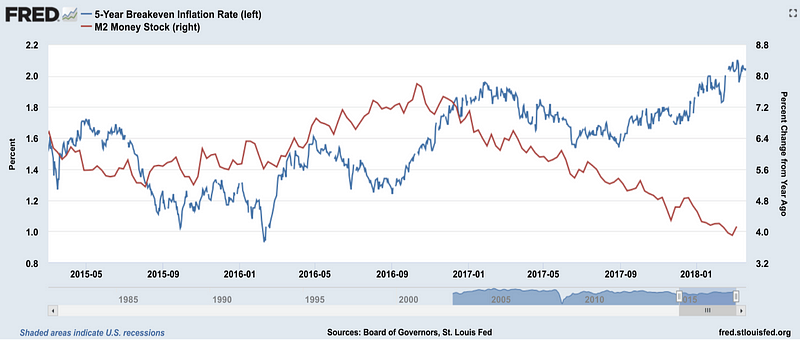
During our last installment in the series in the February 15th WILTW, we drew the connection between the sharp slowdown in M2 growth — the result of the Fed’s tighter monetary policy and short-term, interest-rate hikes — and rising M2 velocity, as dictated by the relationship M2V=NGDP/M2. Anything that alters the direction of M2 will have the opposite effect on velocity, all else being equal. Therefore, tighter monetary policy (evidenced by falling M2 growth) and higher interest rates can lead to rising velocity, which has historically been closely associated with rising inflation and inflation expectations.

The five-year breakeven inflation rate, a measure of intermediate-term inflation expectations, has recently surged to a three year high of 2.05%. And, during the past 18 months, the upward trend in the breakeven rate (blue line below) has coincided with shrinking growth in the M2 money supply (red line). The rising breakeven rate has been driven by the rising yield on five-year USTs outpacing the yield increase of five-year Treasury Inflation-Protected Securities (TIPS), which have benefited from relatively stronger demand than their non-indexed UST counterparts.
5-year UST/TIPS breakeven inflation rate (blue, lhs) vs. year-over-year growth of M2 money stock (red, rhs), March 2015 to March 2018 
Source: St. Louis Fed
A March 12th Bloomberg article, headlined “Investors Brace for Inflation to Come Roaring Back,” elaborated on how “TIPS have become the sanctuary for the once-ubiquitous ‘bond vigilantes’.”

“Why would investors show so much alarm by embracing TIPS when trader bets and the Fed’s favorite measure of inflation showed nothing to get excited about? The answer is we’ve seen this motion picture before, and it didn’t end well. [During the period between] 2001, when the Bush tax cuts began, and June 2006, when the Fed last raised interest rates before the financial crisis, the surplus (2.6 percent of GDP) turned into a 3.8 percent deficit [at its nadir]. The unemployment rate, hovering near a 40-year low of 3.9 percent, climbed to 6.3 percent [at its high]. The implied volatility of U.S. government bonds, a measure of investor uncertainty on the economy, increased 53 percent to 161 from 105. And inflation, measured by the Personal Consumption Expenditure index, quickened to 2.4 percent [at its high] from 1.8 percent.

During this period when the financial system was hurtling toward the breaking point and the economy was deteriorating, TIPS proved superior, returning 49 percent when the rest of the Treasury market gained 28 percent, the Bloomberg Barclays Indexes show.”

We have long argued that while QE was deflationary for commodities, it was inflationary for financial assets, especially stocks and bonds. One could therefore argue that reversing QE (via QT) will trigger considerably more volatility in both the stock and bond markets in the months ahead, as cost-of-capital assumptions increase, opportunity-costs rise, earnings multiples contract and credit stress intensifies among highly-leveraged businesses (see section 2).

It is worth pointing out that rising M2 velocity does not necessarily imply an acceleration of real GDP growth. As the experience during the early-and-late 1970s illustrates, velocity can increase even while real GDP growth is receding, as indicated by the green arrows in the following chart....
...MORE

UPDATED—NVIDIA Wants to Be the Brains Behind the Surveillance State (NVDA)

Update below.
Origianal post:

The company just rolled out a $399,000 two-petaflop supercomputer that every little totalitarian and his brother is going to lust after to run their surveillance-city smart-city data slurping dreams.
The coming municipal data centers will end up matching the NSA in total storage capacity and NVIDIA wants to be the one sifting through it all. More on this down the road, for now here's the beast.
From Hot Hardware:

NVIDIA Unveils Beastly 2 Petaflop DGX-2 AI Supercomputer With 32GB Tesla V100 And NVSwitch Tech (Updated)
Of the over 28,000 attendees at NVIDIA’s GTC 2018 GPU Technology Conference, many converged on the San Jose Convention Center this week to learn about advancements in AI and Machine Learning that the company would bring to the table for developers, researchers and service providers in the field. Today, NVIDIA CEO Jensen Huang took to the stage to unveil a number of GPU-powered innovations for Machine Learning, including a new AI super computer and an updated version of the company’s powerful Tesla V100 GPU that now sports a hefty 32 Gigabytes of on-board HBM2 memory.

A follow-on to last year’s DGX-1 AI supercomputer, the new NVIDIA DGX-2 can be equipped with double the number of Tesla V100 32GB processing modules for double the GPU horsepower and a whopping 4 times the amount or memory space, for processing datasets of dramatically larger batch sizes. Again, each Tesla V100 now sports 32GB of HMB2, where previous generation Tesla V100 was limited to 16GB. The additional memory can afford factors of multiple improvements in throughput due to the data being stored in local memory on the GPU complex, versus having to fetch out of much higher latency system memory, as the GPU crunches data iteratively. In addition, NVIDIA also attacked the problem of scalability for its DGX server product by developing a new switch fabric for the DGX-2 platform.....MORE
The data sifting is so fast that data storage companies are starting to supercharge their systems with GPU's using the older DGX-1.
From TechTarget's SearchStorage:

Pure Storage AIRI is AI-ready infrastructure that integrates Pure's all-flash FlashBlade NAND storage blades and four Nvidia DGX-1 artificial intelligence supercomputers.
Pure Storage is elbowing into AI-based storage with FlashBlade, a use case that's a natural progression for the scale-out unstructured array.

The all-flash pioneer this week teamed with high-performance GPU specialist Nvidia to unveil Pure Storage AIRI, a preconfigured stack developed to accelerate data-intensive analytics at scale.

AIRI stands for AI-ready infrastructure. The product integrates a single 15-blade Pure Storage FlashBlade array fed by four Nvidia DGX-1 deep learning supercomputers. Connectivity comes from two remote direct memory access 100 Gigabit Ethernet switches from Arista Networks.
In this product iteration, Pure uses 15 midrange 17 TB FlashBlade NAND blades. Pure Storage claims a half rack of AIRI compute and storage is equivalent to about 50 standard data center racks....MORE
Finally, from Tiernan Ray at Barron's Tech Trader:

Nvidia: One Analyst Thinks It’s Decimating Rivals in A.I. Chips
Nvidia's CEO Jen-Hsun Huang is taking away the oxygen from competitors in A.I., Rosenblatt analyst Hans Mosesmann tells Barron's, by a combination of chip performance that's hard to match and software technology that others can't offer.
The fastest-growing part of chip maker Nvidia’s (NVDA) business is its “data center” chips product line, driven in part by sales of graphics chips — “GPUs” — that are widely used for artificial intelligence tasks such as machine learning.

That division looks to have a very bright future, according to one analyst who attended Nvidia’s annual “GTC” conference last week.

“What Nvidia did with their announcements last week was to cause everyone, including Intel (INTC), but also startups, to re-examine their roadmaps,” says Hans Mosesmann of Rosenblatt Securities.

I chatted with Mosesmann by phone on Friday. Mosesmann, who has a Buy rating on Nvidia stock, and a $300 price target, foresees the company having something of a lock on the A.I. chip market.
"Nvidia has reset the level of performance,” he told me.
Nvidia’s data center business totaled $606 million in revenue, or 21% of its total, and more than doubled from a year earlier. (For more details on Nvidia’s revenue trends, see the company’s presentation on its investor relations Web site.)

Nvidia, in Mosesmann's thinking, keeps upping the ante. Not only turning up performance of chips, but also redefining the battle by making it about software, and about system-level expertise in A.I., not just about the chip itself:
[Nvidia CEO] Jen-Hsun [Huang] is very clever in that he sets the level of performance that is near impossible for people to keep up with. It’s classic Nvidia — they go to the limits of what they can possibly do in terms of process and systems that integrate memory and clever switch technology and software and they go at a pace that makes it impossible at this stage of the game for anyone to compete.

Everyone has to ask, Where do I need to be in process technology and in performance to be competitive with Nvidia in 2019. And do I have a follow-on product in 2020? That’s tough enough. Add to that the problem of compatibility you will have to have with 10 to 20 frameworks [for machine learning.] The only reason Nvidia has such an advantage is that they made the investment in CUDA [Nvidia’s software tools].

A lot of the announcements at GTC were not about silicon, they were about a platform. It was about things such as taking memory [chips] and putting it on top of Volta [Nvidia’s processor], and adding to that a switch function. They are taking the game to a higher level, and probably hurting some of the system-level guys. Jen-Hsun is making it a bigger game.
An immediate result, Mosesmann believes, is that a lot of A.I. chip startups, companies that include Graphcore and Cerebras,are going to have a very hard time keeping up.
“He’s destroying these companies,” says Mosesmann of the young A.I. hopefuls. “These private companies have to go back and get another $50 million [of funding]."

“He's taking all the oxygen out of the room,” says Mosesmann.
For the established competitors such as Intel, Mosesmann sees plenty of attempts at A.I. suddenly rendered moot.

Intel bought A.I. chip startup Nervana Systems in 2016 for $400 million. I’ve written a bunch about how Nervana is becoming Intel’s A.I. focus....MUCH MORE
Update: "'Nvidia's Slightly Terrifying Metropolis Platform Paves the Way for Smarter Cities' (NVDA)"

"Half of IKEA founder’s private fortune goes to economic development of northern Sweden"

That's a lot of economic development.
Lifted in toto from the Barents Observer:

Ingvar Kamprand was very interested in Sweden’s rural Norrbotten region.

It is the Swedish newspaper Dagens Nyheter which has posted a photo of Ingvar Kamprand’s handwritten will where he says half of the fortune will go to his children, while the other half goes to the family’s foundation aimed at supporting economic developments in the northernmost region of the country.

The newspaper estimates the IKEA founder’s private fortune to be about 750 million Swedish kroner (€74,3 million).

Regional newspaper Norrländska Socialdemokraten (NSD) tells the story about Ingvar Kamprand’s passion for traveling the Torne Vally in the years after establishing the company’s northernmost mall in Haparanda on the Swedish, Finnish border.

The IKEA mall in Haparanda serves customers throughout the Barents Region, including northern Norway, Russia’s Kola Peninsula and Republic of Karelia, as well as Finnish Lapland.
How the money will be spent in Norrbotten is not year clear. Decisions will be taken by the family’s foundation. Kamprand’s will simply reads «These funds will be used for the development of business activities in Norrland.»

The will only contains a smaller part of the IKEA founder’s total generated income from the furniture malls. At the time of his death this winter, Kamprand’s foundations world-wide value had could be worth as much as 620 billion Swedish kroner (€61,4 billion), the business weekly Veckans Affärer reports.
Barents Observer home

Monday, April 2, 2018

Amazon's Antitrust Paradox (AMZN)

From the Yale Law Journal, Vol. 126, #3, Jan. 2017:
abstract. 
Amazon is the titan of twenty-first century commerce. In addition to being a retailer, it is now a marketing platform, a delivery and logistics network, a payment service, a credit lender, an auction house, a major book publisher, a producer of television and films, a fashion designer, a hardware manufacturer, and a leading host of cloud server space. Although Amazon has clocked staggering growth, it generates meager profits, choosing to price below-cost and expand widely instead. 

Through this strategy, the company has positioned itself at the center of e-commerce and now serves as essential infrastructure for a host of other businesses that depend upon it. Elements of the firm’s structure and conduct pose anticompetitive concerns—yet it has escaped antitrust scrutiny.

This Note argues that the current framework in antitrust—specifically its pegging competition to “consumer welfare,” defined as short-term price effects—is unequipped to capture the architecture of market power in the modern economy. We cannot cognize the potential harms to competition posed by Amazon’s dominance if we measure competition primarily through price and output. Specifically, current doctrine underappreciates the risk of predatory pricing and how integration across distinct business lines may prove anticompetitive. These concerns are heightened in the context of online platforms for two reasons. First, the economics of platform markets create incentives for a company to pursue growth over profits, a strategy that investors have rewarded. Under these conditions, predatory pricing becomes highly rational—even as existing doctrine treats it as irrational and therefore implausible. Second, because online platforms serve as critical intermediaries, integrating across business lines positions these platforms to control the essential infrastructure on which their rivals depend. This dual role also enables a platform to exploit information collected on companies using its services to undermine them as competitors. 

This Note maps out facets of Amazon’s dominance. Doing so enables us to make sense of its business strategy, illuminates anticompetitive aspects of Amazon’s structure and conduct, and underscores deficiencies in current doctrine. The Note closes by considering two potential regimes for addressing Amazon’s power: restoring traditional antitrust and competition policy principles or applying common carrier obligations and duties.
Introduction
“Even as Amazon became one of the largest retailers in the country, it never seemed interested in charging enough to make a profit. Customers celebrated and the competition languished.”
—The New York Times1

“[O]ne of Mr. Rockefeller’s most impressive characteristics is patience.”
—Ida Tarbell, A History of the Standard Oil Company2
In Amazon’s early years, a running joke among Wall Street analysts was that CEO Jeff Bezos was building a house of cards. Entering its sixth year in 2000, the company had yet to crack a profit and was mounting millions of dollars in continuous losses, each quarter’s larger than the last. 

Nevertheless, a segment of shareholders believed that by dumping money into advertising and steep discounts, Amazon was making a sound investment that would yield returns once e-commerce took off. Each quarter the company would report losses, and its stock price would rise. One news site captured the split sentiment by asking, “Amazon: Ponzi Scheme or Wal-Mart of the Web?”3

Sixteen years on, nobody seriously doubts that Amazon is anything but the titan of twenty-first-century commerce. In 2015, it earned $107 billion in revenue,4 and, as of 2013, it sold more than its next twelve online competitors combined.5 By some estimates, Amazon now captures 46% of online shopping, with its share growing faster than the sector as a whole.6 In addition to being a retailer, it is a marketing platform, a delivery and logistics network, a payment service, a credit lender, an auction house, a major book publisher, a producer of television and films, a fashion designer, a hardware manufacturer, and a leading provider of cloud server space and computing power. Although Amazon has clocked staggering growth—reporting double-digit increases in net sales yearly—it reports meager profits, choosing to invest aggressively instead. The company listed consistent losses for the first seven years it was in business, with debts of $2 billion.7 While it exits the red more regularly now,8 negative returns are still common. The company reported losses in two of the last five years, for example, and its highest yearly net income was still less than 1% of its net sales.9
 ...MUCH MORE

HT: Naked Capitalism Links post, Apr 2

"China Wants Its Own Brains Behind 30 Million Self-Driving Cars" (INTC; NVDA)

We'll have more on the other start-ups that are also targeting the market later this month but for now some of the state of play.

From Bloomberg, March 25:
  • Intel-backed Horizon Robotics working with Audi, Ford partner
  • Value of China’s yearly chip imports dwarfs that of crude oil
China’s aspiration to deploy 30 million autonomous vehicles within a decade is seeding a fledgling chip industry, with startups like Horizon Robotics Inc. emerging to build the brains behind those wheels.
The Beijing-based company is taking aim at Nvidia Corp. and Mobileye NV just as the autonomous-driving business takes off and uncertainty looms over international trade. Annual revenue from the chips used in driverless vehicles globally should more than double to $5 billion by 2021, according to Gartner Inc.
China’s aspiration to deploy 30 million autonomous vehicles within a decade is seeding a fledgling chip industry, with startups like Horizon Robotics Inc. emerging to build the brains behind those wheels.
The Beijing-based company is taking aim at Nvidia Corp. and Mobileye NV just as the autonomous-driving business takes off and uncertainty looms over international trade. Annual revenue from the chips used in driverless vehicles globally should more than double to $5 billion by 2021, according to Gartner Inc.
Horizon Robotics is an example of China’s resolve to move up the manufacturing value chain by focusing less on commodity smartphones and TVs, and more on sophisticated semiconductors and artificial intelligence that can help cars drive themselves or spaceships land on the moon. That industrial policy is meant to help China reduce its 1.75 trillion yuan ($276.4 billion) in annual chip imports, a value dwarfing its oil imports.
“China has to spare no efforts to pick up and develop its own chip technology to improve our own sense of security, especially when the U.S. government is making us fearful about any protectionism against China,” Wei Shaojun, director of the Beijing-based Institute of Microelectronics at Tsinghua University, said at a forum in Shanghai....MORE

"How the AI cloud could produce the richest companies ever" (AMZN; MSFT; GOOG)

From MIT's Technology Review, March 22:
Amazon, Google, and Microsoft all want to dominate the business of providing artificial-intelligence services through cloud computing. The winner may have the OS of the future.

For years, Swami Sivasubramanian’s wife has wanted to get a look at the bears that come out of the woods on summer nights to plunder the trash cans at their suburban Seattle home. So over the Christmas break, Sivasubramanian, the head of Amazon’s AI division, began rigging up a system to let her do just that.­­­­­

So far he has designed a computer model that can train itself to identify bears—and ignore raccoons, dogs, and late-night joggers. He did it using an Amazon cloud service called SageMaker, a machine-learning product designed for app developers who know nothing about machine learning. Next, he’ll install Amazon’s new DeepLens wireless video camera on his garage. The $250 device, which will go on sale to the public in June, contains deep-learning software to put the model’s intelligence into action and send an alert to his wife’s cell phone whenever it thinks it sees an ursine visitor.

Sivasubramanian’s bear detector is not exactly a killer app for artificial intelligence, but its existence is a sign that the capabilities of machine learning are becoming far more accessible. For the past three years, Amazon, Google, and Microsoft have been folding features such as face recognition in online photos and language translation for speech into their respective cloud services—AWS, Google Cloud, and Azure. Now they are in a headlong rush to build on these basic capabilities to create AI-based platforms can be used by almost any type of company, regardless of its size and technical sophistication.

“Machine learning is where the relational database was in the early 1990s: everyone knew it would be useful for essentially every company, but very few companies had the ability to take advantage of it,” says Sivasubramanian. 
Amazon, Google, and Microsoft—and to a lesser extent companies like Apple, IBM, Oracle, Salesforce, and SAP—have the massive computing resources and armies of talent required to build this AI utility. And they also have the business imperative to get in on what may be the most lucrative technology mega-trend yet.

“Ultimately, the cloud is how most companies are going to make use of AI—and how technology suppliers are going to make money off of it,” says Nick McQuire, an analyst with CCS Insight.

Quantifying the potential financial rewards is difficult, but for the leading AI cloud providers they could be unprecedented. AI could double the size of the $260 billion cloud market in coming years, says Rajen Sheth, senior director of product management in Google’s Cloud AI unit. And because of the nature of machine learning—the more data the system gets, the better the decisions it will make—customers are more likely to get locked in to an initial vendor.

In other words, whoever gets out to the early lead will be very difficult to unseat. “The prize will be to become the operating system of the next era of tech,” says Arun Sundararajan, who studies how digital technologies affect the economy at NYU’s Stern School of Business. And Puneet Shivam, president of Avendus Capital US, an investment bank, says: “The leaders in the AI cloud will become the most powerful companies in history.”

It’s not just Amazon, Google, and Microsoft that are pursuing dominance. Chinese giants such as Alibaba and Baidu are becoming major forces, particularly in Asian markets. Leading enterprise software companies including Oracle, Salesforce, and SAP are embedding machine learning into their apps. And thousands of AI-related startups have ambitions to become tomorrow’s AI leaders.

Who will be the winners?Amazon, Google, and Microsoft all offer services for recognizing faces and other objects in photos and videos, for turning speech into text and vice versa, and for doing the natural-language processing that allows Alexa, Siri, and other digital assistants to understand your queries (or some of them, anyway). 
So far, none of this activity has resulted in much in the way of revenue; none of AI’s biggest players bother to break out sales of their commercial AI services in their earnings calls. But that would quickly change for the company that creates the underlying technologies and developer tools to support the widespread commercialization of machine learning. That’s what Microsoft did for the PC, by creating a Windows platform that millions of developers used to build PC programs. Apple did the same with iOS, which spawned the mobile-app era....MORE

Judge Says Proceed With Class-Action Against Tesla Re: SolarCity Purchase (TSLA)

Although it will take some fancy lawyering, the plaintiff shareholders have a real chance at winning this suit.

From Bloomberg, March 28:
Tesla Investors Can Move Ahead With SolarCity Deal Lawsuit
  • Conflicts among Elon Musk, other directors raised questions
  • Judge finds Musk dominated board consideration of buyout
Tesla Inc. investors can press forward with claims that billionaire founder Elon Musk duped them into backing his $2.6 billion buyout of a solar-energy firm founded by his cousins, another setback in a rough week for the automaker.

Tesla shareholders challenging the acquisition of SolarCity Corp. produced enough evidence showing the deal may have been flawed by conflicts among Musk and other company directors, a Delaware judge ruled Wednesday. More than 85 percent of the company’s stockholders voted to back the acquistion.

Musk’s electric-car maker is facing a crisis in the wake of a fatal crash involving one of its Model X cars in California earlier this month. Tesla’s shares have fallen on all but five days this month and the company lost its perch to General Motors Co. as the most valuable automaker. The stock declined 7.7 percent Wednesday to $257.78.

The crash, which is under investigation, adds to Musk’s challenges including concerns that the company won’t reach its production targets for the all-important Model 3 sedan. Tesla didn’t say whether the vehicle’s Autopilot system was engaged during the accident.

Tesla said it didn’t agree with the judge’s decision in the investor suit and will be taking appropriate next steps. The company insists the allegations in the complaint are false.

Pension funds that opposed the 2016 SolarCity buyout accused Musk, who owns a 22 percent stake in Tesla, of using his outsize influence and reputation to manipulate the shareholder vote over the buyout.

Critics of the deal called it a bailout for SolarCity and said it raised questions about the Musk-led company’s corporate governance. Tesla added two new independent directors last year after investors complained its board was too closely tied to the chief executive officer....MORE
Here's the court's opinion, we'll be back with more on why this is an uphill climb for the shareholders.
IN RE TESLA MOTORS, INC. STOCKHOLDER LITIGATION

For some of our thinking over the years here's November 2017's "So, How Was Tesla's Purchase Of SolarCity Not a Fraud? (TSLA; SCTY)".

The stock is down another $13.21 (4.96%) at $252.92.

Some Of NVIDIA's Chips Are Getting the Wrong Answer For Math Problems (NVDA)

This doesn't sound as earthshaking as the Intel  Pentium FDIV bug which was discovered in 1994 but it is troubling.
From The Register:

 2 + 2 = 4, er, 4.1, no, 4.3... Nvidia's Titan V GPUs spit out 'wrong answers' in scientific simulations
Fine for gaming, not so much for modeling, it is claimed
Nvidia’s flagship Titan V graphics cards may have hardware gremlins causing them to spit out different answers to repeated complex calculations under certain conditions, according to computer scientists.

The Titan V is the Silicon Valley giant's most powerful GPU board available to date, and is built on Nv's Volta technology. Gamers and casual users will not notice any errors or issues, however folks running intensive scientific software may encounter occasional glitches.

One engineer told The Register that when he tried to run identical simulations of an interaction between a protein and enzyme on Nvidia’s Titan V cards, the results varied. After repeated tests on four of the top-of-the-line GPUs, he found two gave numerical errors about 10 per cent of the time. These tests should produce the same output values each time again and again. On previous generations of Nvidia hardware, that generally was the case. On the Titan V, not so, we're told.
We have repeatedly asked Nvidia for an explanation, and spokespeople have declined to comment. With Nvidia kicking off its GPU Technology Conference in San Jose, California, next week, perhaps then we'll get some answers.

All in all, it is bad news for boffins as reproducibility is essential to scientific research. When running a physics simulation, any changes from one run to another should be down to interactions within the virtual world, not rare glitches in the underlying hardware.

Collisions
Take for instance software that models molecular interactions. This sort of code uses Newtonian equations to predict the state of a system at any given time, such as calculating the position of particles after collisions. If a simulation has the same environment and starts with the same conditions, the output should be the same, again and again. But that isn’t always the case when using Nvidia’s Titan V GPUs to crunch the numbers.

An industry veteran, who alerted us to the issue, reckoned this is due to a memory issue. Chip companies normally push their high-end silicon to the limit to maximize performance. Nvidia may be overclocking or red-lining its Titan V in some way, causing read errors from memory. These mistakes are carried forward in calculations, resulting in numerical errors. Another cause could be a design blunder.

It is not down to random defects in the chipsets nor a bad batch of products, since Nvidia has encountered this type of cockup in the past, we are told. The moneybags biz released patches for some of its older GeForce and Titan models that exhibited similar problems to address these errors. There was no issue with its Titan X card based on its Pascal architecture, we're told....
 ...MORE

Keynes Named U.S. Economics Editor at The Economist

From TalkingBizNews:
Soumaya Keynes has been named the U.S. economics editor for The Economist and will be moving from London to Washington.

She has been an economics correspondent. Keynes expects to move in May.
Henry Curr, formerly U.S. economics editor, is now leading global economics coverage for the publication, based in London....MORE

Bono's Investment Guy (and early FB investor): “I Think You Can Make a Legitimate Case that Facebook Has Become Parasitic”

From the University of Chicago's Promarket, a major interview:

Roger McNamee: “I Think You Can Make a Legitimate Case that Facebook Has Become Parasitic”
In an interview with ProMarket, Facebook early investor Roger McNamee talks about his efforts to get Facebook to fix its business model and the moment he realized the social media giant is unwilling to change.
With Facebook increasingly mired in controversy following the Cambridge Analytica data harvesting scandal, an apologetic Mark Zuckerberg broke five days of radio silence on Wednesday as he made the media rounds. Facing a transcontinental backlash and intensifying calls to regulate Facebook, Zuckerberg expressed regret and even some openness to government regulation, so long as it’s the “right” regulation. Echoing these sentiments, Facebook’s COO Sheryl Sandberg also said that Facebook is “open to regulation.”

Belated public statements aside, many are skeptical of Facebook’s willingness to address its privacy issues, not least because the company reportedly knew for two years that Cambridge Analytica had harvested the personal data of millions of users without their consent. The FTC is currently investigating whether the company violated the terms of a consent decree it signed with the agency in 2011 to settle charges that it deceived consumers by sharing data they were told would be kept private with advertisers and third-party apps. As part of its agreement with the FTC, Facebook agreed to conduct regular privacy audits, conducted by independent auditors, for a period of 20 years. If the FTC finds Facebook to be in violation of the agreement (it already suspected Facebook of violating it before, in 2013), the company could be fined billions of dollars. In a letter to Facebook, senator Ron Wyden (D-OR) already requested that the company list all the incidents from the last ten years in which third parties violated its privacy rules and collected user data, in addition to providing copies of every privacy audit it prepared since 2011.

Moreover, the Cambridge Analytica revelations helped shed light on a greater problem: Facebook’s business model, which, as Zeynep Tufekci wrote in the New York Times , relies on massive surveillance of users “to fuel a sophisticated and opaque system for narrowly targeting advertisements and other wares to Facebook’s users.” Former employees and third-party app developers have attested that Cambridge Analytica was not alone: other firms have been utilizing the same covert data harvesting methods as well.

Roger McNamee probably has more reasons than most to doubt Facebook’s act of contrition. As an early investor in the company and former mentor to Mark Zuckerberg, McNamee—a renowned venture capitalist and cofounder of the private equity firm Elevation Partners—played a pivotal role during the company’s early days, advising Zuckerberg to refuse a billion-dollar acquisition offer from Yahoo in 2006 and helping facilitate the hiring of Sandberg. But starting in 2016, when he first noticed bad actors were exploiting Facebook’s algorithms and advertising tools and alerted Zuckerberg and Sandberg, McNamee had been trying unsuccessfully to get Facebook to acknowledge that its product was putting people in harm’s way.

This process, said McNamee in a recent interview with ProMarket, gradually turned him from a “huge fan” into one of Facebook’s harshest critics. “I arrived at this by really small degrees over almost two years,” he says. “With extreme reluctance, I realized that these people whom I trusted and helped were committed to a course of action that I could no longer support and that my friendship with them had to be put in a box while we address the threat to democracy.”...
...MUCH MORE
 
Previous visits with Mr. McNamee:
Nov. 1, 2017
Early Facebook investor compares the social network to Nazi propaganda, likens its workers to Goebbels and claims it is creating a climate of 'fear and anger' 
Nov. 12, 2017
"Climateer Line of the Day: Bono's Guy Talks Regulating Facebook and Google"
January 8, 2018 
"Facebook Can’t Be Fixed" (FB)

May 2012
Bono's Elevation Partners Runs $90 Mil to $1.5 Bil in Facebook, Making Him the World's Most Insufferable Musician (FB)

Also from May 2012:
"How Mark Zuckerberg Hacked the Valley" (FB)

Related:
Nov. 2017 
Climateer Line of the Day: Neurotransmitters and Facebook Edition
Via The Verge:

 "The short-term, dopamine-driven feedback loops we've created are destroying how society works.  No civil discourse, no cooperation; misinformation, mistruth. And it's not an American problem — this is not about Russians ads. This is a global problem."
—Former Facebook Vice President for Addicting Users, Chamath Palihapitiya
And the rest of the story:

Former Facebook exec says social media is ripping apart society
‘No civil discourse, no cooperation; misinformation, mistruth.’
Another former Facebook executive has spoken out about the harm the social network is doing to civil society around the world. Chamath Palihapitiya, who joined Facebook in 2007 and became its vice president for user growth, said he feels “tremendous guilt” about the company he helped make. “I think we have created tools that are ripping apart the social fabric of how society works,” he told an audience at Stanford Graduate School of Business, before recommending people take a “hard break” from social media. 
Palihapitiya’s criticisms were aimed not only at Facebook, but the wider online ecosystem. “The short-term, dopamine-driven feedback loops we’ve created are destroying how society works,” he said, referring to online interactions driven by “hearts, likes, thumbs-up.” “No civil discourse, no cooperation; misinformation, mistruth. And it’s not an American problem — this is not about Russians ads. This is a global problem.”...MUCH MORE, including video
Possibly also of interest:

Founding Facebook President: ‘God only knows what it’s doing to our children’s brains’ (FB)

Want to Make Big Money? Engineer A Little Addiction Into Your Product

"'We're designing minds': Industry insider reveals secrets of addictive app trade"

"Google, Twitter and Facebook workers who helped make technology so addictive are disconnecting themselves from the internet"

Dopamine Labs: "Meet the tech company that wants to make you even more addicted to your phone"

If You Want To Be Happy, Listen Up. Now! alternative title: The FT's Izabella Kaminska Is...

"China will win the A.I. race, according to Credit Suisse"

From CNBC, March 22:
  • China will be number one in artificial intelligence due to the country's lack of "serious law" about data protection, said Dong Tao, vice chairman for Greater China at Credit Suisse Private Banking Asia Pacific.
  • But, at some point, tighter data privacy laws will be introduced in China too, Tao said.
  • It would be a challenge for authorities to balance protecting the privacy of tech users and not hurting the sector's growth, he added.
The two largest economies in the world are dominating global research and development in the artificial intelligence field, but China is likely to emerge the winner, according to Credit Suisse.
That prediction was based largely on one reason: China lacks "serious law" about data protection, which gives companies pretty much free rein to develop their technology, said Dong Tao, vice chairman for Greater China at Credit Suisse Private Banking Asia Pacific.
At present, China lags U.S. in every area of AI development — hardware, research and algorithm, and industry commercialization — except big data, according to a recent Oxford University report.
"I'm not saying Chinese companies are better than American companies, I'm not saying Chinese engineers are better than American engineers. What will make China be big in AI and big data is: China has no serious law protecting data privacy," Tao told reporters Thursday at the Credit Suisse Asian Investment Conference in Hong Kong while explaining his call for the East Asian giant to become the top player in AI.

"WeChat is processing 7 billion photos a day — that's a massive, massive data resource. They will have an edge in image recognition," he added.

The comments by Tao, a well-known China expert, came in the wake of increasing legal backlash over data and privacy issues in some countries. Facebook, for example, has come under regulatory scrutiny for the way it handles user data.

Chinese technology companies won't be spared either, Tao said, explaining that tighter data privacy laws would be introduced at some point. And it would be a challenge for authorities to balance protecting the privacy of tech users and not hurting the sector's growth, he added....MORE

M&A In the Re/Insurance Business: Who's Next?

Following on the heels of AXA's purchase,* which I believe propelled XL to #2 on first quarter S&P 500 leaderboard, Artemis looks at other potential targets:
SoftBank closing on Swiss Re, Chaucer & Aspen on the block
It’s M&A season in insurance and reinsurance with seemingly nobody being safe from the searching eyes of an investor or acquirer and things are moving apace, with a number of deals on the table and likely more discussions going on behind closed doors.

The rumour mill has been rife with discussions about who will be next, after insurance giant AIG seemingly kicked off this current spell of activity with its acquisition of Bermudian insurance, reinsurance and third-party capital management group Validus.

That was quickly followed by rumours including whether XL Group could be a target, which was more recently confirmed to be true with the announcement that French insurance giant AXA would be buying XL, another Bermudian insurance, reinsurance and third-party capital management group.
Going on in the background of all of this was the news that reinsurance giant Swiss Re was having early stage talks with Japanese tech giant SoftBank Group about an investment in the reinsurer.
That deal has really set the imagination alight and got the rumour mill churning, as it clearly shows that no matter how big you are in reinsurance right now, you could always be bigger and a potentially transformative deal is attractive to everyone, especially if it can secure them a position outside of the M&A limelight.

According to the latest news on SoftBank and Swiss Re, the discussions are now making progress and the tech firm, headed by Masayoshi Son, is said to be offering between 100 and 105 francs per share for a stake in Swiss Re that could be as large as 25%.

At the upper end of that share price range it would value the reinsurance firm at roughly $39 billion, making the mooted SoftBank investment worth as much as $9.6 billion.

The price is approximately 16% above Swiss Re’s share price the day the initial rumours that SoftBank was interested emerged, so represent a decent increase in valuation for the reinsurance firm.
It’s said that these discussions have made progress and SoftBank is closing in, but at this stage no announcement has been forthcoming....MUCH MORE
*March 28: "Re/Insurance: Axa May Have Made A Giant Mistake With Its Purchase of XL Group"

First Deep Sea Mining Production Vessel Launched in China

From gCaptain:
Toronto-based Nautilus Minerals Inc. has announced that its newbuild deep sea mining production support vessel has been launched at the Mawei shipyard in China.
The vessel, named Nautilus New Era, will be used by Nautilus and its partner, Eda Kopa (Solwara) Limited, to mine for gold and copper at the Solwara 1 Project site in the Bismarck Sea of Papua New Guinea.

Today’s launch is a significant milestone for the Company and the deep water seafloor mining industry,” said Mike Johnston, CEO of Nautilus. “Mawei Yard has designed and built the world’s first Deep Sea Mining Production Support Vessel, in cooperation with Nautilus and Marine Assets Corporation.”

About the Nautilus New Era
The Production Support Vessel (PSV), which Nautilus will charter from Dubai-based Marine Assets Corporation for a minimum period of 5 years, will be equipped with a dynamic positioning system which will provide a stable platform for deepsea mining operations irrespective of wind and wave conditions....MORE
We had a couple mentions of Nautilus in 2012's "Screw the Asteroids: 'DeepGreen strikes deal with Glencore for undersea mining metals'"