From The Barents Observer, December 11:
Moscow has conducted numerous hybrid operations and provocations on Svalbard, says Stian Bones. The history professor at the UiT Arctic University of Norway talks with the Barents Observer about his new publication about the Norwegian Arctic archipelago.
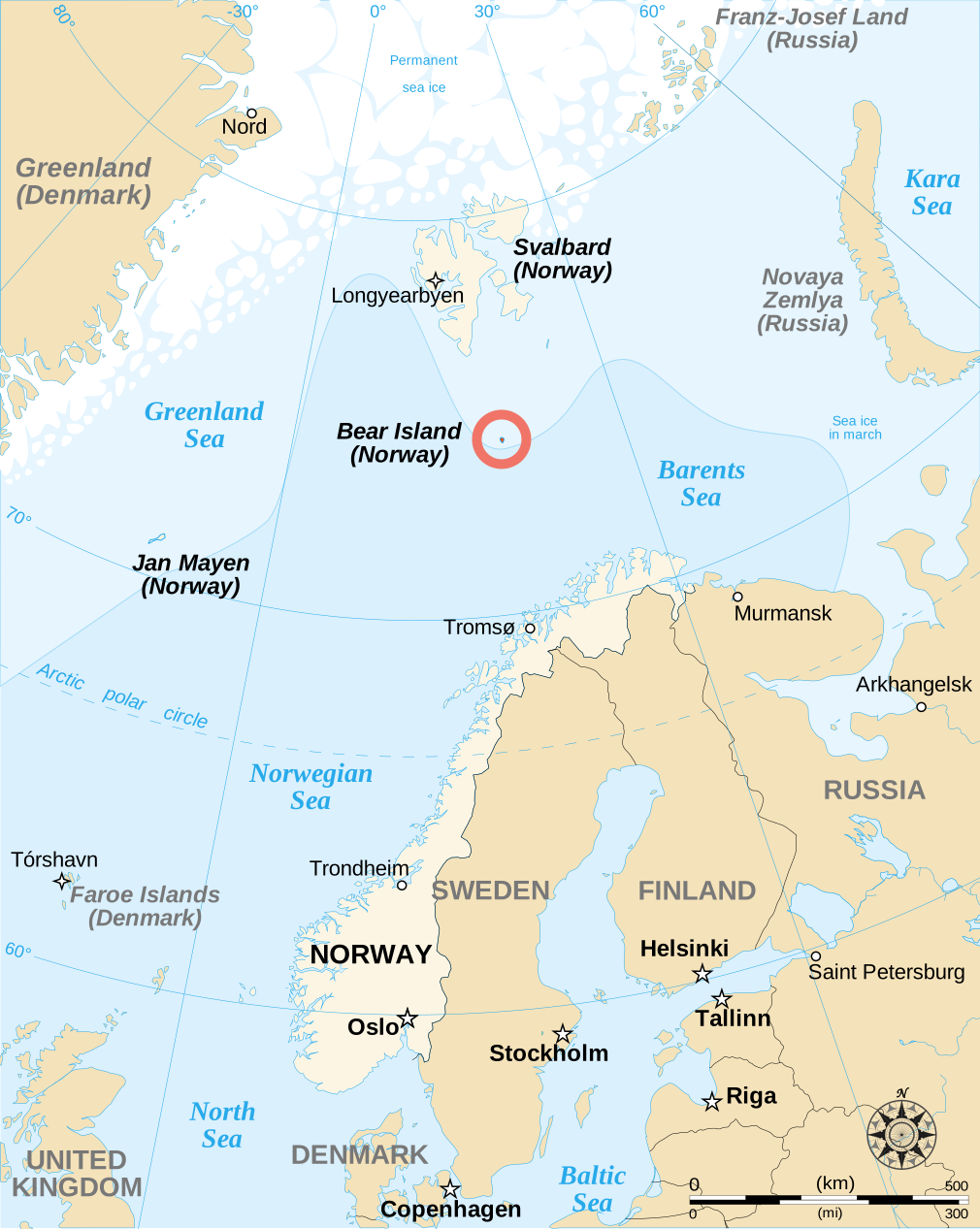
Svalbard is important for Russia because of its location at the gateway to the Barents Sea and the proximity to the Northern Fleet's bases on the Kola Peninsula, Bones explains in this podcast.
Svalbard also has significance for Moscow because of the fisheries. It also wants to monitor Norway's communications and satellite activities on the archipelago. In addition, Russia has a long tradition and a strong history there, the professor says.
Norway gained full and absolute sovereignty over Svalbard in 1925 when the Svalbard Treaty was ratified. In 2025, Norway celebrated the 100-year-anniversary of the agreement.
According to professor Bones, Moscow has conducted numerous hybrid operations and provocations on Svalbard. He argues that the arctic archipelago is part of a broader Russian information campaign that is aimed at testing Western cohesion and the sanctions regime.
Among the approaches actively applied by Moscow is so-called 'bilateralization.'
"It's not unusual that great powers that have smaller neighbouring countries in their vicinity, that they want to try and dominate or influence them. One aspect and one way of doing that is to try and tie up the smaller country in bilateral discussions on certain issues, not allowing them room for maneuver, but try and lock them in in a political process. I think that is what the Soviet Union and Russia also have been trying to do with regards to Norway and Norway-Svalbard politics, but has not really been successful in much of that."
Read the full transcript below
Stian Bones, professor of history at UiT, the Arctic University of Norway, you are one of the authors of a new article that is titled "Hybrid Threats in High Latitudes. Facing Russia on Svalbard". Let's talk a little bit about this publication. Can you say a few words firstly, what are hybrid threats and how does Russia apply them in Svalbard?
Hybrid threats and hybrid warfare are very difficult to define actually. A lot of researchers have written numerous articles trying to define what that actually means. But I think one of the very important aspects of this concept is that it is harmful, harmful activities that uses the spectrum between war and peace, the gray zone, and that operations and plans that are produced to have an effect in this gray zone are done so with malign intent. They are meant to sow distrust in authorities and between us, and they are meant to reduce the state capacity that is being attacked. And it is also a spectrum from a low level of aggression to a high level of aggression.
So in this spectrum, Norway is kind of in the middle, I would say, whereas other states that have been targeted by Russia have been much harder targeted and in a way that can best be described as hybrid warfare. We are not there.
But Russia uses hybrid threats with regards to Svalbard and Norway in order to sow provocations, in order to improve Russia's power position vis-a-vis Norway and the West, in order to sow distrust in the West and undermine the sanctions policy, and also to address and forward some narratives that we are going to explore now that Russia wants to highlight.
So let's look a little bit at Svalbard, this very far northern archipelago, the Norwegian archipelago. Why is this area important for Russia?
I think there are several reasons why this is important for Russia. First of all, and this has been a topic for decades really, is that the Svalbard archipelago, including the Bear Island, is an entrance into the Barents Sea. And the Barents Sea and the area there and the Murman coast is of course the home base for the Russian Northern Fleet, which is of great importance for strategic deterrence for Russia. That is one really important aspect.
Another is the economic. Traditionally, Russia has had economic activities on the Svalbard archipelago; mining, coal. That was important many decades ago. But Russia still has important fisheries in the fisheries protection zone. That's important too.
And I think also now, Russia is very keen on monitoring Norwegian and other Western activities that is kind of more sensor-based. For instance, communications, satellites, that kind of activities that Norway has and Norwegian companies are doing on in Svalbard. They want to monitor this.
And of course, the last aspect, which is also important, is the historical. Because Russia has a long tradition and a strong history there.
So let's look at the history. In 1925, the Svalbard Treaty was ratified. So this year in 2025, Svalbard has been part of Norway for 100 years. Can you please tell us a few words about how Svalbard became Norwegian and also about the Svalbard Treaty?
Yes, I'm happy to do that. And also address an opinion that I find, I read quite often, that this was part of the Versailles Treaty system. And it happened in the aftermath of the First World War. That's correct. But it was not a part of the settlement between the great powers after the First World War.
Instead, it was a Norwegian initiative to find out about and settle the question of sovereignty on the Svalbard archipelago once and for all. So it was Norway that brought up this question. But Norway knew that it had the support of important nations, for instance, Great Britain, and very importantly from the United States. So it was really important that the Norwegian view was supported by the United States. And also, I think it is important to note that the Svalbard Treaty solved another matter back in that day on how to be managed internationally. Because there were different options. You could have a regime, like for instance, you have in Palestine, where Great Britain ruled the area as a mandate on behalf of the international community. Or you could have the other option that was to give a country sovereignty over the territory. And it was the last option that was chosen.
So Norway gained full and absolute sovereignty back then. But with some clauses on certain kinds of activities, fishing and hunting, and also economic activity. It's a long history, and a long history between Norway and Russia, these bilateral relations in Svalbard....
....MUCH MORE
We have quite a few posts on Svalbard, among them are some pertinent to this discussion:
One hundred Years Of Norwegian Svalberg: A Corner Of NATO Where Lenin Presides
Which had this outro:

I'm not entirely sure what the Russian play is here. It might be as straightforward as securing access to the Atlantic for Russia's Arctic-based submarines.
Or, with the European return to coal against the backdrop of EU disunity, it might be a desire to restart the Norwegian coal mines and get the European Coal and Steel Community (originally France, Germany, Benelux) up and running again, this time with Russian membership and possible observer status for Norway.
With the Russians, who knows? More after the jump....
June 2024 - Researcher: "New Svalbard White Paper Affirms Norwegian Jurisdiction on Svalbard"
And September 2024's Meanwhile, In The Arctic: "Svalbard-research becomes more important for China, professor says".
Possibly also of interest:
July 2019 Escape From NorwayWhat dark secret compelled her to run?
February 2020 "Moscow Plays Hard Ball in the High North"
January 2021 "Norway eyeing deep-sea metal mining future instead of oil"
November 2021 Forget Taiwan, Kashmir, Ukraine and Iran, The Real Geopolitical Hotspot Is Svalbard
December 2021 Geopolitics: "Moscow aims to enhance presence in Svalbard as part of hybrid-strategy, expert warns"
January 2022 "Svalbard Minute by Minute"
Can you feel the excitement?
February 2022 Skulduggery: "'Human activity' behind Svalbard cable disruption"
And many, many more.
And from Icepeople.net (the world's northernmost newspaper):
Random weirdness for the week of March 29, 2022: Yet another UFO visits Svalbard, where people and NFTs are fleeing toward the sun to be saved from pillagers