From the Wall Street Journal via MSN April 10:
Large banks including JPMorgan Chase are preparing to offer a new way for investors to bet against managers of private-credit funds.
The banks are working with S&P Global to launch an index of credit-default swaps that would protect buyers against defaults by companies included in the index, called CDX Financials. Private-credit funds managed by Apollo Global Management, Ares Management and Blackstone will make up 12% of the index, which also includes insurers, regional banks and credit-card companies.
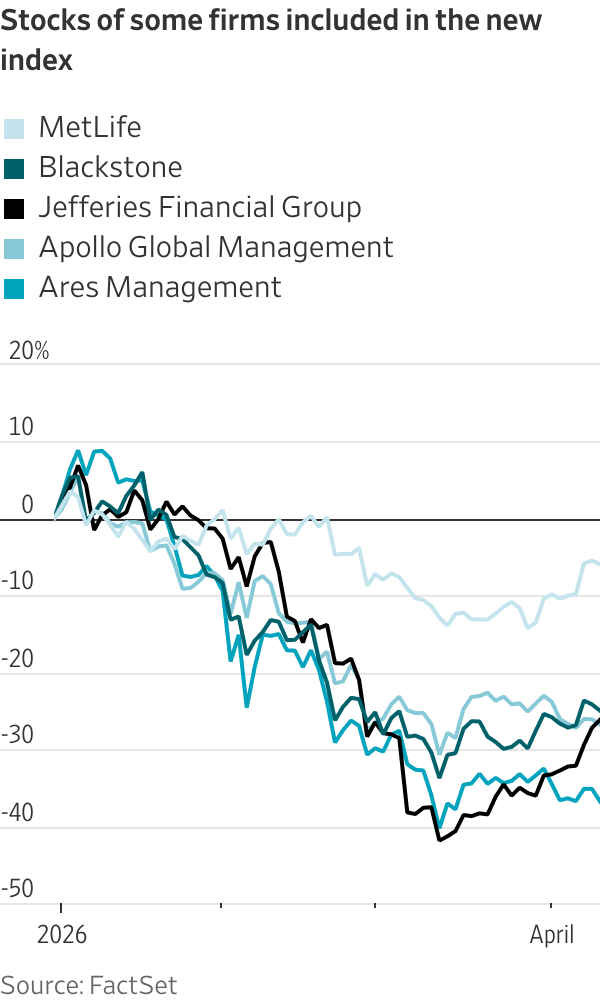
The index would rise when the market sentiment on those firms turned negative. If it gains traction, the so-called FINDX would give debt investors and traders a fast way to hedge or short what is now a more than $3 trillion industry. Private credit increasingly touches banks, insurance companies and other parts of the financial system.
“Private credit has grown fast and there’s a lot of financial exposure arising in different ways so there is a real demand for this product,” said Dominique Toublan, head of credit strategy at Barclays.
Banks want the index both as a product to trade and as a tool to protect against potential losses from their own loans to private-credit fund managers.
Hedge funds are keen for a way to easily make bets on a downturn in private credit. Stress has been building, as a spate of defaults and losses, combined with fears about the fate of loans to software companies, caused a stampede of individual investors asking for their money back. Some hedge funds began trying to short individual stocks and bonds issued by firms that invest in private credit, but the process was cumbersome and costly, one hedge-fund manager said....
....MUCH MORE
If a CDS purchaser does not own the underlying debt they are flat out gambling and we've been down this road before, 2008 and all that where the payoff comes if you can put the debtor into default or worse. Talk about perverse incentives.
The problem is the same one gamed by Polymarket and Kalshi: if you can get regulation at the Federal level you sidestep any state-level enforcement due to the Supremacy Clause—Article VI, Clause 2—of the Constitution, Federal Preemption.
If interested see some of the posts that came out of The Great Recession and related events:
Perversity and Credit Default Swaps
It's Time to Regulate Credit Default Swaps Using State Gambling Laws
The ideas are not original to me. Former New York Insurance Superintendent Eric Dinallo said:
“It’s legalized gambling. It was illegal gambling. And we made it legal gambling…with absolutely no regulatory controls. Zero, as far as I can tell,”And earlier posts:
July 2010
Financial Reform: Enforce New York's 1908 Bucket Shop Law and trash the 2,319 Page Dodd-Frank Bill
It is time to dispense with this congressional foolishness and enforce the 1908 Bucket Shop law.November 2011
Throw in some state anti-gambling statutes and you would have prevented the financial meltdown....
Are Derivatives Contracts Nothing More than Unenforceable Gambling Debts?
...Here's the U.S, Senate testimony of Eric Dinallo, then-Superintendent of the New York State Insurance Department on October 14, 2008 (8 page PDF).
...I have argued that these naked credit default swaps should not be called swaps becausethere is no transfer or swap of risk. Instead, risk is created by the transaction. Indeed, youhave no risk on the outcome of the day’s third race at Belmont until you place a bet onhorse number five to win....
...“Bucket shops” arose in the late nineteenth century. Customers “bought” securities orcommodities on these unauthorized exchanges, but in reality the bucket shop was simplybooking the customer’s order without executing on an exchange. In fact, they weresimply throwing the trade ticket in the bucket, which is where the name comes from, andtearing it up when an opposite trade came in. The bucket shop would agree to take theother side of the customer’s “bet” on the performance of the security or commodity.Bucket shops sometimes survived for a time by balancing their books, but were wipedout by extreme bull or bear markets. When their books failed, the bucketeers simplyclosed up shop and left town, leaving the “investors” holding worthless tickets....

