From SemiAnalysis, September 25:
...Introducing the SemiAnalysis China Datacenter Model
1,000+ facilities across 60+ operators mapped, built retail-first and flipped by AI, largest hyperscaler leases 1/5 national capacity, 100MW in 12 months, Eastern Data Western Compute
China sits at the frontier of the global model race. GLM 5.3 and Kimi K3 are the latest in a run of striking open-weights releases. ByteDance's Doubao serves 345M monthly users as China's ChatGPT, and Seedance is the State-Of-The-Art video generation model.
Every one of those models runs on a datacenter, and China has been building them at a pace that has gone largely unmeasured outside the country. The biggest tenant files no 10-K. Several of the largest landlords have never listed. Most of the primary sources are in Chinese. So the market settled on two lazy assumptions: China is big, and China is empty. Published estimates of China’s datacenter capacity differ by 15x, and reports keep citing high vacancy rates.
As with our flagship SemiAnalysis Datacenter Model, we use building-level data to show which of the most widely cited narratives hold, starting with how large the market is.
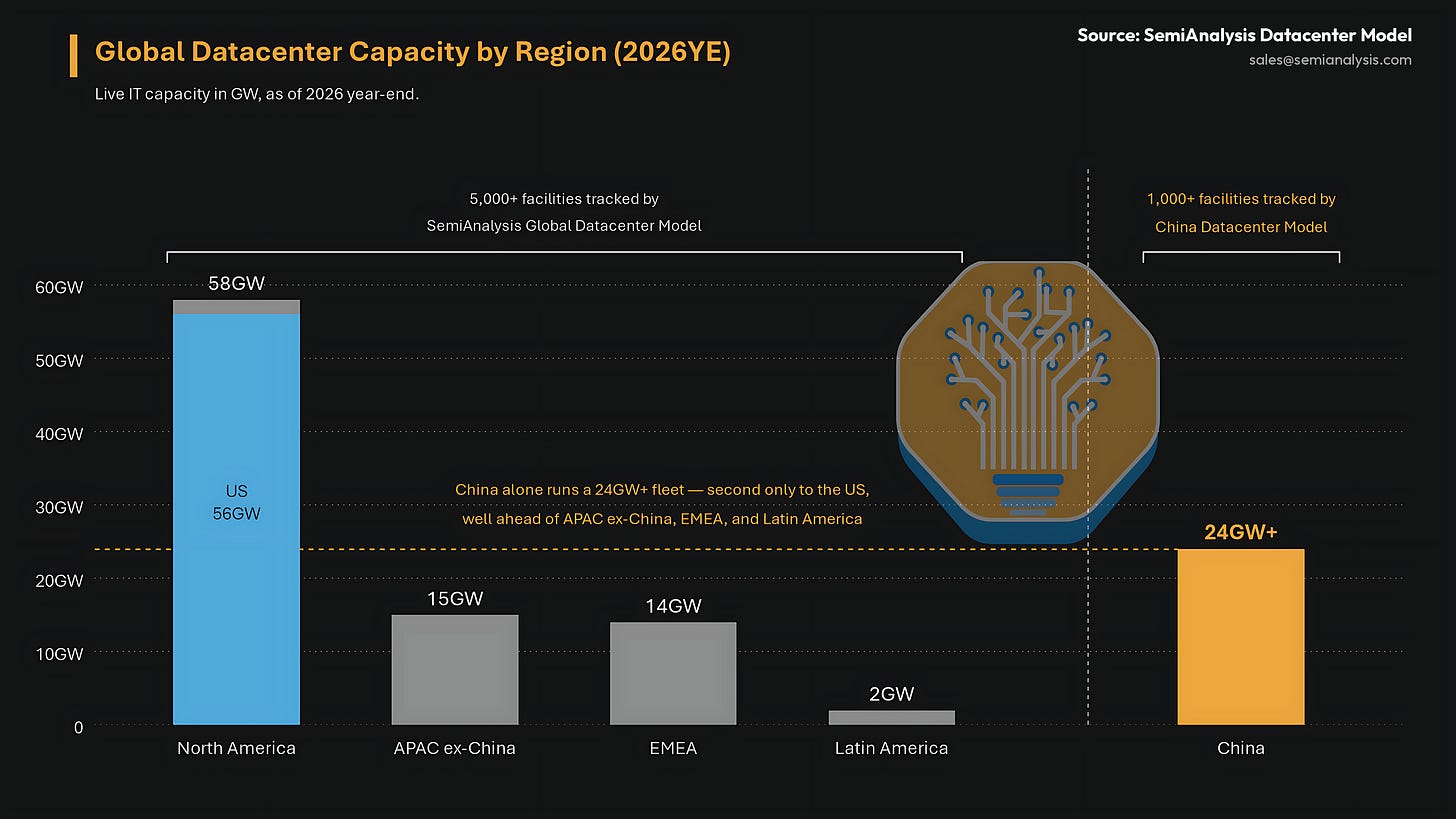
The global model tracks over 5,000 facilities across four regions. The US leads the world with 56GW of capacity as of 2026YE, followed by ~15GW for APAC ex-China, ~14GW for EMEA, and ~2GW for Latin America. Until now, it stopped at the border of China. Today we cross it.
Our tracking of 1,000+ datacenter facilities across over 60 players shows that China alone boasts a fleet of over 24GW. Bigger than EMEA. Bigger than the rest of Asia. This excludes ~20GW of dated pipeline and another ~30GW of announced projects.
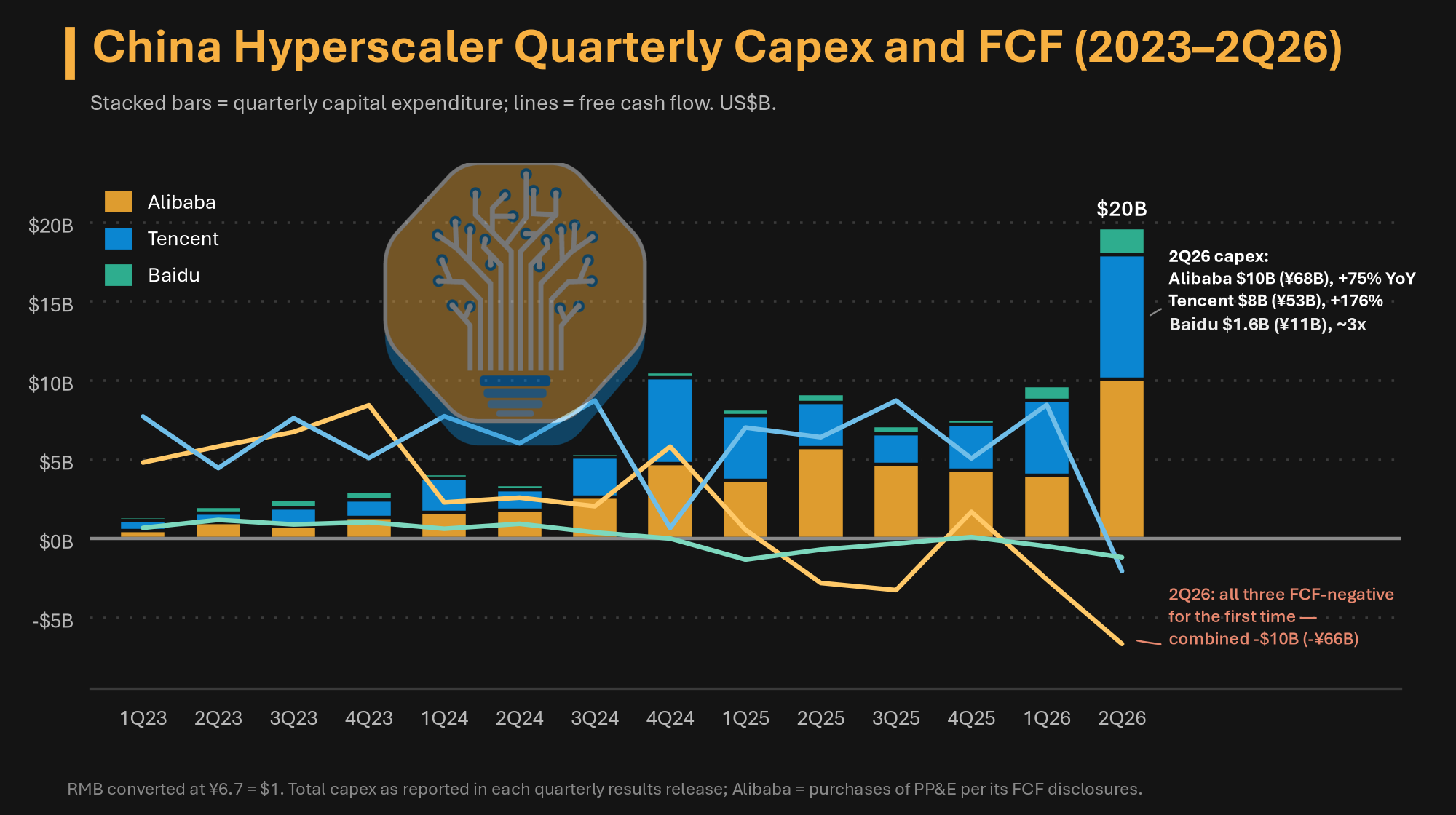
Growth is at an inflection point. In 2Q26, the combined capex of Alibaba, Tencent, and Baidu (“BAT”) reached $20B, more than doubling YoY, and for the first time on record, all three posted negative free cash flow. This is the largest capex step-up in the sector’s history.
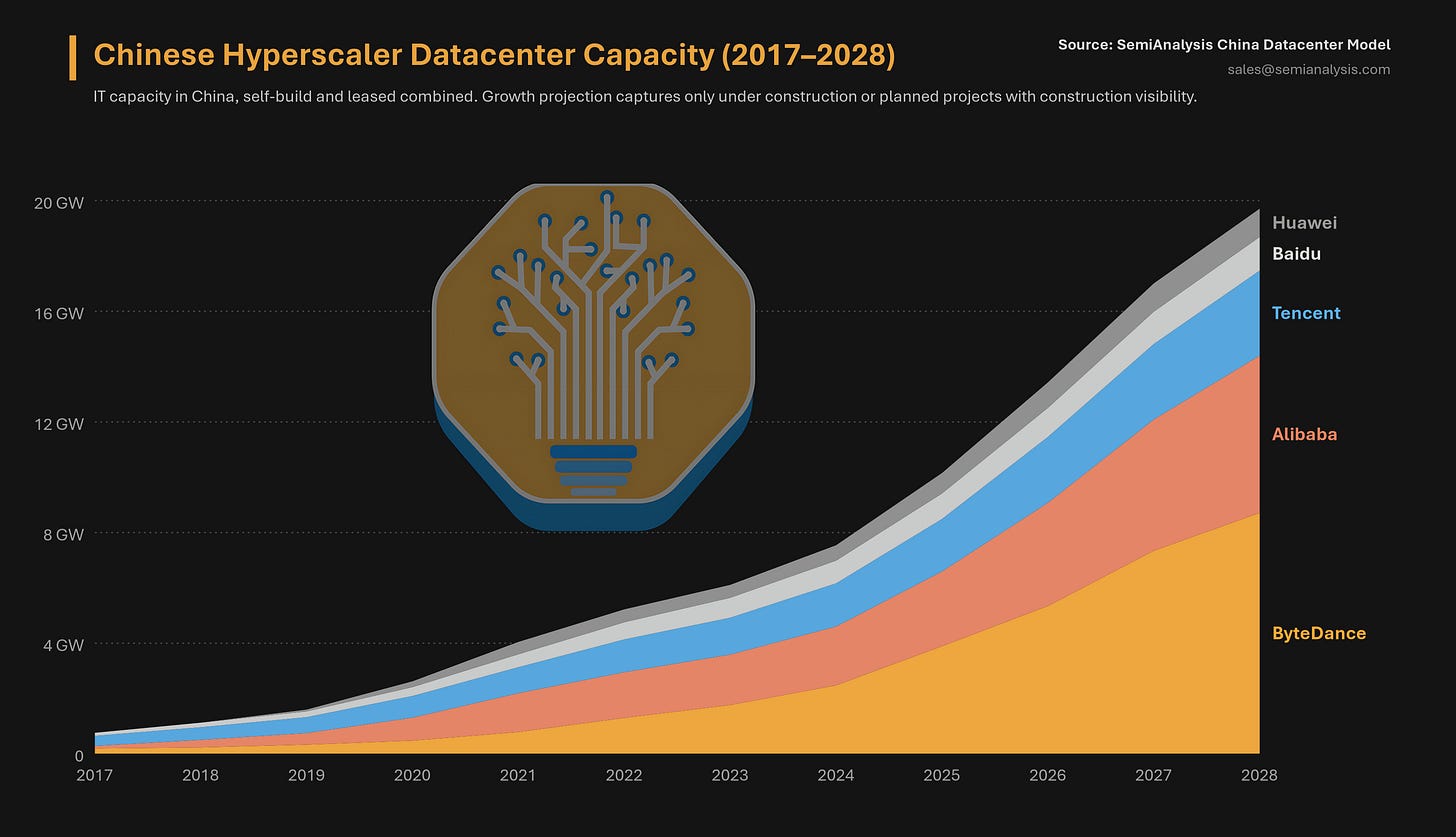
That total leaves out the largest spender of all, ByteDance, which remains private. According to our China Datacenter Model, ByteDance alone occupies roughly a fifth of delivered datacenter capacity in China, and it rents nearly all of it, making it the single most important customer for all wholesale colocation players in the country.
The listed players get the attention, but they are only the visible tip of the iceberg. This is also true for datacenter landlords. GDS and VNET, the only two Chinese datacenter landlords listed in the US, signed 1.3GW of wholesale orders in 1H26. But according to our China Datacenter Model, they captured barely a third of ByteDance and Alibaba orders in 2024–2026YTD.
The buildout is a nationwide effort, and the state-owned carriers are also part of it. China’s datacenter market was historically telecom-dominated. The state carriers held the majority of the market share in the 2010s, and still own a third of national capacity today. The national power grid companies invest aggressively too. Their combined capex accelerated from 2024, ending the 14th Five-Year Plan 24% over the original blueprint. The 15th plan (2026–2030) layers another 40% on top, to over $746B (¥5T).
Largely free of power constraints, labor shortages, and public protests, China routinely delivers 100MW datacenter facilities in under 12 months. Modular DCs are the standard playbook, which Tencent deployed its third-gen modular design in 2014. What is old news in China is only now being adopted at scale in America, as we detailed in The Wild Wild West of LEGO Datacenters.
The growth does not stop at China’s border. Overseas leasing by Chinese hyperscalers is set to double from 2026 to 2029 and approach ~4GW of leased capacity in our SemiAnalysis Datacenter Model. That number still understates their offshore compute, because it excludes the hundreds of thousands of GPUs they rent from Western clouds, which we covered at length in How Oracle Is Winning the AI Compute Market.
However, the market also faces some dark clouds. Vacancy rates are high, and datacenter developers compete heavily on price. Chip supply is also constrained, due to export restrictions. But as explained below, neither has stopped AI datacenters from being built and filled at a remarkable speed....
....MUCH MORE