Amazon is one of the two hyperscalers we think know where they are going with AI.
(GOOG being the other)
That being said, if AMZN is playing fast and loose with how they present their reality, they should be called out.
From The Register, July 31:
"Tell me lies, tell me sweet little lies"
Amazon reported its earnings today, and because I am professionally depressed I read the thing in full [PDF].
"How long can I go before the red haze of rage sets in" is a fun game, and today I made it all the way to the bottom of the second page when I encountered a bullet point touting how AWS "made its spec-drive [sic] coding agent, Kiro, available on iOS."
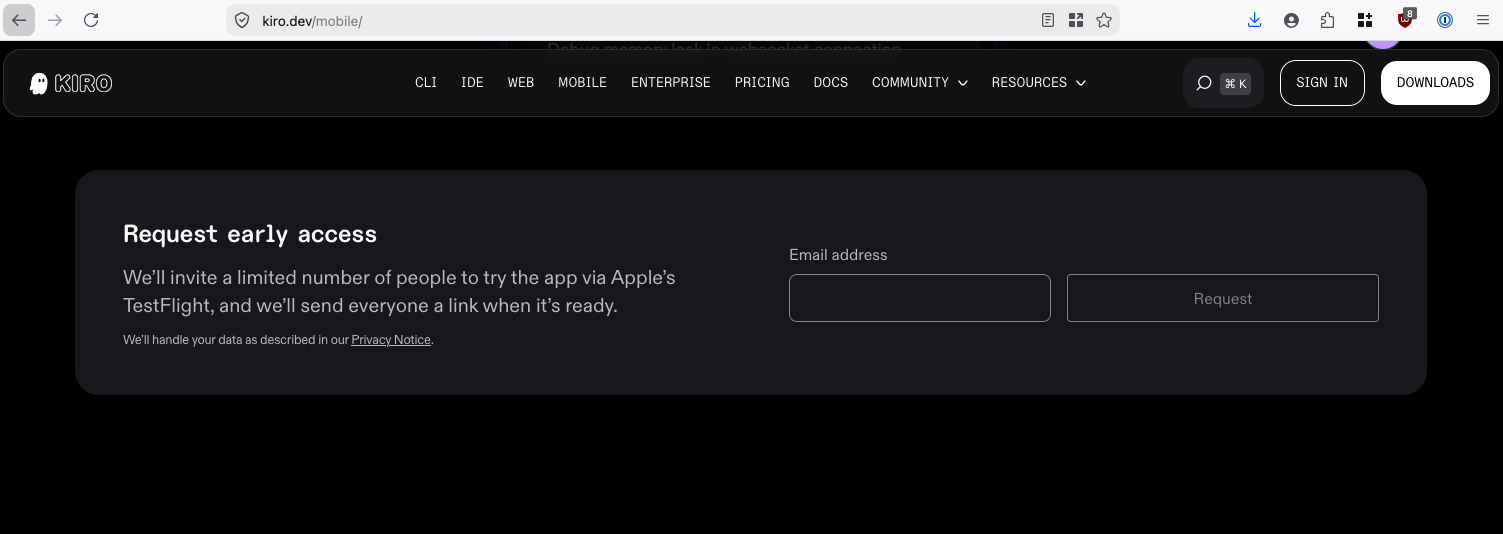
Yes, I was in the room when they announced it at the New York summit, six weeks ago. As of this writing, their website, which I have screenshotted says I can "request early access" because "We'll invite a limited number of people to try the app via Apple's TestFlight, and we'll send everyone a link when it's ready." So Kiro is "available" in the same way as I am available to play in the NBA. You can twist yourself into a pretzel and assert that this claim is technically true, but for all practical readings it's what we'd colloquially term "a lie." You need to be explicitly invited to Apple's developer beta testing tool, where a limited number of users can try out an unpublished version. You cannot download it on your phone, and there is no page in the App Store that showcases the product.
The delay is almost certainly due to Apple's byzantine App Store policies, which I have some sympathy for — but this is an earnings statement. If they're going to "shade the truth" like this, what else are they not being forthcoming about?
Once you notice it becomes hard to stop
There are a lot of other statements that one suspects might not stand up to scrutiny. Graviton boasts "up to 30 to 40% better price-performance," which I only accept because I have seen the numbers myself on customer workloads. The express statement that their AI business and chips business are each exceeding $25 billion run rates in consecutive bullets, with no word on whether those dollars overlap (we will come back to this point shortly). And their Bedrock statement: "customers spent more in Q2 than all prior quarters combined," which makes it sound like a rocket until you realize that they're saying the past 90 days exceeded the other 10 quarters for which Bedrock has been available. Without actual numbers tied to these, that makes it sound like for the first couple of years Bedrock was showing up wearing a party hat but no pants.
Then there's the AWS operating margin of 39.4%, which came in above every published analyst estimate and which everyone will invariably cite as cherry-picked proof the AI buildout is printing money. On the call, CFO Brian Olsavsky disclosed that it includes roughly $600 million of mark-to-market gains on energy derivative contracts. By his math, AWS margins were up 650 basis points year over year, or 520 "if you exclude the derivative accounting gain." Strip that gain out yourself (behold the power of arithmetic!) and the blowout margin goes right back inside the range analysts had modeled. Amazon now hedges electricity the way an airline hedges jet fuel, and this quarter the hedges paid off directly. Olsavsky noted these adjustments "have not been significant in prior quarters." The first quarter they are significant, they land in AWS margin, and their Q3 guidance already assumes no impact from these remeasurements going forward. Amazon knows it's noise, but clearly saw no reason to turn down claiming the win.
The chips business that sells no chips
Back to those dueling $25 billion run rates I touched on; describing their "AI chips business" that way struck me as an incredibly odd thing to say.
That business has revenue, growth, a triple-digit trajectory, sarcastic numbers of happy customers — but what it doesn't have is a product that you can buy. There is no Trainium price list, they will not ship you a socketed Graviton chip to put in your next desktop build, there isn't even an external part number. What Amazon books as "chips revenue" is EC2 instance rental (possibly filtered through higher level services like Bedrock, SageMaker, the half-baked agents that fail to properly explain your AWS bill to you, etc.), and an EC2 instance is not a chip. It's the chip, plus the nVME, plus the NICs (themselves built on Nitro, which uses Amazon's own silicon), plus some aspects of the data transfer that somehow aren't directly billed, plus the building the whole mess lives in—and then with AWS's margin layered on top. The silicon itself is a minority line item in the internal bill of materials that constitutes its business.
You don't have to take my word for it; Amazon CEO and AI Marketing Manager Jassy spent last quarter's call lamenting that the cost of components, "particularly memory, has skyrocketed," so by his own testimony a growing slice of the "chips business" is memory revenue.
Cynically, the category exists so that headline writers will talk about it in the same breath as Nvidia's data center numbers, which they of course will. But Nvidia's $25 billion is silicon sold in the form of physical packaged chips, shoveled out their loading dock. Amazon's is fully-loaded infrastructure rental. This is a hotel comparing its revenue to a mattress company's....
....MUCH MORE
Regarding the chips, most people who follow the company know they aren't yet selling Trainium and handing over title to the silicon. That's still on the come and should happen in the next six to nine months. As for the margins, this is the first analysis we've seen that highlighted the hedges. Not doing so is just lazy, something we used to see with Mexico's state-owned oil company and their hedges.
Pemex runs a remarkably profitable hedge book and including those profits without highlighting the fact they are financial rather than operational income statement items gives a distorted view of how Pemex is actually performing. So kudos to the writer and to The Register for the highlight.
Recently:
July 30 - "Amazon beats Q2 earnings expectations, as AI, chip businesses see $25 billion run rate" (AMZN)
The negative we will see tomorrow, pointed out in the Yahoo story, is the company is spending all their cash flow rather than returning it to shareholders.
As our earlier GeekWire link, "Ahead Of Today's Amazon Report GeekWire Looks At The Behemoth (AMZN)", quoted:
“We’re not investing approximately $200 billion in capex in 2026 on a hunch,” CEO Andy Jassy wrote in his April shareholder letter.The GeekWire article had the Bezos story at Fortune as a sidebar:
Jeff Bezos says this business is becoming Amazon’s next ‘pillar’
Amazon’s next pillar could be built on a foundation of silicon.
In a new interview with Fortune, Amazon founder and Executive Chair Jeff Bezos says the company’s custom chip business is on track to become one of Amazon’s most durable businesses, placing it alongside Marketplace, Prime, and Amazon Web Services as a core pillar of the company.
“A few of our offerings have become durable pillars, things like Marketplace and Prime and AWS,” Bezos told Fortune. “What I see right now is that our chips business, our silicon business, is lining up to be our next pillar.”....
....MUCH MORE, including links to the Fortune article.