In 2025 the Trump administration pulled the Persian Gulf Arab states—the GCC—much closer to the U.S. through a series of deals/agreements/investments.
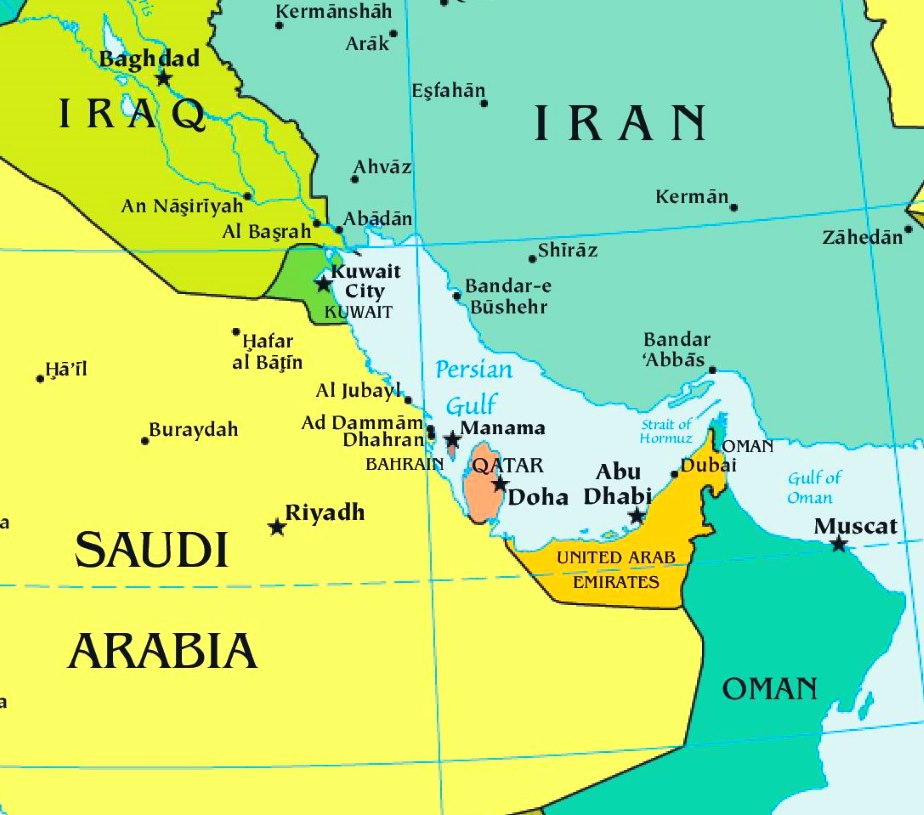
That series of events were crucial for understanding the current reality.
From American Affairs Journal:
Fall 2025 / Volume IX, Number 3
Something big happened in the Persian Gulf in May 2025. Donald Trump, fresh off one of the most astonishing comebacks in recent political history, hopped from one Arab capital to the next. He was greeted not merely as a visiting head of state but as something like a returning emperor. The images were surreal: camel processions, sword dances, ululating crowds, gleaming skyscrapers, and desert megaprojects rising from the sand like mirages. Even more staggering were the numbers. By the end of his tour of Saudi Arabia, Qatar, and the United Arab Emirates, Trump announced that U.S. companies had signed deals worth an eye-watering $2 trillion.1 This was, by any measure, the sale of the century, crafted by a man who styles himself as the ultimate dealmaker. But what kind of world order was being built in the Gulf, and how did we get here?
To understand what was unfolding in the Gulf, we need to rewind. The deeper logic of this new order wasn’t born in a single summit; it emerged, barely noticed, through a series of seemingly disconnected events over the last two years. The subsequent outbreak of a brief but dramatic shooting war between Israel and Iran—and the U.S. intervention it induced—are not likely to change its overall trajectory and may ultimately function to solidify it.
A Tale of Ambition and High Stakes
Throughout President Biden’s four years in office, his administration found itself increasingly entangled in the world’s oldest geopolitical trip wires. Against the backdrop of a high-stakes confrontation with Russia over Ukraine, and a simmering confrontation with China over trade and technology, the press talked about a “New Cold War.” In a bold gambit to regain the strategic advantage, President Joe Biden unveiled a flagship project at the September 2023 G20 Summit in New Delhi: a new trade corridor linking India to Europe via the Arabian Peninsula, dubbed the India–Middle East–Europe Corridor, or IMEC.2 It was touted as the West’s response to the Belt and Road Initiative (BRI), Beijing’s global enterprise linking roads, ports, and railways with the goal of making China the center of a vast Eurasian trade network.
But just one month after Biden’s news conference, Hamas launched its devastating October 7 attack on Israel, plunging the region into chaos and disrupting the fragile normalization talks between Israel and Saudi Arabia. The fallout sent shockwaves through the very region IMEC was meant to stabilize, casting doubt on the project’s future.
At the same time, as if in a parallel universe, another portentous development was unfolding. This one less bloody but no less destabilizing: artificial intelligence (AI) had moved from speculative hype to a widely accessible everyday technology, with potentially world-transforming impact. OpenAI, the company at the forefront of this revolution, began with no clear business model. Its founders half-joked that once they built an Artificial General Intelligence (AGI), they’d simply ask it how to generate returns. But with the release of ChatGPT in 2022 and the broader generative AI boom that followed, the company stumbled into a business model: automation at scale.
By late 2024, however, OpenAI was no longer a scrappy research outfit. Rather, it was a financial blackhole with geopolitical consequences. The financial demands of developing cutting-edge AI had become staggering. In that year alone, the company lost $5 billion.3 Its CEO, Sam Altman, a lean figure with steel-blue eyes and an uncanny ability to command attention without theatrics, understood what few others did: there was no turning back. The only way out of the debt trap was through.
So Altman doubled down. He envisioned a global infrastructure network to match the scale of his ambition: a $7 trillion blueprint to build the physical and digital scaffolding for the AI age.4 That sum exceeded Japan’s GDP and the combined market capitalization of Apple and Microsoft. But to Altman, it wasn’t optional; it was urgent. In a widely circulated blog post, he warned that without massive new compute supply, AI could become “a very limited resource that wars get fought over.”5
There was also a more calculated logic at play. By building and controlling the infrastructure of compute, OpenAI could secure a dominant position in the AI economy, just as Amazon had done by monopolizing the infrastructure of online commerce. Altman’s blueprint called for a massive buildout: data centers, semiconductor fabs, power plants, high-capacity fiber networks, and new trade corridors. He pitched the plan not only to Microsoft and Nvidia but also to Persian Gulf governments.
By then, Gulf sovereign wealth funds had already pivoted toward AI at scale. In 2024, Gulf states—the UAE, Saudi Arabia, Qatar, and Kuwait—dramatically ramped up AI investments, collectively committing tens of billions in funds, data centers, and strategic infrastructure. Altman, alongside other U.S. AI executives, began quietly deepening ties with these regimes.
At the center of Altman’s courtship stood a shadowy figure who represented his country’s towering ambition to become an AI superpower. His name is Sheikh Tahnoun bin Zayed. He is brother to the ruler of the United Arab Emirates, Mohamed Bin Zayed, and his national security advisor. Tahnoun also serves as his country’s AI czar. Tahnoun heads both the MGX fund, an Emirati investment firm in AI with $100 billion in capital, and G42, a vast technology conglomerate involved in fields ranging from AI to biotechnology, with particular expertise in government-backed cyber operations and surveillance systems.6 These roles give Tahnoun unmatched leverage across the region’s AI, finance, and compute sectors. Tahnoun’s master plan and Altman’s grand strategy overlapped, and they began working hand in hand. Thus, Altman’s vision for planetary AI infrastructure had found its anchor in the fossil-fuel-rich, regulation-light economies of the Persian Gulf.
While the Biden administration signaled its commitment to constraining the global diffusion of American AI technology by imposing more and more export controls, Altman was already forging the deals that would make such constraints obsolete. His revolution needed capital, land, and dispatchable power, and the Gulf was the only place offering all three.
Altman was not alone. His turn to the Gulf reflected a broader convergence, one that would come to define the coalition behind Trump’s return to power. It was an amalgam of AI moguls, cryptofinanciers, fossil fuel interests, and real estate developers. What binds Trump’s business coalition is the structural interdependence of its core sectors—AI, crypto, energy, and real estate—each feeding the infrastructural needs of the others. AI is the engine: it demands colossal compute resources, generates vast data flows, and drives the automation of decision-making across sectors. Crypto is the payment system: it monetizes usage, distributes rewards, and enables capital to flow across borders without much regulatory friction. But these technologies are intensely resource-hungry. They require a constant, high-volume energy supply, something intermittent renewables can’t provide. This is also why the coalition favors fossil fuels and nuclear, since only they offer the stability and scale needed.
All of this—compute, power, fiber, liquidity—ultimately rests on real estate. Land, buildings, and zoning regimes form the chassis of the entire system. Data centers, energy hubs, and submarine cable landing stations must be physically sited, cooled, secured, and connected.
The Middle East, particularly the Persian Gulf, has reemerged as a strategic hub for Trump’s business coalition. With its abundant dispatchable energy, permissive regulatory regimes, and position at the intersection of global trade routes, the Gulf is uniquely positioned to anchor the infrastructure of the AI age. The coalition’s ascent, enabled by the election of the AI-industry-aligned Trump, meant that Biden’s IMEC project, long stalled by regional conflict, would now be retooled and repurposed.
IMEC retained its original ambition: to link Europe and Asia through a secure, high-capacity trade corridor. But under Trump, it acquired an additional layer, a digital one. The emphasis shifted to the corridor’s southern leg, the route connecting Gulf-based data centers with India’s vast pool of educated, low-cost office labor. How these Gulf data campuses will link to European markets remains unclear, but Trump’s visit offered some hints that will be explored below. As under Biden, the project still aligns with the Gulf monarchies’ goals of diversifying income, gaining access to advanced technologies, and elevating their global relevance.
Yet under Trump, the political logic of IMEC has shifted dramatically. No longer a multilateral initiative shepherded by technocrats and international institutions, the corridor is now turning into a privatized artery of power governed not by memoranda of understanding or diplomatic summits, but by sovereign wealth funds, ambitious tech firms, and transactional deal-making.
To be sure, the Trump administration has floated other infrastructural ambitions: a land bridge through Canada and Greenland to the emerging Transpolar Sea Route and a renewed push to control chokepoints like the Panama Canal.7 But these remain geopolitical mirages: underdeveloped, logistically uncertain, and disconnected from any coherent implementation strategy. IMEC, by contrast, is real, resilient, and already underway. After a year of regional upheaval, it is paradoxically more secure than ever, bolstered by a convergence of interests among Gulf states and countries like Iraq, Syria, and Turkey, all of which see in the corridor a path to integration, logistical leverage, and infrastructure rents. It is moving rapidly from planning to execution and, unlike most of Trump’s ventures, reflects a rare alignment of capital, geography, and strategic intent.
To understand how the road to Riyadh became the epicenter of Trump’s Eurasian strategy, we must return to New Delhi, where Biden first launched the corridor.
From Biden to Trump: IMEC under New Management
The announcement of IMEC at the September 2023 G20 Summit in the Indian capital marked a rare moment of transcontinental alignment, with India, the United States, the European Union, and key Gulf states as signatories. But the corridor wasn’t just a symbolic rebuke to Beijing. It was a strategic effort to anchor India more firmly in the Western orbit without demanding formal alignment. By improving India’s access to European markets and channeling Gulf capital into regional logistics infrastructure, the United States hoped to offer Indian Prime Minister Narendra Modi a viable alternative to deepening ties with China or Russia. The goal was not to absorb India into an alliance but to prevent its gravitational drift toward a rival Eurasian bloc.
At stake was not just competition with China’s BRI, with its Northern and Middle Corridors linking China to Europe through Russia and Central Asia, but also competition with yet another rival trade route, the Russian- and Iranian-backed International North–South Transport Corridor (INSTC).8 That project, nearly complete, connects Russia, Iran, and India through a web of ports, rails, and Caspian crossings. IMEC was a bet that India’s ambitions could be turned westward not by ideology but by infrastructure.
IMEC was Biden’s attempt to carve a U.S.-aligned corridor through the heart of Eurasia’s infrastructure contest, which would mean a resilient supply chain outside of China’s reach. Accordingly, IMEC was framed as a state project: rooted in formal diplomacy, coordinated with the European Union, aligned with Israel, and backed by a growing U.S. military footprint in the eastern Mediterranean and Red Sea. And in many ways, it was the last major push of a technocratic, multilateral hegemony: coordinated through formal diplomacy, reliant on NATO and EU frameworks, and governed by elite consensus rather than charismatic politics or brute coercion.
That vision unraveled on October 7, 2023. As later revealed by internal Hamas records, the attack was not merely about Gaza. It aimed to disrupt the regional realignment that IMEC depended on, particularly the pending normalization of ties between Saudi Arabia and Israel, which threatened to marginalize Hamas diplomatically. Iran responded by activating its regional network: Hezbollah in Lebanon, militias in Iraq and Syria, and the Houthis in Yemen. Tehran saw IMEC not just as a Western power play but as a direct competitor to its own strategic corridor, the INSTC, a project it views as a tool to overcome the stringent sanctions imposed by the United States and European Union. The resulting conflict spiraled into a full-blown regional war. What had begun as a diplomatic corridor became a battlefield.
In 2024, the Biden administration mounted one of the largest U.S. military deployments to the region since the Iraq War, positioning carrier strike groups, air defenses, and strategic bombers to deter direct Iranian escalation. American protection shielded Israel from large-scale missile attacks and enabled the IDF to inflict serious damage on Hezbollah and Hamas. The collapse of Assad’s regime in Syria, following Hezbollah’s defeat, delivered a major blow to Iranian influence. The Biden administration hoped that these battlefield gains would revive the push toward Israeli-Saudi normalization and breathe life back into IMEC.
Under Biden, artificial intelligence had been deliberately fenced off from corridor diplomacy. The administration viewed AI through the lens of national security, not market expansion. Beginning in 2023 and continuing into 2024, Washington imposed strict export controls on AI-enabling chips, citing risks of diversion to China. These controls affected Gulf states like the UAE, requiring a U.S. license to obtain advanced semiconductors such as Nvidia’s H100.9 Nevertheless, the UAE pushed back hard. In 2024, Tahnoun bin Zayed, the UAE’s national security advisor, led an intensive campaign to gain exemptions from these controls. The Emirati conglomerate G42 was at the center of this push. It had already severed ties with China’s Huawei and rebranded as a trusted U.S. partner. But American intelligence agencies weren’t convinced. G42’s historic entanglements with Beijing, its use of Chinese‑built infrastructure, and its role in spyware operations all raised red flags. CIA briefings warned of backdoor leakage of U.S. tech to Chinese actors via G42, while then Commerce Secretary Gina Raimondo and CIA Director William Burns personally traveled to Abu Dhabi to press for tighter controls.10....
....MUCH MORE
Originally posted August 30, 3035.
Some of our posts from the Spring of 2025:
May 13 - "GE Vernova to export $14.2 billion in turbines, energy solutions to Saudi Arabia, US says" (GEV)
- Saudi Crown Prince Sets Up Potential AI Juggernaut Which Immediately Partners With Nvidia (NVDA)
- "Why Nvidia is the tech winner of the US-China tariff truce" (NVDA)
- "Saudi Arabia Has The Wealth – And Desire – To Become An AI Player"
- Some Details On Super Micro Computer's $20 Billion Deal With Saudi Arabia's DataVolt (SMCI; NVDA)
May 15, 2025 - U.S. Still Mulling Whether To Allow Nvidia To Sell One Million+ Most Powerful Chips To UAE
First up, some of the deals that were announced today. From Bloomberg, May 15:
Trump Touts $200 Billion in UAE Deals in Wrapping Mideast Trip
US President Donald Trump has secured $200 billion in deals during a visit to the United Arab Emirates, according to the White House, including agreements involving artificial intelligence that will boost the Gulf nation’s technological ambitions.
“These deals will significantly expand investment in the United States and U.S. market access in the United Arab Emirates,” the White House said in a statement Thursday.
The announcements came during the third and final leg of the US president’s visit to the Middle East, where he highlighted investments earlier in the week of $600 billion from Saudi Arabia and more than $243 billion with Qatar. Trump made scoring business deals a centerpiece of his first planned overseas trip since returning to office.
The deals and initiatives with the UAE include:
- A $14.5 billion commitment from Etihad Airways to invest in 28 Boeing Co. 787 and 777X aircraft powered by GE Aerospace engines.
- ExxonMobil Corp., Occidental Petroleum Corp., and EOG Resources Inc. plan to partner with the Abu Dhabi National Oil Company to expand oil and natural gas production valued at $60 billion.
- A $4 billion primary aluminum smelter project that Emirates Global Aluminum will develop in Oklahoma.
- RTX Corp. is partnering with Emirates Global Aluminum and the UAE’s Tawazun Council on a gallium project to shore up US critical mineral supplies.
AI has been central to many of the agreements Trump has negotiated in the region. Gulf nations have been eager to secure greater access to cutting-edge chips in a bid to become hubs for the emerging technology and diversify their economies. Thursday’s announcements include:
- Plans for Qualcomm Inc. to help develop a new “global engineering center” in Abu Dhabi focused on AI and data centers.
- A new AI campus in the UAE that will be built by G42, the crown jewel of the country’s tech ambitions, and operated in partnership with several US companies. The US Commerce Department said the campus will include 5 gigawatts of capacity for AI data centers, providing a regional platform for large-scale providers of cloud or computing services.
- Amazon Web Services Inc., e& — formerly telecom company Etisalat — and the UAE Cybersecurity Council will partner on bolstering public cloud services in the country....
....MORE